 Calc
Kepler's Third Law Calculator – Orbital Period & Radius Solver
 Created by Priya Sharma · Physics Editor · Energy & Gravity · Last updated: November 2026
Use this free Kepler's Third Law Calculator to connect an orbit's size with its period, T = 2π√(r³/GM). Find the period from the orbit radius — or work backwards and find the radius from a known period.
Johannes Kepler published this relationship in 1619, after a decade of wrestling with Tycho Brahe's exquisitely precise observations of Mars. He had no idea why it worked — gravity had not been invented yet as an explanation. What he found was pure pattern: for every planet, the square of the orbital period is proportional to the cube of the orbit's size, T² ∝ r³, with the same constant of proportionality for the whole solar system. It took Newton, two generations later, to show that the pattern is the fingerprint of an inverse-square gravitational force, and to supply the missing ingredient — the mass of the central body — that turns Kepler's proportion into the exact equation this calculator uses.
The cube in the formula is what makes orbits behave so counter-intuitively. Move a planet twice as far from its star and its year does not double — it grows by 23/2, a factor of about 2.83, because the planet has a longer path to travel and a weaker gravitational pull urging it along, so it moves more slowly too. Push out to Neptune, 30 times Earth's distance, and the year stretches by 303/2 ≈ 164. This steep scaling is why the outer solar system is a realm of centuries, why distant exoplanets take so long to confirm, and why a satellite just a few hundred kilometres higher already circles noticeably more slowly.
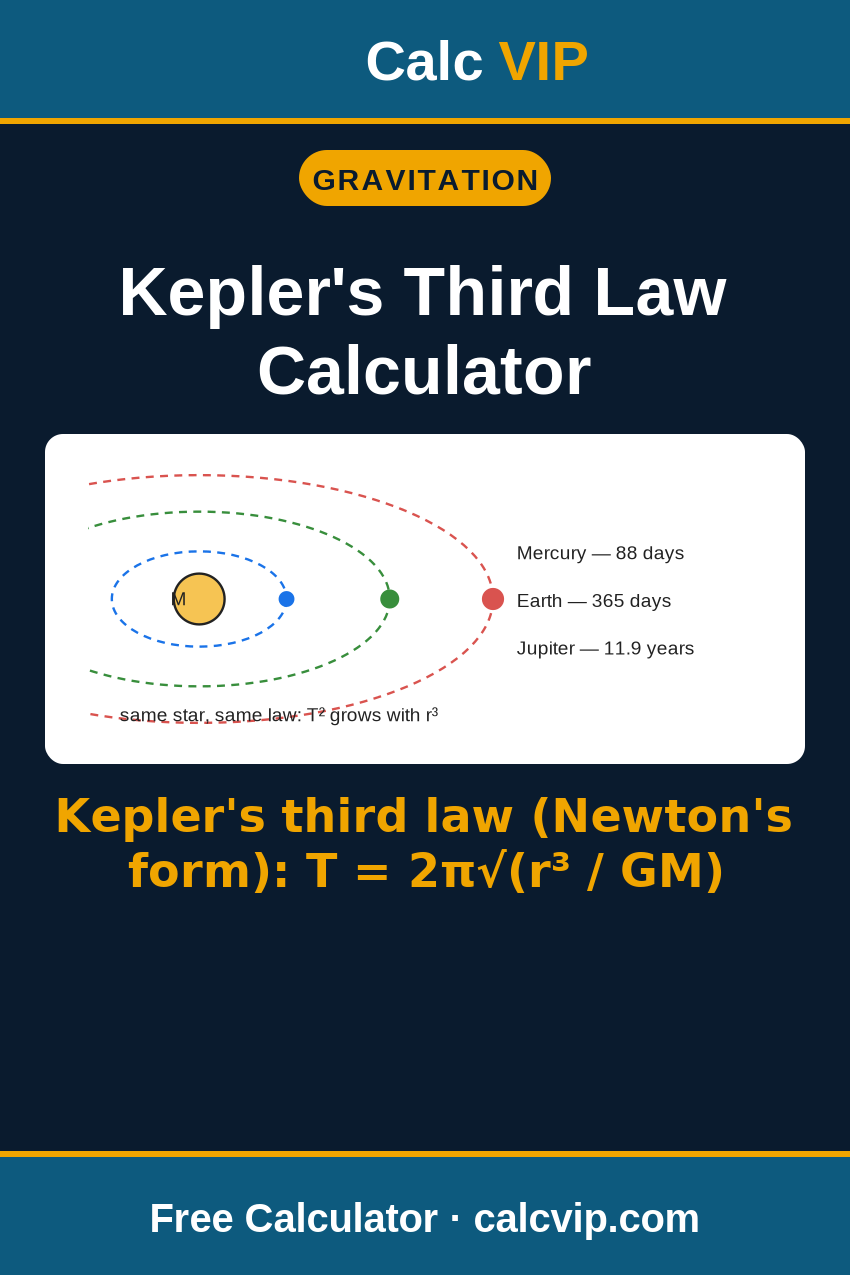
Because the law links only three quantities — period, orbit size and central mass — knowing any two reveals the third. That triangle is the workhorse of astronomy. Periods are easy to measure (just watch and wait), distances can be measured with radar or parallax, and so the law hands us the masses of stars, planets and even the black hole at the centre of the Milky Way — quantities that cannot be put on any scale. This calculator works the triangle in the two directions students and mission planners need most: period from radius, and radius from period.
Formula
Kepler's third law (Newton's form): T = 2π√(r³ / GM), with G = 6.674 × 10⁻¹¹ N·m²/kg². It rearranges into three working forms. To find the radius from a known period: r = (GMT² / 4π²)1/3. To find the central mass — the astronomer's direction — M = 4π²r³ / (GT²). And for anything orbiting the Sun there is a famous shortcut: with r in astronomical units and T in years, T² = r³, because Earth's own orbit (r = 1, T = 1) fixes the constant. The period depends on the orbit radius and the central mass only — not on the orbiting body's mass, a point the "Common mistakes" section below returns to.
| Symbol | Meaning | Units |
|---|---|---|
| T | orbital period — time for one complete orbit | seconds (s); days or years for display |
| r | orbit radius from the central body's centre (semi-major axis for an ellipse) | metres (m); km or AU for display |
| M | mass of the central body | kilograms (kg) |
| G | universal gravitational constant, 6.674 × 10⁻¹¹ | N·m²/kg² |
| a | semi-major axis — the r to use for elliptical orbits | m, km or AU |
Why the satellite's own mass cancels out
Students often expect a heavier satellite to orbit differently, and the formula's silence about the satellite's mass m looks like an omission. It is a cancellation. Gravity pulls the satellite with force GMm/r², and Newton's second law divides that force by the very same m to get the acceleration: a = GM/r². The mass appears once in the pull and once in the inertia, and the two effects annihilate each other exactly. Set that acceleration equal to the centripetal requirement v²/r and Kepler's law falls out in three lines — with m nowhere in sight.
The cancellation is the same one Galileo dramatised with falling objects: in a given gravitational field, everything falls — and orbits — together, regardless of its mass. It is why the Space Station and a bolt floating beside it share an orbit perfectly, and why this calculator never asks what your satellite weighs. There is one honest refinement: strictly, both bodies orbit their common centre of mass, so the exact law uses M + m in place of M. For a satellite around a planet the correction is one part in billions and can be ignored; for two comparable stars it matters, and our Binary Star Calculator is built on exactly that version.
How to use
- Choose the direction of the calculation: period T from orbit radius r, or orbit radius r from period T.
- Pick a central body preset (Sun, Earth or Jupiter) or choose Custom and type its mass in kilograms — scientific notation such as 1.989e30 works.
- Enter the orbit radius in kilometres, measured from the centre of the central body — for a satellite, that means the planet's radius plus its altitude — or enter the period in days.
- Click "Calculate" to get the period in seconds, days and years, or the radius in kilometres and metres.
- Sanity-check with Earth: r = 149,600,000 km around the Sun must return almost exactly 365 days; a satellite period around Earth must exceed the ~84-minute minimum of a surface-grazing orbit.
Worked examples
Example 1 — Earth around the Sun (the check case). r = 1.496 × 10⁸ km = 1.496 × 10¹¹ m, M = 1.989 × 10³⁰ kg.
T = 2π√(r³/GM) = 2π√((1.496 × 10¹¹)³ / (6.674 × 10⁻¹¹ × 1.989 × 10³⁰)) ≈ 3.155 × 10⁷ s ≈ 365.2 days — one year, as it must be. Working backwards from T = 365.25 days returns r ≈ 1.496 × 10¹¹ m, confirming the two modes are consistent inverses.
Example 2 — the Moon around Earth. r = 384,400 km = 3.844 × 10⁸ m, M = 5.972 × 10²⁴ kg.
T = 2π√((3.844 × 10⁸)³ / (6.674 × 10⁻¹¹ × 5.972 × 10²⁴)) ≈ 2.372 × 10⁶ s ≈ 27.5 days — the sidereal month (the tiny excess over the familiar 27.3 days comes from the rounded distance used here).
Example 3 — designing the GPS constellation (radius from period). GPS satellites are timed to complete exactly two orbits per sidereal day, so T = 43,082 s = 0.4987 days.
r = (GMT²/4π²)1/3 ≈ 26,560 km from Earth's centre — an altitude of about 20,190 km. The half-day period is deliberate: each satellite then repeats the same ground track every day.
Example 4 — Jupiter's year. Jupiter orbits at 5.203 AU = 7.783 × 10¹¹ m from the Sun.
T ≈ 3.745 × 10⁸ s ≈ 11.87 years. The shortcut agrees instantly: T = √(5.203³) = √140.9 ≈ 11.87 years.
Example 5 — Mercury's sprint. Mercury orbits at 0.387 AU = 5.790 × 10¹⁰ m.
T ≈ 7.597 × 10⁶ s ≈ 87.9 days — the shortest year in the solar system, run at the highest average orbital speed (about 47 km/s).
Example 6 — a "hot Jupiter" exoplanet. Many discovered exoplanets huddle at 0.05 AU = 7.48 × 10⁹ m from their star.
T ≈ 3.53 × 10⁵ s ≈ 4.08 days. Such short periods are exactly why these planets were found first: a transit repeats every few days, so telescopes quickly collect several.
Kepler's law in real life
Weighing the Sun and stars. Historically, Earth's orbit turned this law into the first accurate scale for the solar system: period and distance in, solar mass out. The same trick with binary stars (see our Binary Star Calculator) still anchors almost every stellar mass astronomers quote.
Satellite constellation design. GPS, Galileo and GLONASS all park at the half-sidereal-day radius this law dictates, so their ground tracks repeat daily. Weather satellites choose the one-day radius; surveillance satellites choose low, fast orbits — every choice is a Kepler trade between period and height.
Exoplanet hunting. A transiting planet reveals its period directly. Kepler's law converts period into orbital distance, and distance into expected temperature — the first step in judging whether a new world sits in its star's habitable zone.
Weighing the galactic black hole. Stars whipping around Sagittarius A* have measured periods and orbit sizes; the law returns a central mass of about 4 million Suns confined to a tiny volume — the strongest evidence for the Milky Way's supermassive black hole, recognised by the 2020 Nobel Prize.
Mission timing. Transfer orbits to Mars or Venus are ellipses whose periods this law sets; launch windows open when the geometry of two Keplerian periods lines up — roughly every 26 months for Mars.
Space debris and graveyard orbits. Retired geostationary satellites are boosted a few hundred kilometres higher. The law says their period then exceeds a day, so they drift away from the protected ring — a parking solution written entirely in T and r.
The two-body correction: when m is not negligible
The exact statement of the law is T = 2π√(r³ / G(M + m)): both bodies orbit their shared centre of mass, and the relative motion responds to the sum of the masses. For a 1,000 kg satellite around Earth, m/M is about 10⁻²¹ and the correction is unmeasurable. For the Moon it is 1.2% of Earth's mass — small, but large enough that precision lunar work includes it. For Pluto and its moon Charon, each about a ninth the other's mass, ignoring the sum would misstate the system mass badly; the Earth–Moon check in our Binary Star Calculator shows the sum emerging naturally from the same formula. The rule of thumb: if the orbiting body is less than a ten-thousandth of the central mass, this page's simpler form is exact for all practical purposes.
Kepler's law at galactic scale: weighing the Milky Way
Nothing in the derivation mentions planets. Point the same law at the Sun's own orbit around the Milky Way — radius about 8 kiloparsecs (2.47 × 10²⁰ m), period about 230 million years — and it returns the mass enclosed within the Sun's orbit: M = 4π²r³/(GT²) ≈ 1.7 × 10⁴¹ kg, roughly 85 billion solar masses. The visible stars inside that radius add up to noticeably less, and the shortfall was among the early quantitative hints of dark matter — Kepler's law reporting more gravity than the light can explain. Run it at the scale of galaxy clusters and the discrepancy grows to a factor of several, which is why a law written for planets in 1619 remains a working instrument in cosmology: wherever anything orbits anything, the period and the radius testify about the mass, including mass nobody can see.
The law also schedules the search for habitable worlds. A planet receives Earth-like sunlight around a smaller, dimmer star at a smaller distance — around a star of 0.5 solar masses, the temperate zone sits near 0.65 AU — and Kepler's law converts that address into a calendar: T = √(a³/M) = √(0.65³/0.5) ≈ 0.74 years, about 271 days. Transit hunters use exactly this to know when to watch for the next eclipse of the star by its planet, and how many transits a mission like Kepler or TESS can hope to catch. Period, distance, mass: give the law any two and it hands back the third, from a moon's week to a galaxy's eon.
Quick reference: the Sun's family by Kepler's law
| Planet | Orbit radius (AU) | Period from T = √(a³) |
|---|---|---|
| Mercury | 0.387 | 0.241 yr ≈ 88 days |
| Venus | 0.723 | 0.615 yr ≈ 225 days |
| Earth | 1.000 | 1.000 yr ≈ 365 days |
| Mars | 1.524 | 1.881 yr ≈ 687 days |
| Jupiter | 5.203 | 11.87 yr |
| Saturn | 9.537 | 29.45 yr |
| Uranus | 19.19 | 84.06 yr |
| Neptune | 30.07 | 164.9 yr |
Every row is the same one-line calculation — the entire architecture of the solar system, from Mercury's 88-day sprint to Neptune's 165-year crawl, is Kepler's cube-square pattern wearing different distances.
When periods fall into rhythm: resonances
Kepler's law also explains the solar system's musical structure. Wherever period ratios approach small whole numbers, gentle gravitational tugs repeat in step and accumulate: Io, Europa and Ganymede are locked in a 1:2:4 chain of periods (the Laplace resonance), Neptune and Pluto in a 3:2 embrace that keeps them forever apart despite crossing orbits, and the Kirkwood gaps in the asteroid belt are the empty seats where periods would form simple ratios with Jupiter's. None of this needs new physics — it is the period–distance relation of this page, read as a table of possible rhythms, with gravity supplying the patient metronome.
Common mistakes
- Entering altitude instead of centre distance. The r in Kepler's law is measured from the central body's centre. For a satellite 400 km above Earth, r is 6,771 km, not 400 km — using 400 km understates the period wildly.
- Expecting the satellite's mass to matter. It cancels: pull and inertia both scale with m. A cubesat and a space station at the same radius share the same period, which is why rendezvous is possible at all.
- Mixing units inside the formula. With G in SI units, r must be in metres, M in kilograms and T comes out in seconds. The calculator converts its km and day inputs for you — hand calculations must do the same.
- Using the diameter, or the full width of an ellipse. For circular orbits r is the radius; for ellipses it is the semi-major axis — half the longest diameter, not the whole of it.
- Applying T² = a³ around other bodies. The shortcut's constant is 1 only for orbits around the Sun measured in AU and years. Around Earth or Jupiter the full formula with the correct M is required — Jupiter's moons, for instance, run on a completely different constant.
FAQ
Why is it called the "third law"?
Kepler published three laws of planetary motion; the third relates the period of a planet to the size of its orbit: T² is proportional to r³.
Does this work for moons and satellites too?
Yes — use the planet's mass as M. For example, the Moon's period around Earth (27.3 days) follows from its distance of 384,400 km and Earth's mass.
What if the orbit is an ellipse, not a circle?
Use the semi-major axis (half the longest diameter of the ellipse) in place of r — the same formula applies.
What units does the formula need?
Strict SI: metres, kilograms and seconds, with G = 6.674 × 10⁻¹¹ N·m²/kg². This calculator accepts kilometres and days at the input and converts internally — the conversion step is where most hand calculations go wrong.
Why doesn't the period depend on the satellite's mass?
Because gravity's pull and the satellite's inertia are both proportional to its mass, so the mass cancels when you solve for the motion. Everything in the same orbit — station, astronaut, stray bolt — circles together.
Can I find the central mass from a period and a distance?
Yes: rearrange to M = 4π²r³/(GT²). That is precisely how the masses of the Sun, the planets with moons, binary stars and the Milky Way's central black hole were all measured.
What is the shortest possible orbit period around Earth?
About 84 minutes, for a hypothetical orbit skimming the surface (r = 6,371 km). Real satellites need a few hundred kilometres of clearance from the atmosphere, so practical periods start near 90 minutes.
Does the law work for the moons of other planets?
Yes, with that planet's mass as M. Jupiter's four Galilean moons obey T² ∝ r³ among themselves with Jupiter's constant — watching them through a small telescope over a few nights is enough to weigh Jupiter.
How exact is the law?
Extremely, for two bodies. Real systems add small corrections: other planets' tugs, non-spherical mass distributions, and — famously for Mercury — general relativity, which adds 43 arcseconds per century to Mercury's orbital precession that Newtonian Kepler cannot explain.
What happens to the period if the radius doubles?
It grows by 23/2 ≈ 2.83. Check with Earth and a hypothetical twin at 2 AU: T = √(2³) = √8 ≈ 2.83 years.