 Calc
Inelastic Collision Calculator – Stick-Together Velocity & KE Lost
 Created by James Carter · Physics Writer · Forces & Motion · Last updated: November 2026
Use this free Inelastic Collision Calculator for a perfectly inelastic collision — the two objects stick together and move as one. Momentum is still conserved, but some kinetic energy is lost to heat, sound and deformation.
Perfectly Inelastic Collision (Stick Together)
"Perfectly inelastic" is the technical name for the most familiar kind of crash there is: the one where the participants do not bounce apart but stay together — two railway wagons coupling, a tackler wrapping up a runner, a dart thudding into a board and staying there. Because the pair ends as a single combined mass with a single shared velocity, momentum conservation alone is enough to fix the outcome completely. There is only one unknown — the final velocity v' — and one equation that must hold, so this calculator needs nothing beyond the two masses and the two starting velocities.
The drama of a perfectly inelastic collision is in its energy ledger. Momentum emerges from the crash untouched, exactly as it must, but kinetic energy does not: a share of the motion energy is always spent in the act of sticking — crumpling, heating, sounding, deforming. That is not a flaw in the physics but the physics itself, and it is why this collision type matters so far beyond the classroom. Every crumple zone, every coupling hook, every padded landing is engineered around the question this page answers: given the masses and speeds, how fast does the wreck move afterwards, and how much energy had to go somewhere else?
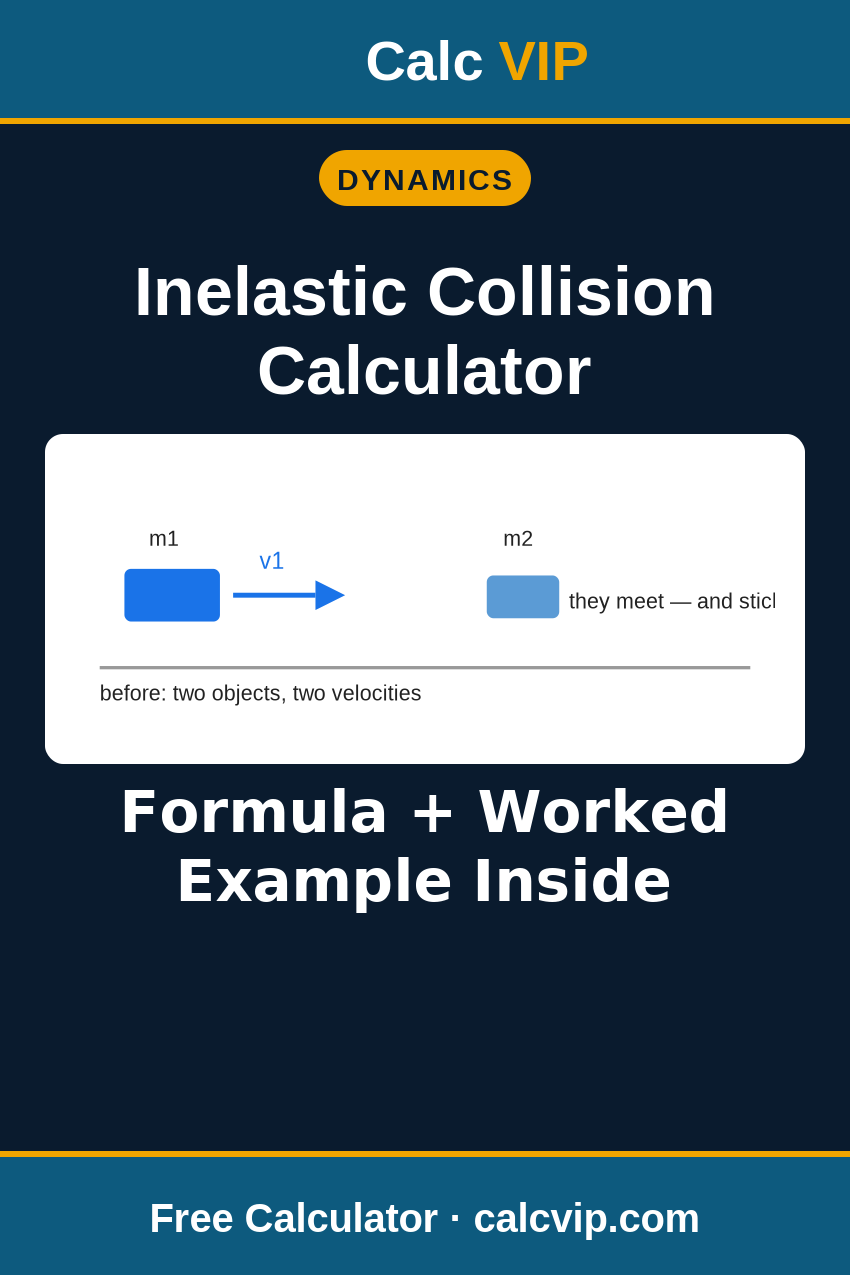
One result surprises nearly everyone who meets it: for a moving object striking a stationary one, the fraction of kinetic energy lost is fixed by the masses alone — it equals the target's share of the total mass. Equal masses lose exactly half. A striker nine times heavier than its target loses only a tenth. The speeds do not enter into it at all. The worked examples below show the pattern emerging from the arithmetic, and the depth section derives it in two lines — it is one of those rare results that is both simple and genuinely useful, because it tells an engineer the energy bill of a sticking collision before a single speed is measured.
Formula
v' = (m1v1 + m2v2) / (m1 + m2) — from conservation of momentum. The kinetic energy lost is KE before − KE after, where KE = ½mv² and the stuck-together pair moves as one mass (m1 + m2) at speed v'.
The momentum equation rearranges for whichever quantity is missing: a required striking velocity for a target final speed, v1 = ((m1 + m2) v' − m2v2) / m1, or an unknown mass from a measured outcome, m2 = m1 (v1 − v') / (v' − v2). The energy side has its own tidy form when the target is at rest: the fraction of kinetic energy surviving is m1 / (m1 + m2), so the fraction lost is m2 / (m1 + m2) — the target's share of the combined mass. As with every collision formula, the bookkeeping that matters is signs: velocities in opposite directions must carry opposite signs, and a head-on impact entered with two positive speeds is not a head-on impact at all, but a rear-end one.
| Symbol | Meaning | Units |
|---|---|---|
| m1, m2 | masses of the two objects | kg |
| v1, v2 | velocities before the collision (signed) | m/s |
| v' | shared velocity of the stuck pair afterwards | m/s |
| KE before / after | total kinetic energy, Σ ½mv², before and after | joules (J) |
| KE lost | KE before − KE after (becomes heat, sound, deformation) | joules (J) |
Why momentum survives the crash but kinetic energy does not
The two quantities behave differently because they are built differently. Momentum is a vector sum, p = mv, and the internal forces of a collision — however violent — come in equal and opposite pairs that cancel in the total. Nothing inside the crash can change the total momentum; only an external force can. Kinetic energy is a scalar built from v², and squaring changes everything: when two masses merge their motion into one slower shared velocity, the v² of the combined motion is worth less than the separate v² terms it replaces. The "missing" energy has not vanished — the first law of thermodynamics forbids that — it has changed address, into the internal energy of the wreckage: bent metal, torn fibres, warmed and compressed material, and the sound wave that carried the bang away.
There is a deeper way to see why sticking is the maximum-loss outcome. For any system, the kinetic energy splits into two parts: the energy of the centre of mass moving as a whole, which momentum conservation locks away untouchably, plus the energy of motion relative to the centre of mass. A collision can only spend the second part. When the objects stick, their relative motion falls to zero — every spendable joule is spent — so the loss is the largest physics permits for that starting momentum. Bouncier collisions keep some relative motion and lose less; the perfectly elastic collision keeps all of it and loses none. This page's calculator sits at the full-spending end of that spectrum.
How to use
- Enter both masses in kg and both starting velocities in m/s.
- Use a negative velocity for an object moving in the opposite direction (head-on collisions) — the sign is what tells the calculator the geometry.
- Click "Calculate Final Velocity" to see the shared final velocity of the stuck pair.
- Read the energy lines: kinetic energy before, after, and the joules and percentage lost. A 100% loss means the pair ended at rest — possible only when the two momenta exactly cancelled.
Worked examples
Example 1 — the standard case. A cart of mass 3 kg moving at 8 m/s hits a stationary cart of mass 1 kg and they latch together.
v' = (3 × 8 + 1 × 0) / (3 + 1) = 24 / 4 = 6 m/s
KE before = ½ × 3 × 8² = 96 J; KE after = ½ × 4 × 6² = 72 J.
Kinetic energy lost = 96 − 72 = 24 J (25% of the original). Note the lost fraction, 25%, is exactly the target's mass share: 1 kg out of 4 kg.
Example 2 — head-on, equal and opposite: the full stop. Two 2 kg carts approach at 5 m/s and −5 m/s and stick. v' = (2 × 5 + 2 × (−5)) / 4 = 0 m/s — the pair hangs motionless. KE before = ½ × 2 × 25 + ½ × 2 × 25 = 50 J; KE after = 0 J. All 50 J (100%) is converted. This is the extreme case: zero total momentum means even the centre-of-mass share of the energy is zero, so everything was spendable — and spent.
Example 3 — railway wagons coupling. A loaded wagon of 12,000 kg rolls at 3 m/s into a stationary wagon of 8,000 kg; the couplings engage. v' = (12,000 × 3) / 20,000 = 1.8 m/s. KE before = ½ × 12,000 × 3² = 54,000 J; KE after = ½ × 20,000 × 1.8² = 32,400 J. Lost = 21,600 J (40%) — again the stationary wagon's mass share, 8,000/20,000. That lost energy is the clang, the shudder through the freight, and the work done in the coupling mechanism; shunting yards are designed around it.
Example 4 — the rugby tackle. A 90 kg runner at 7 m/s is wrapped up by an 80 kg tackler coming the other way at −3 m/s; they go down together. v' = (90 × 7 + 80 × (−3)) / 170 = 390 / 170 = 2.29 m/s — the pair still drifts forward, because the runner's momentum was bigger. KE before = ½ × 90 × 49 + ½ × 80 × 9 = 2,205 + 360 = 2,565 J; KE after = ½ × 170 × 2.29² ≈ 447 J. Lost ≈ 2,118 J (82.6%) — absorbed by pads, bodies and turf, which is precisely what they are for.
Example 5 — putty onto a cart. A 0.5 kg lump of putty flies at 20 m/s and sticks to a stationary 1.5 kg cart. v' = (0.5 × 20) / 2 = 5 m/s. KE before = ½ × 0.5 × 400 = 100 J; KE after = ½ × 2 × 25 = 25 J. Lost = 75 J (75%) — the putty's own mass share of the total is small, but the target's share is 1.5/2 = 75%, and that is the loss. Light strikers hitting heavy stationary targets pay the steepest energy tax.
Example 6 — skaters joining hands. A 60 kg skater gliding at 4 m/s catches the hand of a stationary 50 kg skater and they glide on together. v' = (60 × 4) / 110 = 2.18 m/s. KE before = ½ × 60 × 16 = 480 J; KE after = ½ × 110 × 2.18² ≈ 262 J. Lost ≈ 218 J (45.5%) — spent in the jolt through their arms and shoulders, which anyone who has done this has felt. (If the second skater pushes off afterwards, that is new energy from muscles, not a refund of the loss.)
Perfectly inelastic collisions in real life
Railway coupling. Freight wagons are joined by rolling them together until the couplers click — a designed perfectly inelastic collision, repeated thousands of times a day. Example 3's numbers show why coupling speeds are kept low: the energy that must be absorbed grows with the square of the approach speed.
Tackling and holding in sport. A tackle that wraps and holds is this calculator with people: the pair's final drift is set by momentum, and the large energy loss is absorbed by padding, muscle and ground rather than by either player's frame alone.
Spacecraft docking. When a crew vehicle docks with a station, capture latches make the two one structure — a perfectly inelastic event at orbital speeds, choreographed so the relative velocity is centimetres per second and the energy to absorb is tiny. The momentum arithmetic deciding the station's slight velocity change is exactly v' above.
Bullets and blocks. A bullet embedding in a wooden block is the textbook perfectly inelastic collision — and the working half of the ballistic pendulum, the classic instrument for measuring bullet speeds before electronic timers existed.
Catching. A fielder's glove, a cricketer's hands, an egg caught in a sheet: in each, projectile and catcher move off together, and the energy loss is taken by glove leather, arms giving way, or the sheet's stretch. Catching hard with stiff hands shortens the event and raises the force — but the momentum outcome is the same.
Snow and accretion. A snowball rolling and gathering snow, or a raindrop sweeping up mist droplets, grows by a stream of tiny sticking collisions. Each capture is governed by the same weighted-average velocity — which is why a growing aggregate's speed is always dragged towards the speed of what it absorbs.
The lost-energy rule: the target's mass share
Here is the two-line derivation promised in the introduction. With the target at rest, v' = m1v1 / (m1 + m2). The surviving kinetic energy is ½ (m1 + m2) v'² = ½ (m1 + m2) × m1²v1² / (m1 + m2)² = ½ m1v1² × m1 / (m1 + m2) — the original kinetic energy multiplied by m1 / (m1 + m2). So the fraction kept is the striker's mass share and the fraction lost is the target's: lost fraction = m2 / (m1 + m2). It explains every example on this page at a glance — 25% for the 3 kg and 1 kg carts, 40% for the wagons, 75% for the putty — and it fails gracefully: if the target was moving, the rule no longer applies directly, because some of the target's own energy is also in play.
Quick reference: energy lost when a moving object sticks to a stationary one
| Mass relationship | Final speed v' | KE lost |
|---|---|---|
| m1 = m2 (equal) | v1 / 2 | 50% |
| m1 = 3 × m2 | 3v1 / 4 | 25% |
| m1 = 9 × m2 | 9v1 / 10 | 10% |
| m2 = 3 × m1 | v1 / 4 | 75% |
| m2 = 9 × m1 | v1 / 10 | 90% |
The table reads as a design rule in both directions: heavy strikers shrug off sticking collisions, keeping most of their speed and energy; light strikers hitting heavy targets surrender almost everything — which is why a fly bouncing off a train loses the argument entirely, and why coupling a light wagon into a heavy rake is a gentle event for the rake and a jolt for the wagon.
Common mistakes
- Conserving kinetic energy out of habit. Momentum is the conserved quantity here; kinetic energy is not, and assuming it is produces a final speed that is too high. If a problem says the objects stick, the energy books are supposed to show a loss.
- Forgetting the combined mass after impact. KE after is ½ (m1 + m2) v'² — the whole stuck mass moving at the shared speed. Using only one object's mass understates the surviving energy and overstates the loss.
- Entering head-on speeds with the same sign. Opposite directions need opposite signs. Two positive speeds describe a chase, not a head-on crash, and the calculator will faithfully solve the wrong event.
- Saying the lost energy "disappears". It converts — to heat, sound and deformation work. An answer that cannot say where the joules went is an answer that has not finished the physics.
- Using the elastic formulas for a sticking collision. Elastic formulas assume a bounce and will predict the objects separating — for a latch, a tackle or an embedding bullet they are simply the wrong tool, however neatly they conserve energy.
FAQ
Why is kinetic energy lost but momentum is not?
Momentum depends on velocity once (p = mv) and the total is fixed by conservation. Kinetic energy depends on velocity squared, so when the combined mass moves slower, the total ½mv² drops — the missing energy becomes heat, sound and deformation.
Is a perfectly inelastic collision the maximum energy loss?
Yes. For a given starting momentum, sticking together loses the most kinetic energy possible, because the final speed is as low as momentum conservation allows.
What are real examples?
A football player tackling and holding on, two railway wagons coupling together, or a bullet embedding itself in a wooden block.
What is the difference between "inelastic" and "perfectly inelastic"?
An ordinary inelastic collision loses some kinetic energy but the objects still separate — a car crash with a bounce, a dropped ball that rebounds weakly. "Perfectly" inelastic is the limiting case: the objects stick, relative motion ends, and the loss is the maximum possible for the momentum involved.
Can the stuck pair end up completely at rest?
Yes — whenever the total momentum is zero, as in Example 2's equal head-on collision. Then v' = 0 and every joule of kinetic energy is converted. It is the only arrangement in which a collision can spend 100% of the motion energy.
Why does sticking lose the most energy?
Because a system's kinetic energy divides into an untouchable part — the centre of mass gliding on, protected by momentum conservation — and a spendable part, the motion relative to the centre of mass. Sticking zeroes the relative motion, so the entire spendable part is spent.
If I double the striking speed, what happens to the energy lost?
It quadruples, like all kinetic energies: double v and both KE before and the lost amount (a fixed fraction of it, for a stationary target) grow by a factor of four. The final speed v' merely doubles. This square law is why modest speed increases make crashes disproportionately more destructive.
Does the lost-fraction rule work if the target is moving?
Not directly. The rule "lost = m2 / (m1 + m2)" was derived for a stationary target. With both objects moving, work through v' and the two KE totals — the calculator does exactly that — because the target's own kinetic energy is also part of the ledger.
How does this connect to the ballistic pendulum?
The pendulum's first stage is a perfectly inelastic collision: the projectile embeds in the block, momentum conservation sets the pair's speed, and this page's energy loss happens in the block. Only the second stage — the swing — conserves mechanical energy, which is why the pendulum method uses a different law for each stage.
Could the pair ever gain kinetic energy instead?
Not in a passive collision. A gain requires stored energy to be released during the event — a compressed spring between the carts, a small explosive charge — and then the event is better described as an explosion, where the extra kinetic energy has a clear source.