 Calc
Lever Calculator – Balance Equation F₁d₁ = F₂d₂ Solver
 Created by James Carter · Physics Writer · Forces & Motion · Last updated: November 2026
Use this free Lever Calculator to solve the lever balance equation in any direction — find the load force, the effort force, or either distance from the fulcrum when a lever is in balance.
"Give me a place to stand and I will move the Earth" — Archimedes' boast is the lever's whole biography in one sentence. A lever is a rigid bar turning on a pivot, the fulcrum, and its rule is a balance of turning effects: effort × its distance from the fulcrum equals load × its distance. Arrange the distances one way and a child balances an adult on a seesaw; arrange them another and a crowbar tears out a nail that fingers could never shift. This calculator solves the balance equation in all four directions — for the load force, the effort force, or either distance — because in practice any one of the four is the thing you do not know.
The equation's engine is torque, the turning effect of a force, measured as force × perpendicular distance from the pivot. Balance is the state where the clockwise torque and the anticlockwise torque cancel, and the lever hangs in equilibrium, neither rising nor falling. Multiply a modest force by a long arm and its torque matches a large force on a short arm — force has been traded for distance, the golden rule of all machines, paid out here in its purest form: your hand travels far so that the load, gripped by a proportionally larger force, travels a little.
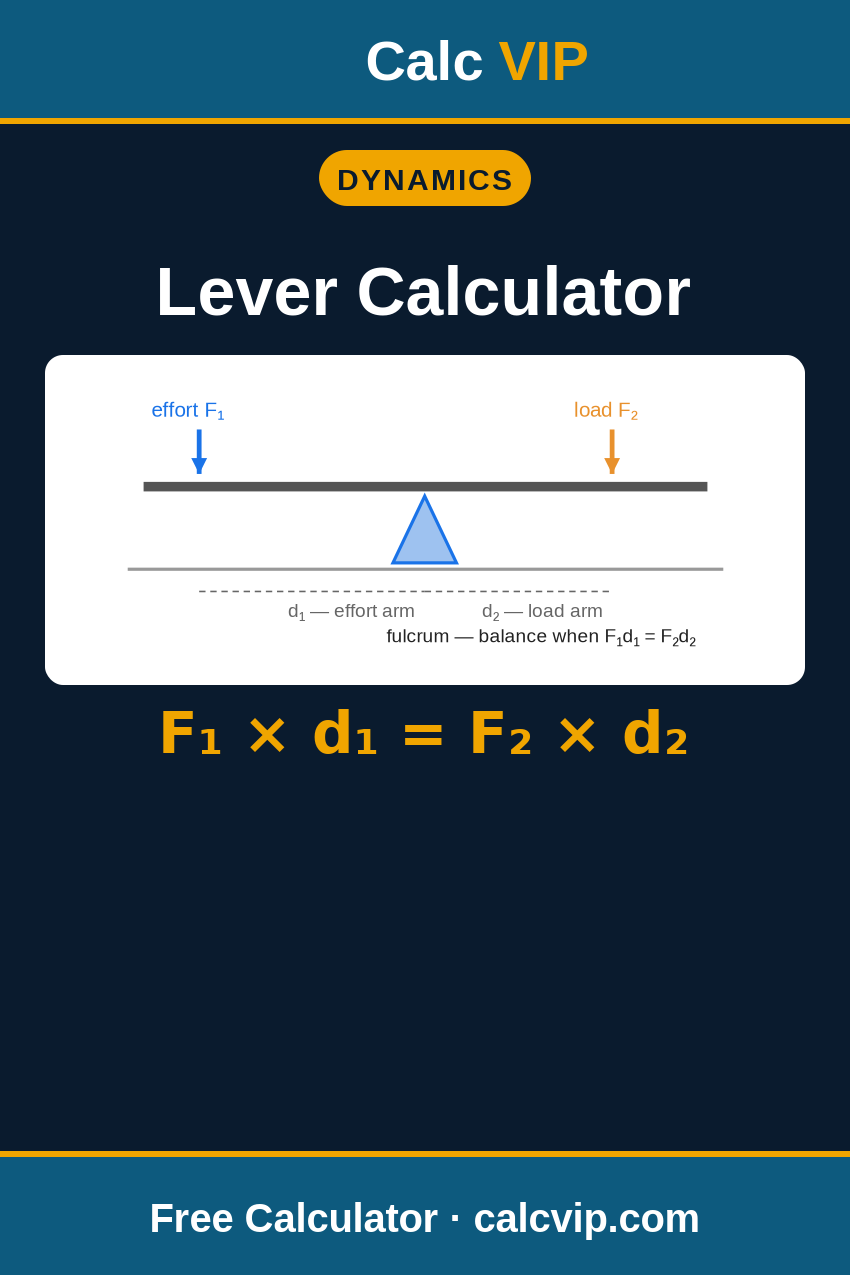
Levers sort into three classes by the order of their three characters — fulcrum, effort, load — along the bar. Class 1 puts the fulcrum between effort and load (seesaw, crowbar, scissors). Class 2 puts the load between fulcrum and effort (wheelbarrow, nutcracker), always multiplying force. Class 3 puts the effort between fulcrum and load (tweezers, the human forearm), always multiplying distance and speed instead. The balance equation on this page governs all three without modification — only the geometry of which distance belongs to which force changes, and the class decides whether the machine is a force multiplier, a speed multiplier, or a balancer.
Formula
Lever balance (equal torques): F₁ × d₁ = F₂ × d₂
where F₁ is the effort, F₂ is the load, and d₁, d₂ are their distances from the fulcrum. Rearranged, any one value follows from the other three.
The four rearrangements are the four modes of the calculator: F₂ = F₁d₁/d₂ · F₁ = F₂d₂/d₁ · d₁ = F₂d₂/F₁ · d₂ = F₁d₁/F₂. The mechanical advantage of the lever is the distance ratio itself, MA = d₁/d₂ = F₂/F₁ — read straight off the bar before any force is measured. Distances are measured from the fulcrum to the line of each force, and they must be perpendicular distances: if a force acts at an angle, only its component perpendicular to the bar contributes torque, and the effective arm shortens by the cosine of the angle. Forces in newtons and distances in metres keep the torques in newton-metres on both sides, where they can be compared honestly.
| Symbol | Meaning | Units |
|---|---|---|
| F₁ | effort — the force you apply | N |
| d₁ | effort arm — fulcrum to effort's line of action | m |
| F₂ | load — the force the lever works against | N |
| d₂ | load arm — fulcrum to load's line of action | m |
| τ | torque — turning effect, F × d | N·m |
Torque: why distance multiplies force
A force's turning effect depends on where it acts as much as how big it is. Push a door near its hinges and it barely moves; push at the handle and it swings — same force, different torque. The lever is that observation industrialised: by choosing where the fulcrum sits, you choose the exchange rate between force and distance. Balance is reached when the two torques match, and the equation F₁d₁ = F₂d₂ is simply the statement that neither side is winning the turn. Everything else about levers — the three classes, the mechanical advantage, the speed trade — is bookkeeping on that single equality.
The trade is enforced by geometry, not generosity. When the bar rotates through a small angle, each point on it travels a distance proportional to its distance from the fulcrum: the effort end sweeps d₁-worth of arc for every d₂-worth at the load end. Work in (F₁ × its travel) therefore equals work out (F₂ × its travel) only if F₁d₁ = F₂d₂. Energy conservation and torque balance are the same law read twice — which is why no arrangement of levers, however ingenious, can multiply both force and distance at once, and why Archimedes, to move the Earth with a human push, would have needed his end of the lever to travel an astronomical distance: the boast survives the physics, but the schedule does not.
How to use
- Choose the quantity you want to find from the drop-down.
- Enter the other three values — forces in newtons, distances in metres from the fulcrum.
- Click "Calculate" to get the missing value.
- Check the implied MA (d₁/d₂) against your intention: above 1 you are buying force, below 1 you are buying speed and reach.
Worked examples
Example 1 — the force multiplier. You push down with an effort of 50 N at 2 m from the fulcrum, and the load sits only 0.5 m from the fulcrum.
F₂ = F₁ × d₁ / d₂ = 50 × 2 / 0.5 = 200 N.
The lever multiplies your force by 4 — the ratio of the two distances.
Example 2 — solving for the effort arm. You must balance an 800 N load sitting 0.25 m from the fulcrum, and you can push with 100 N. How far out must you stand? d₁ = F₂d₂/F₁ = 800 × 0.25 / 100 = 2 m. The distance mode is the seesaw designer's tool: it tells you where to sit, where to place the stone, where to cut the bar.
Example 3 — the crowbar. A nail resists with 1200 N, its claw gripping 0.1 m from the bar's curve (the fulcrum), while your hand pulls at 1.2 m... on a long wrecking bar: F₁ = 1200 × 0.1 / 1.2 = 100 N. A two-handed heave of 100 N extracts a nail that a 1200 N direct pull could not — MA 12, bought with a bar a metre long and a pull that travels twelve times the nail's rise.
Example 4 — the seesaw truce. A child weighing 300 N sits 2 m from the pivot; where must a 600 N adult sit to balance? d₂ = F₁d₁/F₂ = 300 × 2 / 600 = 1 m. Torque check: 300 × 2 = 600 N·m against 600 × 1 = 600 N·m — the equation's two sides agree, as the playground demonstrates daily.
Example 5 — the wheelbarrow. A barrow carries a 500 N load centred 0.4 m ahead of the wheel axle (the fulcrum), with the handles 1.2 m behind it: F₁ = 500 × 0.4 / 1.2 = 166.67 N shared between two hands. Class 2 geometry — the load between fulcrum and effort — guarantees the advantage; the wheel carries the rest of the weight, which is the barrow's second, quieter trick.
Example 6 — your own forearm. The biceps attaches 0.04 m from the elbow (the fulcrum) and the load sits in the hand, 0.32 m out. To hold a 100 N weight: F₁ = 100 × 0.32 / 0.04 = 800 N of biceps tension. Class 3 levers run at MA 1/8 — a deliberate loss: in exchange, the hand sweeps eight times the distance the muscle shortens, and moves eight times as fast. Your arms are built for speed and range, not force, and this calculation is the receipt.
Levers in real life
Tools that multiply force. Crowbars, bolt cutters, car jacks, pliers and bottle openers are class 1 or 2 levers with distance ratios chosen for the job — a bottle opener's ratio is small because a cap needs little force; a bolt cutter's is huge because a padlock shackle needs a great deal.
Balances and scales. The equal-arm balance is a lever reporting that two torques match; the steelyard is the cleverer version, sliding one known weight along a graduated arm until F₁d₁ = F₂d₂, reading the load's weight off the distance — this calculator's d-solving mode, cast in brass.
The human and animal body. Nearly every limb is a class 3 lever sacrificing force for speed: forearms, jaws in reverse (the jaw is class 2 at the molars), the foot in walking (class 2 around the toes). Evolution paid force to buy velocity and range of motion, and muscles are sized by the torques of Example 6.
Playground and workshop safety. Seesaw balance, scaffold planks, ladder leverage and the pry-bar that suddenly slips are all torque problems. Knowing where the balance point falls — and how a load's torque grows as it slides outward — is practical safety, not just examination physics.
Cranes and counterweights. A tower crane is a lever balanced by a counterweight: the jib's load torque (huge force × long arm) is matched by concrete blocks (huge force × short arm) on the other side. The operator's load chart is a table of allowed F₂d₂ products.
Oars, paddles and scissors. An oar is a class 1 lever whose fulcrum (the rowlock) shifts the advantage between boat speed and rower effort; scissors are two class 1 levers sharing a pivot, their cutting force rising as the material slides towards the pivot — d₂ shrinking mid-cut, exactly as the formula predicts.
When the lever itself has weight — and when the pull is angled
The ideal equation treats the bar as weightless and the forces as perpendicular. Real bars have weight, and it acts at the bar's centre of mass as an extra load (or effort, depending on which side of the fulcrum it falls): add its torque, F = weight × distance of the centre of mass from the fulcrum, to the correct side of the balance. A heavy crowbar helps you once the nail starts moving and fights you while you position it, for exactly this reason. Angled forces need the other correction: only the component perpendicular to the bar turns it — an effort applied at angle φ to the bar delivers F sin φ to the balance, so a push at 60° to the bar delivers sin 60° ≈ 0.87 of its force, and a pull along the bar (φ = 0) turns it not at all, which is why you instinctively push a lever at right angles. This calculator assumes the clean case; the corrections tell you which way the clean answer errs.
Quick reference: distance ratio and what it buys
| d₁ : d₂ | MA | 100 N effort balances | Typical tool |
|---|---|---|---|
| 1 : 4 | 0.25 | 25 N | forearm, tweezers (speed) |
| 1 : 1 | 1 | 100 N | equal-arm balance |
| 2 : 1 | 2 | 200 N | bottle opener |
| 4 : 1 | 4 | 400 N | Example 1's bar |
| 12 : 1 | 12 | 1200 N | wrecking bar (Example 3) |
One column is the mirror of the other: whatever the force column gains, the travel column — not shown, but always the inverse ratio — quietly pays.
Compound levers: multiplying the multipliers
Levers chain. Bolt cutters work because two levers drive each other: the handles form one lever whose output squeezes the jaws, a second, shorter lever, and the total advantage is the product of the two ratios — a handle ratio of 6 driving a jaw ratio of 5 cuts with MA 30, which is how hand force severs a steel bolt. Nail clippers hide three levers in a pocket tool; a piano key drives a train of them to throw a hammer at the string far faster than the finger moved. The balance equation never changes — each stage simply hands its F₂ to the next stage as F₁ — and this calculator, applied stage by stage, analyses the whole train. The bill arrives as always in travel: the final jaw closes a thirtieth of the distance the handles sweep.
Common mistakes
- Measuring distances from the end of the bar. Both arms are measured from the fulcrum. A 2 m bar with the fulcrum 0.5 m from the load has arms 1.5 m and 0.5 m, not 2 m and 0.5 m.
- Swapping which distance belongs to which force. d₁ travels with F₁, d₂ with F₂. Cross them and the answer inverts — the surest check is the MA: if you wanted force multiplication, d₁/d₂ must exceed 1.
- Expecting force and distance to multiply together. The product is conserved. A lever that multiplies force by 4 divides the load's travel by 4 — plan the working room for your end's long sweep.
- Forgetting the bar's own weight. A heavy bar's weight acts at its centre of mass and adds torque to one side. For long steel bars this is not a pedantic correction; it can rival the load.
- Pulling at an angle and using the full force. Only the perpendicular component makes torque. A pull 30° off perpendicular delivers sin 60° ≈ 0.87 of its force to the balance — and a pull along the bar delivers nothing at all.
FAQ
How does a lever multiply force?
It trades distance for force: your effort moves through a large distance so the load can be lifted with a larger force through a small distance. The product F × d (the torque) is the same on both sides.
Where is the fulcrum in a wheelbarrow or a bottle opener?
In a wheelbarrow the fulcrum is the wheel axle, the load sits in the bucket and your hands supply the effort. A bottle opener works the same way, with the cap edge as the fulcrum.
Does this calculator include the lever's own weight?
No — it assumes a light, rigid lever and no friction at the fulcrum, which is a good model for most textbook and DIY problems.
What are the three classes of lever, in one line each?
Class 1: fulcrum between effort and load (seesaw). Class 2: load between fulcrum and effort (wheelbarrow) — always multiplies force. Class 3: effort between fulcrum and load (forearm) — always multiplies speed and distance.
Could Archimedes really have moved the Earth?
The torque arithmetic allows it; the logistics do not. To lift Earth (weight ≈ 5.9 × 10²⁵ N) with a 100 N push needs a distance ratio of about 10²³ — and his end of the lever would have to travel roughly 10²³ times the distance the Earth moved. Shifting the planet by 1 cm would take him some 10²¹ metres of travel. The boast is a correct intuition about torque wearing an impossible schedule.
Why does a door handle sit far from the hinges?
Torque. The handle's distance from the hinge (the fulcrum) is d, and the latch's resistance acts at nearly the same radius — but your hand's placement maximises the torque your force produces for opening against the closer and the seals. Move the handle to mid-door and the same push feels half as strong.
What happens if the fulcrum is exactly under the load?
d₂ = 0, so the load produces no torque at all and any effort tips the bar — you are no longer levering the load, just lifting it with the bar as a handle. The calculator's division by d₂ is the algebra's way of refusing the same degenerate case.
Is a balance scale really a lever?
Yes — the original one. Equal arms make F₁ = F₂ at balance, so the unknown weight equals the known weights in the other pan. The steelyard variant uses unequal arms and a sliding weight, solving for distance instead of force.
Why do scissors cut better near the pivot?
Because d₂ — the distance from pivot to the material — shrinks as the material slides in, raising the force ratio F₂ = F₁d₁/d₂ at the same hand squeeze. Cardboard that defeats the blade tips surrenders at the throat.
Does friction at the fulcrum matter?
Slightly: it eats a small torque both ways, creating a dead band within which the lever will not move even when slightly unbalanced. For well-made pivots it is negligible; for a rusty gate hinge it is the difference between the calculated effort and the real one.