 Calc
Orbital Period Calculator – Satellite Period from Altitude
 Created by Priya Sharma · Physics Editor · Energy & Gravity · Last updated: November 2026
Use this free Orbital Period Calculator to find how long a satellite takes to circle the Earth at a given altitude — and the speed it must travel. Just enter the height above Earth's surface.
An orbit is a balancing act performed at speed. A satellite is perpetually falling toward Earth, but it is also moving sideways so fast that the ground curves away beneath it at the same rate it falls — so it never lands. The period, the time for one full circuit, is set by how that balance plays out at a given height: gravity weakens with altitude, so a higher satellite needs less sideways speed to hold its circle, yet it has a much longer circle to complete. Both effects stretch the period, which is why orbit periods climb so quickly with height — from about 90 minutes for the Space Station to a full day for weather satellites parked 36,000 km up.
Everything on this page follows from two equations. The speed a circular orbit demands at radius r is v = √(GM/r) — fast enough that gravity's inward pull exactly supplies the turning. The period is then just circumference divided by speed, T = 2πr/v, which simplifies to Kepler's third law, T = 2π√(r³/GM). The one input that matters is r, and the trap hidden in it is that r is measured from Earth's centre: the altitude you type in must be added to Earth's radius of 6,371 km before anything else happens. This calculator does that addition for you and reports the speed and the number of orbits per day alongside the period.
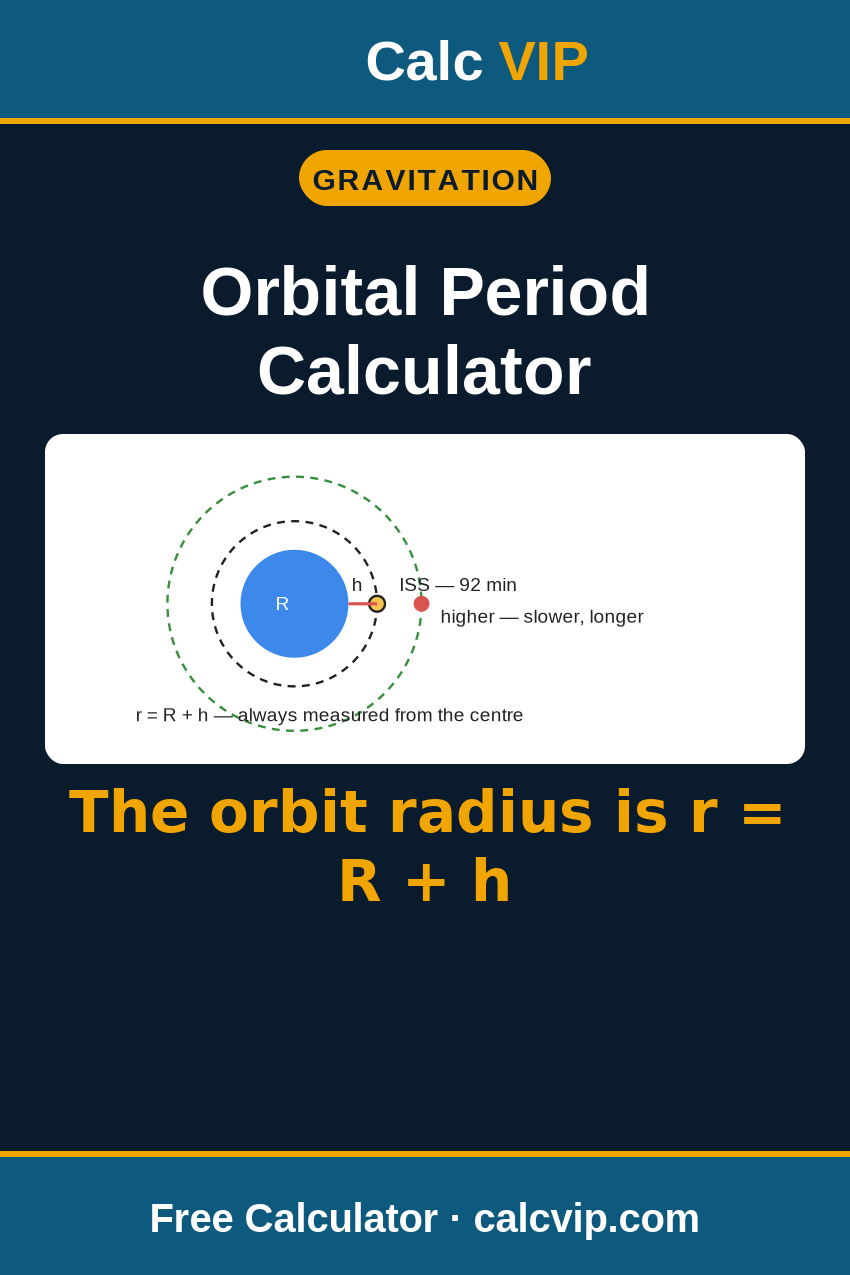
The numbers explain the lived experience of orbit. The Space Station's crew watch a sunrise every 92 minutes — about 16 a day. A navigation satellite at 20,200 km sees the same ground track repeat daily because its period is half a day. A geostationary satellite's period matches Earth's spin exactly, so it never sets. Enter any altitude and you are reading off where your satellite sits in that family: how rushed its days are, how often it passes overhead, and how much of the planet it can see.
Formula
The orbit radius is r = R + h, with Earth's radius R = 6,371 km and mass M = 5.972 × 10²⁴ kg. The orbital speed is v = √(GM/r), and the period is T = 2πr / v = 2π√(r³/GM), with G = 6.674 × 10⁻¹¹ N·m²/kg². The same formula rearranges to find the altitude a mission needs for a target period: r = (GMT²/4π²)1/3, then subtract R. Orbits per day is simply 86,400 ÷ T. Note what is absent: the satellite's mass. It cancels between gravity's pull and the satellite's inertia, so a 400-tonne station and a 4 kg cubesat at the same altitude share the same period to many decimal places.
| Symbol | Meaning | Units |
|---|---|---|
| T | orbital period — time for one complete circuit | seconds (s); minutes and hours for display |
| h | altitude above Earth's surface — the input | kilometres (km) |
| r | orbit radius from Earth's centre, r = R + h | metres (m) in the formula |
| R | Earth's radius, 6,371 km | km |
| v | orbital speed for a circular orbit at radius r | m/s |
| M, G | Earth's mass 5.972 × 10²⁴ kg; G = 6.674 × 10⁻¹¹ | kg; N·m²/kg² |
The 84-minute floor: why no Earth orbit is faster
Set the altitude to zero and the formula returns a period of about 84.4 minutes and a speed of 7,910 m/s. That is the fastest any Earth satellite can possibly circle: an orbit grazing the surface itself. It is a theoretical floor — the atmosphere makes such an orbit impossible in practice — but it frames everything above it. The Space Station, 400 km up, is only 10% slower in period than this absolute limit. Low Earth orbit is a narrow band, period-wise: everything between 300 km and 2,000 km altitude lives between roughly 90 and 127 minutes.
The floor has a beautiful consequence. A pendulum with the same period as a surface orbit — about 84.4 minutes — was a 19th-century curiosity, and the same number appears in the time a dropped object would take to fall through a tunnel through the Earth and back. All three are the same physics wearing different clothes: motion governed by Earth's GM and R alone. Whenever a problem involves falling, swinging or circling at Earth's surface, 84 minutes is lurking nearby.
How to use
- Enter the satellite's altitude above Earth's surface in kilometres — for example 400 for the International Space Station.
- Click "Calculate Orbital Period".
- Read the orbit radius (Earth's radius plus your altitude), the orbital speed in m/s, and the period in seconds, minutes and hours.
- Check the orbits-per-day figure: it tells you how often the satellite's ground track repeats and how many sunrises its crew or cameras see daily.
- Compare altitudes: try 550 (Starlink), 20,200 (GPS) and 35,869 (geostationary) to feel how steeply the period grows.
Worked examples
Example 1 — the International Space Station. h = 400 km, so r = 6,371 + 400 = 6,771 km = 6.771 × 10⁶ m.
v = √(GM/r) ≈ 7,672 m/s; T = 2πr/v ≈ 5,545 s ≈ 92.4 minutes, about 15.6 orbits per day — a sunrise roughly every hour and a half for the crew.
Example 2 — the theoretical minimum. h = 0 (an orbit skimming the surface):
v = √(GM/R) ≈ 7,910 m/s; T ≈ 5,061 s ≈ 84.4 minutes, or 17.1 orbits per day. No satellite can beat this period; the real atmosphere pushes practical orbits to 90 minutes and above.
Example 3 — the Hubble Space Telescope. h = 540 km, r = 6,911 km.
v ≈ 7,594 m/s; T ≈ 5,718 s ≈ 95.3 minutes, about 15.1 orbits per day. Hubble's observing schedule is built around these 95-minute cycles of daylight and Earth-shadow.
Example 4 — a Starlink satellite. h = 550 km, r = 6,921 km.
v ≈ 7,589 m/s; T ≈ 5,730 s ≈ 95.5 minutes. Thousands of satellites share nearly this exact period, which is what lets the constellation's coverage pattern repeat so regularly.
Example 5 — a GPS satellite. h = 20,200 km, r = 26,571 km.
v ≈ 3,873 m/s; T ≈ 43,106 s ≈ 11.97 hours — almost exactly half a day, so each satellite passes over the same ground track twice daily, a deliberate design choice.
Example 6 — the geostationary limit. h = 35,869 km, r = 42,240 km.
v ≈ 3,072 m/s; T ≈ 86,400 s = 24.0 hours, exactly 1.00 orbits per day. The satellite's period has grown to match Earth's spin — the subject of our Geostationary Orbit Calculator.
Orbital periods in real life
Why the ISS crew see 16 sunrises. At 92.4 minutes per orbit, the station laps the day–night line constantly: about 15.6 sunrises and sunsets per 24 hours, each "day" lasting only ~45 minutes of light. Crew sleep schedules ignore the Sun entirely and run on mission clocks.
Sun-synchronous weather orbits. Imaging satellites near 800 km (period ≈ 100.7 minutes) use a slight orbital tilt so their plane precesses one degree per day, keeping the local time beneath them constant — every photograph is taken at the same Sun angle, making changes easy to spot.
Ground-station contact windows. A low satellite at 92 minutes is above any one ground station's horizon for only about 10 minutes per pass. Mission control plans commanding, telemetry dumps and astronaut calls around the period this calculator returns.
Debris tracking. Tens of thousands of tracked objects each have a measured period; from the period alone, cataloguers recover the orbit's size and can predict conjunctions — near-misses — days ahead.
Reusable rocket staging. A Falcon 9 first stage separates a few minutes after launch at orbital speeds well below the 7.7 km/s this page computes for 400 km — which is why it can come back, while the second stage continues to full orbital speed and cannot.
Film and fiction checks. Any film showing a station circling Earth in 30 minutes, or taking 6 hours in low orbit, fails this calculator. Real low orbits are locked in the 90–127 minute corridor — a quick authenticity test for space stories.
Elliptical orbits: which radius counts?
Real orbits are rarely perfect circles. A satellite might swing from 300 km altitude at its lowest point (perigee) to 800 km at its highest (apogee). Kepler's law handles this gracefully: the period depends only on the semi-major axis — half the orbit's longest diameter — which for altitude purposes is Earth's radius plus the average of perigee and apogee altitudes. Our example satellite has a semi-major axis of 6,371 + 550 = 6,921 km, so its period is the 95.5-minute figure of a circular 550 km orbit, even though its speed varies around the loop — faster at perigee, slower at apogee, exactly compensating. Enter the average altitude into this calculator and the period comes out right for any eccentricity.
Hohmann transfers: the period law as a travel timetable
Getting between two circular orbits uses half of an ellipse whose periapsis touches one orbit and apoapsis the other — the Hohmann transfer — and its travel time is just half the period of that ellipse, which this page's formula supplies. From the ISS's 400 km orbit to geostationary altitude, the transfer ellipse has semi-major axis a = (6,771 + 42,241)/2 = 24,506 km, a full period of about 10.61 hours, and therefore a one-way travel time of half that: about 5.3 hours. That figure is the real schedule of every GEO delivery: a satellite released in low orbit in the morning coasts up the ellipse and circularises at the ring by afternoon. The same half-period arithmetic times Mars transfers (the ellipse reaching out to 1.52 AU takes about 259 days), lunar trajectories, and every gravity-assist-free journey in the solar system — mission planners quite literally read departure boards written by Kepler's third law.
The formula also checks the Solar System's most familiar clock. The Moon's orbit radius is 384,400 km; entering it gives T ≈ 2.37 × 10⁶ s ≈ 27.5 days, against the measured sidereal month of 27.32 days. The small difference is the Moon's own mass, which the simple formula ignores: using G(M + m) instead of GM closes the gap, a reminder that the calculator's central-body assumption is an approximation whose error grows as the satellite's mass approaches the planet's.
Ground tracks: why orbits repeat (or deliberately don't)
A satellite's period also choreographs the pattern it traces over the rotating Earth. In one 100-minute orbit, Earth turns beneath the satellite by 360° × (100/1,436) ≈ 25.1°, so each successive ground track lies about 25° of longitude west of the previous one, and after 14.4 orbits — one day — the pattern nearly repeats. Earth-observation missions exploit this arithmetic deliberately: a sun-synchronous orbit tunes its period (about 100 minutes at 800 km) and inclination so the ground track repeats under the same lighting every pass, while navigation constellations choose periods of half a sidereal day (GPS: 11 h 58 min) so the same satellites rise over the same places at the same sidereal times daily. When you read that an orbit was "designed", it is usually this page's formula, run backwards from a desired rhythm of coverage.
Quick reference: period and speed by altitude
| Altitude | Speed | Period | Orbits/day |
|---|---|---|---|
| 0 km (theoretical) | 7,910 m/s | 84.4 min | 17.1 |
| 300 km | 7,730 m/s | 90.4 min | 15.9 |
| 400 km (ISS) | 7,672 m/s | 92.4 min | 15.6 |
| 800 km | 7,455 m/s | 100.7 min | 14.3 |
| 2,000 km | 6,900 m/s | 127.0 min | 11.3 |
| 10,000 km | 4,934 m/s | 5.79 h | 4.1 |
| 20,200 km (GPS) | 3,873 m/s | 11.97 h | 2.0 |
| 35,869 km (GEO) | 3,072 m/s | 24.0 h | 1.0 |
Read the speed column downwards and the pattern is unmistakable: the higher the orbit, the slower the satellite travels — yet the longer its period grows. Slowness and long periods are the same fact seen from two sides: weak gravity up high demands little speed, and there is far more circle to complete.
Synodic periods: the period of meeting again
Two orbiting bodies meet on a third clock. Earth laps Mars — periods 1 year and 1.881 years — on the synodic cycle 1/S = 1/1 − 1/1.881, giving S ≈ 2.135 years ≈ 780 days: the rhythm of Mars oppositions, of launch windows to the red planet, and of the planet's apparent retrograde loops. Every pair of orbits in this page's tables defines such a beat frequency, and mission calendars — Mercury's 116-day synodic cycle, the 584-day Venus window — are written in them. Kepler's law gives each traveller's own period; the synodic arithmetic gives the timetable of their reunions.
Common mistakes
- Using altitude as the orbit radius. Entering r = 400 km instead of 6,771 km is the classic error — the period comes out near 4 minutes, absurd on its face. Always add Earth's radius; this calculator exists largely to make that step automatic.
- Assuming higher satellites move faster. The opposite is true: orbital speed falls as 1/√r. The Space Station at 7.67 km/s is much faster than a GPS satellite at 3.87 km/s, even though the GPS satellite's day is far longer.
- Expecting the satellite's mass to change the answer. It cancels out of the physics entirely. Period is a property of the orbit's size and the planet — never of what is doing the orbiting.
- Confusing the period with the time between passes overhead. Earth rotates beneath the orbit, so a 92-minute satellite does not reappear over the same spot every 92 minutes — its ground track shifts westward by about 23° each circuit.
- Forgetting the atmosphere. The formula happily returns a period for 100 km altitude, but drag there destroys a real orbit within hours. Below ~300 km, treat the result as a snapshot, not a sustainable orbit.
FAQ
Why do higher satellites take longer to orbit?
They have a longer path to travel and gravity is weaker up there, so their orbital speed is lower — both effects stretch the period.
What period does a geostationary satellite have?
Exactly one day (about 24 hours), which happens at an altitude of about 35,869 km — see our Geostationary Orbit Calculator.
Does the satellite's mass change the period?
No. The period depends only on the orbit radius and Earth's mass.
How fast is the Space Station really moving?
About 7,672 m/s at 400 km — roughly 27,600 km/h, or 23 times the speed of sound in air. At that pace it crosses the width of the Atlantic in about ten minutes, yet its period is a calm 92.4 minutes because the circle is nearly 42,500 km around.
Why is there a minimum period of about 84 minutes?
Because the tightest possible circle is Earth's own circumference at the surface, flown at the fastest circular-orbit speed the surface allows, 7,910 m/s. Any real satellite flies higher, on a longer path at a lower speed, so its period must be longer.
Does this calculator work for other planets?
It is built with Earth's mass and radius. For other planets, use our Kepler's Third Law Calculator, which accepts any central mass — the same T = 2π√(r³/GM) does the work.
What altitude gives a period of exactly one hour?
None — one hour is below the 84-minute floor. No free orbit around Earth can have a 60-minute period; anything circling that fast would need continuous thrust, not gravity alone.
Why do GPS satellites use a half-day period?
With T ≈ 11 h 58 min (two orbits per sidereal day), each satellite's ground track repeats exactly every day, which simplifies receiver calculations and guarantees the same geometry returns at the same local time.
How long does the Moon take, by this formula?
The Moon is a satellite of Earth at r = 384,400 km: T = 2π√(r³/GM) ≈ 27.5 days — matching the sidereal month. The same equation spans five orders of magnitude, from space stations to the Moon.
If a satellite fires its engine to go faster, does its period shorten?
Counter-intuitively, no — speeding up raises the orbit (the far side lifts), and the larger orbit has a longer period despite the higher speed at the burn point. Orbital mechanics routinely inverts everyday intuition this way.