 Calc
Orbital Separation Calculator – Semi-Major Axis from Period (Kepler III)
 Created by Priya Sharma · Physics Editor · Energy & Gravity · Last updated: November 2026
Use this free Orbital Separation Calculator to run Kepler's third law in reverse: from an orbital period and the total mass of the system, find the semi-major axis — the average distance between the two bodies.
Kepler's third law is usually met as a proportionality — the square of the period goes as the cube of the distance — but rearranged, as on this page, it becomes a measuring instrument: give it a period you can time with a stopwatch and a total mass, and it hands you a distance you could never stretch a tape across. This is how astronomers weigh and measure the universe's binaries. Watch two stars circle each other for a few years, note the period, estimate the separation from this formula, and the pair's total mass falls out — the only direct way to weigh stars at all. Run it the other way, with a known mass, and it predicts where anything must orbit: the altitude of a satellite with a 90-minute period, the spacing of an exoplanet found by its star's wobble, the 1 AU of Earth's own year.
The physics underneath is a single balance. Gravity supplies the centripetal force that bends the orbit into a circle; the period fixes how fast the bending must happen; and the separation is the one distance at which those two demands agree. Because the cube root compresses errors, the formula is forgiving: a 30% error in the total mass moves the answer by only about 9%, which is why period measurements — the easiest thing in astronomy to make precise — yield separations good enough to build a science on.
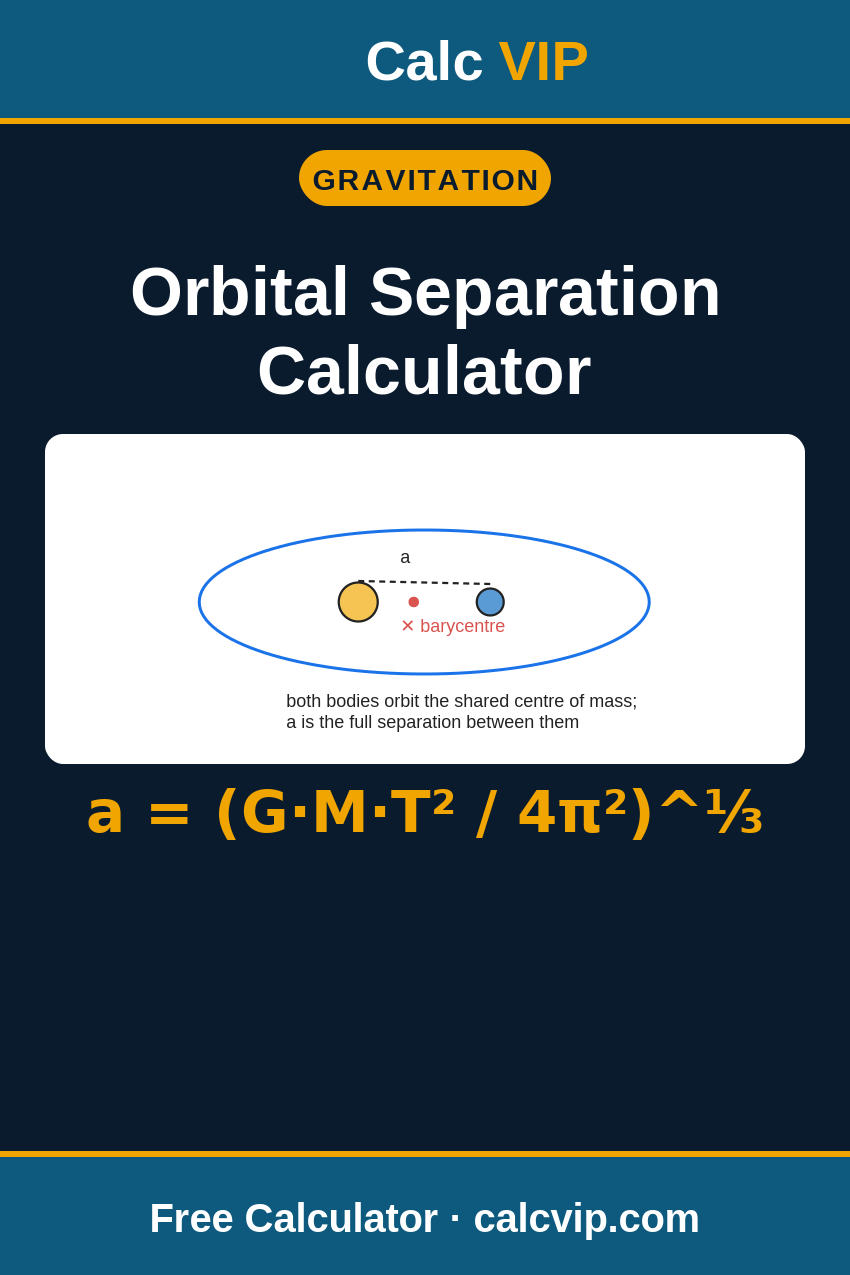
Enter the total mass of the system (both bodies together) in kilograms or solar masses, and the period in seconds, days or years; the calculator returns the separation in kilometres and in astronomical units. Remember that for circular orbits this distance is measured centre to centre, and for two comparable bodies it is the distance between them — each one circles the shared centre of mass at its own smaller radius, a subtlety the concept section unpacks.
Formula
The separation follows from Kepler's third law solved for distance: a = (G·M·T² / 4π²)^⅓ • a in metres (calculator also gives AU), M = total mass of both bodies in kg, T = period in seconds, G = 6.674 × 10⁻¹¹ N·m²/kg².
The other rearrangements serve the other questions astronomers ask. Total mass from a measured separation and period — the star-weighing form: M = 4π²a³ / (GT²). Period from a known separation: T = 2π√(a³/GM). In solar-system units the constant vanishes and the law becomes the pocket rule a³ = M·T² with a in AU, T in years and M in solar masses — the form used in Example 3 below to check a binary in one line. Notice what the formula does not contain: the orbiting body's own mass appears only inside the total M, the eccentricity does not appear at all (a is then the semi-major axis), and there is no dependence on the bodies' sizes or compositions. Gravity's clockwork cares about mass, distance and time — nothing else.
| Symbol | Meaning | Units |
|---|---|---|
| a | separation (semi-major axis) between the two bodies | km, AU |
| M | total mass, M₁ + M₂ | kg (or solar masses) |
| T | orbital period | seconds, days or years |
| G | gravitational constant | 6.674 × 10⁻¹¹ N·m²/kg² |
Two bodies, one centre: what "separation" really means
Textbook pictures show a small body circling a fixed large one, but nature's version is a duet: both bodies orbit the barycentre, the balance point between them, on opposite sides, with the same period. The separation a in Kepler's law is the full distance between the two bodies; the individual orbits are smaller, with radii in inverse proportion to the masses — r₁ = a·M₂/(M₁+M₂) and r₂ = a·M₁/(M₁+M₂). For Earth and the Moon, the barycentre lies about 4,671 km from Earth's centre — inside the Earth, but noticeably off-centre, so Earth wobbles around a point beneath its own surface as the Moon circles. For Pluto and Charon, the barycentre floats in empty space between them, and the pair is honestly a binary. For two equal stars, each traces an orbit of radius a/2. The period, remarkably, depends only on the total mass and the full separation — the split between the partners does not matter to the clock, only to the choreography.
This is also why the radial-velocity method for finding exoplanets works. A planet tugs its star around the barycentre; the star's small orbit makes its light rhythmically Doppler-shift with the planet's period. The period is read off the wobble directly; the separation then comes from this page's formula (with the star's mass dominating the total); and the wobble's size, combined with the barycentre geometry, yields the planet's minimum mass. One measured rhythm, decoded by Kepler, becomes a planet's address and weight.
How to use
- Enter the total mass of the two bodies — star plus planet, planet plus moon, both stars. Choose kilograms or solar masses.
- Enter the orbital period and choose its unit: seconds, days or years.
- Click "Calculate Separation" to get the separation in kilometres and in AU.
- To find an altitude above a planet's surface (for a satellite), subtract the planet's radius from the answer — the formula measures centre to centre.
- For eccentric orbits, read the result as the semi-major axis: the average of the closest and farthest separations, and the quantity the period actually cares about.
Worked examples
Example 1 — Earth around the Sun. Total mass ≈ the Sun's mass 1.989 × 10³⁰ kg, period 1 year.
a = (GMT²/4π²)^⅓ ≈ 1.496 × 10¹¹ m = 149,608,543 km = 1.00 AU.
The formula returns the astronomical unit itself — as it must, since the AU is defined by this very orbit. It is the calibration check of the whole method: period plus mass reproduces the yardstick of the solar system.
Example 2 — the Moon, two ways. Period 27.32 days.
Using Earth's mass alone (5.972 × 10²⁴ kg) gives a ≈ 383,158 km; using the true total, Earth + Moon (6.045 × 10²⁴ kg), gives 384,723 km.
The measured semi-major axis is 384,400 km. Including the Moon's own modest mass moves the answer from 0.3% low to 0.1% high — a neat demonstration that "total mass" in the formula is not pedantry, and that the small partner's contribution is real but small.
Example 3 — a binary of two Suns. Two stars of 1 solar mass each (total 2 M☉), period 10 years.
Pocket form: a³ = M·T² = 2 × 100 = 200, so a ≈ 5.85 AU.
Each star circles the barycentre at half that, 2.92 AU — a stately, decades-wide waltz of the kind visual-binary astronomers patiently map, and the raw data from which stellar masses are weighed.
Example 4 — the space station. Total mass ≈ Earth's, period 92.9 minutes (5,574 s).
a ≈ 6,795 km from Earth's centre — an altitude of about 424 km.
Ninety-minute periods mean skimming the top of the atmosphere; the formula shows there is no alternative. Any Earth satellite with that period, whatever its own mass or purpose, must live at that radius — orbital mechanics assigns addresses by the clock.
Example 5 — Jupiter. Period 11.86 years around the Sun.
a³ = 1 × 11.86² = 140.7, so a ≈ 5.20 AU ✓ (778 million km).
And the geostationary check: a period of one sidereal day (86,164 s) around Earth gives a = 42,163 km, the famous GEO radius — while half that period, 43,080 s, gives 26,560 km, the GPS constellation's home. One formula, every orbit in the sky.
Example 6 — a hot exoplanet. Period 20 days around a star of 0.5 solar masses.
T = 0.0548 yr; a³ = 0.5 × 0.0548² = 0.00150, so a ≈ 0.114 AU — about 17 million km.
Mercury, by comparison, sits at 0.387 AU with an 88-day period. The 20-day world hugs its dim star three times closer than Mercury hugs the Sun — yet because the star is half as massive and far fainter, such a planet can sit in the temperate zone. Period plus stellar mass, through this formula, is how the habitable-zone census is actually taken.
Orbital separation in real life
It weighs the stars. Roughly half of all stars live in binaries. For visual pairs, astronomers measure the period and the angular separation; this formula, run as M = 4π²a³/(GT²), converts them into the total mass — and with the barycentre split, into each star's individual mass. Nearly everything known about how stellar mass relates to brightness and lifetime rests on these measurements.
It places the satellite fleets. Every orbit in commercial use was first computed with Kepler's law: the 42,163 km geostationary ring (period = one sidereal day), the 26,560 km GPS shell (half a day), the ~90-minute low-orbit band. Constellation designers still start here before adding perturbations.
It reads exoplanet systems. Transit and radial-velocity surveys measure periods superbly and masses approximately; the separation follows at once, and with it the planet's equilibrium temperature, its likely composition zone, and whether it sits in the habitable zone — thousands of worlds characterised by one cube root.
It reconstructed the Moon's history. The Moon is receding at 3.8 cm per year, so its period was shorter in the past. Running Kepler backwards through geological evidence — fossil shells recording shorter days and months — reconstructs the Earth–Moon system's evolution, including an era when the Moon orbited in days, not weeks, at a fraction of its present separation.
It times the mergers of black holes. A binary's gravitational-wave frequency is twice its orbital frequency, and as the pair radiates energy the period shrinks and the separation follows this law downward — the chirp LIGO hears is Kepler's third law being read aloud in real time, with the masses extracted from how the pitch climbs.
It catches asteroids with moons. A growing number of asteroids are found to have small companions. The companion's period (easy to time from brightness dips) plus this formula yields the system's total mass; divide by the volume from radar or occultations and out falls the asteroid's density — revealing which are solid rock and which are rubble piles, without ever visiting.
The pocket form: a³ = M T², and when it fails
In AU, years and solar masses, Kepler's law loses its constants entirely — a³ = M·T² — because the Earth's own orbit defines the units. This is the fastest sanity check in orbital mechanics: Jupiter, T ≈ 11.86, gives a = (11.86²)^⅓ ≈ 5.2 ✓; a hypothetical planet at 4 AU must have T = √(64/1) = 8 years. The pocket form fails, instructively, in three regimes. Near a black hole or neutron star, relativistic corrections bend the law at the percent level and beyond. In systems of three comparable bodies, no fixed a exists at all — the law describes pairs. And for bodies orbiting inside a galaxy, the "total mass" is the mass interior to the orbit, which grows with a itself — the very complication whose resolution revealed dark matter, as the orbital-velocity page explores.
Quick reference: period ↔ separation around familiar masses
| System | Period | Separation |
|---|---|---|
| ISS around Earth | 92.9 min | 6,795 km (424 km altitude) |
| GPS satellite | 11 h 58 min | 26,560 km |
| Geostationary satellite | 23 h 56 min | 42,163 km |
| Moon around Earth | 27.32 days | 384,400 km |
| Mercury around Sun | 88 days | 0.387 AU |
| Earth around Sun | 1 year | 1.00 AU |
| Jupiter around Sun | 11.86 years | 5.20 AU |
| Two Suns, binary | 10 years | 5.85 AU |
Read the table as a scaling lesson: multiply the period by 8 and the separation grows only fourfold (8^⅔ = 4). Orbits spread out grudgingly — which is why the outer planets, with periods of decades and centuries, sit at tens of AU rather than thousands, and why a planet with a 1,000-year period still fits within about 100 AU of its star.
Common mistakes
- Forgetting the companion's mass. The M in the formula is the total of both bodies. For Earth–Sun the planet's share is negligible, but for the Moon it shifts the answer by over 1,500 km, and for equal binary stars omitting one partner understates a by about 21%.
- Reading the answer as an altitude. The separation is centre to centre. A result of 6,795 km for the ISS is not its height above the ground — subtract Earth's 6,371 km radius to get the 424 km altitude. Forgetting this is the commonest satellite error of all.
- Expecting the orbiting body's own orbit radius. For comparable masses, neither body travels on a circle of radius a; each circles the barycentre at a fraction of a. Kepler's law gives the separation between them, not either one's path.
- Applying it to eccentric orbits as if a were the current distance. An eccentric pair's separation swings between a(1−e) and a(1+e) while the period stays fixed. The formula returns the semi-major axis a — the quantity the period determines — not today's distance.
- Mixing period units. Years in the SI form (which expects seconds) shrink the answer catastrophically; days read as years inflate it. The unit selector beside the period box exists precisely because this slip is so easy — check it before believing a surprising answer.
FAQ
How do astronomers find exoplanet distances this way?
A transit or radial-velocity survey measures the planet's period very precisely. With the star's mass estimated from its spectrum, Kepler's law immediately gives the orbit size — and with it, whether the planet sits in the habitable zone.
Does the orbiting body's mass matter?
Only through the total mass M. For a planet around a star it changes the answer by far less than 1%, but for two similar stars in a binary both masses count fully.
What separation gives a period of exactly one day around Earth?
About 50,000 km from Earth's centre — well inside the Moon's orbit, which is why no natural satellite can have a one-day period at the Moon's distance.
Does this work for elliptical orbits too?
Yes — for an ellipse, a is the semi-major axis (half the longest diameter), and the same period formula applies. That is why planets with quite eccentric orbits still obey Kepler's third law.
What if I only know the separation and want the period?
Use the rearrangement T = 2π√(a³/GM). The calculator on this page solves for distance, but the same law runs in every direction: any two of period, separation and total mass determine the third.
How accurate is the result for real satellites?
Very good as a first answer — within a fraction of a percent for Earth satellites. Precision work adds corrections for Earth's equatorial bulge (which tugs orbits and precesses them), the Moon and Sun's pulls, and atmospheric drag in low orbit; Kepler gives the address, perturbation theory the exact apartment.
Why does the formula have a cube root?
Because period enters squared and distance cubed — T² ∝ a³ — so solving for a means taking the cube root of a quantity containing T². The practical consequence is mercy: errors shrink through the root, so a 30% mass error becomes only a 9% distance error.
Does the law work for moons of other planets?
Universally — it is the same gravity. Jupiter's four Galilean moons were Kepler's own early test case, and their periods and separations still obey the law with Jupiter's mass in place of the Sun's. Any two-body system in the universe is fair game.
What breaks Kepler's third law?
Close approaches to very compact objects (relativity), strong third-body interference, and non-gravitational forces like drag or radiation pressure on tiny particles. For planets, moons, satellites and binaries under normal conditions, nothing measurable breaks it.
How did Kepler find the law without knowing any masses?
He worked with ratios: comparing planets' periods and relative distances around the same Sun, the unknown mass cancels, leaving T² ∝ a³ as a pure pattern in Tycho Brahe's data (published in 1619). Newton, sixty years later, supplied the mass and the reason — the version this calculator uses.