 Calc
Orbital Velocity Calculator – Satellite Speed for a Circular Orbit
 Created by Priya Sharma · Physics Editor · Energy & Gravity · Last updated: November 2026
Use this free Orbital Velocity Calculator to find the speed a satellite needs for a stable circular orbit, v = √(GM/r). Use the Earth preset or enter any central body's mass and the orbit radius.
Throw a stone sideways and it arcs to the ground. Throw it faster and it lands further away. Newton asked the obvious, world-changing question: how fast would you have to throw it for the ground itself to curve away beneath it as fast as it falls — so that it falls forever and never lands? That speed, for a given distance from a planet's centre, is the orbital velocity, v = √(GM/r). It is the speed of every satellite, moon and space station: not flying, not floating, but falling in a circle. This calculator finds it for any central body and any orbit radius.
The formula's message is counterintuitive and worth absorbing before any numbers: higher orbits are slower. Because r sits in the denominator, a satellite twice as far from the centre needs only 1/√2 ≈ 0.71 times the speed. Gravity up there is weaker, the required "fall" is gentler, and the circle is wider and lazier. The Moon, sixty Earth-radii out, ambles around at barely 1 km/s and takes a month about it; the space station, skimming a few hundred kilometres up, must tear along at 7.67 km/s and circles the planet every hour and a half. Low is fast and frantic; high is slow and stately.
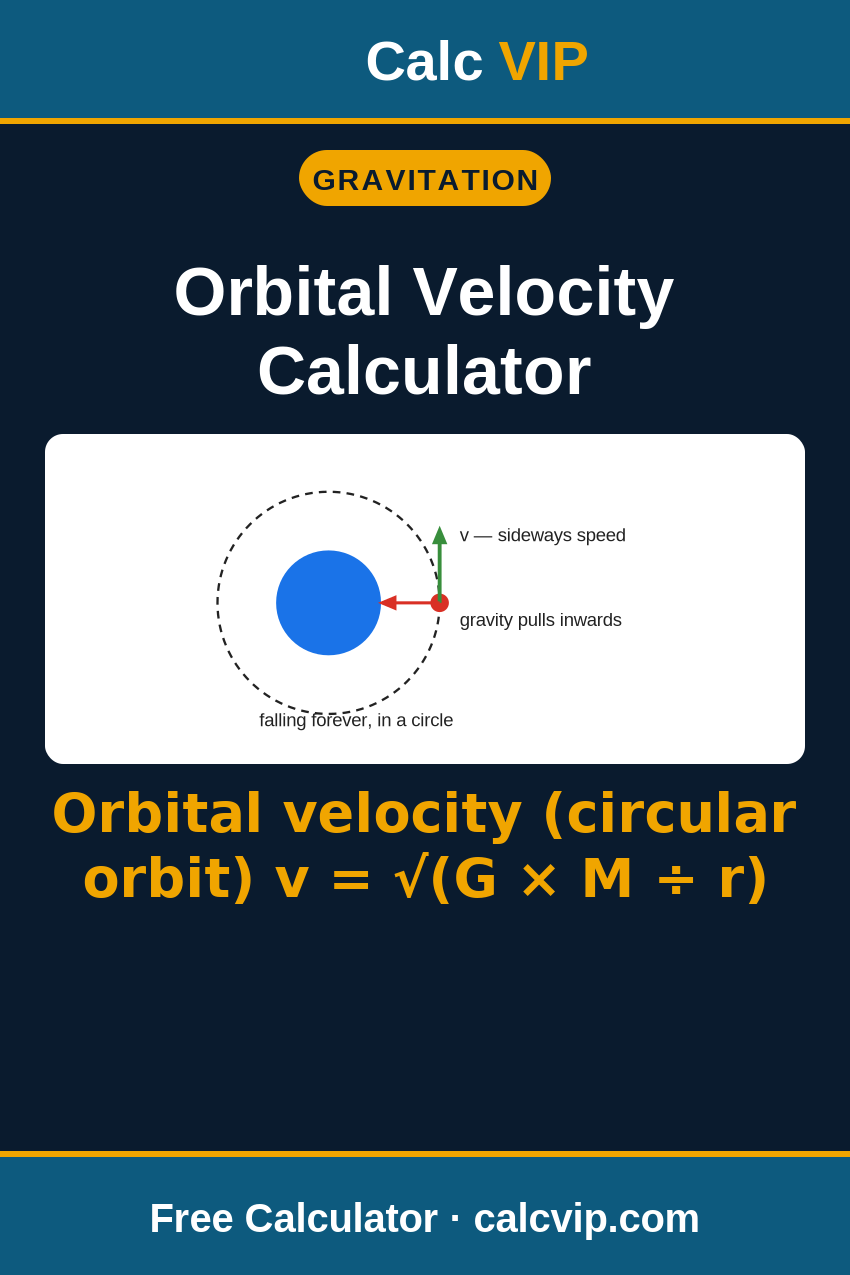
And whose mass matters? Only the central body's. Just as with escape velocity, the satellite's own mass cancels out of the physics — a bolt and a space station in the same orbit travel at the same speed, which is why astronauts can let go of tools and watch them keep station beside them. The orbit is a property of the planet and the radius: pick r, and v, the period, and the whole geometry of the circle are already decided. Everything in this page is a footnote to that one fact.
Formula
Orbital velocity (circular orbit) v = √(G × M ÷ r) • v in metres per second (m/s), M the central body's mass in kilograms (kg), r the orbit radius — centre to centre — in metres (m), G = 6.674 × 10⁻¹¹ N·m²/kg²
The formula comes from setting gravity equal to the centripetal requirement of circular motion: GMm/r² = mv²/r, where the satellite's mass m cancels — the deep reason orbit speed ignores the satellite. Companion formulas complete the picture: the period T = 2πr ÷ v (equivalently Kepler's T = 2π√(r³ ÷ GM)), and the escape velocity at the same radius, √2 × v. The single most common input error is r: it is measured from the central body's centre, so for a satellite at altitude h above Earth, r = 6,371 km + h, never h alone. The calculator's Earth preset plus an altitude entry handles this for you; for custom bodies, add the radius yourself.
| Symbol | Meaning | Units |
|---|---|---|
| v | orbital velocity for a circular orbit | m/s (or km/s) |
| G | universal gravitational constant | 6.674 × 10⁻¹¹ N·m²/kg² |
| M | mass of the central body (planet or star) | kilograms (kg) |
| r | orbit radius from the centre (= body radius + altitude) | metres (m) |
Falling around a planet: Newton's cannonball
The clearest picture of an orbit ever drawn is Newton's own: a cannon on a mountaintop, firing horizontally. A slow shot arcs into the sea nearby. Faster shots land further round the curve of the Earth. At one special speed — 7.91 km/s at the surface — the ball's fall matches the Earth's curvature exactly: it drops towards the ground at the same rate the ground drops away beneath it, and it circles the planet, returning to the cannon from behind. Nothing holds it up. It is in free fall the entire time; it simply never gets closer to the ground. Every satellite since Sputnik is that cannonball, and the astronauts inside them float for the same reason a falling lift's passengers would: everything falls together.
This picture also grades every other speed. Below orbital velocity at your radius, your path is an ellipse that intersects the planet (a crash, or a sub-orbital hop like a ballistic missile's). At orbital velocity, a circle. Between orbital and escape velocity, an ellipse that stays in space — the shape of most real satellite orbits, since perfect circles are an idealisation. At √2 times orbital velocity, the path opens into a parabola and never returns; above that, a hyperbola, with speed to spare at infinity. One number, v = √(GM/r), is the hinge on which all five fates turn.
How to use
- Choose the Earth preset or enter a custom central mass M in kilograms (scientific notation such as 5.972e24 is accepted).
- Enter the orbit radius from the centre — or the altitude, where the calculator offers it, and let it add the body's radius (for Earth: r = 6371 km + altitude).
- Click "Calculate Orbital Velocity" to get the circular-orbit speed in m/s and km/s.
- For the period, divide the orbit's circumference by the speed: T = 2πr ÷ v. For the escape speed at that radius, multiply the answer by √2 ≈ 1.414.
Worked examples
Example 1 — the space station. The International Space Station orbits about 400 km above Earth, so r = 6371 + 400 = 6771 km.
v = √(6.674 × 10⁻¹¹ × 5.972 × 10²⁴ / 6.771 × 10⁶) ≈ 7,672 m/s ≈ 7.67 km/s
At that speed the station circles the Earth in about 93 minutes.
Example 2 — the geostationary perch. A satellite that hovers over one spot on the equator must orbit in 23.94 hours, which fixes r = 42,164 km (altitude 35,786 km):
v = √(6.674 × 10⁻¹¹ × 5.972 × 10²⁴ ÷ 4.2164 × 10⁷) = √(3.986 × 10¹⁴ ÷ 4.2164 × 10⁷) ≈ 3,075 m/s ≈ 3.07 km/s. Check by circumference: 2π × 4.2164 × 10⁷ ÷ 3,075 ≈ 86,160 s ≈ 23.9 hours — the satellite and the ground below it complete their circles together, which is the entire point.
Example 3 — the Moon's stately pace. r = 3.844 × 10⁸ m:
v = √(3.986 × 10¹⁴ ÷ 3.844 × 10⁸) = √1.037 × 10⁶ ≈ 1,018 m/s ≈ 1.02 km/s. At that speed the Moon needs 27.3 days for its 2.4-million-kilometre circuit — the month, derived from one square root.
Example 4 — the fastest possible Earth orbit. Skimming the surface itself, r = 6.371 × 10⁶ m:
v = √(3.986 × 10¹⁴ ÷ 6.371 × 10⁶) = √6.257 × 10⁷ ≈ 7,910 m/s ≈ 7.91 km/s. This is the ceiling for Earth orbit speeds (the famous "first cosmic velocity") — attainable only in principle, since air and terrain forbid it, but the reference point from which every real, higher, slower orbit descends.
Example 5 — GPS satellites. The GPS constellation flies at about 20,200 km altitude, so r = 26,571 km:
v = √(3.986 × 10¹⁴ ÷ 2.6571 × 10⁷) ≈ 3,873 m/s ≈ 3.87 km/s, giving a period of 2π × 2.6571 × 10⁷ ÷ 3,873 ≈ 43,100 s ≈ 12 hours — each satellite passes over the same ground twice a day, a rhythm the whole navigation system is choreographed around.
Example 6 — Earth around the Sun. Change the central mass to the Sun (1.989 × 10³⁰ kg) and r to 1 AU (1.496 × 10¹¹ m):
v = √(6.674 × 10⁻¹¹ × 1.989 × 10³⁰ ÷ 1.496 × 10¹¹) ≈ 29,788 m/s ≈ 29.8 km/s. The same formula, the same physics — our planet is a satellite too, and its year is the period of its fall around the Sun.
Orbital velocity in real life
Launch economics. Reaching 7.67 km/s for low orbit is more than half the battle of any space mission — most of a rocket's fuel is spent buying orbital velocity, not altitude. This is why spaceports sit on east coasts at low latitudes (Earth's spin donates up to 0.47 km/s) and why "making orbit" is the milestone that separates sounding rockets from true spacecraft.
Navigation constellations. GPS, Galileo and their siblings are placed where this formula gives a 12-hour period and global coverage geometry; the system's accuracy rests on knowing each satellite's speed and position to centimetres — orbital mechanics as public infrastructure.
Space debris. At 7.7 km/s, a fleck of paint carries the kinetic energy of a bullet and a bolt that of a grenade. The formula that keeps satellites up also sets the violence of their collisions, and drives the tracking of hundreds of thousands of fragments.
Rendezvous and docking. To dock, a capsule must match its target's orbit exactly — same r, same v, same direction. Catching up is perverse: firing your engine to go faster raises your orbit and slows your average progress around the planet. Docking manoeuvres are this formula played like an instrument, and they are planned days ahead.
Planetary science. Read backwards, v = √(GM/r) weighs worlds: time a moon's orbit, measure its radius and speed, and the planet's mass is determined. Every mass in the Solar System tables was obtained this way, long before any probe arrived.
Your phone's weather picture. Geostationary satellites at 3.07 km/s stare at the same hemisphere forever, returning the full-disc Earth images behind weather forecasts — a direct dividend of the one radius where orbital period and planetary rotation agree.
Kepler's third law: the period is in the radius
Combine this calculator's v with T = 2πr/v and the speed disappears into a deeper pattern: T = 2π√(r³ ÷ GM), so T² ∝ r³ — Kepler's third law, found in 1619 from naked-eye data, here falling out of Newton in two lines. It says the period of any orbit around a given body is fixed by radius alone: double r and the period grows by 2√2 ≈ 2.83. Check the ladder of examples: the station (r = 6,771 km) takes 92 minutes; GPS (r = 26,571 km, ratio 3.92) should take 92 × 3.92^1.5 ≈ 92 × 7.78 ≈ 716 minutes ≈ 12 hours ✓; the Moon (ratio 56.8) takes 92 × 56.8^1.5 ≈ 92 × 428 ≈ 39,400 minutes ≈ 27.3 days ✓. One law, from an hour and a half to a month, without a single new constant.
Elliptical orbits: when the circle stretches
Real orbits are ellipses, and orbital velocity becomes a local affair: a satellite speeds up as it falls towards its low point (perigee) and dawdles at its high point (apogee), trading speed for altitude so that its total energy stays constant — Kepler's second law, and underneath it, conservation of angular momentum. The governing formula generalises to the vis-viva equation, v = √(GM × (2/r − 1/a)), where a is the ellipse's semi-major axis and r the current distance; set r = a and it collapses neatly back to this page's circular formula. Transfer orbits — the Hohmann ellipses that carry probes between planets — are chosen by exactly this arithmetic: burn at perigee to raise apogee, coast the long ellipse, burn again to circularise at the new orbital velocity.
Quick reference: orbital velocities around Earth
| Orbit | Radius from centre | Velocity | Period |
|---|---|---|---|
| surface-skimming (theoretical) | 6,371 km | 7.91 km/s | ≈ 84 min |
| space station | 6,771 km | 7.67 km/s | ≈ 93 min |
| GPS | 26,571 km | 3.87 km/s | ≈ 12 h |
| geostationary | 42,164 km | 3.07 km/s | 23.94 h |
| Moon | 384,400 km | 1.02 km/s | 27.3 days |
The pattern in the last two columns is Kepler's law made visible: as radius climbs by a factor of 57 from the station to the Moon, speed falls by a factor of 7.5 (√57) and the period stretches by a factor of 428 (57^1.5) — the square root and the three-halves power, running the whole table.
Common mistakes
- Using altitude as r. The costliest slip in orbital mechanics. For the station, r is 6,771 km, not 400 km; entering 400 km gives √(GM/4 × 10⁵) ≈ 31.6 km/s — faster than escape velocity, an immediate red flag. Always add the planet's radius.
- Expecting higher orbits to be faster. Intuition says "further, faster"; the formula says the opposite. Speed falls as 1/√r. The Moon crawls at 1 km/s while low satellites sprint at 7.7 — if your answer rises with altitude, something is inverted.
- Confusing orbital and escape velocity. They differ by √2 at the same radius: 7.91 vs 11.19 km/s at Earth's surface. Mixing them up is not a rounding error — it is the difference between circling a planet forever and leaving it forever.
- Putting the satellite's mass in M. M is the central body only. A heavier satellite needs a bigger rocket to reach orbital velocity, but the velocity itself is unchanged — orbit is a property of the planet and the radius.
- Mixing kilometres and metres. G is an SI constant. Entering r in kilometres without converting shrinks v by √1000 ≈ 31.6, turning the station's brisk 7.67 km/s into a helicopter-like 243 m/s. Convert first, calculate second.
FAQ
Why do higher orbits need lower speeds?
Gravity is weaker further away, so less speed is needed for the orbit to balance. The Moon, at 384,400 km, orbits at only about 1.02 km/s.
Does the satellite's own mass matter?
No — just like escape velocity, the formula only uses the central body's mass and the orbit radius.
How is orbital velocity related to escape velocity?
Escape velocity at the same distance is exactly √2 (about 1.41) times the orbital velocity: v_escape = √2 × v_orbit.
How long does one orbit take at a given speed?
The period is the circumference divided by the speed: T = 2πr ÷ v. For the space station, 2π × 6.771 × 10⁶ ÷ 7,672 ≈ 5,546 seconds ≈ 92 minutes — about 16 sunrises a day. Combining T = 2πr/v with v = √(GM/r) gives Kepler's third law, T = 2π√(r³/GM): period depends on radius alone, which is why all geostationary satellites share one special radius.
What is a geostationary orbit?
An orbit whose period equals Earth's rotation — 23 hours 56 minutes — so the satellite hangs over the same point on the equator forever. The formula fixes its radius uniquely: v must satisfy both v = √(GM/r) and v = 2πr/T, giving r = 42,164 km from Earth's centre (35,786 km altitude) and v = 3.07 km/s (Example 2). Weather and television satellites live there.
What happens if a satellite goes faster than orbital velocity?
Its circle stretches into an ellipse, with the fast point becoming the low point (perigee) of the new orbit. Faster still — √2 times orbital velocity — and the ellipse never closes: the satellite escapes. Slower, and it dips into an ellipse whose low point may meet the atmosphere. Orbital velocity is the exact speed at which the path closes into a circle at that radius.
Why do satellites in low orbit eventually fall?
The formula assumes no air, but at 400 km there is still a wisp of atmosphere, and its drag steadily removes energy. Lower energy means a smaller, faster orbit — drag paradoxically speeds the satellite up as it sinks — until the thick lower atmosphere turns the remaining speed into heat. The station needs periodic reboosts precisely because of this slow leak.
Does orbital velocity depend on the direction of travel?
The speed for a circle does not, but the resulting orbit does: launch eastward at the equator and Earth's rotation donates about 0.47 km/s of the required speed for free, which is why spaceports hug coasts and low latitudes and rockets launch towards the ocean, eastbound. A westward (retrograde) orbit must first cancel that gift, and costs noticeably more fuel.
How fast does Earth orbit the Sun?
With M the Sun's mass (1.989 × 10³⁰ kg) and r one astronomical unit (1.496 × 10¹¹ m): v = √(GM/r) ≈ 29,788 m/s ≈ 29.8 km/s. You are, right now, travelling at thirty kilometres per second around the Sun — and the formula says that is exactly the speed at which your perpetual fall towards the Sun curves into Earth's year-long circle.
What is the lowest possible orbital velocity around Earth?
The highest, actually, belongs to the lowest orbit: skimming the surface (ignoring mountains and air) requires 7.91 km/s (Example 4), and every higher orbit is slower. There is no minimum radius problem in the formula — but there is a practical floor set by the atmosphere, below about 300 km altitude, where drag ends orbits in days.