 Calc
Orbital Velocity Solver – Find Orbit Radius or Central Mass
 Created by Priya Sharma · Physics Editor · Energy & Gravity · Last updated: November 2026
Use this free Orbital Velocity Solver to rearrange the circular-orbit equation: if you know the orbital speed and the central mass, find the orbit radius — or if you know the speed and radius, find the mass of the body being orbited.
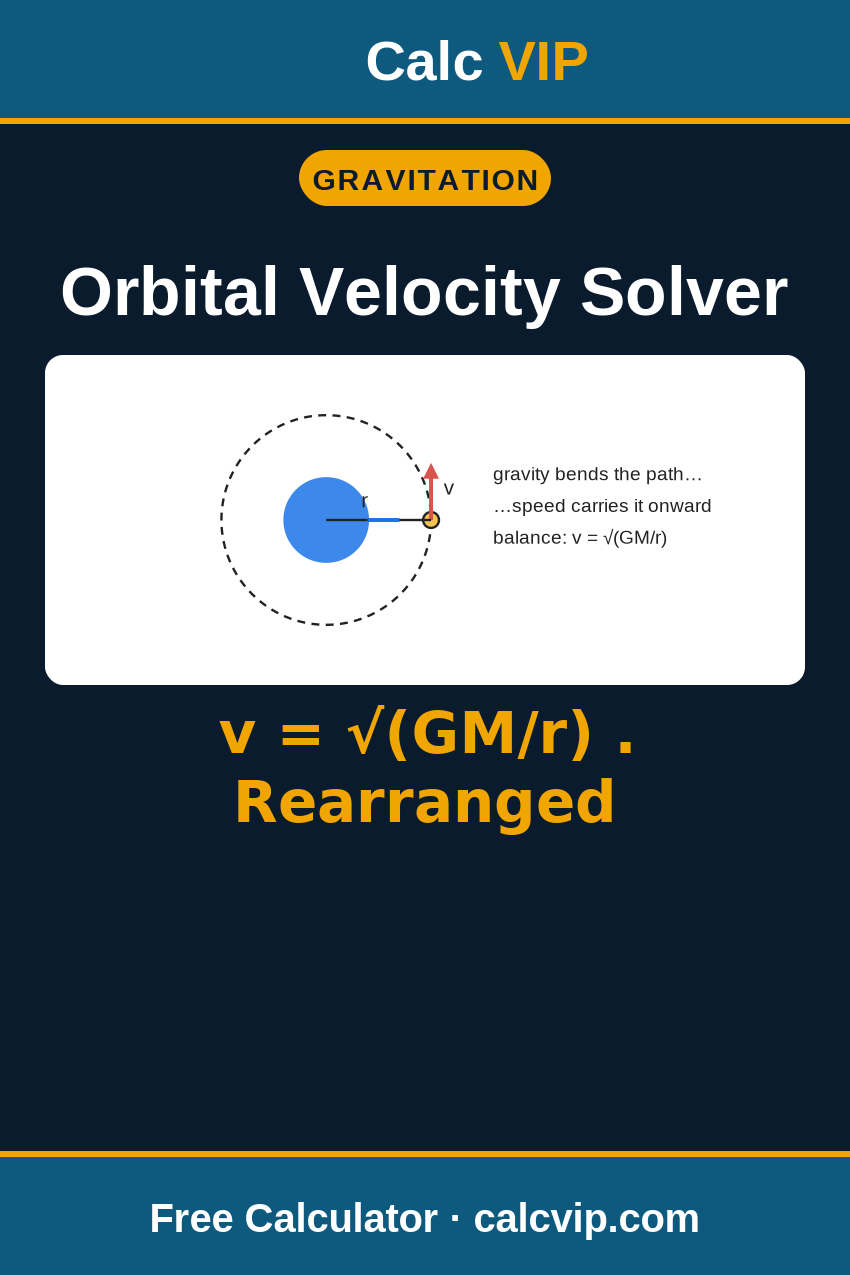
An orbit is a negotiation between speed and gravity, and it has exactly one peaceful settlement at each distance: move at v = √(GM/r) and you circle forever, neither falling in nor flying off. Move slower and the orbit sags into an ellipse that dips toward the planet; move faster and it stretches, until at √2 times the circular speed it opens entirely and you leave for good. This solver rearranges that central equation into its two working forms — r = GM/v², which tells mission planners where a satellite of a given speed must be circling, and M = v²r/G, which is nothing less than a scale for weighing suns, planets and galaxies by watching things go around them.
The mass mode deserves a moment of respect. Almost every mass in astronomy was measured this way or by its Keplerian cousin: the Sun from Earth's motion, Jupiter from its moons, exoplanet-host stars from their planets, and the Milky Way — disconcertingly, as the depth section describes — from its stars. When a news story announces the mass of a newly found black hole, somewhere behind it sits this formula, fed with the speed and orbit size of gas or stars circling the invisible mass.
The calculator assumes a circular orbit and a central mass much heavier than the orbiter, which between them cover satellites, moons, planets and most textbook systems. Enter the speed in m/s and either the mass in kilograms or the radius in kilometres, choose the mode, and the answer appears. For elliptical orbits the same equation with the semi-major axis in place of r gives the orbit's average character — the vis-viva equation, discussed below, is the exact generalisation.
Formula
For a circular orbit, gravity supplies the centripetal force, giving v = √(GM/r). Rearranged, the two solver modes are r = GM/v² and M = v²r/G • v in m/s, r in metres (calculator accepts km in mass mode), M in kg, G = 6.674 × 10⁻¹¹ N·m²/kg².
The derivation is three lines long and worth owning. Gravity on the orbiter is GMm/r²; the centripetal force a circular path demands is mv²/r; setting them equal, the orbiter's mass m cancels — the first hint that orbits are democratic — leaving v² = GM/r. From that root grow the other useful forms: the orbital period T = 2πr/v = 2π√(r³/GM) (Kepler's third law in Newton's clothing), the escape speed at the same radius vesc = √2 × v, and the specific orbital energy, which for a circle is exactly −GM/2r per kilogram — negative, as bound things are. The orbiting body's own mass does not appear in any of them: a satellite and a space station at the same radius share the same speed, the same period and the same fate.
| Symbol | Meaning | Units |
|---|---|---|
| v | orbital speed (circular orbit) | m/s |
| r | orbit radius, centre to centre | km (calculator input in mass mode) |
| M | mass of the central body | kg |
| T | orbital period, 2π√(r³/GM) | s |
The √2 that separates staying from leaving
Multiply the circular speed by √2 ≈ 1.414 and the orbit unbinds: that is escape velocity, and the factor is not a coincidence but an energy identity. A circular orbit's kinetic energy is exactly half the depth of the potential well it sits in (another face of the virial theorem), so doubling the kinetic energy — multiplying speed by √2 — brings the total to zero, the energy of a body at rest at infinity. This is why the numbers in the quick-reference table pair up so neatly: at the space station's radius, staying takes 7,672 m/s and leaving takes 10,849 m/s. It is also why "just 41% faster" is the most consequential phrase in astronautics: every interplanetary mission is the purchase of that extra 41% at the right moment, in the right direction — and why falling short by even a few percent leaves a probe in a long elliptical orbit instead of on its way to Mars.
Between the two speeds lies the whole family of ellipses. A probe fired at 1.2 times circular speed from low Earth orbit does not leave; it climbs into an ellipse whose far point is set by exactly how much energy was added, returning to its firing point each period like a comet on a leash. The vis-viva equation, v² = GM(2/r − 1/a), handles all of it: it gives the speed at any point of any orbit from the current distance r and the semi-major axis a, reduces to this page's formula when r = a (a circle), and is the working tool behind transfer orbits, rendezvous planning and comet prediction.
How to use
- Choose what to solve for in the mode menu: the orbit radius (from speed and mass) or the central mass (from speed and radius). The input fields rearrange themselves to match.
- Enter the orbital speed in m/s — for reference, Earth satellites in low orbit travel near 7,700 m/s, the Moon near 1,022 m/s, and Earth around the Sun near 29,780 m/s.
- In radius mode, enter the central mass in kilograms (scientific notation like 5.972e24 works). In mass mode, enter the orbit radius in kilometres, measured centre to centre — for a satellite, that is the planet's radius plus its altitude.
- Click "Solve" for the answer: radius in km and metres, or mass in kilograms.
- Judge the result physically: around a given mass, a faster speed must mean a smaller radius. If your answer moves the wrong way when you change the speed, an input is off by a power of ten — the classic failure with scientific notation.
Worked examples
Example 1 — where is the space station? The International Space Station travels at v = 7,672 m/s around Earth (M = 5.972 × 10²⁴ kg). Solving for the radius:
r = GM/v² = 6.674 × 10⁻¹¹ × 5.972 × 10²⁴ / 7672² ≈ 6,772 km from Earth's centre — about 401 km above the surface, matching the station's real altitude.
In mass mode, the Moon's speed of 1,022 m/s at r = 384,400 km gives Earth's mass as ≈ 6.02 × 10²⁴ kg.
Example 2 — weighing the Sun with Earth's orbit. Earth orbits at v = 29,780 m/s with r = 149,600,000 km. Mass mode:
M = v²r/G = 29,780² × 1.496 × 10¹¹ / 6.674 × 10⁻¹¹ ≈ 1.99 × 10³⁰ kg.
This is historically how the Sun's mass was first obtained — no visit required, only the speed and size of our own orbit, both measurable from Earth.
Example 3 — finding Jupiter's mass from Io. Io orbits Jupiter at v = 17,334 m/s with r = 421,700 km.
M = 17,334² × 4.217 × 10⁸ / 6.674 × 10⁻¹¹ ≈ 1.90 × 10²⁷ kg — Jupiter's accepted mass.
Run the same pair of numbers in radius mode, from Io's speed and Jupiter's mass, and the solver returns r ≈ 421,585 km: the two modes are the one equation read in its two directions.
Example 4 — the geostationary radius. A satellite that hovers over one spot on the equator must circle in one sidereal day, which at Earth's equator means travelling at v = 3,075 m/s relative to the centre. Radius mode:
r = GM/v² ≈ 42,152 km — about 35,780 km above the surface.
Every television and weather satellite in the geostationary belt lives on this circle, the one radius where the required circular speed matches Earth's spin.
Example 5 — how fast at the Moon's distance? Suppose a satellite circled Earth at the Moon's radius, r = 384,400 km. First find the circular speed: v = √(GM/r) = √(3.986 × 10¹⁴ / 3.844 × 10⁸) ≈ 1,018 m/s.
The Moon itself manages 1,022 m/s — a touch faster, because the correct central mass for the Earth–Moon system includes the Moon's own mass, a correction this solver's single-mass model politely ignores and the mass-mode example above exposes (it returned 6.02 × 10²⁴ kg, slightly more than Earth alone).
Example 6 — weighing a galaxy. Stars at the Sun's distance from the galactic centre, r = 8 kiloparsecs (2.47 × 10²⁰ m), orbit at v = 220,000 m/s.
M = v²r/G ≈ 1.79 × 10⁴¹ kg ≈ 9 × 10¹⁰ solar masses enclosed within our orbit.
The shock comes at larger radii, as the next section explains: the speed refuses to fall, and the implied mass keeps climbing far beyond the visible stars.
Orbital velocity in real life
Every satellite constellation is placed by it. GPS satellites circle at 26,560 km radius because that radius gives the speed — and hence the period of exactly half a sidereal day — that the system's geometry requires. Starlink's shells, weather satellites and the geostationary belt are all this formula solved for different radii, each trading coverage, delay and launch cost against the speed the radius imposes.
It weighs black holes. The mass of Sagittarius A*, the four-million-solar-mass black hole at our galaxy's centre, was measured by tracking individual stars whipping around it at thousands of km/s on orbits a light-day across — M = v²r/G applied to the most extreme system in our neighbourhood, and recognised with a Nobel Prize.
Docking is a speed-matching ritual. A capsule rendezvousing with the space station must match its 7,672 m/s to within centimetres per second, because at orbital speeds a "small" 10 m/s mismatch is a 36 km/h collision. The final approach is flown as a series of tiny orbit changes, each one this formula adjusted by metres.
It sets the price of leaving. Mission budgets are kept in delta-v — total change of velocity — and the first entry is always the circular speed of the departure orbit, with the √2 escape premium itemised after it. The entire architecture of rockets, staging and refuelling depots is downstream of the two numbers in this solver.
Binary stars are astronomy's scales. For visual and spectroscopic binaries, the two stars' speeds and separations give the total mass through this same relation — the only direct way stellar masses are measured, and the calibration behind every stellar model that later "weighs" single stars by their light.
It exposes dark matter. Spiral galaxies rotate wrong: stars far from the centre, where the visible mass has mostly run out, should orbit slowly and instead orbit at the same speed as inner stars. Run this solver honestly on those speeds and the enclosed mass keeps growing — the discrepancy that first convinced astronomers the universe is full of matter that does not shine.
When the speed won't fall: rotation curves and dark matter
The formula v = √(GM/r) makes a promise: once you are outside most of a system's mass, speeds must decline as 1/√r — the Keplerian decline that the outer planets obey, Neptune circling at barely a sixth of Mercury's speed. In the 1970s Vera Rubin measured spiral galaxies doing nothing of the sort. Hydrogen gas at the visible edge of Andromeda, and then of galaxy after galaxy, orbited as fast as gas halfway in. Read through M = v²r/G, a constant v means the enclosed mass grows in direct proportion to r, extending far beyond the last visible star — a halo of unseen matter roughly ten times the mass of everything that shines. Alternative explanations (modified gravity theories) still compete at the margins, but the rotation-curve evidence this simple solver unlocks remains the most direct dynamical case for dark matter, and it began with nothing more sophisticated than this page's equation and a spectrograph.
Quick reference: circular orbits around Earth
| Orbit radius (from centre) | Circular speed | Escape speed there | Who lives there |
|---|---|---|---|
| 6,772 km | 7,672 m/s | 10,849 m/s | ISS, Hubble, Starlink |
| 7,371 km | 7,353 m/s | 10,399 m/s | 1,000 km-altitude satellites |
| 26,560 km | 3,874 m/s | 5,479 m/s | GPS constellation |
| 42,164 km | 3,075 m/s | 4,348 m/s | Geostationary belt |
| 384,400 km | 1,018 m/s | 1,440 m/s | The Moon (at 1,022 m/s) |
Two lessons hide in the table. First, higher orbits are slower orbits — the geostationary giants crawl along at less than half the speed of the low-orbit crowd, which is why a rocket that can reach low orbit has done most, but not all, of the work of reaching anywhere. Second, escape is always the same modest √2 away, which is why probes depart from high orbits when they can: the premium there is smallest.
Common mistakes
- Using altitude where radius belongs. r runs from the centre of the central body. A satellite 400 km up around Earth has r = 6,771 km; solving with 400 km returns a nonsense mass some 280 times too small.
- Feeding km/h or km/s into an m/s field. Orbital speeds quoted in the press are often km/s (7.7 km/s for the ISS). Entered as "7.7" into an m/s box, the solver answers for a world of feathers. Convert first: 1 km/s = 1,000 m/s.
- Expecting heavier satellites to orbit faster. They do not — mass cancels. A bolt and a space station released together at the same radius circle together indefinitely, a fact docking crews rely on.
- Applying the circular formula mid-ellipse. In an elliptical orbit the speed varies — fastest at closest approach, slowest at the far point. This solver gives the circular speed for that radius, or, with the semi-major axis, the orbit-averaged behaviour; for point-by-point speeds use vis-viva.
- Forgetting the orbiter's mass in close pairs. For binary stars and the Earth–Moon system, the correct central mass is the total mass of both bodies. The solver's Moon example shows the fingerprint: it returns slightly more than Earth's mass, because the Moon's mass is silently included in the motion it was fed.
FAQ
Why doesn't the satellite's mass matter?
It cancels out of the equation: a heavier satellite is pulled harder by gravity but also needs proportionally more force to bend its path into the same circle.
Does this work for elliptical orbits?
Not directly — in an ellipse the speed changes around the orbit. This solver assumes a circle; for ellipses the same formula with the semi-major axis gives the average behaviour (the vis-viva equation is the full version).
How was the Sun's mass first measured?
Exactly this way: from Earth's orbital speed (about 29,780 m/s) and the Earth–Sun distance, M = v²r/G gives ≈ 1.99 × 10³⁰ kg.
What happens if a satellite flies slower than the circular speed?
It cannot hold that radius: gravity wins the negotiation and the satellite drops into an ellipse whose highest point is where it slowed down. Slower still and the ellipse intersects the planet — which is precisely how deorbit burns work, shaving off speed until the orbit's low point dips into the atmosphere.
How fast must the ISS go to escape Earth entirely?
Escape speed at its radius is √2 × 7,672 ≈ 10,849 m/s — an extra 3,177 m/s beyond its orbital speed. That increment, called delta-v, is larger than what most visiting spacecraft can deliver, which is why the station is a permanent resident.
Why do higher satellites move slower but take more energy to reach?
Because energy and speed part company in orbit: a high satellite's kinetic energy is lower, but its potential energy is higher by twice as much, so the total energy — what the rocket must supply — grows with altitude even as the speed falls. Orbit is the one place where slowing down is expensive.
Can this solver weigh a planet with no moons?
Indirectly: give it any orbiter, including an artificial one. A single spacecraft tracked through one orbit supplies v and r, and the planet's mass follows — which is why even flyby missions, swinging past a moonless world like Venus, return with its mass refined by the bend in their path.
What is the fastest natural orbit speed in the solar system?
Mercury leads the planets at 47.4 km/s. Closer to the Sun, sungrazing comets briefly exceed 500 km/s near perihelion — but those are plunging ellipses, not circles; for a circular orbit that close, the formula gives a similar figure, a reminder that the Sun's gravity well is deep and steep.
Does the formula work for electrons in atoms?
Formally, the same balance in the Bohr model gives electron speeds — about 2.19 × 10⁶ m/s in hydrogen's ground state — with the electric force playing gravity's role. Quantum mechanics replaces the picture, but the scaling survives: tighter orbits, faster motion, exactly as v ∝ 1/√r demands.
Why is the answer for the Moon's orbit slightly off?
Because the Moon is heavy enough — 1.2% of Earth — that the pair orbit their common centre of mass, and the correct mass in the formula is the sum of both. The solver's tiny overestimate of Earth's mass in that example is not an error; it is the Moon's mass showing up in the data, as it should.