 Calc
Telescope Resolution Calculator – Diffraction & Dawes Limit
 Created by Yuki Tanaka · Physics Editor · Modern Physics · Last updated: November 2026
Use this free Telescope Resolution Calculator to find the smallest detail a telescope can resolve, from its aperture and the wavelength of light. Bigger apertures resolve finer detail — this is the diffraction limit every telescope obeys.
The limit this calculator computes is not a matter of engineering quality or price. It is imposed by the wave nature of light itself. When light from a point source — a star — passes through a circular aperture, it diffracts: the waves interfere with each other and spread the point into a small disc surrounded by faint rings, the Airy pattern. Two stars whose discs overlap too much merge into a single blob, and no magnification, however powerful, can separate what diffraction has blended. John William Strutt, Lord Rayleigh, turned this into a criterion: two sources are just resolvable when the centre of one disc falls on the first dark ring of the other, which for a circular aperture gives θ = 1.22λ/D. The 1.22 is pure geometry — it comes from the first zero of a Bessel function, the mathematics of circular holes.
Three lessons live inside that one formula. Resolution improves (θ shrinks) in direct proportion to aperture: double D and you can split pairs twice as close. It degrades in direct proportion to wavelength: red light at 650 nm resolves about 30% worse than blue at 450 nm through the same telescope, which is why resolution figures are always quoted at a wavelength, conventionally 550 nm in the green. And magnification appears nowhere in it. Magnification decides how big the resolved detail looks; aperture decides whether the detail exists in the image at all. The Dawes limit alongside — an empirical rule from a 19th-century double-star observer, θ ≈ 116/D(mm) arcseconds — is slightly more optimistic than Rayleigh's criterion because a trained eye can detect the slight elongation of two discs not quite separated.
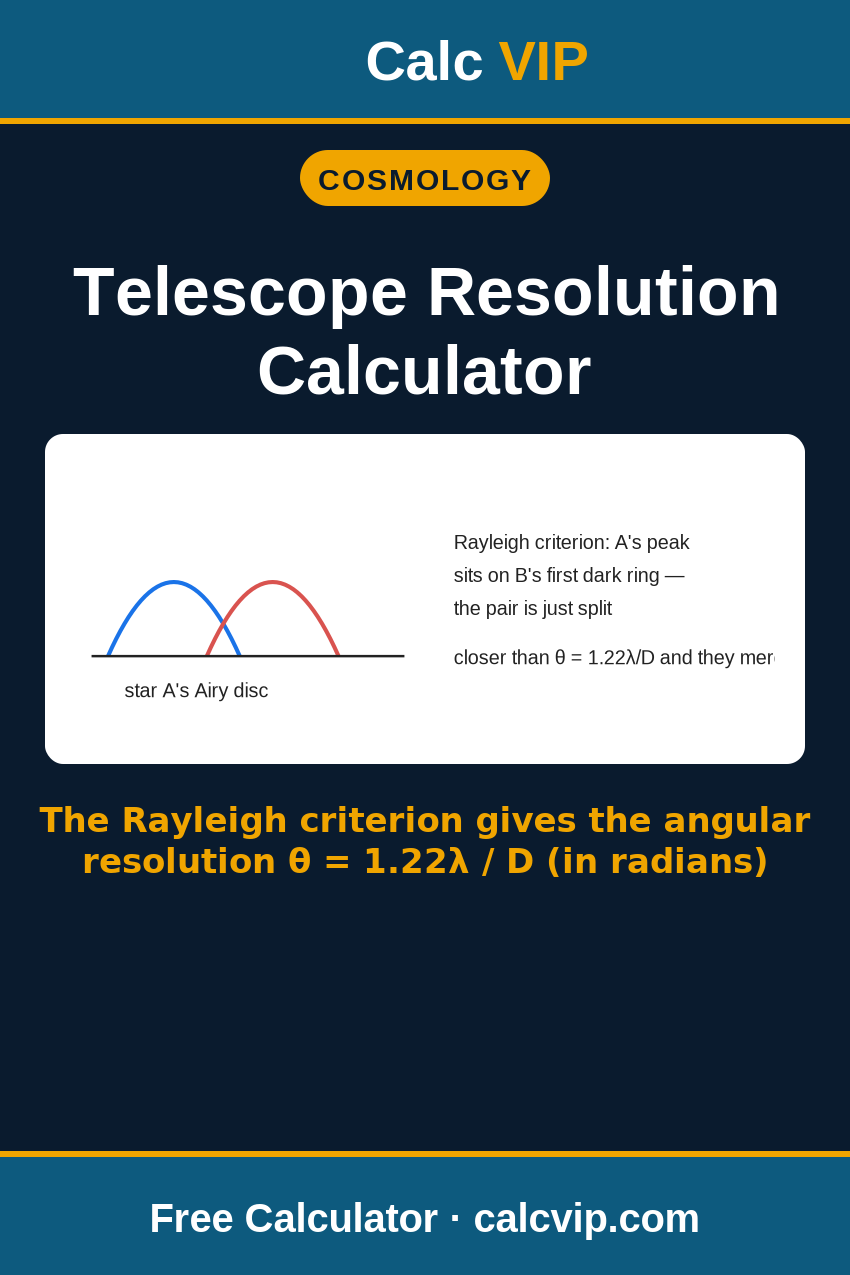
To make the numbers tangible: an angle of 1 arcsecond is the width of a small coin seen from about 4 km away, or the apparent size of a 1.3 km feature on the Moon. A good amateur telescope of 200 mm reaches 0.69 arcseconds; the Hubble Space Telescope, at 2.4 m and above the atmosphere, reaches 0.058. Your own eye, with a dark-adapted pupil of a few millimetres, manages only about 25 arcseconds by the same formula — the rest of our visual sharpness is clever neural processing on a fundamentally blurry signal.
Formula
The Rayleigh criterion gives the angular resolution θ = 1.22λ / D (in radians), where λ is the wavelength and D the aperture. For visual observing, the empirical Dawes limit is θ ≈ 116 / D(mm) arcseconds. One radian equals 206,265 arcseconds. In the calculator's units the working form is θ(arcsec) ≈ 0.252 × λ(nm) / D(mm), which at the standard 550 nm collapses to the pocket rule θ ≈ 138 / D(mm): a 100 mm telescope resolves about 1.4 arcseconds, and the figure scales inversely with aperture from there. Convert an angular resolution into a physical size at the target by multiplying by the distance: size = θ(radians) × distance.
| Symbol | Meaning | Units |
|---|---|---|
| θ | angular resolution — smallest separable angle | radians or arcseconds |
| λ | wavelength of the light | nm (entered), metres in the formula |
| D | aperture diameter | mm (entered), metres in the formula |
| 1 rad | = 206,265 arcseconds — the conversion this page uses | arcseconds |
The atmosphere: why the formula is a promise the sky rarely keeps
Rayleigh's limit assumes perfectly still, transparent air — or none. From the ground, turbulence ruins the bargain. Cells of warm and cool air drifting overhead bend starlight erratically, smearing each star's disc into a dancing blob typically 1 to 3 arcseconds across: the "seeing". On an average night a 400 mm telescope and a 100 mm telescope deliver nearly the same resolution, because both are limited by the atmosphere, not by diffraction. Only on exceptional nights, at exceptional sites, does a large ground telescope approach its formula value, and then only in moments — which is why "lucky imaging" takes thousands of short exposures and keeps the sharpest few percent.
Astronomy's escapes from seeing define its modern history. Put the telescope above the atmosphere (Hubble, and now JWST) and the diffraction limit becomes real — Hubble's 0.058 arcseconds is delivered routinely. Or fight the turbulence directly: adaptive optics measures the distortion hundreds of times per second with a laser guide star and bends a deformable mirror to cancel it, restoring near-diffraction images from the ground in the infrared. Or cheat the aperture itself: interferometers combine light from separated telescopes so the resolution is set by the separation, not the mirror size — the Event Horizon Telescope synthesised an Earth-sized aperture to image a black hole's shadow. Each strategy is a way of honouring θ = 1.22λ/D while changing what D is allowed to mean.
How to use
- Enter the wavelength in nanometres (550 nm is the middle of visible light and is pre-filled).
- Enter the telescope's aperture in millimetres.
- Click "Calculate Resolution" to get the diffraction limit and the Dawes limit, both in arcseconds.
- To turn the angle into a feature size, multiply θ in radians by the object's distance: the calculator's radian figure for a 200 mm scope, times the Moon's distance, gives lunar detail of about 1.3 km.
Worked examples
Example 1 — a 200 mm amateur telescope. For green light, λ = 550 nm, and a 200 mm telescope:
θ = 1.22 × 550 × 10⁻⁹ / 0.200 = 3.36 × 10⁻⁶ rad = 0.69 arcseconds
Dawes limit = 116 / 200 = 0.58 arcseconds — so this telescope can just split double stars about 0.6–0.7 arcseconds apart.
Example 2 — your own eye. Take the dark-adapted pupil as D = 5 mm at 550 nm.
θ = 1.22 × 550 × 10⁻⁹ / 0.005 = 1.34 × 10⁻⁴ rad = 27.7 arcseconds, with a Dawes figure of 116 / 5 = 23.2 arcseconds. Real eyes test nearer a minute of arc because of lens imperfections — the formula gives the diffraction floor beneath biology.
Example 3 — the Hubble Space Telescope. D = 2.4 m = 2,400 mm.
θ = 1.22 × 550 × 10⁻⁹ / 2.4 = 2.80 × 10⁻⁷ rad = 0.058 arcseconds — twelve times finer than the 200 mm amateur scope, and delivered every clear orbit because no atmosphere intervenes. This, more than light grasp, is what a space telescope buys.
Example 4 — a beginner's 80 mm refractor. θ = 1.22 × 550 × 10⁻⁹ / 0.080 = 8.39 × 10⁻⁶ rad = 1.73 arcseconds; Dawes = 116 / 80 = 1.45 arcseconds. Plenty for the Moon's craters, Saturn's rings and the brighter double stars — and on most nights the seeing, not the 80 mm of glass, is the real limit anyway.
Example 5 — why radio telescopes are enormous. The 21 cm hydrogen line observed with a 305 m dish (Arecibo's size):
θ = 1.22 × 0.21 / 305 = 8.4 × 10⁻⁴ rad = 173 arcseconds — nearly 3 arcminutes, hundreds of times coarser than a pocket telescope in visible light, despite a dish the size of a stadium. Radio wavelengths are ~400,000 times longer than light's, so radio astronomy answers with interferometry: arrays whose resolution is set by kilometres of separation.
Example 6 — specifying a telescope for a target. You want to split a double star 0.5 arcseconds apart. By Dawes: D = 116 / 0.5 = 232 mm. By Rayleigh at 550 nm: D = 1.22 × 550 × 10⁻⁹ ÷ (0.5 / 206,265) = 277 mm. Buy for the Rayleigh figure — about 280 mm of aperture — and the split is guaranteed by physics rather than eyesight optimism.
Resolution in real life
Double-star astronomy. Splitting close binary stars is the classic test of a telescope and a night's seeing; catalogues quote separations in arcseconds precisely so observers can check them against this formula before going out.
Planetary observing. Detail on Jupiter — festoons, shadow transits, the Great Red Spot's structure — lives at the 1-arcsecond scale. Aperture, via this formula, decides which features exist for you; that is why planetary observers prize large, well-cooled mirrors.
Lunar exploration from home. A 200 mm scope's 0.69″ corresponds to about 1.3 km on the Moon: craters down to a kilometre or so, rilles and the Apollo landing regions. The hardware itself, metres across, subtends about 0.002 arcseconds — Rayleigh's formula would demand a 65 m aperture — which is why the landers have only ever been photographed by a camera in lunar orbit.
Choosing a telescope to buy. Marketing shouts magnification; this formula whispers the truth. Compare apertures: the scope with the larger D resolves finer detail and gathers more light, and its useful magnification ceiling (roughly 2× per mm of aperture) follows from keeping the Airy disc matched to the eye.
Camera lenses and phones. The same physics caps lens sharpness: a phone camera's tiny aperture and sensor pixels are balanced against diffraction at around f/1.8. Stopping a lens down past about f/11 visibly softens images for exactly Rayleigh's reason.
Microscopes, in mirror image. The microscope's resolution formula is the same law with the geometry inverted (0.61λ/NA). The page's wavelength lesson — shorter λ, finer detail — is why electron microscopes exist: electrons' effective wavelength is picometres.
The Airy disc: what a star really looks like
Point a perfect telescope at a star and you do not see a point. You see the Airy pattern: a bright central disc holding about 84% of the light, ringed by progressively fainter rings. The disc's angular radius to the first dark ring is exactly the θ of this page. The pattern scales with λ/D, so it can be made visible deliberately — defocus slightly or stop the aperture down and the rings emerge. Understanding the disc dissolves several beginners' mysteries: why stars never look like the spikes of photographs (those are artifacts of support vanes), why two close stars first merge into a peanut shape before blending fully, and why "empty magnification" exists — enlarge the disc past the eye's own resolution and you have added size without information. Resolution is the disc's width; everything else is presentation.
Resolution across the spectrum
The formula's λ/D symmetry means every waveband fights the same battle at different scales. Infrared astronomers accept worse resolution per metre of aperture (λ is longer) in exchange for seeing through dust. Ultraviolet and X-ray telescopes win resolution per metre but face mirrors of nightmarish precision — Chandra's 1.2 m optics resolve 0.5 arcseconds at wavelengths a hundred thousand times shorter than light's, because grazing-incidence geometry wastes most of the aperture. At the extreme, gravitational-wave detectors and very-long-baseline interferometers push "aperture" to planetary size. The lesson generalises beyond telescopes: any imaging system built from waves — sonar, ultrasound, radar, the electron microscope — carries a version of θ ∝ λ/D, and engineering is the art of shrinking λ or growing D.
Resolution is not detection — and pixels get a vote
Two neighbouring ideas are easily confused with resolution. Detection is merely registering that something exists: a star far below the resolution limit still deposits its light in a single Airy disc and can be detected, measured and catalogued — it simply cannot be separated from a closer companion or shown to have structure. Most of the stars in any photograph are detected but unresolved. Sampling is the detector's side of the bargain: to record the detail the optics resolve, the Airy disc must span at least two pixels (the Nyquist rule), and camera systems are designed around that match. A telescope can thus be limited by its optics, its sensor, or its atmosphere on any given night — and the smallest of the three numbers is the resolution you actually got. When an image disappoints, this page's formula tells you the optics' ceiling; the diagnosis of which limit actually bit is the observer's craft.
There is also a contrast dimension the bare formula hides. Rayleigh's criterion assumes two equally bright points. A faint companion close to a brilliant star — a planet next to its sun, say — is lost not because the discs overlap geometrically but because the bright disc's rings drown the faint one entirely. Exoplanet imaging therefore attacks contrast (with coronagraphs that mask the star) as much as resolution, and its working metric, the inner working angle, is quoted in units of λ/D — this page's ratio, wearing a different hat.
Quick reference: resolution by aperture (at 550 nm)
| Aperture D | Rayleigh limit | Dawes limit |
|---|---|---|
| 5 mm (eye) | 27.7″ | 23.2″ |
| 50 mm (binoculars) | 2.77″ | 2.32″ |
| 80 mm | 1.73″ | 1.45″ |
| 100 mm | 1.38″ | 1.16″ |
| 200 mm | 0.69″ | 0.58″ |
| 355 mm (14-inch) | 0.39″ | 0.33″ |
| 2,400 mm (Hubble) | 0.058″ | 0.048″ |
Verify any row with the calculator — and remember that the ground-based rows are targets for the best nights only, while Hubble's row is routine.
Common mistakes
- Judging a telescope by magnification. Magnification is a property of the eyepiece you happen to insert, not of the telescope. Resolution and light grasp come from aperture alone; a "600×" toy scope with 60 mm of aperture resolves 2.3 arcseconds and no eyepiece changes that.
- Mixing up radians and arcseconds. The formula returns radians — millionths, for real telescopes. Forgetting the ×206,265 conversion makes a telescope look a quarter-million times worse (or better) than it is.
- Ignoring wavelength. Resolution at the red end (650 nm) is about 30% coarser than at 550 nm, and in the near-infrared (1,600 nm) nearly three times coarser. Comparing two telescopes' limits quoted at different wavelengths is meaningless.
- Expecting the limit on an average night. Seeing of 1–3 arcseconds caps most backyard observing. A disappointing split is usually the atmosphere's verdict, not the telescope's — try again on a still night before blaming the optics.
- Forgetting the central obstruction and optics quality. The formula assumes a perfect, unobstructed aperture. Real reflectors lose a little contrast to their secondary mirrors, and poor figure or collimation can waste the theoretical limit entirely.
FAQ
Why does a bigger aperture see finer detail?
Diffraction spreads each star's image into a disc whose size shrinks as the aperture grows (θ ∝ 1/D). More aperture means smaller discs, so closer stars can be separated.
Can magnification beat the diffraction limit?
No. Magnifying a blurred image only makes the blur bigger. Past the diffraction limit there is no extra detail to reveal.
Why do ground telescopes rarely reach this limit?
Atmospheric turbulence ("seeing") usually blurs images to about 1 arcsecond or worse, unless adaptive optics are used.
What is an arcsecond in everyday terms?
One 3,600th of a degree — the apparent width of a 2 cm coin from about 4 km away, or of a human hair seen from about 20 m. The full Moon spans about 1,800 arcseconds; Jupiter about 40.
What resolution do I need for the planets?
About 1 arcsecond reveals the main Jovian belts, Saturn's Cassini Division and Mars's polar cap in season. That argues for 140 mm or more of aperture — and a night of good seeing to let it perform.
Does a Barlow lens or better eyepiece improve resolution?
No. They change magnification and comfort only. Resolution is fixed by aperture and wavelength before the light ever reaches the eyepiece — though adequate magnification (roughly 1–2× per mm of aperture) is needed for your eye to perceive the detail the aperture resolved.
Why is the Dawes limit smaller than Rayleigh's?
They define "split" differently. Rayleigh requires a clear dip between the two discs; Dawes, from long double-star experience, credits the eye with detecting a notched, elongated image as two stars. Dawes is the optimistic observer's criterion, Rayleigh the conservative physicist's.
How does JWST compare with Hubble?
JWST's aperture is 6.5 m against Hubble's 2.4 m, but it observes in the infrared where λ is several times longer. At 2 µm JWST resolves about 0.077 arcseconds — similar to Hubble in visible light. Bigger mirror, longer waves: the ratio λ/D is what counts.
Can software beat the diffraction limit?
Partly. Deconvolution and lucky imaging recover detail near the limit and can slightly better it for high-contrast targets, and interferometry sidesteps it by enlarging the effective aperture. But information truly absent from the wavefront cannot be invented — super-resolution has hard floors.
What limits a camera's resolution: pixels or diffraction?
Whichever is coarser. Sensors are designed so the Airy disc spans about two pixels; beyond that, extra megapixels record blur at higher fidelity. The formula on this page tells you when a lens — telescope or phone — has become the bottleneck.