Calc
Kinematic Viscosity Calculator – ν = η/ρ in m²/s, cSt & Stokes
 Created by Elena Petrova · Physics Editor · Fluids & Rotation · Last updated: November 2026
Use this free Kinematic Viscosity Calculator to convert a fluid's dynamic viscosity into its kinematic viscosity. Enter the dynamic viscosity η and the fluid density ρ — the calculator divides η by ρ and shows the result in m²/s, centistokes (cSt) and stokes (St).
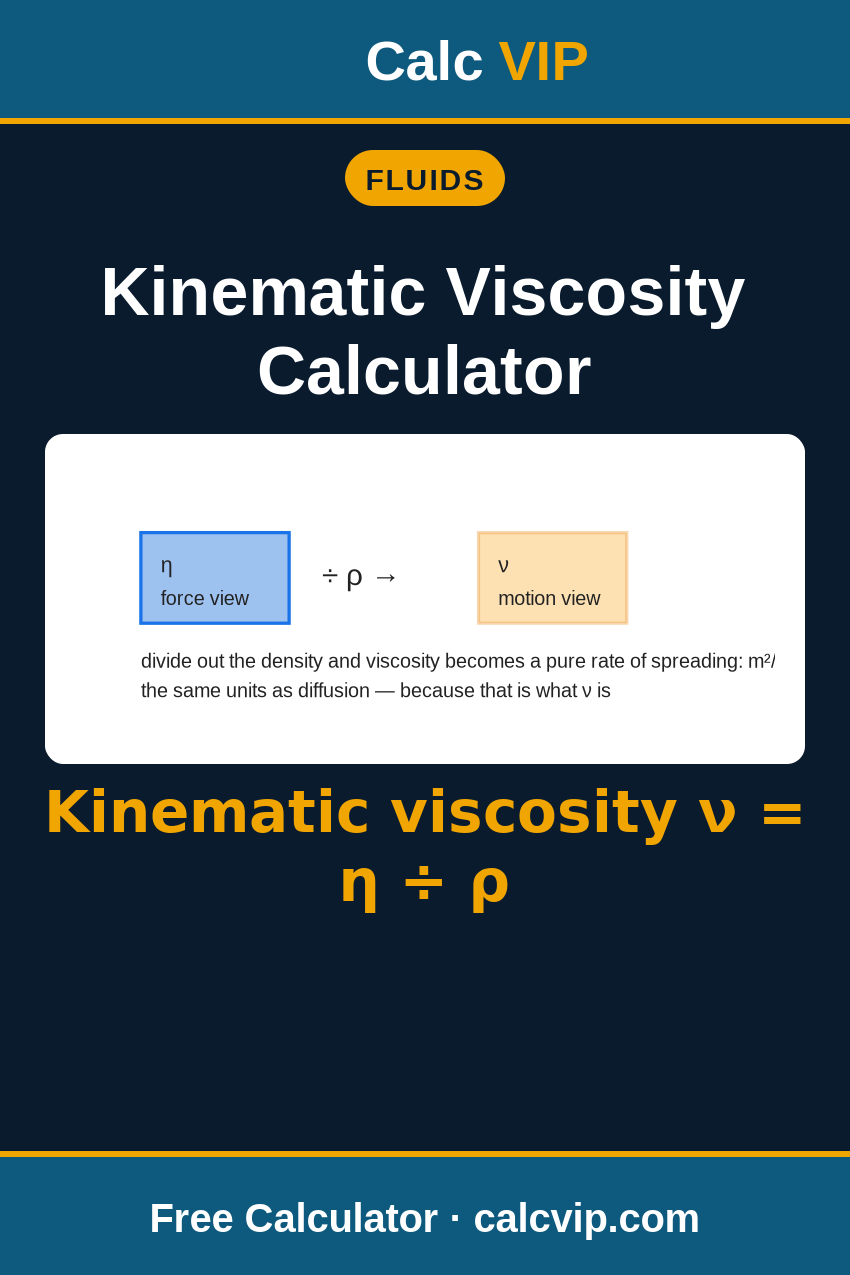
Every fluid carries two viscosities, and they answer different questions. The dynamic viscosity η asks: how much force does it take to shear this fluid? The kinematic viscosity ν asks a subtler question: how fast does motion — momentum — spread through this fluid under its own weight? Dividing η by the density ρ strips the mass out of the measurement, and what remains has units of pure length and time: square metres per second, the same units as a diffusion coefficient. That is no coincidence. Kinematic viscosity is a diffusion coefficient — the one for momentum — and it governs every flow where gravity, rather than a pump, does the pushing: draining tanks, pouring liquids, spreading puddles, oil seeping through soil.
The division by density produces genuine surprises. Air feels immeasurably thinner than water, and by dynamic viscosity it is, 55 times over. But air is also 816 times less dense, and the division more than compensates: the kinematic viscosity of air is about 14.8 × 10⁻⁶ m²/s, nearly fifteen times greater than water's 1 × 10⁻⁶ m²/s. Momentum diffuses through air faster than through water. This is why ν, not η, appears in the Reynolds number and in the design of everything from wind tunnels to oil drains — whenever a fluid moves because it was released rather than forced, ν is the viscosity that decides how it behaves.
The practical home of kinematic viscosity is the oil industry, where fluids are graded, bought and sold in centistokes: a "ISO VG 46" hydraulic oil is one whose ν is 46 cSt at 40 °C, and engine oils carry their SAE grades from cSt measurements at 100 °C. The unit names honour George Stokes, whose law of falling spheres underlies the oldest measurement method. This calculator performs the one division at the heart of all of it, and reports the answer in the three units the field actually uses.
Formula
Kinematic viscosity ν = η ÷ ρ • ν in m²/s, η in Pa·s, ρ in kg/m³
The relation rearranges both ways: η = ν × ρ recovers the dynamic viscosity when you need a force or a stress, and ρ = η ÷ ν finds the density implied by a pair of viscosity measurements — a trick used to check the identity of oils. The unit conversions the calculator applies are exact: 1 St = 10⁻⁴ m²/s and 1 cSt = 10⁻⁶ m²/s, with the happy coincidence that 1 cSt is exactly 1 mm²/s, the unit printed on most oil datasheets. Because ν is η with the density divided out, two fluids with identical dynamic viscosities but different densities have different kinematic viscosities — the lighter one has the larger ν and spreads its momentum faster, volume for volume.
| Symbol | Meaning | Units |
|---|---|---|
| ν | kinematic viscosity — momentum diffusivity | m²/s (also cSt, St) |
| η | dynamic (absolute) viscosity | Pa·s |
| ρ | fluid density | kg/m³ |
Why ν runs the show: the Reynolds number
The single most important formula in fluid mechanics is the Reynolds number, Re = v × L ÷ ν, and ν sits in its denominator. Re compares the flow's inertia with its internal friction and predicts the flow's whole character: below roughly 2,300 in a pipe the flow is laminar — smooth, layered, predictable — and above roughly 4,000 it is turbulent, with eddies multiplying the drag. Because ν is in the denominator, a fluid with ten times the kinematic viscosity flows ten times "slower" in Reynolds terms at the same speed and size. Worked through for a 0.1 m pipe carrying fluid at 1 m/s: water (ν = 1 × 10⁻⁶) gives Re = 100,000, deep in turbulence; an oil of ν = 100 cSt (100 × 10⁻⁶) gives Re = 1,000, calmly laminar. Same pipe, same speed, utterly different flows — decided entirely by the number this calculator produces.
There is a second, quieter role. Because ν has the units of a diffusivity, it sets timescales: a disturbance in a layer of thickness L smooths itself out in a time of order L²/ν. A 1 mm film of water forgets a disturbance in about (0.001)² ÷ 10⁻⁶ = 1 second; the same film of a 1,000 cSt oil takes a thousand seconds. Lubrication films, boundary layers on wings and the slow creep of spilled oil across a floor are all this timescale at work.
How to use
- Enter the dynamic viscosity η in Pa·s (convert from centipoise first if needed: η in Pa·s = cP ÷ 1000).
- Enter the fluid density ρ in kg/m³ — water 1000, most oils 850–950, air 1.225 at sea level.
- Click "Calculate" to see ν in m²/s, centistokes (cSt) and stokes (St).
- Benchmark against water: η = 0.001 Pa·s and ρ = 1000 kg/m³ must return ν = 0.000001 m²/s = 1 cSt. If it does not, a prefix has slipped in η.
Worked examples
Example 1 — a typical oil. An oil with η = 0.09 Pa·s and density 900 kg/m³:
ν = 0.09 ÷ 900 = 0.0001 m²/s = 100 cSt = 1 St — a medium machinery oil, and a clean illustration that 100 cSt and 1 St are the same thing.
Example 2 — water, the reference. η = 0.001 Pa·s, ρ = 1000 kg/m³: ν = 0.001 ÷ 1000 = 0.000001 m²/s = 1 cSt. Nearly every viscometer on Earth is calibrated so that water lands on this round number.
Example 3 — the air surprise. Air: η = 0.0000181 Pa·s, ρ = 1.225 kg/m³: ν = 0.0000181 ÷ 1.225 = 0.0000148 m²/s ≈ 14.8 cSt. The "thin" fluid has fifteen times water's kinematic viscosity — the fact that shapes wind-tunnel scaling, where models are tested in water precisely because its low ν reaches flight Reynolds numbers in a small tunnel.
Example 4 — engine oil. A warm engine oil, η = 0.25 Pa·s, ρ = 870 kg/m³: ν = 0.25 ÷ 870 = 0.000287 m²/s ≈ 287 cSt. Oils are specified this way — an SAE 30 oil is defined by a ν window at 100 °C, not by any force measurement.
Example 5 — glycerin. η = 1.41 Pa·s, ρ = 1260 kg/m³: ν = 1.41 ÷ 1260 = 0.00112 m²/s ≈ 1,119 cSt ≈ 11.2 St. Despite being denser than water, glycerin's enormous η dominates the division.
Example 6 — honey. η = 10 Pa·s, ρ = 1400 kg/m³: ν = 10 ÷ 1400 = 0.00714 m²/s ≈ 7,143 cSt. Seven thousand times water's ν is why a spilled spoonful of honey spreads so reluctantly: momentum — and the puddle — diffuse seven thousand times more slowly.
Kinematic viscosity in real life
Oil grading and buying. Hydraulic oils (ISO VG grades), gear oils and engine oils are all specified by ν in cSt at standard temperatures. Choosing a replacement oil is, in practice, matching the number this calculator gives.
Fuel injection. Diesel and jet fuel must atomise into a fine spray; their ν is held in a narrow band (jet fuel around 1–2 cSt at working temperature) because too-viscous fuel makes coarse droplets and poor combustion.
Draining and pouring. How fast a tank empties, a paint levels or a sauce coats is a gravity flow, and gravity flows run on ν: the same division that makes air's ν large makes a light, syrupy fluid drain faster than a dense thin one in some pairings.
Wind tunnels and towing tanks. Scale-model testing matches Reynolds numbers, and since Re = vL/ν, the fluid's ν sets the speed and size needed — the reason ship models are towed in water and some aircraft tests use pressurised or cryogenic tunnels to shrink ν's effect.
Environmental spills. The spreading rate of an oil slick on water is governed by the oil's ν; response teams estimate slick growth from tabulated cSt values before they ever reach the scene.
Hydraulic system design. Pump suction, valve response and leakage all depend on ν; systems are designed for a working window (often 15–100 cSt), and cold-start problems are usually the oil's ν climbing out of that window overnight.
How ν is measured: the draining-tube viscometer
The standard instrument for ν could hardly be simpler: a U-shaped glass capillary tube in a temperature bath. A fixed volume of fluid is drawn up and timed as it drains through the capillary under gravity alone; the efflux time, multiplied by a constant stamped on the tube, is ν in cSt. Notice what the instrument never does — it never measures a force. Because gravity drives the flow and gravity acts through the density, the density cancels into the result and the tube reads kinematic viscosity directly. This is why laboratories report ν from glass viscometers and η from rotational instruments, and why the conversion on this page — one division by ρ — is performed thousands of times a day in oil labs worldwide.
The paint shop runs a pocket version of the same instrument: the efflux cup (Ford or Zahn cup) is a small cup with a standard hole in its base, filled and timed as it drains. The seconds it empties in are converted to cSt by a chart — crude beside a laboratory viscometer, but the physics is identical, and a coater's whole quality system hangs on those seconds.
Quick reference: kinematic viscosity of common fluids at 20 °C
| Fluid | ν (m²/s) | ν (cSt) |
|---|---|---|
| water | 0.000001 | 1 |
| air | 0.0000148 | 14.8 |
| blood | 0.0000033 | 3.3 |
| light machinery oil | 0.0001 | 100 |
| engine oil (warm) | 0.000287 | 287 |
| glycerin | 0.00112 | 1,119 |
| honey | 0.00714 | 7,143 |
Blood's entry deserves a glance: its η is 3.5 times water's, but because blood is also denser (ρ ≈ 1060 kg/m³), its ν is only 3.3 times water's — the density division quietly at work.
The viscosity index: why oils are quoted at two temperatures
A single ν is a photograph; engineers need the film. Because ν plunges as oil warms, the industry quotes it at two standard temperatures — 40 °C and 100 °C — and scores the pair with a viscosity index (VI): a high-VI oil (150+) thins reluctantly, a low-VI oil (near 0) thins fast. The practical stakes show up in any hydraulic machine that starts cold outdoors and works hot indoors: its oil might be 1,000 cSt at dawn (too thick to suck into the pump), 46 cSt at working temperature (the design point), and the whole warm-up is a journey down the ν curve. Multigrade engine oils exist to flatten exactly this curve with polymer additives. Whenever you use this calculator for an oil, the honest question is never "what is its ν?" but "what is its ν at the temperature it will actually meet?" — and if the answer matters, measure or look up both standard temperatures, not one.
A last worked sanity check ties ν back to flow regime. Take Example 4's warm engine oil (ν = 287 cSt = 0.000287 m²/s) creeping through a 0.05 m gallery at 0.5 m/s: Re = vL/ν = 0.5 × 0.05 ÷ 0.000287 ≈ 87 — profoundly laminar, more than twenty times below the transition. Oil in engines essentially never turbulates; water in pipes essentially never stays laminar. That single contrast, computed from this page's one division, explains half the difference between lubrication engineering and water engineering.
One more fluid: diesel, and the injector's demand
Close with the fluid whose ν quietly runs the freight world. Diesel fuel at working temperature has η ≈ 0.003 Pa·s and ρ ≈ 840 kg/m³, so ν = 0.003 ÷ 840 = 0.0000036 m²/s ≈ 3.6 cSt — barely three and a half times water. That thinness is a design requirement wearing a disguise: injector pumps and micron-scale nozzle holes can only meter and atomise a fuel whose momentum diffuses fast and whose flow responds instantly. Let the same fuel cool towards its cloud point and ν climbs steeply as wax crystals form; filters plug, injectors starve, and trucks stop — the winter diesel failure that fuel standards exist to prevent. Three numbers from one division — η, ρ, ν — and a supply chain hangs on the third.
Salt water offers a last calibration of intuition. Sea water is slightly more viscous than fresh (η ≈ 0.00108 Pa·s) and slightly denser (ρ = 1,025 kg/m³), and the two changes nearly cancel in the division: ν = 0.00108 ÷ 1025 ≈ 1.05 cSt, within 5% of fresh water's 1 cSt. Ocean currents, ship hydrodynamics and desalination plants therefore borrow fresh-water Reynolds numbers with a clear conscience — a small mercy, earned by checking the division rather than assuming it.
Common mistakes
- Entering η in centipoise without converting. The calculator wants Pa·s. 100 cP is 0.1 Pa·s; typing "100" inflates ν a thousandfold.
- Botching the cSt conversion. 1 cSt = 10⁻⁶ m²/s and 1 St = 10⁻⁴ m²/s — the two units differ by a factor of 100, and swapping them is the classic error. Remember: cSt = mm²/s.
- Assuming the "thinner-feeling" fluid has the smaller ν. Air feels thinner than water but has nearly 15× its kinematic viscosity. Feel tracks η; gravity-driven behaviour tracks ν.
- Using ν where a stress is needed. Forces, torques and pressure drops for forced flow need η. ν alone cannot give a force — multiply back by ρ first (η = νρ).
- Ignoring temperature. An oil's ν can change tenfold between a cold morning and operating temperature, and oil grades are defined at 40 °C and 100 °C exactly because of it. A ν without a temperature is an incomplete specification.
FAQ
Why is it called "kinematic" viscosity?
Because its units (m²/s) involve only length and time — the units of kinematics — with no mass or force. It measures how fast momentum spreads through the fluid, so it controls gravity-driven flows like draining and pouring.
What is the kinematic viscosity of water?
About 1 cSt (1 × 10⁻⁶ m²/s) at 20 °C: η ≈ 0.001 Pa·s divided by ρ = 1000 kg/m³. This makes water a handy reference point.
How do I convert cSt to m²/s?
Multiply by 10⁻⁶: 100 cSt = 100 × 10⁻⁶ = 0.0001 m²/s. To convert stokes to m²/s, multiply by 10⁻⁴.
Why is air's kinematic viscosity higher than water's?
Because ν divides by density. Air's η is 55 times smaller than water's, but its density is 816 times smaller, so the quotient comes out about 15 times larger. Momentum diffuses faster through air than through water.
Where does the Reynolds number use ν?
In its denominator: Re = vL/ν. A large ν (thick, momentum-diffusing fluid) keeps Re low and the flow laminar; water's small ν is why everyday water flows are almost always turbulent.
What does mm²/s mean on an oil bottle?
Exactly centistokes: 1 mm²/s = 1 cSt = 10⁻⁶ m²/s. Oil standards bodies prefer mm²/s because it is a pure SI unit; the numbers are identical.
How is kinematic viscosity measured?
Usually with a glass capillary viscometer: time how long a fixed volume takes to drain through a fine tube under gravity, and multiply by the tube's constant. No force is measured — which is precisely why the result is ν and not η.
Does ν change with pressure?
Very little for liquids. For gases, η is nearly independent of pressure while ρ is proportional to it, so a gas's ν falls as pressure rises — at altitude, air's ν is several times its sea-level value, one reason high-flying aircraft live in a different flow regime.
Can two fluids share the same ν but feel different?
Yes. A dense, moderately viscous fluid and a light, slightly viscous one can have equal ν; they will drain alike but exert different forces in a pump or bearing, because their η values differ. ν governs motion patterns, η governs forces.
What kinematic viscosity do hydraulic systems want?
Most are designed for roughly 15–100 cSt at operating temperature. Much below that, leakage and wear climb; much above it, pumps cavitate on the suction side and response turns sluggish — which is why cold starts on thick oil are a design case, not an afterthought.