 Calc
Hydrostatic Pressure Calculator – Pressure at Depth ρgh
 Created by Elena Petrova · Physics Editor · Fluids & Rotation · Last updated: November 2026
Use this free Hydrostatic Pressure Calculator to find the pressure a liquid creates at a given depth. Enter the liquid's density and the depth below the surface — the calculator gives the gauge pressure, and optionally the absolute pressure including the air pressing on the surface.
Hydrostatic pressure is the pressure exerted by a fluid that is standing still — "hydro" for the fluid, "static" for the stillness. It exists because gravity pulls every layer of liquid down onto the layers beneath it: at any depth, the liquid above weighs down on the liquid below, and that squeezing is felt as pressure pushing in every direction at once. It is the pressure a diver's ears feel, the load a dam wall must hold back, and the force that makes a deep submarine hull groan. This calculator turns one depth and one density into that pressure.
The formula behind it is almost suspiciously simple: pressure equals density times gravity times depth, P = ρgh. Nothing else enters. Not the volume of the lake, not the width of the tank, not the shape of the vessel — a metre down in a narrow pipe and a metre down in the open ocean, the pressures in the same liquid are identical. This independence from shape is famous enough to have a name, the hydrostatic paradox, and it surprises nearly everyone the first time they meet it: what matters is only how much liquid stands above the point, stacked in a column, not how much spreads out sideways.
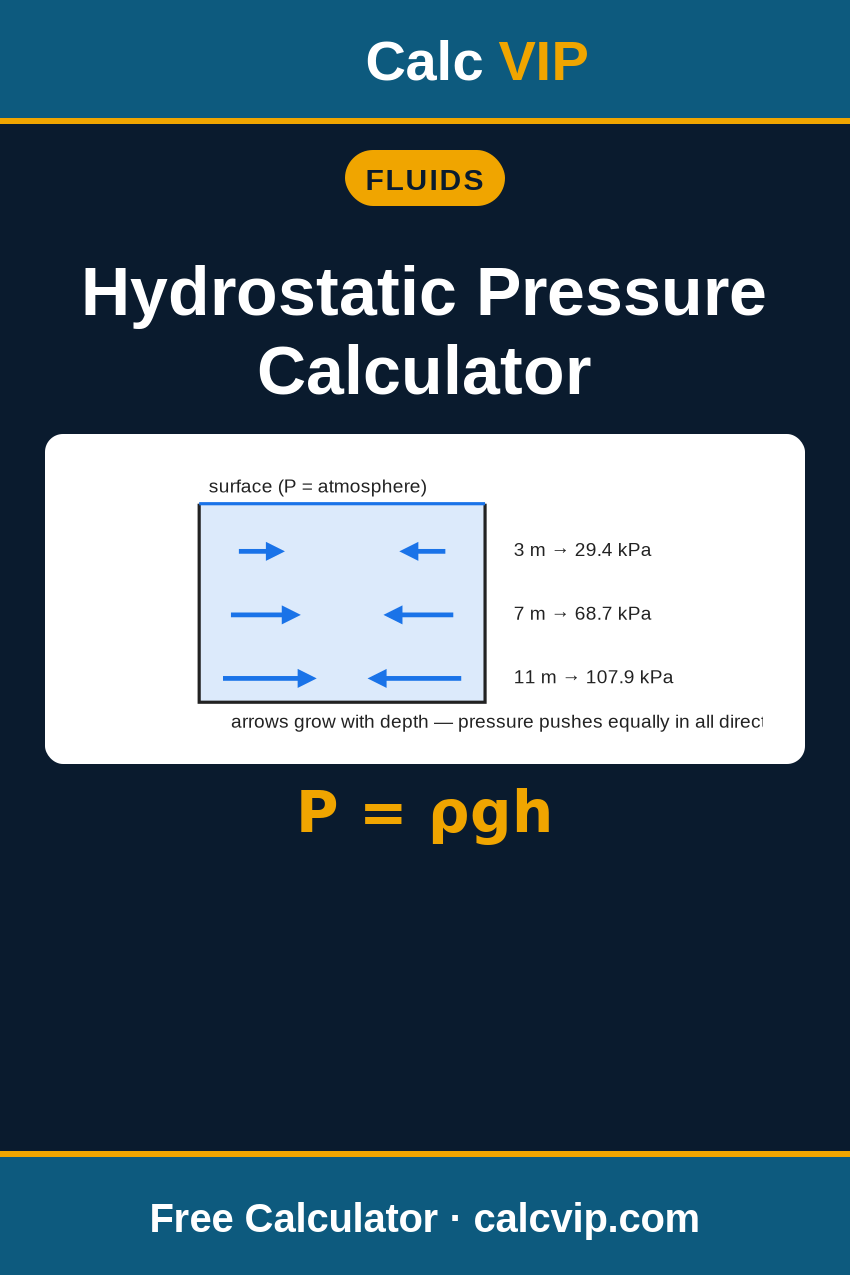
Because the relationship is a straight line, depth is easy to reason about once you have one anchor number: in fresh water, every 10 metres of depth adds about 98 kPa — very nearly one extra atmosphere. Divers plan around that rhythm, engineers sizing a dam integrate the same line from surface to base, and doctors measuring blood pressure are quietly correcting for it whenever a cuff sits above or below heart level. Enter a density and a depth above and you will get both the gauge pressure (the liquid alone) and, if you tick the box, the absolute pressure with the atmosphere's contribution added on top.
Formula
Hydrostatic pressure = ρ × g × h → P = ρgh
The same equation rearranges to answer the other two questions it is usually asked. Want the depth that produces a given pressure? h = P ÷ (ρg). Want the density of an unknown liquid from a pressure reading? ρ = P ÷ (gh). The result of ρgh alone is the gauge pressure — the pressure due to the liquid itself. The absolute pressure adds the atmosphere pressing on the surface: Pabs = ρgh + Patm, with Patm = 101,325 Pa at sea level. Throughout, g = 9.81 m/s². Keep the units disciplined — density in kg/m³, depth in metres — and the pressure emerges in pascals (Pa), with 1 kPa = 1,000 Pa and 1 bar = 100,000 Pa.
| Symbol | Meaning | Units |
|---|---|---|
| P | hydrostatic (gauge) pressure at the depth | pascal (Pa) |
| ρ | density of the liquid | kg/m³ |
| g | gravitational field strength, 9.81 | m/s² |
| h | depth below the liquid's surface | m |
| Patm | atmospheric pressure on the surface | Pa (101,325 at sea level) |
Why pressure grows in a dead-straight line with depth
Imagine a vertical column of liquid with a cross-section of exactly one square metre, standing on the point you care about. The pressure at that point is simply the weight of that column divided by its base area — and since each additional metre of height adds the same volume, and therefore the same weight, of liquid, each metre adds the same pressure: ρg pascals per metre, 9,810 Pa per metre for water. Nothing accumulates or fades; the line from the surface downwards is perfectly straight, doubling depth exactly doubles pressure. This is also why the formula has no term for the container: widen the vessel and you add more columns side by side, but the column standing over your point is unchanged.
The second deep fact is that this pressure pushes equally in all directions — up, down and sideways. A liquid cannot sustain a sideways shove the way a solid can, so any imbalance instantly flows away until the push is the same every way at that depth. That is why the pressure at the bottom of a dam pushes horizontally into the wall just as hard as it pushes down into the foundation, and why a diver's whole body, not just the top of the head, feels the squeeze. It is also the still-fluid root of Pascal's law, which the Pascal's Law Calculator elsewhere on this page explores for confined fluids in machines.
How to use
- Pick a fluid from the list (water, seawater, mercury, olive oil) or choose "Custom density" and type your own density in kg/m³.
- Enter the depth below the liquid surface in metres — measured from the surface down to the point you care about, not from the bottom up.
- Tick the box if you also want the absolute pressure, which adds the atmosphere's 101,325 Pa to the liquid's own pressure.
- Click "Calculate Pressure" to see the gauge pressure in pascals and kilopascals, plus the absolute pressure if you asked for it.
Worked examples
Example 1 — ten metres down in fresh water. At a depth of 10 m in water (ρ = 1000 kg/m³): P = 1000 × 9.81 × 10 = 98,100 Pa = 98.1 kPa. Including the atmosphere: 98,100 + 101,325 = 199,425 Pa (about 199.4 kPa) — roughly double the pressure at the surface.
Example 2 — a diver at 20 m in the sea. Seawater is slightly denser (ρ = 1025 kg/m³): P = 1025 × 9.81 × 20 = 201,105 Pa ≈ 201.1 kPa of gauge pressure, and 201,105 + 101,325 = 302,430 Pa absolute — three atmospheres in total squeezing the diver's body and compressing the air in the tank regulator's demand valve.
Example 3 — the deep end of a swimming pool. At 3 m: P = 1000 × 9.81 × 3 = 29,430 Pa ≈ 29.4 kPa, about 0.29 of an atmosphere extra. Modest — yet already enough to make untrained ears ache on the pool floor, and enough that pool walls and liners must be built for tonnes of sideways force over their whole area.
Example 4 — the bottom of the Mariana Trench. At 10,935 m in seawater: P = 1025 × 9.81 × 10,935 ≈ 109,954,000 Pa — about 110 MPa, or roughly 1,085 atmospheres. Only specially built submersibles with thick spherical titanium cabins survive here; a regular submarine hull rated for a few hundred metres would be crushed flat in seconds.
Example 5 — why barometers are filled with mercury. Rearranged, h = P ÷ (ρg) = 101,325 ÷ (13,600 × 9.81) = 0.7595 m ≈ 760 mm. Atmospheric pressure supports a mercury column just 76 cm tall — a handy desk instrument. The same pressure in water would need a column 10.33 m tall, taller than a three-storey house, which is why nobody makes water barometers.
Example 6 — olive oil in a storage tank. At 0.5 m depth in olive oil (ρ = 910 kg/m³): P = 910 × 9.81 × 0.5 = 4,463.6 Pa ≈ 4.46 kPa. Slightly less than water at the same depth, because the oil is slightly less dense — the formula's ρ is doing exactly the work you would expect.
Hydrostatic pressure in real life
Scuba diving. The diver's rule of thumb — one extra atmosphere for every 10 m — is ρgh in disguise (10.08 m of seawater makes exactly one atmosphere). It governs how fast air is consumed, how nitrogen dissolves in blood, and why ascent must be slow: the pressure halving in the last 10 m is the most dangerous stretch of the whole dive.
Dam engineering. Behind a dam 50 m deep, the base pressure is 1000 × 9.81 × 50 = 490,500 Pa — 4.84 atmospheres pushing sideways. Because pressure grows linearly from zero at the surface, the total load diagram is a triangle, fattest at the bottom — which is exactly the profile of a gravity dam: thin at the top, massively thick at the base.
Water towers and plumbing. A town's water pressure is bought with height, not pumps: a tank 10 m above your tap adds 98.1 kPa, roughly one bar. Raise it 30 m and you get about three bar at the tap — the reason water towers are tall and rooftop tanks in many cities sit as high as the building allows.
Medicine. An IV drip bag is hung about a metre above the patient because ρgh from that metre of height is what pushes fluid into the vein against the blood's own pressure. And a blood-pressure cuff placed 10 cm below heart level reads about 1.04 kPa (roughly 7.8 mmHg) too high, purely from the column of blood between the two heights — nurses are trained to keep the cuff level with the heart for exactly this reason.
Submarines and submersibles. Hull designers work directly from ρgh: a submarine operating at 300 m in seawater faces about 3 MPa of gauge pressure, thirty atmospheres trying to implode it. Test depth, crush depth and the spherical shape of deep submersible cabins all start from this one multiplication.
Weather instruments. Every barometer is a hydrostatic instrument: it balances the atmosphere against a liquid column (Example 5). Falling pressure means a shorter supported column — the mercury drops — and centuries of weather lore about "the glass falling" before a storm are readings of P = ρgh at work.
The hydrostatic paradox, and Pascal's bursting barrel
Connect several vessels of wildly different shapes to the same base and fill them with one liquid: the free surfaces all settle at exactly the same height, and the pressure at the shared base is identical in every branch — even though one branch may hold ten times the weight of water of another. The resolution is that in a vessel that narrows upwards, the sloping walls push down on the liquid (and the liquid pushes up on them), making up the "missing" weight; in a vessel that flares out, the walls carry part of the load. Only the vertical column counts. Blaise Pascal reportedly dramatised this in 1646 by fitting a long, thin tube to a sealed, water-filled barrel and pouring in a single jug of water: the tall thin column — perhaps a kilogram of water — generated enough pressure at barrel depth to burst the staves apart. A kilogram of water, arranged vertically, out-muscled the barrel.
Quick reference: pressure with depth in fresh water
| Depth | Gauge pressure | Absolute pressure |
|---|---|---|
| 1 m | 9.81 kPa | ≈ 1.10 atm |
| 5 m | 49.05 kPa | ≈ 1.48 atm |
| 10 m | 98.1 kPa | ≈ 1.97 atm |
| 20 m | 196.2 kPa | ≈ 2.94 atm |
| 50 m | 490.5 kPa | ≈ 5.84 atm |
| 100 m | 981 kPa | ≈ 10.68 atm |
Read the table as a rhythm: roughly one atmosphere of absolute pressure at the surface, then one more for every 10 m you descend. Seawater's rhythm is a touch quicker (an atmosphere per 10.08 m) because of its extra 25 kg/m³ of dissolved salt.
From pressure to force: the load a surface actually carries
Pressure is not itself a force — it becomes one when multiplied by the area it acts on, F = P × A, and the multiplication is where hydrostatic numbers turn serious. Consider a submarine hatch of area 0.5 m² at 300 m in seawater: the gauge pressure there is 1025 × 9.81 × 300 = 3,016,575 Pa, so the sea leans on the hatch with F = 3,016,575 × 0.5 ≈ 1,508,288 N — the weight of about 154 tonnes, on a door the size of a tea tray. This is why deep hatches open inward or are dogged down with massive fittings, and why a rescue at such depth cannot simply "open the door".
For a vertical surface like a dam wall the pressure varies with depth, so the total force uses the average pressure — the value at the wall's mid-depth. Behind 50 m of fresh water, the average pressure is ρg × 25 = 245,250 Pa, and over a wall 50 m tall the load is 245,250 × 50 ≈ 12,262,500 N per metre of wall width — over twelve meganewtons trying to push every metre of the dam downstream, applied at a third of the depth from the base, where the triangular pressure distribution concentrates it. Dam profiles, lock gates and aquarium windows are all sized by this pressure-times-area step, which is why a great tank at an aquarium can hold back an ocean's worth of menace with glass only centimetres thick — provided the area of each pane keeps the product within the material's strength.
Common mistakes
- Measuring depth from the bottom. h is measured from the free surface downwards. A point 2 m above the floor of a 10 m tank is at h = 8 m, not 2 m.
- Letting the container's size sneak in. A bigger tank does not mean bigger pressure at the same depth. If your answer used the tank's volume or width, it used a quantity the physics ignores.
- Mixing gauge and absolute pressure. Tyre-style gauges read gauge pressure (above atmosphere). If a problem asks for the total load on a submerged hatch, it wants absolute; if it asks what a gauge reads, it wants ρgh alone. The two differ by a whole atmosphere — the largest single error available on this page.
- Using the wrong density units. Densities quoted in g/cm³ (water = 1.0) must be multiplied by 1,000 before entering: water is 1,000 kg/m³, mercury 13,600 kg/m³.
- Expecting pressure to point only downwards. At a given depth the pressure is the same in every direction — the force on a vertical dam wall or a diver's chest is every bit as real as the force on the lake bed.
FAQ
Does the size or shape of the container matter?
No. Hydrostatic pressure depends only on density, gravity and depth — a narrow tube and a wide tank at the same depth have the same pressure at the bottom. This is called the hydrostatic paradox.
What is gauge pressure vs absolute pressure?
Gauge pressure is the pressure due to the liquid alone (ρgh). Absolute pressure adds the atmospheric pressure pushing on the surface, about 101,325 Pa at sea level.
Why do divers' ears hurt as they go deeper?
Every extra 10 m of seawater adds about one whole atmosphere of pressure, which pushes on the eardrum — divers equalise this pressure as they descend.
How deep must I go for the pressure to double?
About 10.3 m in fresh water (10.08 m in seawater): that depth adds one atmosphere of gauge pressure to the one atmosphere already at the surface, doubling the absolute pressure to about 2 atm.
Does hydrostatic pressure work on the Moon?
Yes, but more gently: g there is 1.62 m/s², about a sixth of Earth's, so the same tank of water would press about six times less hard on its base. The formula is unchanged — only g differs.
Why does pressure not depend on the total amount of water?
Because pressure at a point is the weight of the column directly above that point, per unit area. Water off to the sides is supported by its own columns and by the container walls; it never adds to the column overhead.
What pressure is at the surface itself (h = 0)?
The gauge pressure is zero — no liquid above — but the absolute pressure is one atmosphere, 101,325 Pa, from the air. "Zero pressure" in everyday speech almost always means zero gauge pressure.
Can hydrostatic pressure crush a sealed empty bottle taken down deep?
Yes. The bottle's inside stays near one atmosphere while the outside climbs by an atmosphere every 10 m; the difference is a net crushing load. Divers see exactly this happen to sealed bottles and air-filled containers taken down and brought back up crumpled.
How is this different from Pascal's law?
ρgh describes pressure that gravity creates inside a fluid at rest. Pascal's law describes how an externally applied pressure spreads unchanged through a confined fluid — the working principle of hydraulic jacks. Real systems usually involve both at once.
Why is seawater pressure slightly higher than fresh water at the same depth?
Dissolved salts raise seawater's density to about 1,025 kg/m³ against fresh water's 1,000 kg/m³, so every metre of column weighs about 2.5% more — and pressure, being the column's weight, rises by the same 2.5%.