 Calc
Planet Escape Velocity Table Calculator – Compare All Planets
 Created by Priya Sharma · Physics Editor · Energy & Gravity · Last updated: November 2026
Use this free Planet Escape Velocity Table Calculator to compare worlds: pick any planet (or the Moon or Sun) and instantly get its escape velocity and surface gravity, computed live from its real mass and radius.
Every world in the solar system posts the same notice at its border: to leave forever, you must be moving at least this fast. The number is the escape velocity, v = √(2GM/R), and it varies more dramatically across the planets than almost any other property — from the Moon's gentle 2.38 km/s, which a good rifle bullet nearly matches, to the Sun's ferocious 617.7 km/s, which nothing built by humans has ever approached from its surface. This page tabulates the escape velocity and surface gravity of the eight planets, the Sun and the Moon side by side, and the picker lets you inspect any one of them in detail: its mass, its radius, and the two numbers that govern everything that has ever tried to leave it or land on it.
The formula rewards a second look. Escape velocity depends on mass and radius together, as √(M/R) — which means a planet's grip is not about mass alone. Jupiter has 318 times Earth's mass but only 5.4 times its escape velocity, because its radius is 11 times larger and the launch starts correspondingly farther from its centre. Saturn is the table's great surprise in the other direction: nearly a third of Jupiter's mass packed into a similar size would suggest a fierce grip, yet its escape velocity (36.09 km/s) is barely three times Earth's — because Saturn is so extraordinarily fluffy, with a mean density below that of water, that its surface sits far from its centre of mass.
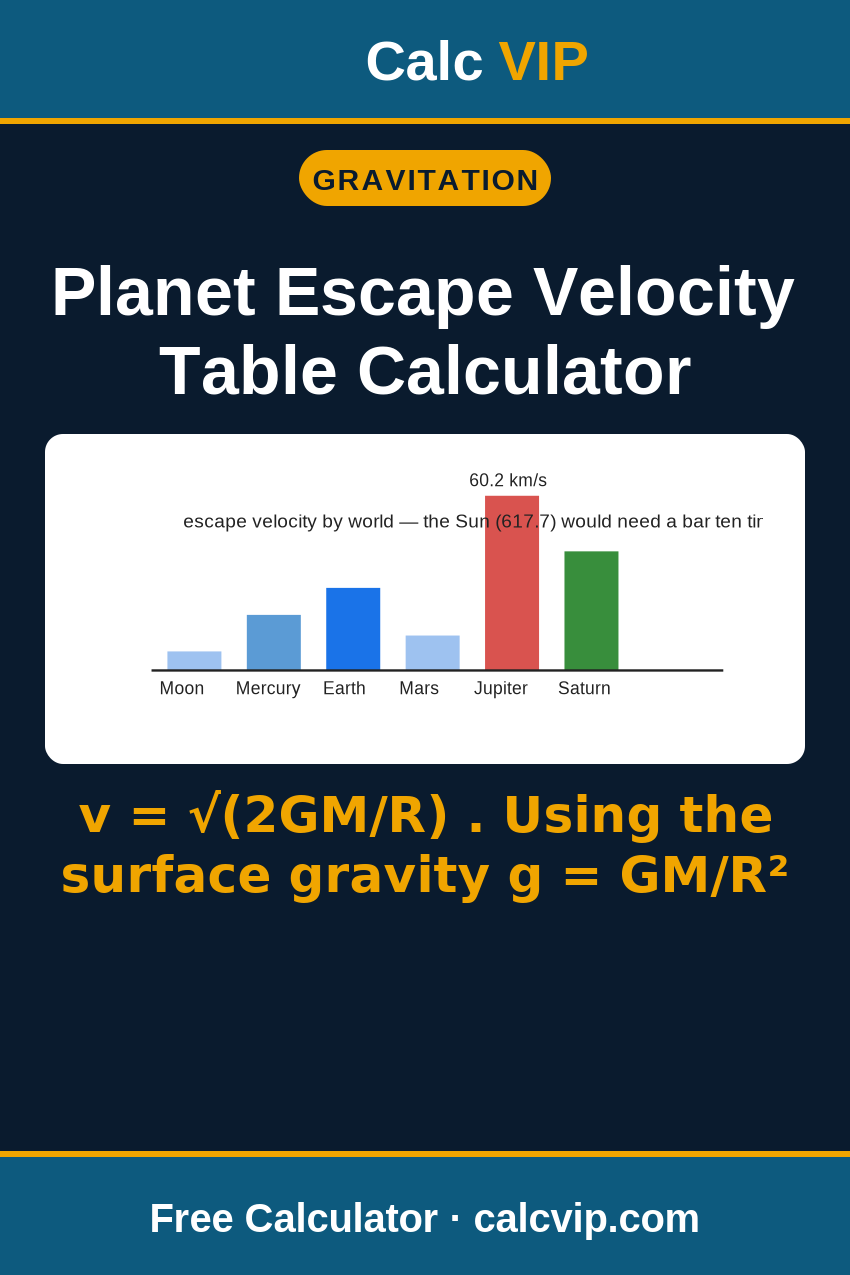
Read the two columns together and the table becomes a travel guide to the solar system's difficulty settings. High escape velocity with high gravity (Jupiter) means: brutal to leave, brutal to land. Low values (the Moon) mean: the easiest port of call beyond Earth, which is why it was reached first and why it tops every plan for an off-world base. The Sun's row is the asymptote — a reminder that our star holds the whole system in a well so deep that escaping the solar system from Earth's orbit requires only a fraction of what escaping the Sun's own surface would demand.
Formula
The escape velocity from a body of mass M and radius R is v = √(2GM/R). Using the surface gravity g = GM/R², the same number can be written v = √(2gR) — handy when g and R are the measured quantities, as they are for most planets. The table's second column uses g = GM/R². A companion relation worth memorising: escape velocity is exactly √2 (about 1.414) times the circular-orbit velocity at the same radius, so anything in low orbit is already 71% of the way — in speed terms — to leaving forever.
| Symbol | Meaning | Units |
|---|---|---|
| v | escape velocity from the surface | m/s (km/s in the table) |
| g | surface gravity | m/s² |
| M | mass of the body | kilograms (kg) |
| R | radius of the body | metres (m) |
| G | universal gravitational constant, 6.674 × 10⁻¹¹ | N·m²/kg² |
Why the two columns do not rise together
Escape velocity scales as √(M/R) while surface gravity scales as M/R² — different mixtures of the same two ingredients — so the table's columns rank the planets differently, and the mismatches are the interesting physics. Venus and Earth are near-twins in both columns because they are near-twins in mass and size. But compare Saturn with Earth: Saturn's escape velocity is 3.2 times Earth's while its surface gravity is only 1.14 times — its enormous radius inflates the √(2gR) product while diluting g itself. Uranus and Neptune split the other way: Neptune, slightly smaller but denser, beats Uranus in both columns despite similar size. The lesson the table teaches at a glance is that "how heavy a world feels" and "how hard it is to leave" are genuinely different questions, answered by different combinations of M and R — which is why both columns earn their place.
There is a third actor neither column shows directly: the atmosphere. Escape velocity decides whether a launched object leaves; for gas molecules, the comparison that matters is between the escape velocity and the thermal speeds of the gas, roughly a sixth of vesc being the rule-of-thumb threshold for holding a gas over geological time. It is why the Moon (2.38 km/s, and warm in sunshine) is airless, while Titan — with a comparable escape velocity of 2.64 km/s but bitterly cold at −179 °C, so its gas molecules crawl — keeps a thick nitrogen sky, and why Earth keeps nitrogen and oxygen but leaks hydrogen and helium. Every row of this table is also a verdict on an atmosphere.
How to use
- Scan the comparison table: each row gives a body's escape velocity (km/s) and surface gravity (m/s²), computed from its mass and radius with the formulas above.
- Pick a body from the dropdown to see its details — mass, radius, and both headline numbers — displayed together.
- Use the two columns comparatively: divide any escape velocity by Earth's 11.19 km/s to feel the relative difficulty of leaving that world.
- Cross-check a row yourself with v = √(2gR): for Earth, √(2 × 9.82 × 6.371 × 10⁶) ≈ 11,186 m/s. Every row passes this test, because both columns come from the same M and R.
Worked examples
Example 1 — Earth, the home row. M = 5.972 × 10²⁴ kg, R = 6,371 km:
v = √(2GM/R) ≈ 11,186 m/s = 11.19 km/s; g = GM/R² ≈ 9.82 m/s². Every other row is best read against this one — it is the only escape velocity our species has ever actually achieved from a surface.
Example 2 — Jupiter, the fortress. M = 1.898 × 10²⁷ kg, R = 69,911 km:
v ≈ 60,198 m/s = 60.20 km/s; g ≈ 25.92 m/s². A chemical rocket leaving Jupiter's cloud tops would need more than five times Earth's escape speed — one reason no sample-return from a gas giant is even on the drawing boards.
Example 3 — the Moon, the open door. M = 7.348 × 10²² kg, R = 1,737.4 km:
v ≈ 2,376 m/s = 2.38 km/s; g ≈ 1.62 m/s². The Apollo lunar module's ascent stage reached orbit with a modest single engine — this row is why. It is also why the Moon could not keep the gases that engine briefly released.
Example 4 — Mercury, small but dense. M = 3.301 × 10²³ kg, R = 2,439.7 km:
v ≈ 4,250 m/s = 4.25 km/s; g ≈ 3.70 m/s². Mercury's gravity nearly matches Mars's (3.73) despite Mercury being far smaller — its huge iron core packs mass into the small radius, and both columns show it.
Example 5 — Saturn, the paradox. M = 5.683 × 10²⁶ kg (95 Earths), R = 58,232 km:
v ≈ 36,092 m/s = 36.09 km/s, yet g ≈ 11.19 m/s² — a surface gravity coincidentally identical to Earth's escape-velocity figure and barely above Earth's gravity. Stand (somehow) on Saturn's cloud deck and you would feel almost Earth-normal weight on a world that is far harder to leave than Earth.
Example 6 — the Sun, off the scale. M = 1.989 × 10³⁰ kg, R = 695,700 km:
v ≈ 617,752 m/s = 617.75 km/s; g ≈ 274.27 m/s² (about 28 g). Nothing in the table comes within a factor of ten — and yet the solar wind's fastest particles and the Parker Solar Probe's perihelion dives both play in the foothills of this number.
The escape table in real life
Mission selection. The table is the first filter of interplanetary planning: destinations are ranked by the total velocity change (Δv) their rows imply. The Moon's 2.38 km/s made it the first target; Mars's 5.03 km/s plus its atmosphere makes it the next plausible one; Jupiter's 60.20 km/s rules out landing-and-return entirely.
Why probes to Mercury are slow. Mercury's modest 4.25 km/s is deceptive — reaching it means falling deep into the Sun's well and shedding the Sun's orbital velocity, an energy problem set by the Sun's row of the table, not Mercury's. Hence MESSENGER's six-year spiral of flybys to arrive.
Atmospheric evolution. Planetary scientists run this table against thermal speeds to explain the skies: Venus kept CO₂ but lost its water's hydrogen; Mars lost most of its air to space (its 5.03 km/s could not hold gases against a young, active Sun); the gas giants kept even hydrogen.
Launch site marketing. "Escape velocity" headlines every discussion of spaceports and space elevators — a climber on an Earth elevator must still reach orbital and escape energies, but starting from the table's 11.19 km/s row with the rotation's 0.47 km/s head start at the equator.
Interstellar probes. Leaving the solar system from Earth's surface means beating two rows at once — Earth's 11.19 km/s and then the Sun's grip at Earth's distance (42.1 km/s heliocentric). Voyager's gravity-assist route is the table's two hardest numbers, circumvented rather than confronted.
Exoplanet habitability screens. For a newly found exoplanet, its computed escape velocity is compared with its equilibrium temperature to ask the first habitability question: can this world even keep an atmosphere and oceans? The table's logic, applied to worlds light-years away.
Reading the table like a rocket engineer: Δv budgets
Professionals translate this table into a single currency: Δv, the total velocity change a mission must buy with propellant. Leaving Earth's surface for low orbit costs about 9.4 km/s of Δv (the 7.8 km/s orbital speed plus gravity and drag losses); escaping Earth entirely adds the step from 7.8 to 11.19 km/s at altitude — cheap, thanks to already being most of the way there. A Mars sample return must purchase Mars's 5.03 km/s row again in reverse, with a rocket it carried all the way there — the tyranny that makes such missions feats of miniaturisation. And the table explains the solar system's traffic patterns: everything humanity has ever landed and brought back came from the two gentlest rows, the Moon (2.38) and, via sample capsules, asteroids whose escape velocities are measured in metres per second. Ambition in spaceflight is, to first order, the art of climbing this table one row at a time.
Escape velocity shrinks with altitude
The table's figures are surface values — the worst case. Because v = √(2GM/r) falls as 1/√r, altitude is a discount: at the geostationary ring's distance, Earth's escape velocity is only about 4,344 m/s, barely more than a third of the surface figure, which is why probes departing from high orbits need so little extra push. Around the Moon the same discount applies in miniature: from a 100 km orbit, escape takes about 2,310 m/s rather than the surface's 2,376 m/s. Staging strategies are built on this curve — climb first on cheap chemical thrust, then let small efficient engines work where the well is already shallow. Read the table as the price list at sea level, and this section as the exchange rate at altitude.
Quick reference: the full comparison
| Body | Escape velocity | Surface gravity | vs Earth escape |
|---|---|---|---|
| Mercury | 4.25 km/s | 3.70 m/s² | 0.38× |
| Venus | 10.36 km/s | 8.87 m/s² | 0.93× |
| Earth | 11.19 km/s | 9.82 m/s² | 1.00× |
| Moon | 2.38 km/s | 1.62 m/s² | 0.21× |
| Mars | 5.03 km/s | 3.73 m/s² | 0.45× |
| Jupiter | 60.20 km/s | 25.92 m/s² | 5.38× |
| Saturn | 36.09 km/s | 11.19 m/s² | 3.23× |
| Sun | 617.75 km/s | 274.27 m/s² | 55.2× |
The interactive table above additionally details Uranus and Neptune — mid-twenties km/s, the deep-freeze giants — and the picker's per-body cards carry the masses and radii behind every row.
The missing row: Pluto and the small worlds
The picker covers the eight planets, the Sun and the Moon, but the formula keeps going down the size scale. Pluto, demoted but not diminished, posts an escape velocity of about 1.21 km/s and surface gravity of 0.62 m/s² — gentle numbers that, combined with its bitter cold, let it keep a thin nitrogen atmosphere that snows out and revives with its seasons. Below Pluto the table dissolves into the asteroid regime, where escape velocities shrink to metres and even centimetres per second and "landing" becomes docking. The same two formulas span the whole range; only the picker had to stop somewhere.
Common mistakes
- Assuming the biggest planet is hardest to stand on. Jupiter's surface gravity (25.92 m/s²) is only 2.6 times Earth's despite 318 times the mass — the radius squared dilutes it. Escape velocity punishes size less than gravity does, which is why the two columns rank worlds differently.
- Forgetting these are surface values. Escape velocity falls with altitude as 1/√r. From the ISS's altitude Earth's escape velocity is already down to about 10.85 km/s; the table's figures are the from-the-ground numbers, the honest worst case.
- Comparing escape velocity with orbital velocity directly. They differ by √2 at the same radius. A satellite in low Earth orbit at 7.9 km/s is not "70% escaped" in energy terms — kinetic energy goes as v², so it holds exactly half the energy needed to leave.
- Thinking escape velocity depends on the escaping object's mass. It does not — the m cancels, which is why a molecule and a moon rocket face the same threshold speed (though very different energies). Direction is equally free: any path that does not intersect the planet works.
- Reading Saturn's gravity as a misprint. Its 11.19 m/s² genuinely equals Earth's escape velocity's digits — a pure coincidence of units and numbers, and a handy memory hook for both.
FAQ
Which planet is hardest to escape from?
Jupiter, at about 60.2 km/s — more than five times Earth's escape velocity. The Sun is in another league entirely at about 617.8 km/s.
Why did the Moon lose its atmosphere?
Its escape velocity is only 2.38 km/s, so over billions of years the faster gas molecules simply drifted away into space.
Do rockets really reach 11.19 km/s to leave Earth?
They reach escape energy gradually — burning fuel over minutes and often using orbit first — rather than in one instant burst at the ground, and the atmosphere is far behind them by then.
Why is Venus's escape velocity so close to Earth's?
Because Venus is Earth's near-twin: 0.815 of its mass in 0.949 of its radius. √(M/R) therefore lands within 7% of Earth's value. The planets' very different surfaces — Venus's crushing CO₂ sky — are chemistry and history, not gravity.
Could a human jump into orbit on any of these bodies?
Not on any table entry — even the Moon demands 1.68 km/s for orbit. But small asteroids beat the table entirely: on Bennu, escape velocity is about 0.2 m/s, and a careless jump or a rover's hop genuinely risks leaving forever, a real operational concern for sample missions.
Why does the Sun's gravity read only 28 g?
Because its surface is 109 Earth radii from its centre, and gravity falls with radius squared. The Sun's mass is enormous, but standing on its visible surface means standing very far from most of it. Compress the Sun and both its numbers explode — see our Schwarzschild Radius Calculator.
Do the gas giants really have a "surface" for these numbers?
By convention, the 1-bar pressure level — roughly where Earth's sea-level pressure occurs — defines their radius, and the table's values refer to it. It is the only sensible border for a world that shades gradually from sky to ocean of liquid hydrogen.
Which body is hardest to land on?
Landing is escape in reverse, plus atmosphere. Venus combines a near-Earth escape velocity with a crushing, corrosive sky — landers survive hours. Jupiter is worse: 60.20 km/s of arrival energy and no surface at all. By combined verdict, the table's toughest rows are Venus and the giants.
How fast must a molecule move to escape Earth?
The same 11.19 km/s threshold — mass cancels. What matters is the fraction of molecules reaching it: at exosphere temperatures hydrogen's thermal tail crosses the line steadily, which is why Earth has leaked most of its primordial hydrogen while keeping nitrogen (heavier, slower) for billions of years.
Is escape velocity ever lower than orbital velocity?
Never at the same radius — escape is always √2 times the circular-orbit speed there. At different radii the comparison inverts freely: escape velocity from high altitude can be less than orbital velocity at the surface, which is exactly the trade staging rockets exploit.