 Calc
Momentum Calculator – p = mv, Kinetic Energy & Impulse
 Created by James Carter · Physics Writer · Forces & Motion · Last updated: November 2026
Use this free Momentum Calculator to find the momentum of a moving object (p = mv). It also shows the object's kinetic energy for comparison, and a second mini-tool below calculates impulse (J = F × t).
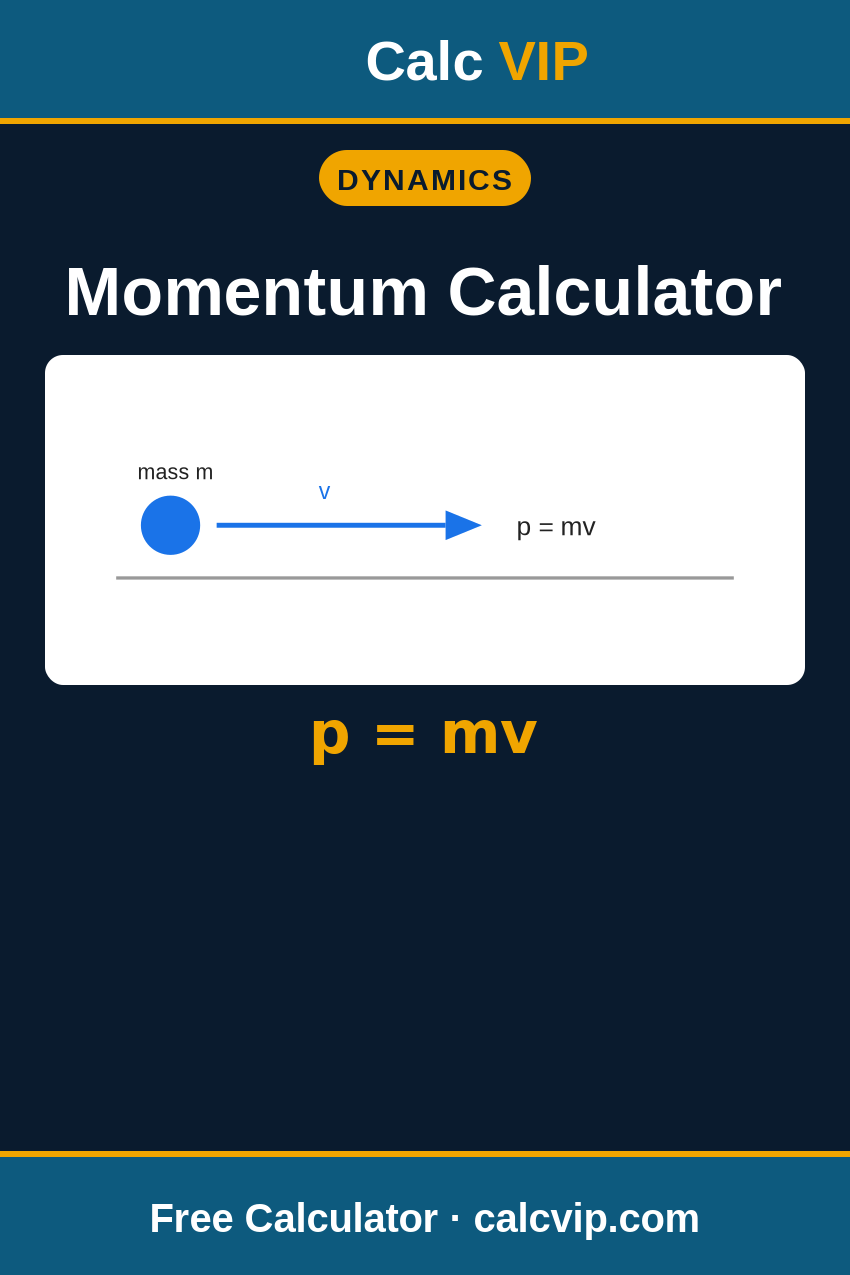
Momentum (p = mv)
Impulse (J = F × t)
Momentum is physics' measure of how much motion an object has — and how hard it is to stop. A cricket ball at full pace is hard to catch; a table-tennis ball at the same speed is nothing. A slow-moving lorry is nearly unstoppable; a fast bicycle is easily halted. In each pair the difference is captured by one quantity: mass multiplied by velocity.
Newton thought of momentum as the "quantity of motion", and it has a property that makes it precious to physicists: in any collision or interaction between objects, the total momentum is conserved — it is the same afterwards as before, as long as no outside force interferes. Whole areas of physics, from car-crash analysis to rocket design, are built on tracking where the momentum goes.
Momentum is a vector: it points the way the object moves, and direction matters when objects collide head-on or bounce apart. This calculator works with the size of the momentum for motion in a straight line, shows the kinetic energy alongside for contrast, and includes a second tool for impulse — the quantity that changes momentum.
Formulas
Momentum: p = mv • Kinetic energy: KE = ½mv² • Impulse: J = F × t — impulse equals the change in momentum.
The unit of momentum is the kilogram metre per second (kg·m/s). Impulse is measured in newton-seconds (N·s), and the two units are exactly equivalent — a fact hidden inside the impulse–momentum theorem: F × t = Δp. A force acting for a time delivers an impulse, and the object's momentum changes by precisely that amount. Double the force or double the time and you double the change.
That single statement explains a huge amount of safety engineering. If a given change of momentum is unavoidable — a car's occupants must lose all their momentum in a crash — then stretching the time over which it happens reduces the force in proportion. Airbags, crumple zones, seatbelt webbing that gives slightly, a fielder's hands drawing back with the catch: all are devices for buying time.
| Symbol | Meaning | Units |
|---|---|---|
| p | momentum, p = mv | kg·m/s |
| m | mass | kilograms (kg) |
| v | velocity | m/s |
| KE | kinetic energy, KE = ½mv² | joules (J) |
| J | impulse, J = F × t = Δp | N·s (= kg·m/s) |
| F | force | newtons (N) |
| t | time the force acts | seconds (s) |
Momentum versus kinetic energy
The calculator shows both quantities because they behave differently, and the difference matters. Momentum is proportional to velocity; kinetic energy is proportional to velocity squared. Double the speed of an object and its momentum doubles, but its kinetic energy quadruples. A car at 100 km/h has twice the momentum of the same car at 50 km/h, but four times the kinetic energy — and it is kinetic energy that must be dissipated by the brakes, which is why braking distances grow so brutally with speed.
They also differ in conservation. Momentum is conserved in every collision. Kinetic energy is conserved only in perfectly elastic collisions (billiard balls, nearly); in most real collisions much of it is converted to sound, heat and crumpled metal, while the momentum quietly balances to the last decimal.
How to use
- For momentum, enter the mass in kg and the velocity in m/s, then click "Calculate Momentum".
- For impulse, enter the force in newtons and how long it acts in seconds.
- Momentum is measured in kg·m/s and impulse in N·s — the two units are equivalent.
Worked examples
Example 1 — the ball. A ball of mass 2 kg moves at 15 m/s. Momentum p = 2 × 15 = 30 kg·m/s, and its kinetic energy = ½ × 2 × 15² = 225 J. Impulse check: a force of 20 N acting for 0.5 s gives J = 20 × 0.5 = 10 N·s.
Example 2 — car versus lorry. A car of 1000 kg at 20 m/s has momentum 1000 × 20 = 20,000 kg·m/s and kinetic energy ½ × 1000 × 20² = 200,000 J. A lorry of 10,000 kg at only 10 m/s has momentum 10,000 × 10 = 100,000 kg·m/s — five times the car's, despite half the speed — and kinetic energy ½ × 10,000 × 10² = 500,000 J. Mass counts once in momentum, which is why the slow lorry is still the harder vehicle to stop.
Example 3 — catching a fast ball. A ball of 0.15 kg arriving at 40 m/s carries momentum 0.15 × 40 = 6 kg·m/s. Stopping it means removing all 6 units. With bare, rigid hands stopping it in 0.01 s, the force is F = 6 ÷ 0.01 = 600 N — a sharp sting. A padded glove that lets the hands ride back and stretches the stop to 0.2 s needs only F = 6 ÷ 0.2 = 30 N. Same impulse, same momentum change, twenty times less force.
Example 5 — the rifle's answer. A rifle of mass 4 kg fires a 0.02 kg bullet at 800 m/s. The bullet's momentum is 0.02 × 800 = 16 kg·m/s, so conservation of momentum sends the rifle backwards at 16 ÷ 4 = 4 m/s. The bullet's kinetic energy dwarfs the rifle's, but their momenta are exactly equal and opposite — momentum is the quantity that must balance.
Example 6 — the sticky collision. A trolley of 3 kg rolling at 4 m/s hits a stationary 1 kg trolley and they couple together. Total momentum before = 3 × 4 = 12 kg·m/s. Afterwards the combined 4 kg must carry the same 12, so they roll on at 12 ÷ 4 = 3 m/s. Kinetic energy is not conserved here (it falls from 24 J to 18 J); momentum is — it always is.
Momentum in real life
Car safety. Example 3 is the airbag principle at full scale. In a crash, the occupants' momentum must fall to zero; the only choice engineers have is the time it takes. Crumple zones that collapse progressively, seatbelts that spool out slightly, and airbags that cushion the head all stretch the stopping time from milliseconds to tenths of a second, cutting the force by the same factor.
Rockets. A rocket has nothing to push against, so it carries its momentum with it and throws part of it backwards. Exhaust gas leaves at high speed with momentum pointing down and back; the rocket gains equal momentum pointing up and forwards. The faster the exhaust, the more momentum each kilogram of fuel delivers — which is why exhaust velocity dominates rocket design.
Recoil and collisions. Fire a cannon of 500 kg that launches a 5 kg shell at 200 m/s: the shell leaves with momentum 5 × 200 = 1000 kg·m/s, so the cannon must recoil with the same 1000 kg·m/s in the opposite direction — a recoil speed of 1000 ÷ 500 = 2 m/s. Total momentum before (zero) equals total momentum after (1000 − 1000 = 0). Conservation always balances the books.
Supertankers and the long stop. A loaded tanker of 300,000 tonnes (3 × 10⁸ kg) moving at a modest 5 m/s carries momentum of 3 × 10⁸ × 5 = 1.5 × 10⁹ kg·m/s. Its engines astern deliver a comparatively tiny force, so shedding that momentum takes kilometres and tens of minutes — the largest momentum management problem in everyday transport.
Crash-test ratings. When a test car hits the barrier, engineers read the momentum change and its duration off the instruments: the impulse is fixed by the car's mass and speed, so the star rating is essentially a report on how gracefully the structure stretched the time — momentum physics, scored out of five.
Elastic and inelastic collisions
Collisions come in two limiting kinds, and momentum conservation governs both. In a perfectly inelastic collision the objects stick together and move as one — the diagram below shows a 2 kg trolley at 3 m/s hitting a stationary 1 kg trolley and coupling to it: total momentum 6 kg·m/s shared by 3 kg gives a joint speed of 2 m/s. Kinetic energy is not conserved here: it falls from ½ × 2 × 3² = 9 J to ½ × 3 × 2² = 6 J, the missing 3 J going into sound, heat and the coupling mechanism. In a nearly elastic collision, like Newton's cradle or billiard balls, kinetic energy survives almost intact and the objects bounce apart — yet the momentum total still balances exactly. When analysing any collision, momentum is the reliable ledger; kinetic energy may or may not be.
Example 4 — skaters pushing apart. Two ice skaters start at rest, holding hands: one of 60 kg, one of 40 kg. They push apart, and the 60 kg skater glides off at 2 m/s, carrying momentum 60 × 2 = 120 kg·m/s. The total started at zero, so the partner must carry −120 kg·m/s — a recoil speed of 120 ÷ 40 = 3 m/s in the opposite direction. The lighter skater always leaves faster, in exact inverse proportion to the masses. It is the cannon recoil of the real-life section, performed on ice.
Follow-through: impulse in sport
Coaches who tell players to "follow through" are teaching impulse. A tennis racket in contact with the ball for only about 5 milliseconds can add limited impulse, F × t; swinging through the shot keeps the strings on the ball a little longer and, more importantly, ensures the racket is still accelerating at contact, raising F. Golfers, cricketers and baseball hitters all chase the same product: maximum force sustained for the longest contact time transfers the most momentum to the ball. The reverse skill — the fielder's soft hands, the boxer rolling with a punch — deliberately lengthens the contact time of an incoming momentum change to shrink its force, exactly as Example 3 quantified.
Conservation of momentum: Newton's third law in disguise
Why should total momentum be conserved at all? Because forces come in pairs. When two objects collide, each exerts an equal and opposite force on the other for exactly the same contact time — so each delivers an equal and opposite impulse, and whatever momentum one gains, the other loses. The total cannot change; it can only be redistributed. External forces (friction with the ground, gravity during a long interaction) can leak momentum in or out, which is why the law is stated for closed systems — but seal the system and the bookkeeping is perfect.
This is also why momentum, not kinetic energy, is the reliable detective at a collision scene. Energy can hide — as heat, sound, crumpled metal — but momentum has nowhere to hide. Measure the masses and velocities afterwards, run the totals backwards, and the velocities before the collision are recovered, which is literally how accident investigators and particle physicists (reading detector tracks instead of skid marks) reconstruct events no one saw.
Quick reference: momenta from bullets to tankers
The table's lesson is the trade between mass and velocity: a bullet and a supermarket trolley can carry the same momentum, while a slow ship out-momentums everything else on the page combined. Stopping any of them requires an impulse equal to the full figure — the only choice is over what time, and therefore at what force.
| Object | Momentum |
|---|---|
| 10 g bullet at 400 m/s | 4 kg·m/s |
| 0.15 kg ball at 40 m/s (Ex. 3) | 6 kg·m/s |
| 2 kg ball at 15 m/s (Ex. 1) | 30 kg·m/s |
| car, 1000 kg at 20 m/s (Ex. 2) | 20,000 kg·m/s |
| lorry, 10,000 kg at 10 m/s (Ex. 2) | 100,000 kg·m/s |
| loaded tanker at 5 m/s | 1.5 × 10⁹ kg·m/s |
The centre of mass does not negotiate
Behind every momentum problem stands a silent character: the centre of mass, whose velocity is the total momentum divided by the total mass. In Example 6's collision it moves at 12 ÷ 4 = 3 m/s before the trolleys couple — and 3 m/s afterwards, because coupling cannot change the total momentum. In fact it moves at 3 m/s during the collision too, and through every collision, explosion and pirouette in this subject: internal forces, however violent, cannot accelerate the centre of mass at all.
External forces are the only negotiators. That is why the skaters of Example 4 glide apart with their midpoint frozen on the ice, why a rocket's exhaust and body share a stationary centre of mass in empty space, and why accident investigators can anchor their reconstructions to a point that obeyed the simplest possible motion — a straight line at a steady speed — while everything around it was chaos.
Common mistakes
- Ignoring direction. Momentum is a vector. Two objects with momenta of +6 and −6 kg·m/s approaching head-on have a total momentum of zero, not 12 — which completely changes what can happen in the collision.
- Confusing momentum with kinetic energy. They scale differently (v versus v²) and obey different rules: momentum is always conserved in collisions, kinetic energy usually is not.
- Treating impulse as a force. Impulse is force × time. A huge force for a millisecond and a gentle force for a second can deliver the same impulse and the same change of momentum.
- Forgetting the units are interchangeable. kg·m/s and N·s are the same unit in different dress — an impulse of 10 N·s changes momentum by exactly 10 kg·m/s.
- Adding momenta that point in opposite directions. Momentum is a vector. Two trolleys of 6 kg·m/s approaching head-on have a total momentum of zero, not 12 — choose a positive direction and give the other a minus sign before adding.
FAQ
What is the difference between momentum and kinetic energy?
Momentum (p = mv) depends on velocity once and has a direction. Kinetic energy (KE = ½mv²) depends on velocity squared and is a scalar — doubling the speed doubles momentum but quadruples kinetic energy.
Is momentum conserved?
Yes. In a closed system with no external forces, the total momentum before a collision equals the total momentum after it.
Why do airbags reduce injury?
They increase the time (t) over which your momentum changes, so the force (F = J/t) is smaller — the same impulse spread over a longer time.
Can a small object have a large momentum?
Yes, if it is fast enough. A 10 g bullet at 400 m/s has momentum 0.01 × 400 = 4 kg·m/s — comparable to a thrown cricket ball — because velocity can compensate for tiny mass.
What is the momentum of a stationary object?
Zero, whatever its mass. With v = 0, p = mv = 0. A parked lorry has no momentum — but it has plenty of inertia, which is why getting it moving takes a large impulse.
Why are kg·m/s and N·s the same unit?
A newton is a kg·m/s², so a newton-second is kg·m/s² × s = kg·m/s. Impulse and momentum are measured in the same unit because impulse is a change of momentum.
Does light have momentum?
Yes — surprisingly, light carries momentum even though it has no mass, which is how solar sails are pushed through space and how radiation pressure shapes comet tails. The simple p = mv formula applies to ordinary objects; light needs Einstein's version, p = E/c.
Can a system's total momentum be zero while its parts are moving?
Yes — two equal masses approaching at equal speeds cancel exactly, as do the skaters of Example 4 pushing apart. Zero total momentum does not mean nothing is moving; it means the motions balance, and the centre of mass stays put.
Why does a heavier gun recoil less?
The bullet's momentum is fixed by its mass and muzzle velocity, so the gun must take the same momentum backwards. Doubling the gun's mass halves its recoil velocity (v = p/m) — and quarters the recoil energy, since KE = p²/2m falls with the extra mass twice over.
What is the momentum change when a ball bounces off a wall?
Twice its incoming momentum, if it rebounds at the same speed: a 0.15 kg ball arriving at 40 m/s and leaving at 40 m/s changes by 6 − (−6) = 12 kg·m/s. Bouncing is the most expensive thing a ball can do to the wall — twice the impulse of simply stopping.