 Calc
Change in Momentum Calculator – Δp = m(v − u) & Impulse
 Created by James Carter · Physics Writer · Forces & Motion · Last updated: November 2026
Use this free Change in Momentum Calculator to find Δp when an object's velocity changes — including bounces, where the change is bigger than you might expect. Add the contact time and it also gives the average force, using the impulse–momentum theorem.
Change in Momentum (Δp = m(v − u))
Momentum change is where Newton's laws meet the real world of impacts. An object's momentum, p = mv, is a running total of its motion — and the only way to change that total is to apply a force for some time. The impulse–momentum theorem, J = F × t = Δp, says the books must balance exactly: the impulse delivered by the force equals the change in momentum, every time, for every object. This calculator works the theorem in both directions: from a velocity change to the momentum change (and the impulse that must have caused it), and — if you add the contact time — to the average force that delivered it.
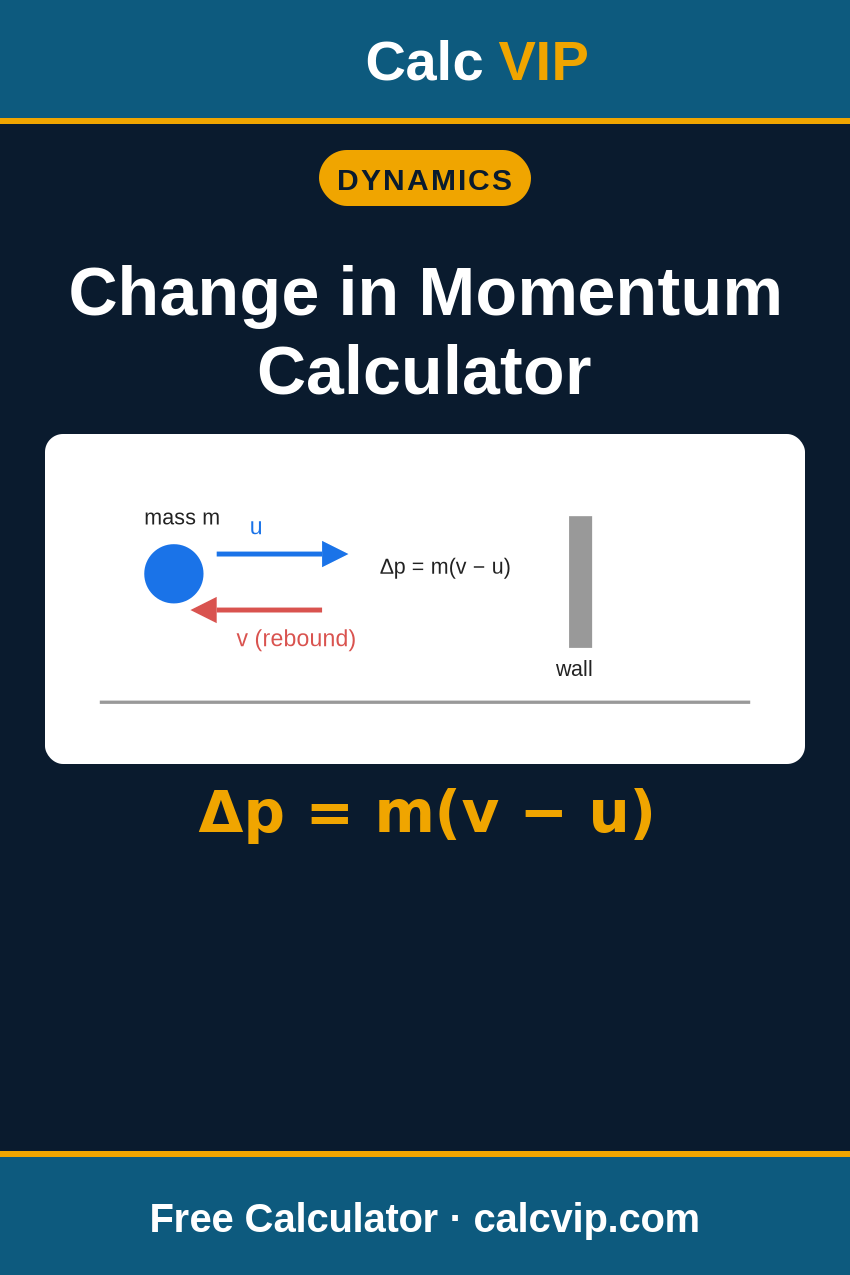
The bounce is the case that makes the theorem famous. A ball arriving at a wall at 10 m/s and stopping dead has changed its momentum by 10 units per kilogram. The same ball bouncing back at 10 m/s has changed it by 20 — because momentum is a vector, reversing direction is a change twice as large as cancelling the motion. Walls, bats and bumpers must supply that doubled impulse, and the objects feel it as doubled force for the same contact time. Anyone who has headed a football rather than catching it has the intuition; this page supplies the arithmetic.
That arithmetic runs modern safety design. A crash fixes the Δp of each occupant — their mass times their velocity change is not negotiable. What engineering controls is the t: airbags, crumple zones, seatbelt webbing and helmet foam all exist to stretch the time over which the momentum change happens, because F = Δp / t means every doubling of the time halves the force. The same equation, run the other way, is the coach's friend: a bat or racket that stays in contact longer delivers more impulse and sends the ball away faster. One theorem, two industries.
Formula
Δp = m(v − u) • Impulse J = Δp • Average force F = Δp / t — the impulse–momentum theorem: the impulse applied to an object equals its change in momentum.
The theorem is Newton's second law in its original form. Newton did not write F = ma; he wrote that force is the rate of change of momentum, F = Δp / Δt, which rearranges to F × t = Δp and covers even cases where the mass itself changes. The three quantities trade off against each other in fixed proportion: given the same Δp, halving the contact time doubles the average force, and doubling the time halves it. The calculator's force is an average — real impact forces spike and fall — but the average is what the impulse fixes, and it is the number that decides whether structures, bones and eggshells survive. Signs matter throughout: momentum is a vector, so Δp for a rebound is computed with a negative final velocity, and its magnitude can approach 2mu — twice the momentum the object arrived with.
| Symbol | Meaning | Units |
|---|---|---|
| m | mass of the object | kg |
| u, v | velocity before and after (signed) | m/s |
| Δp | change in momentum, m(v − u) | kg·m/s |
| J | impulse — equal to Δp, also F × t | N·s |
| t | contact (interaction) time | seconds (s) |
| F | average force during the contact | newtons (N) |
The force–time graph: impulse is an area
Plot the force of an impact against time and it draws a hill: zero before contact, a steep rise as surfaces compress, a peak, and a fall as they separate. The impulse is the area under that hill — force multiplied by time, accumulated moment by moment — and the theorem says that area must equal Δp, whatever shape the hill takes. This single picture explains both safety engineering and sports technique. Crumple zones and airbags do not shrink the hill's area — the occupant's Δp is already fixed — they stretch the hill sideways: longer time, lower peak, same area. A bat swung with follow-through does the opposite favour for the ball: it keeps the force applied a fraction longer, growing the area and therefore the ball's Δp. Whenever you see a force–time graph in a crash report or a biomechanics paper, read it as a picture of this theorem.
The average force the calculator reports is the height of the rectangle with the same area and the same base as the real hill. Peak forces are typically about twice the average for a smooth impact (the hill is roughly triangular), which is worth remembering when comparing a calculated average against a material's breaking strength: design against the peak, not the mean.
How to use
- Enter the mass, the starting velocity u and the final velocity v, all in kg and m/s.
- If the object rebounds, enter the final velocity as a negative number — direction matters, and the rebound case is where Δp surprises.
- Optionally add the contact time in seconds to get the average force during the change.
- Compare scenarios: keep Δp fixed and vary only the time to see the force fall as contact stretches — the entire principle of protective design in one experiment.
Worked examples
Example 1 — the bouncing ball. A ball of mass 0.5 kg hits a wall at 10 m/s and rebounds at 6 m/s, so u = 10 and v = −6.
Δp = 0.5 × (−6 − 10) = 0.5 × (−16) = −8 kg·m/s — a change of 8 kg·m/s (the minus sign shows the direction flipped).
If the contact lasted 0.2 s, the average force was F = 8 / 0.2 = 40 N. Had the ball merely stopped (v = 0), Δp would have been only 5 kg·m/s — the rebound cost the wall an extra 3.
Example 2 — a crash-test car. A 1,000 kg car strikes a barrier at 15 m/s and stops: Δp = 1,000 × (0 − 15) = −15,000 kg·m/s. If the front structure crushes over 0.15 s, the average force on the car is 15,000 / 0.15 = 100,000 N — about ten tonnes of weight. Engineer the crush to last 0.5 s instead (a longer, softer crumple zone) and the same Δp is delivered at 30,000 N. Same crash, same momentum change — a third of the force, bought purely with time.
Example 3 — the tennis return. A 0.057 kg tennis ball arrives at −30 m/s (towards the racket) and leaves at +50 m/s. Δp = 0.057 × (50 − (−30)) = 0.057 × 80 = 4.56 kg·m/s. Strings and ball are in contact for about 0.005 s, so the average force is 4.56 / 0.005 = 912 N — the racket briefly pushes with the weight of a 93 kg mass, which is why a well-struck return feels like it was hit by something much heavier than a felt ball.
Example 4 — dropping an egg, two ways. A 0.06 kg egg falls and lands at 8 m/s, stopping in both cases: Δp = 0.06 × (0 − 8) = −0.48 kg·m/s. On a hard floor the stop takes about 0.005 s → average force 0.48 / 0.005 = 96 N, and the shell loses. On thick foam the stop stretches to 0.2 s → 0.48 / 0.2 = 2.4 N, and the egg survives. Identical Δp; a fortyfold difference in force. This is the whole science of packaging in one breakfast.
Example 5 — the karate strike. A striker's hand and forearm, effective mass about 0.7 kg, arrive at 12 m/s and are stopped by the target. Δp = 0.7 × (0 − 12) = −8.4 kg·m/s. Delivered over a contact of 0.01 s, the average force is 8.4 / 0.01 = 840 N. Board-breaking demonstrations are this example with the roles read backwards: the board must absorb the hand's Δp faster than the hand does, so the board's structure fails first.
Example 6 — a hailstone on a roof. A large 0.02 kg hailstone falls at 25 m/s and shatters on impact, its vertical motion ending in about 0.002 s. Δp = 0.02 × (0 − 25) = −0.5 kg·m/s, and the average force is 0.5 / 0.002 = 250 N from a stone weighing as much as four sheets of paper. Tiny mass, tiny time — the division is what makes hail dangerous to greenhouses, solar panels and car roofs.
Momentum change in real life
Airbags and crumple zones. The occupant's Δp in a crash is set by the speed change; the car's job is to make t long. An airbag stretches a head's stopping time from milliseconds (dashboard) to a tenth of a second or more, cutting the average force by an order of magnitude — Example 2's trade, worn by the passengers.
Catching with soft hands. Fielders pull their hands back as the ball arrives, stretching the contact from a sting to a cushion. The ball's Δp is the same either way; the force on the palms is not. Wicketkeepers and goalkeepers build careers on F = Δp / t.
Bungee jumping. A falling jumper's momentum must be cancelled and then reversed. A bungee cord stretches that change over seconds rather than the milliseconds of a rigid stop, keeping the peak force to a few times body weight — the force–time hill stretched to a gentle slope.
Carrier landings. A jet touching down at 60 m/s is stopped by the arresting wire in about two seconds over the deck's length — a huge Δp delivered at a force the airframe and pilot can survive. The wire's hydraulic give is contact-time engineering at industrial scale.
Follow-through in batting and golf. For the ball, a longer contact means a bigger impulse and a bigger Δp — more speed away. Coaches teach follow-through because it keeps the implement in contact those extra fractions of a millisecond where force is still being applied.
Sand pits and crash mats. Long jumpers land in sand, gymnasts on foam, and stunt performers on airbags the size of rooms: all are Δp absorbers, spreading a fixed momentum change over enough time and distance that the average force stays well inside what bodies tolerate.
Stop, bounce or splat: comparing momentum changes
Three fates await an object arriving at a surface with momentum mu. Stopping (a catch, a perfect landing) removes the momentum: Δp = mu. Bouncing reverses it, up to Δp = 2mu for a perfectly elastic rebound — the surface must supply twice the impulse, which is why a rubber ball stings a bare hand more than a lump of clay of the same mass and speed. Splatting also removes the momentum (Δp = mu) but over a long, soft contact, so the average force is small — the clay's revenge is that it is gentle. Notice that force and Δp are telling different stories in these comparisons: the bounce and the stop differ in Δp, while the splat and the stop share a Δp and differ only in time. Keeping the two apart — how much momentum changed, versus how quickly — is the entire skill this calculator trains.
One more case bends students' intuition, because the speed never changes at all: a pure direction change. Let an object moving at speed v be deflected through 90° — a ball glancing off a corner post, a spacecraft swinging around a planet — emerging at the same speed v at right angles to its arrival. The momentum change is not zero; as vectors, Δp = m(v_after − v_before) has magnitude √2 × mv, about 1.41 times the object's whole momentum, delivered without the object speeding up or slowing down by a hair. Gravity assists run on exactly this: the planet's gravity supplies a large Δp that rotates the spacecraft's velocity, and the rotation alone is worth fuel the spacecraft never has to carry.
Quick reference: typical contact times
| Event | Typical contact time | Consequence |
|---|---|---|
| golf club on a ball | ≈ 0.0005 s | enormous peak forces, thousands of N |
| hailstone on glass | ≈ 0.002 s | small masses still crack panels |
| ball on a hard wall | ≈ 0.005–0.01 s | forces of hundreds of N for sports balls |
| car crash (crumple zone) | ≈ 0.1–0.15 s | engineered to keep occupant forces survivable |
| catching with giving hands | ≈ 0.1–0.3 s | same Δp, a fraction of the sting |
| bungee cord stop | ≈ 1–3 s | peak force only a few times body weight |
The table spans four orders of magnitude in time, and the force column follows inversely. Whenever a problem or a product promises gentler impacts, look for where it bought its time — that purchase is the whole mechanism.
Common mistakes
- Forgetting that momentum is a vector. A rebound entered with a positive final velocity computes the Δp of a mere slow-down. The bounce case — often the whole point of the question — needs the negative sign, and it nearly doubles the answer.
- Confusing Δp with the final momentum. Δp is the change, mv − mu. An object ending with momentum 3 kg·m/s that started with 10 has Δp = −7, not 3. Reporting the endpoint instead of the change quietly breaks the impulse equation.
- Believing a bigger force means a bigger Δp. Δp is fixed by the mass and the two velocities alone. Force only decides how the change is delivered — a shove and a tap can carry identical Δp if their times differ accordingly.
- Treating the average force as the peak. Real impact forces spike; the peak is commonly around twice the average the calculator reports. Comparing the average directly against a breaking strength underdesigns by a factor of two.
- Mixing up the units. kg·m/s and N·s are the same unit wearing two names — a good consistency check. But dividing Δp by a time in milliseconds without converting gives a force a thousand times too small.
FAQ
Why is the momentum change for a bounce larger than for a stop?
Stopping takes the momentum from mv to 0, a change of mv. Bouncing takes it from +mv to −mv, a change of 2mv — the wall must supply twice the impulse.
What does the negative sign in Δp mean?
Only direction. Momentum is a vector, so Δp points opposite to the original motion when an object slows down or rebounds. Its size (magnitude) is what matters for the force.
How does this explain crumple zones and airbags?
Δp is fixed by the crash, but F = Δp/t — stretching the time t over which the change happens makes the average force smaller and the crash more survivable.
Is Δp the same thing as impulse?
Yes — the impulse–momentum theorem states they are equal: J = F × t = Δp. "Impulse" names the cause (force applied over time); "change in momentum" names the effect. The calculator's result line reports both because problems are posed in both languages.
Does Δp depend on how big the force was?
No. Δp is determined entirely by the mass and the before-and-after velocities. A gentle force acting for long and a violent force acting briefly can produce the same Δp — the theorem guarantees the products F × t match.
Are kg·m/s and N·s really the same unit?
Identical. A newton is a kg·m/s², so a newton-second is a kg·m/s. The dual naming is a useful audit: if a calculation produces Δp in one and impulse in the other and they disagree, the error is in the arithmetic, not the units.
Can Δp be zero even though a force acted?
Yes — if the object's velocity returns to exactly its starting vector. A satellite completing one full orbit under gravity ends with the same velocity it started with: gravity acted the whole time, yet the net Δp over the closed loop is zero (the impulses around the loop cancel as vectors).
Why do coaches teach follow-through?
Because the ball's Δp equals the impulse, and impulse grows with contact time. A swing that keeps the bat or racket driving through the ball applies force for longer, buying the ball extra momentum that a checked, jabbing swing leaves unclaimed.
What if the object's mass changes during the event?
Then Δp = m(v − u) no longer tells the whole story — a cart gathering rain or a rocket shedding exhaust needs the full momentum balance, tracking the momentum carried by the arriving or departing mass too. This calculator assumes a single object of fixed mass.
How large can the force get as the contact time shrinks?
In principle, without limit: F = Δp / t grows as t shrinks, which is why near-instant events — a hammer strike, a hailstone, a bullet's impact — produce forces so disproportionate to the masses involved. In practice, materials deform, and that deformation buys back time and caps the peak.