 Calc
Momentum Solver Calculator – Solve p = mv for Momentum, Mass or Velocity
 Created by James Carter · Physics Writer · Forces & Motion · Last updated: November 2026
Use this free Momentum Solver Calculator to solve any one unknown in the momentum equation p = mv. Enter any two of momentum, mass and velocity, choose what to find, and get the third instantly.
Momentum is the physicist's measure of "how much motion" an object carries — Newton himself called it the quantity of motion, and the definition has not needed revision since: multiply the mass by the velocity. The product sounds humble, but it fuses the two ways an object can be hard to stop. A parked lorry is hard to budge because of its mass; a rifle bullet is hard to stop because of its speed; momentum is the single number that prices both difficulties on the same scale. This calculator solves the equation from any corner: give it any two of momentum, mass and velocity, and it returns the third.
What elevates momentum from a definition to a law is that nature conserves it. In any collision, explosion or interaction inside a closed system, the total momentum afterwards equals the total momentum before — always, exactly, even when kinetic energy is destroyed in the crash. That conservation is why this one multiplication sits underneath collision analysis, rocket propulsion, recoil, traffic-safety engineering and most of particle physics. Nearly every problem in those fields begins by writing down p = mv for each object involved, which is precisely the arithmetic this page automates.
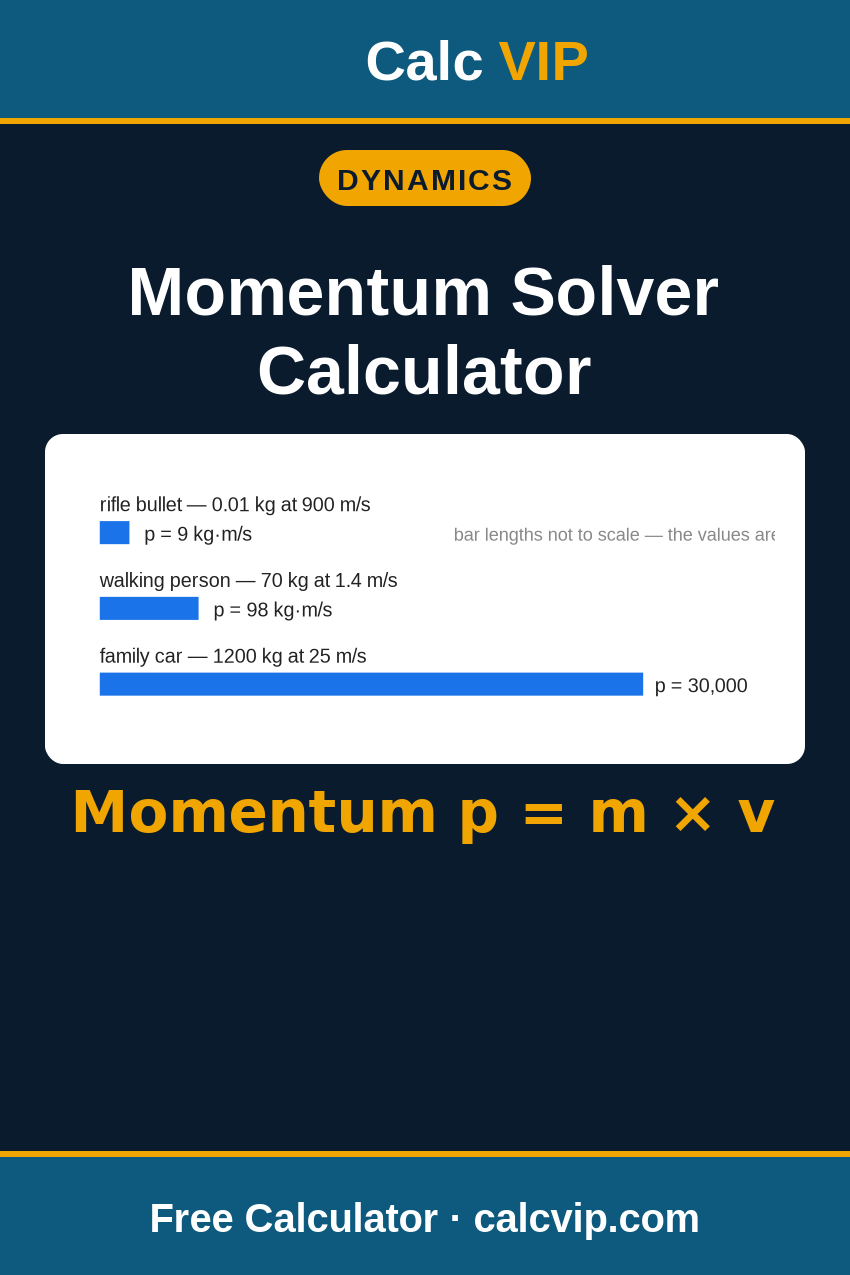
Two properties deserve attention before the numbers start. First, momentum is a vector: it points the way the velocity points, and motion in the opposite direction carries negative momentum — the sign convention that makes head-on collisions come out right. Second, momentum grows only in direct proportion to speed, unlike kinetic energy, which grows with the square. That single difference explains a surprising amount of the physical world, from why catching a ball differs from stopping a car to why airbags are designed around time rather than distance. Both themes run through the sections below.
Formula
Momentum p = m × v • p in kilogram metres per second (kg·m/s), m in kilograms (kg), v in metres per second (m/s)
The same equation rearranges to solve for either input: m = p ÷ v finds the mass that carries a known momentum at a known speed, and v = p ÷ m finds the speed a known mass needs to carry a known momentum. Because the three quantities are locked in one product, any two pin down the third — the three modes of the calculator above are the three corners of one triangle. A unit check keeps the algebra honest: kg × (m/s) gives kg·m/s, and dividing momentum by either factor returns the other in its own units. Momentum's unit has a second identity worth knowing: a kg·m/s is exactly a newton-second (N·s), the unit of impulse — the first hint that momentum and pushes are two views of the same thing, a connection the depth section below makes exact.
| Symbol | Meaning | Units |
|---|---|---|
| p | momentum — quantity of motion | kg·m/s (= N·s) |
| m | mass of the object | kg |
| v | velocity (signed — direction matters) | m/s |
Momentum is not kinetic energy — the difference that runs the world
Students often treat momentum and kinetic energy as two names for "oomph". They are not, and the calculator's Example 1 object shows why. A 5 kg ball at 12 m/s carries momentum p = 60 kg·m/s and kinetic energy ½ × 5 × 12² = 360 J. Double its speed to 24 m/s and the momentum merely doubles, to 120 kg·m/s — but the kinetic energy quadruples, to 1,440 J. Momentum is proportional to v; energy is proportional to v². Every doubling of speed buys twice the momentum but four times the energy, and the two quantities therefore answer different questions.
Momentum answers: for how long must a force act to stop this? Energy answers: over what distance must a force act to stop this? A catcher's glove, an airbag and a crumple zone all work on the momentum question — they stretch the stopping time so the force stays survivable. Brakes work on the energy question — they convert the kinetic energy to heat over a stopping distance, which is why braking distances grow with the square of speed while the push you feel in a gentle stop does not. Keeping the two ledgers separate — momentum for time and impulse, energy for distance and work — is the single most clarifying habit in mechanics, and p = mv is the entry in the first ledger.
How to use
- Choose what you want to find in the dropdown: momentum p, mass m, or velocity v. The two input labels change to match the two quantities you need to supply.
- Enter the two known values — mass in kilograms, velocity in metres per second (divide km/h by 3.6 to convert), momentum in kg·m/s.
- Use a negative velocity for motion in the opposite direction if direction matters; the momentum will carry the sign too.
- Click "Solve" to get the missing value. To run the equation backwards — checking a mass or a speed — switch the mode and reuse the momentum you just found.
Worked examples
Example 1 — the ball (momentum mode). A ball of mass 5 kg moves at 12 m/s: p = 5 × 12 = 60 kg·m/s. The reverse modes close the triangle: m = 60 ÷ 12 = 5 kg and v = 60 ÷ 5 = 12 m/s.
Example 2 — a bowling ball. A 7 kg bowling ball rolling at 8 m/s carries p = 7 × 8 = 56 kg·m/s — nearly the momentum of Example 1's lighter, faster ball. Mass and speed trade against each other inside the same product, which is why a slow heavy object and a fast light one can be equally hard to stop.
Example 3 — a lorry. A 12,000 kg lorry cruising at 25 m/s (90 km/h) carries p = 12,000 × 25 = 300,000 kg·m/s — five thousand times the ball's momentum. Nothing about the lorry feels extreme, yet stopping it means removing a third of a million newton-seconds of momentum, which is why lorry brakes, runaway-truck ramps and following distances are engineered so conservatively.
Example 4 — finding a mass. A loaded trolley on a test track is measured carrying 240 kg·m/s of momentum while rolling at 15 m/s: m = 240 ÷ 15 = 16 kg. Mass mode turns a momentum and a speed into the mass that connects them — the same trick engineers use to weigh rail wagons from their coupling behaviour.
Example 5 — finding a velocity. A rifle bullet of mass 0.03 kg leaves the muzzle carrying 18 kg·m/s: v = 18 ÷ 0.03 = 600 m/s. The bullet's momentum is modest — less than a third of the bowling ball's — but it is concentrated in 30 grams, which is why it is the speed, found by this mode, that does the damage.
Example 6 — the cyclist. A rider and bicycle of combined mass 80 kg at 6 m/s carry p = 80 × 6 = 480 kg·m/s — eight times the ball of Example 1. A walking pedestrian (70 kg at 1.4 m/s) carries just 98 kg·m/s. The cyclist's five-fold speed advantage over the pedestrian becomes a five-fold momentum advantage at similar mass: speed is the lever that matters most at human scales.
Momentum in real life
Airbags and crumple zones. A crash must remove the occupant's momentum; the only choice is how long it takes. Stretching the stop from a twentieth of a second to half a second cuts the average force tenfold — the entire design philosophy of modern car safety is impulse management, priced in kg·m/s.
Rocket propulsion. A rocket has nothing to push against; it throws mass backwards instead. The exhaust carries momentum one way, the rocket gains equal momentum the other way — conservation of the total, computed one p = mv at a time, is the whole of rocket science's first chapter.
Catching and fielding. A fielder's hands ride backwards with a caught ball, and a boxer rolls with a punch: both are stretching Δt to shrink the force for a fixed Δp. Coaches teach the technique; this equation is the reason it works.
Recoil. A rifle's backward kick is the bullet's forward momentum handed to the gun. The 18 kg·m/s of Example 5's bullet, delivered to a 3 kg rifle, drives it back at 6 m/s — the same solver, run in velocity mode.
Traffic engineering. Example 3's 300,000 kg·m/s is why a lorry and a car are not treated as equals in barrier design, braking regulations or safe following distances: at equal speeds, momentum scales with mass, and mass differs by a factor of ten.
Newton's cradle and the pool break. In near-elastic collisions momentum passes from ball to ball almost untouched, which is why the cradle's end ball flies out at nearly the incoming speed and why a pool break scatters the rack the way it does: the total p before is the total p after, redistributed.
Impulse: momentum's other face
Newton's second law, in the form he actually wrote it, says force is the rate of change of momentum: F = Δp ÷ Δt. Rearranged, a force applied for a time delivers an impulse J = F × Δt, and the impulse equals the momentum change — which is why momentum's unit, the kg·m/s, is identical to the impulse unit, the newton-second. The numbers make the safety engineering vivid. Stopping Example 6's cyclist (Δp = 480 kg·m/s) in a hard 0.1 s demands an average force of 480 ÷ 0.1 = 4,800 N; stretching the same stop over 0.5 s needs only 480 ÷ 0.5 = 960 N. Same momentum, same impulse, fivefold difference in force — bought entirely with time. Every helmet liner, boxing glove, gymnastics mat and car dashboard is this paragraph rendered in foam and steel: none of them reduces the impulse, all of them reschedule it.
Momentum in two dimensions: the vector at work
Everything so far has run along one line, but momentum's vector nature earns its keep in two dimensions, where it splits into independent components that are conserved separately. A ball rolling diagonally with momentum components px = 36 kg·m/s eastward and py = 48 kg·m/s northward carries a total momentum of √(36² + 48²) = √3,600 = 60 kg·m/s, aimed along the diagonal of the 36–48–60 triangle. Bounce it off a north–south wall and only the eastward component reverses: px becomes −36 while py sails on untouched, and the ball leaves with the same 60 kg·m/s at a mirrored angle. Break a rack of pool balls, track an explosion's fragments, or resolve a car's momentum before a junction collision, and the method is always this: the equation p = mv applied twice, once per axis, with the totals on each axis conserved independently. This calculator handles the one-dimensional core — but every component of every two-dimensional problem is that same core, wearing a direction. The components also explain everyday surprises: a cricket ball (0.16 kg at 40 m/s, p = 6.4 kg·m/s) carries less momentum than a medicine ball lobbed gently (5 kg at 3 m/s, p = 15 kg·m/s), despite being thirteen times faster — mass votes in every component, and the medicine ball outvotes the cricket ball on both axes at once.
Quick reference: momenta of familiar moving things
| Object | Mass | Speed | Momentum |
|---|---|---|---|
| rifle bullet | 0.01 kg | 900 m/s | 9 kg·m/s |
| walking person | 70 kg | 1.4 m/s | 98 kg·m/s |
| cyclist and bike | 80 kg | 6 m/s | 480 kg·m/s |
| sprinter | 70 kg | 10 m/s | 700 kg·m/s |
| family car at 90 km/h | 1,200 kg | 25 m/s | 30,000 kg·m/s |
| lorry at 90 km/h | 12,000 kg | 25 m/s | 300,000 kg·m/s |
Read the table as a stopping problem: each row is the impulse some brake, glove, barrier or crumple zone must supply. Five orders of magnitude separate the bullet from the lorry — and the bullet still outranks nothing but itself, a reminder that momentum alone never tells the whole story; concentration and timescale decide what a given p actually does.
Common mistakes
- Feeding in km/h. The formula wants metres per second. A car at 90 km/h is moving at 25 m/s; entering 90 inflates the momentum 3.6 times. Divide km/h by 3.6 first — the single most common error with this equation.
- Dropping the sign. Momentum is a vector. Two identical objects approaching head-on at equal speeds have momenta that cancel to zero as a system; entering both velocities as positive manufactures momentum that does not exist and ruins every collision calculation downstream.
- Confusing momentum with kinetic energy. p = mv and KE = ½mv² are different ledgers (time versus distance, as the concept section explains). Doubling speed doubles one and quadruples the other; using the wrong one misprices crashes and brakes alike.
- Giving a stationary object momentum. However massive it is, v = 0 means p = 0. A parked lorry has no momentum to conserve; it acquires some only when something hits it — which is exactly the collision calculation.
- Rearranging carelessly. Mass is p ÷ v, not p × v. A two-second unit check catches it: kg·m/s divided by m/s leaves kg; multiplied, it leaves nonsense units that no mass ever had.
FAQ
What is momentum?
Momentum is the "quantity of motion" of a moving object — how hard it is to stop. A heavy, fast object has a lot of momentum; a light, slow one has very little.
Is momentum a vector?
Yes. Momentum points in the same direction as the velocity, so use a negative velocity for motion in the opposite direction and the momentum will be negative too.
What unit is momentum measured in?
Kilogram metres per second (kg·m/s), which is the same as a newton-second (N·s).
Is momentum always conserved?
The total momentum of a closed system — one with no outside pushes — never changes, in collisions, explosions and everything else. Individual objects trade momentum freely; the total is untouchable. Outside forces (friction with the road, gravity during a long flight) leak momentum in or out, which is why conservation is applied over the short moment of a collision, when those leaks are negligible.
Can momentum be negative?
Yes — the sign records direction, nothing more sinister. An object moving left at 5 m/s with mass 2 kg has momentum −10 kg·m/s if right is positive. Negative momentum is not "less than nothing"; it is momentum pointing the other way, and it cancels positive momentum in a system total.
What is impulse, in one sentence?
Impulse is force multiplied by the time it acts, and it always equals the change in momentum it produces — push twice as long at the same force and you buy twice the Δp.
How can something nearly massless have serious momentum?
By being fast. Momentum prices mass and speed equally, so a 10-gram bullet at 900 m/s carries 9 kg·m/s — and light itself carries momentum with no mass at all, which is how solar sails and laser tweezers push. Mass is one route to momentum; speed is the other.
Does a heavier object always have more momentum?
Only at the same speed. The product decides: a 7 kg bowling ball at 8 m/s (56 kg·m/s) outranks a 30-gram bullet at 600 m/s (18 kg·m/s), but the same bullet at 900 m/s and a heavier charge reverses comparisons quickly. Never judge by mass alone.
Why is the unit also written N·s?
Because a newton is a kg·m/s², so a newton-second is a kg·m/s exactly. The double identity is a clue that momentum and impulse are the same currency — one measures the motion an object has, the other the push needed to change it.
What momentum does a person have standing still on a moving train?
Relative to the platform, plenty: a 70 kg passenger on a train at 30 m/s carries 2,100 kg·m/s of platform-frame momentum, even while sitting perfectly still in the carriage frame. Momentum is frame-dependent — always ask "velocity measured from where?" before comparing values.