 Calc
Net Force Calculator – Combine Forces & Find Acceleration
 Created by James Carter · Physics Writer · Forces & Motion · Last updated: November 2026
Use this free Net Force Calculator to combine up to three pushes and pulls acting on an object. Forces to the right count as positive and forces to the left as negative — the calculator finds the total (net) force and the acceleration it produces on a given mass.
Almost nothing in the real world is pushed by just one force. A box on a warehouse floor feels your push, friction dragging backwards, and perhaps a colleague pulling from the other side. A car feels its engine, the air, and the road. Yet the box and the car respond to all of that confusion in the simplest possible way: they behave exactly as if a single force — the sum of everything, with directions taken into account — were acting alone. That single stand-in force is the net force, and finding it is the first step of nearly every problem in dynamics.
The recipe is bookkeeping, not magic. Choose a direction to call positive, give every force a sign according to which way it points, and add. What survives the addition is the net force, and Newton's Second Law then turns it into an acceleration: a = Fnet ÷ m. Forces that cancel leave nothing behind, and nothing is precisely what the object feels — it carries on as it was, at rest or in steady motion. Forces that fail to cancel leave a remainder, and the remainder is what speeds the object up, slows it down, or bends its path.
This calculator handles the common classroom and workshop case of up to three forces along one line. Enter the mass, list the forces with their directions, and it returns the net force, the direction it points, and the acceleration it causes. The same signed-addition idea extends to any number of forces and, with components, to forces at angles — but the one-line version already covers tug-of-war ropes, braking cars, accelerating lifts and most of the pushes and pulls of everyday life.
Formula
Net force Fnet = F₁ + F₂ + F₃ + … (each force signed by direction) • Newton's Second Law: Fnet = m × a, so a = Fnet ÷ m and m = Fnet ÷ a
The sign convention does the directional work: pick right (or up, or "forwards") as positive once, then every force pointing that way enters as +, every opposing force as −. The sign of the total is the answer's direction. Two rearrangements cover the inverse problems: if you know the acceleration a mass needs and want the force that delivers it, multiply, F = m × a; if you know the force and the acceleration it produced and want the mass, divide, m = F ÷ a. Units are strict: forces in newtons, mass in kilograms, and acceleration comes out in m/s² — a newton is defined as exactly the force that gives 1 kg an acceleration of 1 m/s², so no conversion factors ever appear.
| Symbol | Meaning | Units |
|---|---|---|
| Fnet | net force — the signed sum of all forces | newtons (N) |
| F₁, F₂, F₃ | individual pushes and pulls, signed by direction | newtons (N) |
| m | mass of the object | kilograms (kg) |
| a | acceleration produced by the net force | m/s² |
Why only the net force matters
An object cannot feel its forces one at a time. Internally, every push and pull transmits through the material and sums at every point; the object's centre of mass responds to the total alone. This is why a passenger jet cruising steadily at 900 km/h — engines thrusting with tens of thousands of newtons — feels exactly like sitting in a parked car: the thrust is cancelled newton for newton by air drag, the net force is zero, and so the acceleration is zero despite the enormous individual forces involved. Size of forces is not the point; imbalance is.
That insight runs both ways. If an object is observed to accelerate, a net force must exist, and hunting for it is a reliable diagnostic: something, somewhere, is pushing harder than everything pushing back. If an object moves steadily or rests, the forces must be balanced, however complicated they look. Engineers exploit the balanced case deliberately — a bridge at rest has every load cancelled by support forces — and fear the unbalanced one, because the leftover force is what bends, stretches and breaks things.
There is one more subtlety worth carrying: the net force decides the acceleration, not the velocity. A net force pointing backwards on a forwards-moving car produces a backwards acceleration — the car slows down, still moving forwards while it does so. Direction of travel and direction of acceleration are separate facts, and the net force speaks only about the second one.
How to use
- Enter the mass of the object in kilograms.
- Enter up to three forces in newtons and pick each one's direction — right is positive, left is negative. Leave a force blank if you have fewer than three.
- Click "Calculate" to see the net force, its direction, and the resulting acceleration.
- Read the sign: a positive net force accelerates the object to the right, a negative one to the left, and zero means the forces are balanced.
Worked examples
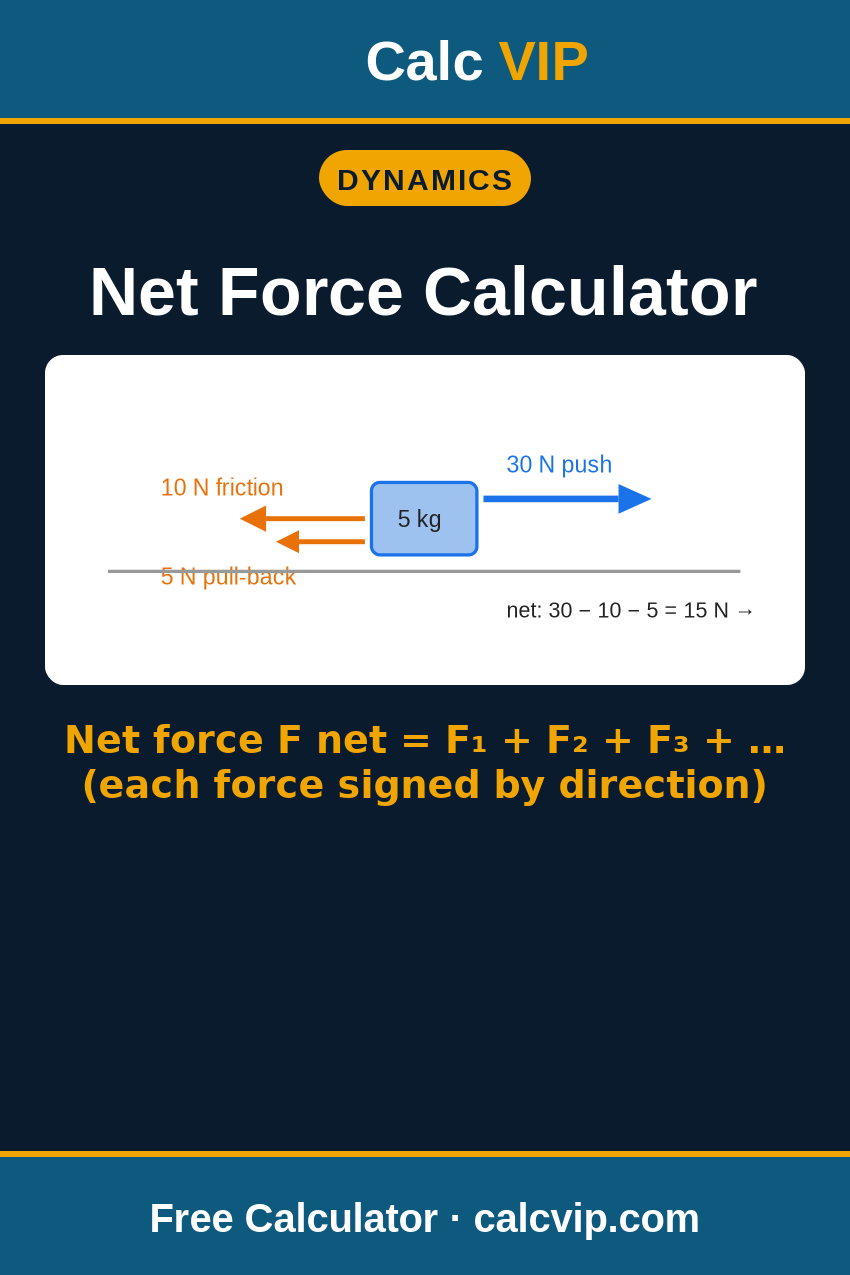
Example 1 — the pushed box. A box of mass 5 kg is pushed with 30 N to the right, while friction and a second push pull it back with 10 N and 5 N to the left.
Fnet = 30 − 10 − 5 = 15 N to the right.
a = Fnet ÷ m = 15 ÷ 5 = 3 m/s² to the right. Half the push was spent cancelling the opposition; only the surviving 15 N accelerates the box.
Example 2 — tug of war. The blue team pulls a rope with 120 N and 90 N to the right; the orange team pulls with 150 N to the left. Treating the rope and teams' grip as one system of mass 30 kg at the marker: Fnet = 120 + 90 − 150 = 60 N to the right, so the marker accelerates at 60 ÷ 30 = 2 m/s² towards the blue side. Three strong pulls, one modest remainder — most contests are decided by the difference, not the totals.
Example 3 — a car pulling away. A car of mass 900 kg has its engine driving it forwards with 3,000 N while air drag and rolling resistance together oppose it with 1,200 N. Fnet = 3,000 − 1,200 = 1,800 N, and a = 1,800 ÷ 900 = 2 m/s². As the car speeds up, drag grows, the net force shrinks, and the acceleration fades — which is why cars sprint eagerly off the line but creep the last few km/h to their top speed, where drag finally cancels the thrust completely.
Example 4 — the book that goes nowhere. A 2 kg book rests on a table. Gravity pulls it down with mg = 2 × 9.81 = 19.62 N; the table pushes up with a normal force of exactly 19.62 N. Vertically, Fnet = 19.62 − 19.62 = 0 N, so a = 0 — the book stays put. Balanced does not mean force-free: two real forces are acting, they simply erase each other's effect.
Example 5 — a rocket at liftoff. A small rocket of mass 1,000 kg weighs 1,000 × 9.81 = 9,810 N. Its motor produces 25,000 N of thrust upwards. Fnet = 25,000 − 9,810 = 15,190 N upwards, giving a = 15,190 ÷ 1,000 = 15.19 m/s² — about one and a half g of acceleration on top of gravity's pull. Any thrust less than 9,810 N would leave the net force pointing down and the rocket sitting on the pad, burning fuel to no effect.
Example 6 — braking to a stop. A 1,200 kg car travelling right brakes; the road's friction on the tyres totals 6,000 N to the left, and we ignore the much smaller air drag. Fnet = −6,000 N, so a = −6,000 ÷ 1,200 = −5 m/s². The negative sign is the whole story: the velocity points right, the acceleration points left, and the car sheds 5 m/s of speed every second until it stops.
Net force in real life
Driving and braking. Every change of a car's speed is a net-force report. Accelerating, cruising and braking correspond to positive, zero and negative net force, and the brake pedal is really a net-force control — it decides how large a backwards remainder the tyres are asked to produce.
Lifts and the feeling of weight. When a lift accelerates upwards, the floor's push on you exceeds your weight, so the net force on your body points up and you feel heavier. The surplus force is precisely m × a — for a 60 kg person accelerating at 2 m/s², an extra 120 N.
Towing and recovery. A tow rope pulling a stranded car must overcome rolling resistance before any force is left to accelerate it. If the rope pulls with 2,500 N and resistance takes 900 N, only 1,600 N is available to get the car moving — undersized ropes snap because they were chosen for the total pull, not the remainder plus the jerk of starting.
Aircraft in level flight. Pilots summarise steady flight as "thrust equals drag, lift equals weight" — two separate net-force zeros, one horizontal, one vertical. Any climb, descent or speed change is a deliberate, temporary imbalance.
Sports. A football struck by a boot experiences an enormous net force for a few milliseconds — thousands of newtons — which is what changes its velocity so violently. In flight, gravity and drag alone remain, and their small net force curves the ball's path into the familiar arc.
Moving furniture. Two people pushing a wardrobe in the same direction add their forces; pushing against each other wastes both. The practical art of shifting heavy objects is mostly the art of making every applied force point the same way, so the net force is the sum rather than the difference.
Free-body diagrams: the bookkeeping made visible
Professionals rarely add forces from a written list; they draw them. A free-body diagram replaces the object with a single dot and draws every force as an arrow starting at the dot, sized in proportion to the force and pointing the way the force acts. The diagram forces completeness — gravity, support, friction, pushes, pulls — because a missing arrow is visible at a glance, and it makes the net force geometrical: arrows that cancel are drawn equal and opposite, and the leftover arrow is the answer. Before trusting any net-force calculation, sketch the diagram. Most errors in this topic are not arithmetic at all; they are forces that were never written down, or forces invented that do not exist.
Forces at angles: the same idea, one extra step
This calculator adds forces along a single line, but the net-force idea does not change when forces point at angles — only the bookkeeping grows. Each angled force is first split into a horizontal component (F cos θ) and a vertical component (F sin θ); the horizontal components are then added with signs, the vertical components are added with signs, and the two totals combine by Pythagoras into one net force. A 100 N force at 30° above the horizontal, for instance, contributes 86.6 N horizontally and 50 N vertically. Every two-dimensional problem in dynamics is this calculator run twice, once per direction — which is why mastering the signed one-line version matters.
Once the two totals exist, they combine into a single resultant with Pythagoras: if the horizontal total is 60 N and the vertical total is 80 N, the net force is √(60² + 80²) = 100 N, pointing at arctan(80 ÷ 60) = 53° above the horizontal. The acceleration then follows from that one resultant, a = 100 ÷ m in the 53° direction. Notice that the components, not the original angled forces, are what get added — adding the raw magnitudes of angled forces directly is meaningless, because forces pointing different ways partly cancel in a way only components can capture.
Quick reference: reading a net force
| Situation | Net force | Motion |
|---|---|---|
| object at rest, forces balanced | 0 N | stays at rest |
| cruising car or plane, steady speed | 0 N | constant velocity |
| push exceeds friction | push − friction | accelerates forwards |
| braking car | backwards (negative) | decelerates |
| rocket at liftoff | thrust − weight | accelerates upwards |
| falling object at terminal velocity | 0 N (drag = weight) | constant velocity |
The table's pattern is the whole topic in miniature: motion changes exactly when, and only when, the middle column is not zero.
Common mistakes
- Adding forces without signs. 30 N right and 10 N left make 20 N, not 40 N. Direction is half of every force's identity; unsigned addition is the single most common error in this topic.
- Assuming motion needs a net force. Steady motion needs none — only changes of motion do. A sliding object with friction exactly matched by a push glides at constant speed indefinitely.
- Forgetting friction or gravity. Real pushes almost always fight friction, and vertical problems always include weight. If your net force uses only the forces mentioned in the question's first sentence, it is probably incomplete.
- Confusing net force with the biggest force. The biggest force wins only what is left after the others cancel. A 25,000 N rocket thrust produced a net force of 15,190 N — gravity took its share first.
- Reporting acceleration without direction. a = 3 m/s² is half an answer. The sign (or a stated direction) is part of the result, because acceleration is a vector too.
FAQ
What is net force?
The net force is the single force that has the same effect as all the individual forces combined. It is what actually accelerates the object.
Why do leftward forces count as negative?
Force is a vector, so direction matters. Choosing right as positive means leftward forces subtract. The sign of the answer then tells you which way the net force points.
What if the net force is zero?
The forces are balanced, so the acceleration is zero: the object stays at rest or keeps moving at a constant velocity (Newton's First Law).
Can net force be negative?
Yes — the sign simply reports direction under your chosen convention. A net force of −6,000 N means 6,000 N pointing in whichever direction you labelled negative, usually left or down.
How many forces can act on one object?
There is no limit. Real objects often have five or more (gravity, support, friction, pushes, air drag, buoyancy…). This calculator takes three along a line, but the signed-addition method is identical for any count.
What is the difference between net force and total force?
Used carefully, "total" sometimes means the sum of magnitudes — 30 N + 10 N = 40 N of force "involved". Net force is the vector sum with directions, 20 N in that case, and it is the net force alone that decides acceleration.
Does a net force always cause speed to increase?
No. It causes velocity to change. Aligned with the motion it speeds the object up; opposed, it slows it down; sideways, it turns it. Speeding up is only one of three outcomes.
How is net force measured in practice?
Directly, with spring balances or force sensors arranged to read the resultant; or indirectly, by measuring mass and acceleration and multiplying — which is how the forces inside car crashes and rocket tests are usually reconstructed.
Why does a heavier object need more net force for the same acceleration?
Because a = F ÷ m: double the mass and the same force produces half the acceleration. Mass is inertia — resistance to changes in motion — and the net force must overcome all of it.
What net force acts on a satellite in a steady circular orbit?
A substantial one — gravity — pointing towards the Earth. The satellite's speed is constant but its direction changes continuously, which is acceleration, so a net (centripetal) force must exist. Zero net force would send it off in a straight line.