 Calc
Normal Force Calculator – Flat Surface & Incline N = mg cos θ
 Created by James Carter · Physics Writer · Forces & Motion · Last updated: November 2026
Use this free Normal Force Calculator to find the force a surface pushes back with. Choose a flat surface or an incline, enter the mass (and the slope angle for an incline), and the calculator returns the normal force in newtons.
Every object resting on a surface is in a quiet negotiation. Gravity pulls it down into the floor, the table or the slope — and the surface pushes back, perpendicular to itself, with a force called the normal force (normal being the mathematician's word for "at right angles"). Without that pushback, everything would simply fall through everything else. The normal force is the reason solid ground is solid, and computing it is a gateway skill: friction, apparent weight and half of dynamics take the normal force as their starting input.
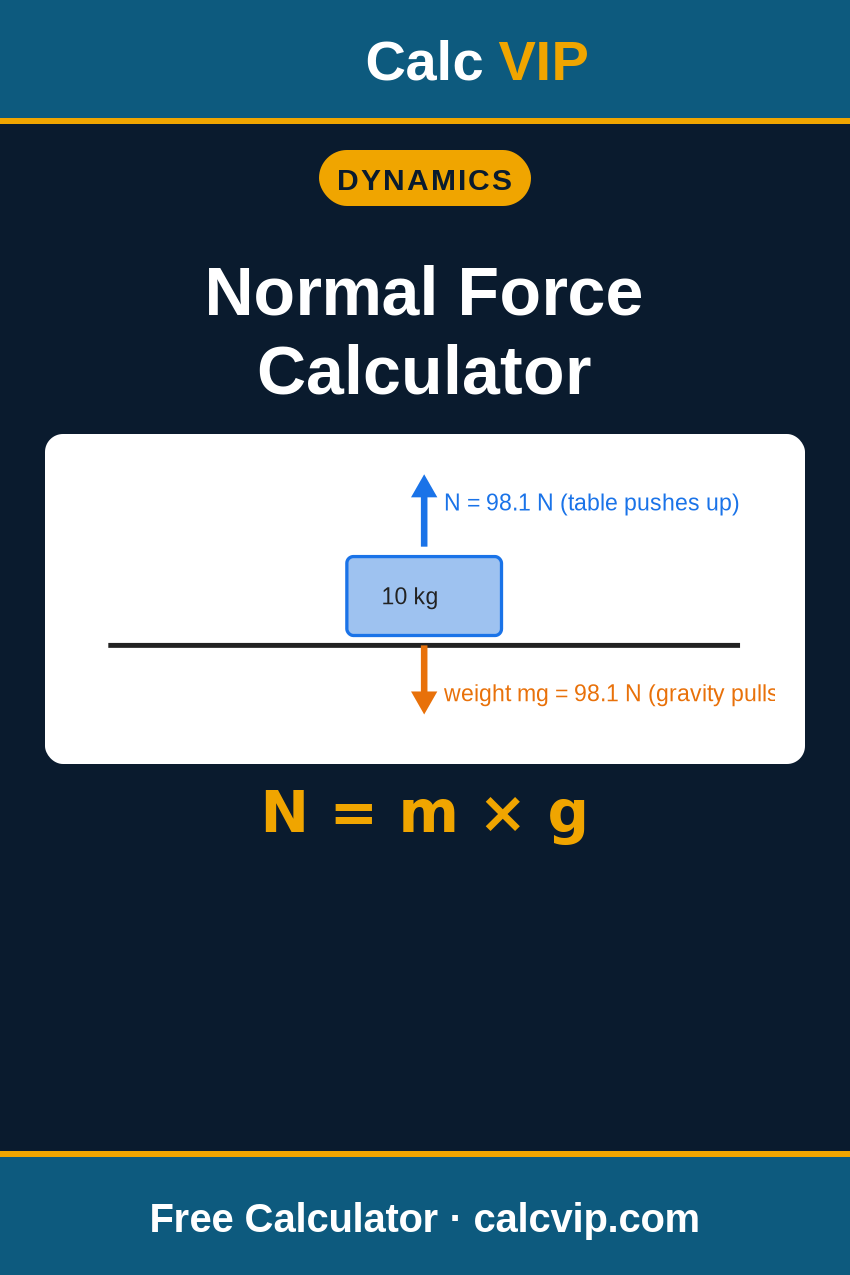
On flat ground the negotiation is simple: the surface pushes up with exactly the object's weight, N = mg, because nothing else is happening vertically. Tilt the surface, though, and the picture changes. Only the part of the weight pressing straight into the slope needs answering, and that part is mg cos θ — so the normal force shrinks as the slope steepens, reaching zero on a vertical wall, which indeed pushes back on nothing that merely leans-less falls past it. The rest of the weight, mg sin θ, points along the slope and is somebody else's problem (friction's, usually).
This calculator covers both standard cases and lets you change g, so the same box can be weighed against floors on the Moon or Mars. Enter the mass, pick the surface, add the angle if there is one, and the normal force appears. Keep the result nearby if you are heading for a friction calculation — N is the number friction multiplies.
Formula
Flat surface: N = m × g • Incline at angle θ: N = m × g × cos θ • N in newtons, m in kg, g in m/s²
The two formulas are one idea at two tilts: the normal force equals the component of the weight pointing straight into the surface. At θ = 0° the incline formula returns mg cos 0° = mg, the flat case; at θ = 90° it returns zero. Rearranged, the flat formula also runs the scale-maker's conversion, m = N ÷ g — a surface (or a scale) reporting a normal force can be turned back into the mass that produced it, but only where g is known and nothing is accelerating. Watch the angle's cosine: it falls slowly at first (cos 10° = 0.98) and then fast (cos 60° = 0.50), so gentle slopes barely change N while steep ones gut it — a fact with real consequences for grip, as the applications below show.
| Symbol | Meaning | Units |
|---|---|---|
| N | normal force — the surface's perpendicular push | newtons (N) |
| m | mass of the object | kilograms (kg) |
| g | gravitational field strength (Earth ≈ 9.81) | m/s² |
| θ | slope angle above the horizontal | degrees (°) |
A force that decides its own size
The normal force is unusual among forces: it has no formula of nature fixing its size in advance. Instead it is a constraint force — it takes whatever value is needed to stop the object passing through the surface, and not a newton more. Rest a book on a table and N equals the book's weight. Press down on the book with your hand and N quietly grows by exactly your push. Stack a second book on top and N doubles. The surface is not measuring anything; at the microscopic level its material compresses a fraction of a millimetre, and the electromagnetic repulsion between its atoms and the object's atoms strengthens until equilibrium is reached. A floor is, in effect, an extremely stiff spring that always stops at precisely the required force.
That self-adjusting character explains the cases where N is not mg. Accelerate the surface upwards — a lift floor — and N must exceed mg to provide the net force for the acceleration: N = m(g + a). Pull upwards on the object with a rope and N shrinks by the rope's share. Round the top of a hill at speed and the road's required push falls, even to zero, which is the stomach-lurching moment of a hump-backed bridge. In every case the method is the same: write down what the vertical (or into-surface) motion demands, and the normal force is whatever satisfies it.
Direction deserves its own sentence, because it is the most-tested fact on this page: the normal force is always perpendicular to the surface — straight up from a floor, tilted from a slope, sideways from a wall you lean against. It is never "opposite to gravity" except by coincidence on flat ground, and it is never along the slope. Friction owns the along-surface direction; the normal force owns the through-surface one, and the two together make up everything a surface can do to an object resting on it.
How to use
- Choose the surface type: flat, or inclined (a slope).
- Enter the mass of the object in kilograms.
- For an incline, enter the slope angle in degrees above the horizontal.
- Adjust g if you are not on Earth (Moon 1.62, Mars 3.71). Click "Calculate" to get the normal force in newtons.
Worked examples
Example 1 — flat versus tilted. A 10 kg box on flat ground: N = mg = 10 × 9.81 = 98.1 N. Move the same box onto a 30° incline: N = mg cos θ = 98.1 × cos 30° = 98.1 × 0.866 = 84.96 N. The tilt cost the surface about 13 N of push — that missing share of the weight is now directed along the slope instead of into it.
Example 2 — a person standing still. A 75 kg person on a level floor experiences N = 75 × 9.81 = 735.75 N from the ground — 367.9 N through each foot, on average. This is the force a bathroom scale actually measures and converts into its kilogram display; the scale is a normal-force meter in disguise.
Example 3 — the 45° slope. A 20 kg crate on a 45° ramp: N = 20 × 9.81 × cos 45° = 196.2 × 0.7071 = 138.73 N. At 45° the weight splits exactly evenly between into-slope and along-slope components — each is mg ÷ √2 — which is why 45° is the crossover where sliding tendencies start to dominate holding ones for most materials.
Example 4 — a gentle ramp. A 5 kg box on a 20° loading ramp: N = 49.05 × cos 20° = 49.05 × 0.9397 = 46.09 N. Barely 3 N less than the flat value of 49.05 N — gentle slopes tax the normal force lightly, which is why wheelchair ramps and loading bays at such angles still offer nearly full friction for grip.
Example 5 — the same box on the Moon. The 10 kg box of Example 1, set down on flat lunar ground with g = 1.62 m/s²: N = 10 × 1.62 = 16.2 N. The box's mass is unchanged and its weight is a sixth of Earth's, so the Moon's surface needs to push back with only a sixth of the force — and friction available there falls by the same factor, one reason lunar rovers drive so cautiously on slopes.
Example 6 — a steep slope. A 15 kg pack resting on a 60° scree slope: N = 15 × 9.81 × cos 60° = 147.15 × 0.5 = 73.58 N — exactly half the flat-ground value, because cos 60° = 0.5. The other half of the weight now acts along the slope, and since friction is capped at μ × 73.58 N, most packs (and people) cannot rest on a 60° slope unaided.
Normal force in real life
Weighing. Every scale — spring, load cell or balance-beam conversion — reports the normal force and labels it in kilograms via Earth's g. Move the scale to a slope or a lift and the "weight" changes, not because mass changed, but because N did.
Vehicle grip. A tyre's maximum friction is μ × N, so anything that unloads a wheel — cresting a hill, cornering weight transfer, a steep slope's cos θ — directly cuts the grip budget. Racing cars fight back with aerodynamic downforce: wings that press the car into the road, manufacturing extra normal force out of air.
Buildings and foundations. Floors, shelves and foundations are rated by the normal forces they must supply. A library stack room's floor carries the full mg of every shelf forever; engineers add margins because the surface's push must never fail, even once.
Ramps and accessibility. The cos θ factor is why steep ramps are doubly hostile to wheelchairs: the along-slope pull grows (sin θ) while the normal force feeding tyre grip shrinks (cos θ). Building codes cap ramp angles for physics reasons before comfort ones.
Skiing and climbing. A skier's grip on the snow scales with mg cos θ; on very steep faces the normal force is a fraction of body weight, edges bite less, and technique shifts to managing the along-slope component instead. Climbers on slabs live by the same equation, trusting shoes while cos θ still delivers enough N for friction to work with.
Conveyor belts and sorting lines. Packages on inclined conveyors stay put only while friction — capped by μ mg cos θ — exceeds mg sin θ. Belt designers pick angles and belt materials from exactly this page's two formulas, and a package that slides backwards is a normal-force shortfall made visible.
When N is not mg cos θ either
The incline formula assumes gravity is the only force pressing the object into the surface. Add anything else with an into-surface component and N adjusts by exactly that component. Push down on a box on a slope and N grows by your push's into-slope share; strap the box to the slope and the strap's tension adds its share instead. On a flat floor, an angled pull — dragging a suitcase by its handle — lifts part of the weight, so N = mg − F sin θ, which is precisely why a pulled suitcase feels lighter and slides more easily than a pushed one, whose handle angle presses it into the floor and raises N. The rule never changes: N equals the total into-surface pressure from all causes, and this calculator handles the common case where gravity is the only cause.
Normal force on hills: when the road curves away
Curved ground changes the negotiation again, because an object following a curved path is accelerating towards the curve's centre, and the normal force must supply the difference. Drive over a crest — a hump-backed bridge — and the road curves downwards, so part of your weight is "spent" on the downward acceleration of following the arc: N = m(g − v²/r). A 1,000 kg car crossing a crest of radius 50 m at 10 m/s has v²/r = 100 ÷ 50 = 2 m/s², so the road pushes up with only 1,000 × (9.81 − 2) = 7,810 N instead of 9,810 N — a fifth of the normal force gone, and with it a fifth of the available grip, which is why crests are treacherous in the wet. Go fast enough that v²/r = g and N reaches zero: the car leaves the road. The same physics in a dip reverses sign — N = m(g + v²/r) = 11,810 N for the same car and speed — pressing occupants into their seats and suspension into its stops. Rollercoasters are simply these two formulas, choreographed.
Notice what the crest example teaches about the calculator's two modes: flat and incline formulas assume the surface is straight and the object is not accelerating through it. The moment the surface curves or accelerates — lifts, crests, dips, centrifuges — the normal force is set by the motion's demands, and the static formulas become the starting point rather than the answer. Recognising which regime you are in is most of what "understanding the normal force" means.
Quick reference: the cosine factor
| Slope angle θ | cos θ | N for a 10 kg object |
|---|---|---|
| 0° (flat) | 1.000 | 98.1 N |
| 10° | 0.985 | 96.6 N |
| 20° | 0.940 | 92.2 N |
| 30° | 0.866 | 84.96 N |
| 45° | 0.707 | 69.4 N |
| 60° | 0.500 | 49.05 N |
| 90° (wall) | 0 | 0 N |
Read the middle column as "fraction of your weight the surface still feels": a slope must reach 60° before it halves, which is why moderate hills change grip less than drivers expect — and steep ones change it more.
Common mistakes
- Writing N = mg automatically. That equality is flat-ground-only. Slopes take cos θ, lifts take acceleration into account, angled pushes and pulls add or subtract their share.
- Using sin θ for the incline. The into-slope component is mg cos θ; mg sin θ runs along the slope. A quick check saves you: at θ = 0 the formula must return mg — only cos does that.
- Pointing N opposite to gravity. The normal force is perpendicular to the surface, not antiparallel to gravity. On a slope it points tilted, out of the hillside.
- Treating N as a property of the object. The same box has different normal forces on different surfaces, slopes and planets. N belongs to the situation, not the object.
- Feeding mass into friction instead of N. Friction's formula wants the normal force. On anything but flat ground, computing N first — the job of this page — is a compulsory step, not a refinement.
FAQ
Is the normal force always equal to the weight?
No. It equals mg only on a flat, non-accelerating surface. On a slope it is mg cos θ, and in a lift it changes with the acceleration.
Why does the incline formula use cos θ?
Only the part of the weight pressing straight into the surface counts, and that component is mg cos θ. The other component, mg sin θ, acts along the slope.
What direction does the normal force act?
Always perpendicular (at 90°) to the surface — straight out of a flat floor, or at an angle out of a slope.
What actually creates the normal force?
Electromagnetic repulsion between the atoms of the two surfaces. The object's atoms press into the surface's atoms, electron clouds resist the overlap, and the resulting push grows until it balances the pressing force — the surface behaving like an immensely stiff spring.
Can the normal force be zero?
Yes — whenever contact is lost or no pressure exists: an object in free fall, a car airborne over a crest, or a box on the ceiling-side of nothing at all. Zero N also means zero friction, which is why airborne wheels cannot brake or steer.
Is the normal force a reaction to weight?
Not strictly. Newton's third-law partner of the object's weight (Earth pulling the object) is the object pulling the Earth. The partner of the normal force is the object pushing down on the surface. N and mg are often equal, but they are different forces acting on the same object, not an action–reaction pair.
Does a heavier object always have a bigger normal force?
On the same surface in the same situation, yes — N scales with m. But a light object pressed down hard can exceed a heavy object resting gently, because N answers the total pressure, not the mass alone.
Why do my feet hurt on a ladder but not the floor?
The normal force is similar, but pressure is force ÷ area. A rung concentrates the same N onto a few square centimetres, and it is pressure, not force, that your nerves report.
What is the normal force on a vertical wall?
From gravity alone, zero — gravity runs parallel to a wall, not into it. Press an object against a wall with your hand, though, and the wall's normal force equals your push, which is how friction can then hold the object up.
How is N measured in engineering?
With load cells and pressure-sensitive films placed at the interface, or indirectly from strain in the supporting structure. Tyre engineers map the normal force across a contact patch point by point, because grip follows it everywhere.