 Calc
Planetary Density Calculator – Average Density from Mass & Radius
 Created by Priya Sharma · Physics Editor · Energy & Gravity · Last updated: November 2026
Use this free Planetary Density Calculator to find the average density of a planet or moon from its mass and radius. Density reveals what a world is made of — rock, metal, ice or gas.
Two numbers — a world's mass and its radius — are all astronomers usually get for a distant planet, and dividing one by the volume implied by the other produces the single most revealing quantity in planetary science: the average density. It works because the ingredients of worlds come in well-separated densities. Hydrogen and helium gas, even compressed, sit near or below 1,000–1,700 kg/m³; water ice near 900–1,600; rock between 2,700 and 3,500; iron and nickel near 7,900. A planet averaging 700 kg/m³ must be mostly gas; one averaging 5,500 kg/m³ must be mostly rock and metal. Density is the fingerprint that lets us classify worlds we will never touch.
The solar system's own table reads like a story of distance. Earth, at 5,513 kg/m³, is the densest planet — a ball of rock wrapped around an enormous iron core, further squeezed by its own gravity. Mercury and Venus follow close behind; Mars, smaller and less compressed, averages 3,934. Then the fall off a cliff: Jupiter 1,326, Uranus 1,270, Neptune 1,638, and Saturn a scarcely believable 687 kg/m³ — the only planet less dense than water, a world that would float in a large enough ocean. The pattern is the solar nebula's temperature gradient, preserved: close to the young Sun only rock and metal could condense; far out, gas and ice were available in bulk.
This calculator takes any mass and radius — presets cover the Earth, Moon, Mars, Jupiter and the Sun — and returns the volume and the average density in kg/m³ and g/cm³. The two units differ by exactly a factor of 1,000, and planetary scientists habitually quote g/cm³, so an answer of 5.51 g/cm³ for Earth and 5,513 kg/m³ are the same statement. Invent a world with the Custom option and you can test planet-building recipes of your own: the density will tell you immediately whether your creation is a gas giant, an ocean world or a ball of iron.
Formula
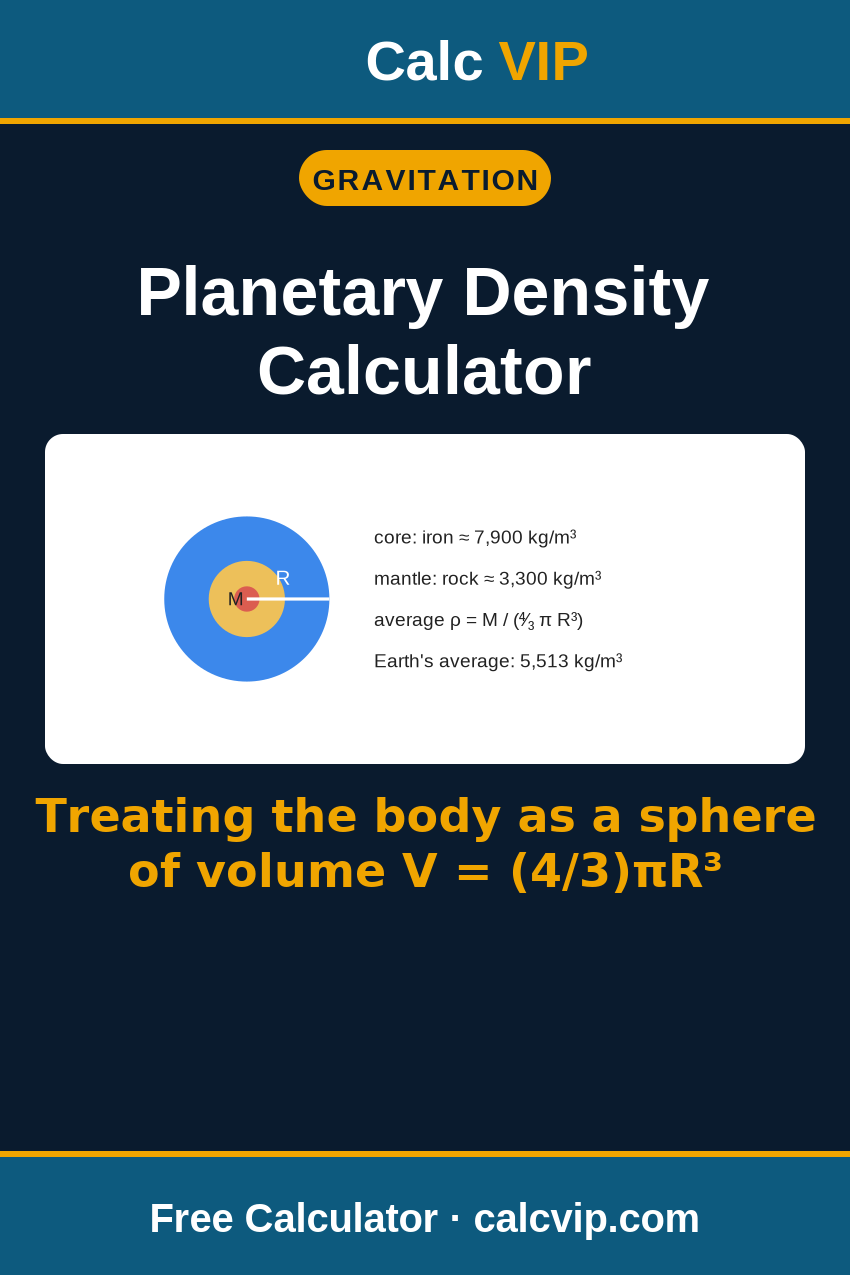
Treating the body as a sphere of volume V = (4/3)πR³, its average density is ρ = M / V = M / ((4/3)πR³) = 3M / (4πR³) • ρ in kg/m³, M in kg, R in metres (calculator accepts km).
The formula rearranges to fill in whichever quantity is missing. Given a density and a radius, the mass is M = (4/3)πR³ρ — the way to build a planet to a recipe. Given a mass and a target density, the radius is R = (3M / 4πρ)1/3 — the way to ask how big a pure-iron Earth, or a pure-ice Jupiter, would be. Water has a density of 1,000 kg/m³ (1 g/cm³), rock about 3,000 kg/m³ and iron about 7,870 kg/m³, so a planet's average density is a strong clue to its recipe. One caution built into the cube: density is brutally sensitive to the radius. Because R enters cubed, a 5% error in a planet's measured radius becomes a roughly 16% error in its density — the dominant uncertainty for nearly every exoplanet ever characterised.
| Symbol | Meaning | Units |
|---|---|---|
| ρ | average (bulk) density of the body | kg/m³ (= g/cm³ × 1000) |
| M | total mass of the body | kg |
| R | mean radius of the body | km (calculator input) |
| V | volume, (4/3)πR³ | m³ |
Compression: why big worlds cheat
The naive reading of the density table — Earth is denser than the Moon, so Earth must be made of heavier stuff — is only half true, because gravity squeezes. A planet's own weight compresses its interior: rock at the bottom of Earth's mantle is crushed to densities far above the 2,700 kg/m³ of the same rock in your hand, and the iron core is squeezed beyond 10,000 kg/m³. The Moon, too small to squeeze much, shows nearly its honest ingredient density of 3,345 kg/m³. To compare recipes fairly, scientists compute an uncompressed density — what the planet would average if its material were all at surface pressure. Earth's uncompressed density is only about 4,000–4,400 kg/m³; the rest of the famous 5,513 is self-compression. Mercury, remarkably, still beats Earth uncompressed — evidence that Mercury is genuinely the most iron-rich planet, probably because a giant ancient collision stripped away much of its rocky mantle.
Compression also bends the mass–radius relationship that exoplanet hunters rely on. Double a rocky planet's mass and its radius grows by much less than the cube root of two, because the extra gravity squeezes the new material harder; a five-Earth-mass rocky planet is only about 1.5 Earth radii across, not 1.7. Gas giants break the pattern entirely: beyond about Saturn's mass, adding gas mostly adds compression rather than size, which is why Jupiter, at 318 Earth masses, is barely larger in radius than Saturn — and why the most massive brown dwarfs are all roughly Jupiter's size despite spanning a factor of fifty in mass.
How to use
- Pick a preset body — Earth, Moon, Mars, Jupiter or Sun — or choose Custom and enter any mass and radius.
- Mass goes in kilograms (scientific notation like 5.972e24 works and is strongly recommended) and radius in kilometres. Use the mean radius for flattened worlds like Saturn and Jupiter.
- Click "Calculate Density" to get the volume in m³ and the density in kg/m³ and g/cm³.
- Read the answer against the ingredient scale: below ~1,700 suggests gas or ice dominance; 3,000–4,000 a rocky or icy-rocky mix; above ~5,000 a rock-and-metal world with a substantial core.
- Remember the radius-cubed warning: if the radius you entered is uncertain by a few percent, the density is uncertain by roughly three times as much — quote exoplanet densities with humility.
Worked examples
Example 1 — Earth. M = 5.972 × 10²⁴ kg, R = 6,371 km.
V = (4/3)π × (6.371 × 10⁶)³ ≈ 1.083 × 10²¹ m³
ρ = 5.972 × 10²⁴ / 1.083 × 10²¹ ≈ 5,513 kg/m³ = 5.51 g/cm³.
Earth is the densest planet in the solar system — a sign of its large iron-nickel core. Jupiter, by contrast, averages only about 1,326 kg/m³.
Example 2 — Jupiter. M = 1.898 × 10²⁷ kg, R = 69,911 km.
V = (4/3)π × (6.9911 × 10⁷)³ ≈ 1.431 × 10²⁴ m³
ρ = 1.898 × 10²⁷ / 1.431 × 10²⁴ ≈ 1,326 kg/m³ = 1.33 g/cm³.
A world 318 times Earth's mass averages barely a quarter of Earth's density: it is hydrogen and helium, with the modest figure above 1,000 reflecting how fiercely its own gravity compresses that gas.
Example 3 — the Moon. M = 7.348 × 10²² kg, R = 1,737.4 km.
V ≈ 2.197 × 10¹⁹ m³; ρ = 7.348 × 10²² / 2.197 × 10¹⁹ ≈ 3,345 kg/m³ = 3.34 g/cm³.
Almost pure rock with only a small iron core — the density signature that supports the giant-impact origin story, in which the Moon condensed mostly from Earth's mantle material rather than from core-rich debris.
Example 4 — Mars. M = 6.417 × 10²³ kg, R = 3,389.5 km.
V ≈ 1.631 × 10²⁰ m³; ρ ≈ 3,934 kg/m³ = 3.93 g/cm³.
Between Moon and Earth: a rocky planet with a significant but proportionally smaller iron core, and not enough mass to compress itself to terrestrial figures. NASA's InSight lander confirmed the picture seismically, measuring a large, liquid, iron-rich core.
Example 5 — Saturn, the floater. M = 5.683 × 10²⁶ kg, R = 58,232 km.
V ≈ 8.270 × 10²³ m³; ρ ≈ 687 kg/m³ = 0.69 g/cm³.
Less dense than water — the famous bathtub fact. Saturn achieves it by being almost all hydrogen and helium while having only 95 Earth masses, too little gravity to compress its gas as hard as Jupiter does.
Example 6 — the Sun. M = 1.989 × 10³⁰ kg, R = 695,700 km.
V ≈ 1.410 × 10²⁷ m³; ρ ≈ 1,410 kg/m³ = 1.41 g/cm³.
A star of gas and plasma averaging only 40% more than water — while its core, crushed by the weight above it, runs at about 150,000 kg/m³, denser than any ordinary solid. Average density describes the whole; the interior is another world entirely.
Planetary density in real life
Classifying exoplanets. For a transiting exoplanet, the dip in starlight gives the radius and the star's wobble gives the mass — and this calculator does the rest. The result sorts new worlds instantly: the TRAPPIST-1 planets cluster near Earth-like densities and are presumed rocky, while "super-puff" planets like those of Kepler-51 average under 100 kg/m³, lighter than candy floss, and demand exotic explanations involving hazes or rings.
Reading a moon's recipe. Saturn's moon Titan averages 1,881 kg/m³ and Jupiter's Ganymede 1,936 kg/m³ — both roughly half ice, half rock by mass, exactly what their densities announce. Europa's 3,010 kg/m³ says mostly rock with a thin icy shell — which is why its subsurface ocean, though global, is a film compared with the deep ice mantles of its neighbours.
Testing the giant-impact theory of the Moon. The Moon's density (3,345) is far below Earth's (5,513) and close to the density of Earth's mantle rock. That single comparison has constrained Moon-formation models for fifty years: the Moon must be built mostly from mantle material — Earth's or the impactor's — with very little iron core mixed in, exactly as the giant-impact simulations produce.
Asteroid mining and planetary defence. An asteroid's density, from its mass (measured by a visiting spacecraft or a moonlet's orbit) and its volume (from radar or imaging), separates solid metal worlds — Psyche, target of a NASA mission, is a suspected exposed iron core — from rubble piles like Bennu and Ryugu, whose densities near 1,200 kg/m³ reveal them as loosely bound gravel with empty space inside. The distinction decides both mining value and how an impactor would respond to a deflection attempt.
Weighing in on "ocean worlds". A rocky planet of Earth's mass with a global water layer would average noticeably less than 5,513 — a few percent of water by mass drops the density by hundreds of kg/m³. Several known exoplanets sit exactly in that ambiguous band, and their densities are the main evidence debated when headlines announce a possible water world.
White dwarfs and beyond. Run the same arithmetic on a white dwarf — a solar mass in an Earth-sized volume — and the density lands near 10⁹ kg/m³, a tonne per teaspoon. A neutron star reaches 10¹⁷–10¹⁸. The formula never changes; only the ingredients do, and density remains the first clue at every scale of astronomy.
Density is not enough: the moment of inertia
Two planets can share a mass, a radius and therefore a density, yet be built completely differently inside — one uniform, one with a huge dense core and a light fluffy mantle. The quantity that separates them is the moment of inertia factor, C/(MR²): 0.4 for a uniform ball, about 0.33 for Earth (core-heavy), 0.25 for a strongly concentrated body. Spacecraft measure it from how a planet's gravity field and rotation respond to tides and wobbles; combining it with density turns a one-number guess into an actual interior model with core size and mantle composition. It is the natural next step after this calculator, and it is how we know, for instance, that Mercury's iron core fills an outsized share of the planet — the fact its chart-topping uncompressed density first hinted at.
Quick reference: densities of solar-system worlds
| Body | Mass (kg) | Mean radius | Density |
|---|---|---|---|
| Earth | 5.972 × 10²⁴ | 6,371 km | 5,513 kg/m³ |
| Mercury | 3.301 × 10²³ | 2,439.7 km | 5,427 kg/m³ |
| Venus | 4.867 × 10²⁴ | 6,051.8 km | 5,242 kg/m³ |
| Mars | 6.417 × 10²³ | 3,389.5 km | 3,934 kg/m³ |
| Moon | 7.348 × 10²² | 1,737.4 km | 3,345 kg/m³ |
| Neptune | 1.024 × 10²⁶ | 24,622 km | 1,638 kg/m³ |
| Sun | 1.989 × 10³⁰ | 695,700 km | 1,410 kg/m³ |
| Jupiter | 1.898 × 10²⁷ | 69,911 km | 1,326 kg/m³ |
| Uranus | 8.681 × 10²⁵ | 25,362 km | 1,270 kg/m³ |
| Saturn | 5.683 × 10²⁶ | 58,232 km | 687 kg/m³ |
Sort the table by density and the solar system sorts itself: the four rocky worlds on top, the four giants at the bottom, and the Sun — a star, mostly hydrogen — sitting unembarrassedly among the giants it outweighs a thousandfold.
Common mistakes
- Entering the diameter instead of the radius. It doubles R, multiplies the volume by eight, and shrinks the density eightfold — Earth comes out at 689 kg/m³, Saturn-like nonsense that should trigger an immediate re-check.
- Mixing up kg/m³ and g/cm³. They differ by 1,000. Earth's density is 5,513 kg/m³ and 5.51 g/cm³; quoting "5,513 g/cm³" describes something denser than any normal matter.
- Using the equatorial radius for a flattened planet. Saturn's equatorial radius is 60,268 km but its mean radius is 58,232 km; using the equatorial figure understates the density by about 10%. For oblate worlds, always use the mean (volumetric) radius.
- Reading the average as the recipe, exactly. Density constrains the mix but does not uniquely determine it — a planet of 50% iron + 50% ice can mimic one of rock. Compression, temperature and layering all blur the fingerprint; density is the first clue, not the whole case.
- Forgetting the radius is cubed. Small radius errors explode: a 2% radius error is a 6% density error, and a 10% radius error is a 33% density error. Most published exoplanet density uncertainties are really radius uncertainties in disguise.
FAQ
Which planet is the least dense?
Saturn, at about 687 kg/m³ — less than water. Its bulk is hydrogen and helium gas compressed by its own gravity.
Does a high density always mean a metal core?
Usually it means a large fraction of heavy material (rock and metal) rather than ice or gas, but the average alone cannot separate core size from composition — scientists combine it with the moment of inertia for that.
Why is Earth's average density higher than surface rock?
Surface rock is about 2,700 kg/m³, but the core is mostly iron and nickel, and the deep interior is also squeezed to much higher densities by the pressure of the layers above.
Would Saturn really float in water?
In the thought experiment, yes — its average density of 687 kg/m³ is less than water's 1,000. In practice the ocean would need to be thousands of kilometres deep, Saturn has no solid surface to rest in it, and the planet would disrupt long before it bobbed. Treat it as a vivid way to remember the number, not an engineering proposal.
How do we know a planet's mass and radius in the first place?
Radius comes from transits — the fraction of starlight blocked — or, for solar-system bodies, direct imaging and occultations. Mass comes from gravity's effects: the wobble the planet induces in its star, the orbits of its moons, or the tracking of a visiting spacecraft. Density is what you get when both measurements meet.
What density would a pure water world have?
Somewhat above 1,000 kg/m³ — self-compression raises it, to roughly 1,200–1,800 kg/m³ for an Earth-mass ocean planet, because water deep inside is squeezed and eventually turns to high-pressure ice. A measured density in that band, for a planet too warm for surface ice, is the classic ocean-world signature.
Why is Mercury denser than Venus despite being smaller?
Partly composition — Mercury is roughly two-thirds iron by mass — and the leading explanation is violence: a giant impact early in its history is thought to have blasted away much of its original rocky mantle, leaving the oversized core behind. Its uncompressed density is the highest of any planet, which is what gives the game away.
Can a planet be denser than iron?
Its average can exceed the density of iron at surface pressure (7,870 kg/m³) if compression is extreme — massive rocky planets squeeze their interiors well past the uncompressed values of their ingredients. The densest known exoplanets average around 10,000 kg/m³ or more, consistent with iron-rich compositions under immense self-compression.
What is the density of a black hole?
The question dissolves on inspection: if you divide a black hole's mass by the volume inside its event horizon, the "density" falls with the square of the mass — a supermassive black hole like M87* averages less than the density of water by that measure, while a stellar one is astronomically dense. It is a reminder that density is a bulk property, and event horizons are not containers of uniform stuff.
Does density tell us if a planet could support life?
Indirectly. A density in the rocky band (roughly 3,500–6,000 kg/m³) suggests a solid surface with silicate chemistry — the kind of world where oceans and continents can exist. Gas-giant densities rule out a surface altogether. Density cannot promise life, but it can quickly rule out the worlds where life as we know it has nowhere to stand.