 Calc
Pulley System Calculator – Mechanical Advantage, Effort & Rope Length
 Created by James Carter · Physics Writer · Forces & Motion · Last updated: November 2026
Use this free Pulley System Calculator to find the mechanical advantage of a block and tackle from the number of supporting ropes, the effort force you need, and how much rope you must pull to lift the load.
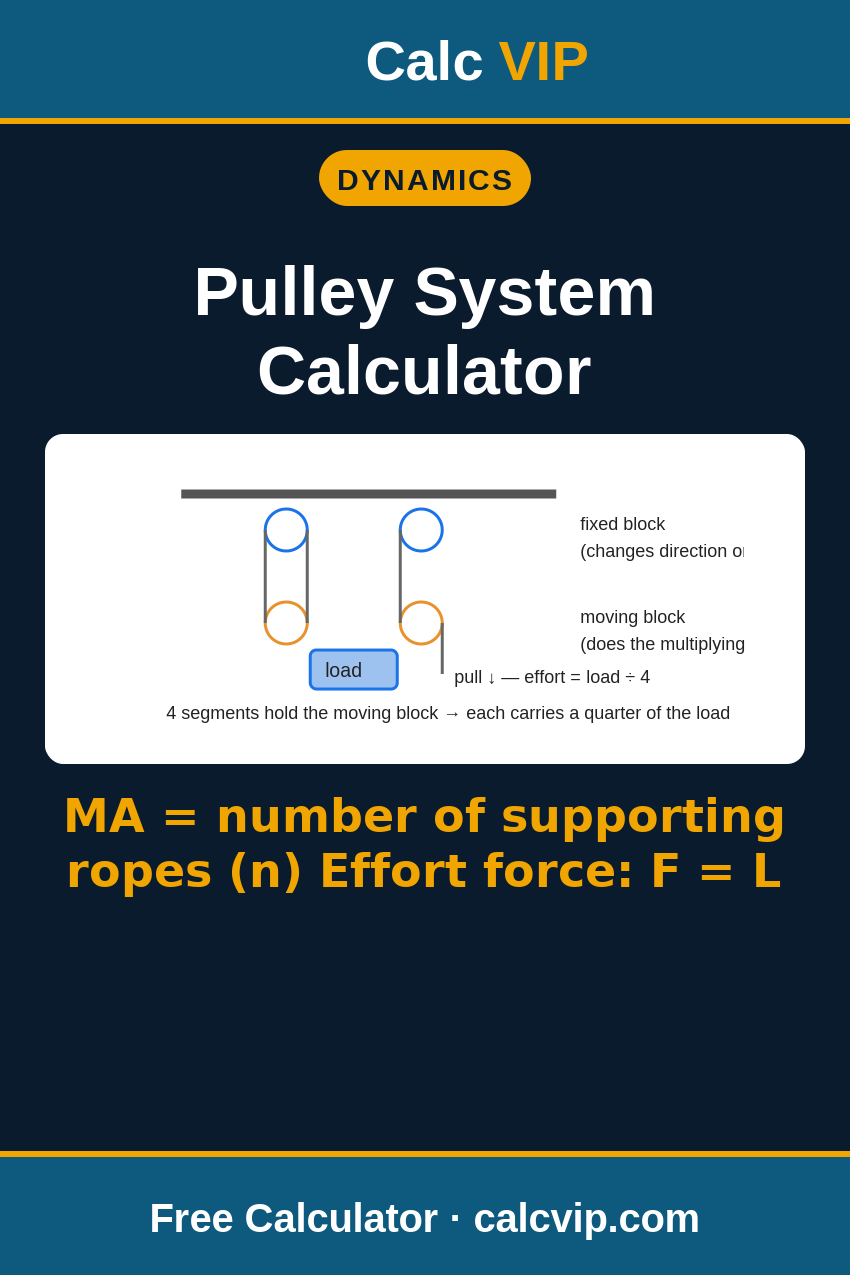
A single pulley changes a force's direction and nothing else — useful, but no stronger than your own arm. Add pulleys and rope in the arrangement called a block and tackle, and the same arm suddenly lifts engines, boats and safes. The secret is sharing: rig the rope so that n segments of it hold up the moving block, and each segment carries only its share of the load, so the effort you must supply falls to the load divided by n. This calculator turns the count of supporting ropes into the three numbers that plan a lift — the mechanical advantage, the effort force, and the length of rope you will have to pull through your hands to raise the load a given height.
The payment, as with every machine, is distance. Each supporting segment must shorten by the lift height as the load rises, so the free end travels n times the height: pull 4 metres of rope to lift the load 1 metre with four supporting ropes. Work is conserved — effort × rope pulled = load × height in the ideal case — and the tackle is best understood as a lever that resets itself continuously, exchanging a long, easy haul for a short, heavy lift. Sailors, who raised yards and cargo with muscle alone for millennia, graded their tackles by exactly this count: a single whip (n = 1), a gun tackle (n = 3), a luff tackle, a double tackle — the names are rope-counts in uniform.
The ideal numbers here assume weightless, frictionless pulleys. Reality taxes the system twice: each pulley's bearing friction steals a few percent of the tension passing over it, and the moving block's own weight joins the load. The result is that real effort runs above Load/n — by perhaps 5–10% per sheave in a plain-bearing tackle — and the wise rigger treats this page's effort as the floor, checks it against the rope's and pulleys' rated loads, and counts the supporting segments twice before trusting a lift to them. The counting rule, explained below, is where most mistakes happen.
Formula
Mechanical advantage: MA = number of supporting ropes (n)
Effort force: F = Load / n
Rope pulled: rope length = n × lift height
The three lines are one conservation law read three ways. The load is shared equally among n tensioned segments — in the ideal system the tension is the same throughout one continuous rope, so each segment pulls up with the effort force F, and nF = Load. The rope-length line follows from the rope being inextensible: the total rope is constant, so whatever the n segments surrender as they shorten must arrive at the free end. Rearranged, the formulas answer the rigger's other questions: n = Load / F (how many segments a target effort demands — round up, then rig at least that many), and height = rope / n (how high a given haul will lift). The load enters in newtons — mass × 9.81 if you start from kilograms — and in a real rig the moving block's weight should be added to it before dividing.
| Symbol | Meaning | Units |
|---|---|---|
| n | number of rope segments supporting the moving block | — (a count) |
| MA | mechanical advantage = n for an ideal tackle | none (a ratio) |
| F | effort — tension you apply to the free end | N |
| Load | weight of the load (plus the moving block, in real rigs) | N |
| h | height the load is lifted | m |
How to count supporting ropes — the one skill this page needs
The whole calculation hangs on n, and n is a count of rope segments that hold up the moving block — not a count of pulleys. The reliable method: draw a horizontal line just above the moving block and count every rope crossing it. Each crossing is a segment pulling up on the block with tension F. A segment counts when it is attached to the moving block or passes around one of its pulleys. The subtle case is the free end you haul on: if it leaves the moving block heading up, your pull adds a segment and counts; if it leaves a fixed top pulley heading down — the convenient arrangement, letting you pull downwards — it contributes no support, because its tension pulls on the fixed block, not the moving one. Two tackles with identical pulley counts can therefore differ by one in n, and the difference is a whole segment's worth of effort.
Friction bends the ideal picture in a specific direction. In a real rope each sheave it passes over skims a percentage off the tension, so the segments nearest the hauling end pull harder than those furthest away, the sharing is uneven, and the total effort exceeds Load/n. A useful field estimate: allow roughly 10% extra effort per sheave for plain bearings, 5% for ball-bearing blocks. The efficiency of the whole tackle — ideal effort divided by real effort — falls as n grows, which quietly caps useful tackles at around n = 6–8 for hand work: beyond that, extra segments add more friction than advantage.
How to use
- Enter the load's weight in newtons (weight = mass × 9.81 if you know the mass in kg).
- Count the rope segments that hold up the moving pulley block — that is n.
- Enter how high you want to lift the load, then click "Calculate".
- Add a friction allowance before rigging: roughly 5–10% more effort per pulley, and the moving block's own weight added to the load.
Worked examples
Example 1 — the standard tackle. A load of 600 N hangs from a block and tackle with 4 supporting ropes, lifted by 1 m.
MA = 4, so effort = 600 / 4 = 150 N.
Rope pulled = 4 × 1 = 4 m — you pull 4 metres of rope to raise the load 1 metre.
Example 2 — an engine hoist. An engine block weighing 2000 N must rise 0.5 m out of an engine bay, on a tackle with 6 supporting ropes: effort = 2000 / 6 = 333.33 N, rope pulled = 6 × 0.5 = 3 m. One person can supply 333 N with a good stance and gloves — the difference between a workshop job and a crane hire is six segments of rope.
Example 3 — the single pulley. A bucket of tools weighing 300 N is hauled 2 m up a scaffold through one fixed pulley: n = 1, effort = 300 N, rope pulled = 2 m. No advantage at all — the pulley's entire contribution is letting the worker pull down, using body weight, instead of up. Direction is a feature; it is just not a multiplier.
Example 4 — raising a sailboat's mast gear. A load of 1200 N on a gun tackle (n = 3) rises 2 m: effort = 1200 / 3 = 400 N, rope = 3 × 2 = 6 m. Three segments is the classic compromise — meaningful help, modest rope to coil afterwards, and friction still a minor tax.
Example 5 — a construction lift. A 5000 N machine part must go up 20 m on a big tackle with 10 supporting ropes: effort = 5000 / 10 = 500 N, but rope pulled = 10 × 20 = 200 m. The force is trivial; the logistics are not — two hundred metres of rope must be hauled, kept untangled and finally coiled, which is why big lifts motorise the hauling end.
Example 6 — a rescue system. A casualty and stretcher weighing 800 N are raised 10 m on a 5-segment system: effort = 800 / 5 = 160 N, rope = 5 × 10 = 50 m. Rescue teams prize this arrangement: a small team can supply 160 N all day, the load rises slowly and controllably, and the system's friction — the ideal formula's enemy — becomes a safety feature when lowering.
Pulleys in real life
Sailing. The block and tackle is the sailor's engine: mainsheets, halyards and cargo whips are graded by their rope count, and a yacht's winch is a tackle's rotating cousin. Reading a boat's rigging is reading a row of these calculations made visible.
Cranes and hoists. A tower crane's hook block is a moving block with many sheaves; the count of rope falls at the hook sets the winch's required pull exactly as n does here. Reeving diagrams in the crane's manual are this page with serial numbers.
Elevators and counterweights. Lifts roping 2:1 or 4:1 over the motor sheave trade motor torque for rope travel identically to a tackle — the "supporting ropes" idea wearing a steel cable, with the counterweight playing the effort.
Theatre and film rigging. Flying scenery and performers is block-and-tackle work with human loads, where the ideal numbers are derated heavily, every segment is inspected, and the rope-length line of the formula plans how much line the fly rail must handle.
Climbing and rescue. Haul systems for crevasse rescue are tackles built from carabiners and prusiks, counted exactly as here (3:1 and 5:1 are the standards) — with carabiner friction so high that real advantage runs well below n, a live lesson in the efficiency discussion above.
Everyday machines. Venetian blinds, clotheslines on pulleys, gym cable machines and the humble clothes-prop all borrow pieces of the idea; the gym machine's weight stack, guided over pulleys, shows the direction-change-only case (n = 1) in daily use.
Efficiency: why real tackles fall short of n
Measure a real tackle and its advantage is always less than its rope count. Each sheave's bearing resists turning, and the rope itself resists bending around the sheave; both effects skim tension, so the segments do not share the load equally — the segment nearest your hand carries the most, the furthest segment the least, and the moving block is lifted by a total less than n times your pull. Ball-bearing blocks skim perhaps 5% per sheave, plain-bore blocks 10%, and a rope bent around a carabiner (the climber's improvised pulley) can lose a third at a single turn. The practical consequences: use the largest sheaves and the fewest segments that do the job, prefer pulling down (adding your weight) to pulling up, and when a lift truly matters, test it a few centimetres off the ground first — the tackle will tell you its real advantage immediately, in the only units that count.
Quick reference: one load, many tackles (1200 N load, 2 m lift)
| Supporting ropes n | Ideal effort | Rope pulled |
|---|---|---|
| 1 (single fixed pulley) | 1200 N | 2 m |
| 2 | 600 N | 4 m |
| 3 (gun tackle) | 400 N | 6 m |
| 4 | 300 N | 8 m |
| 6 | 200 N | 12 m |
Every row does identical work — 2400 joules of it — arranged at a different exchange rate between force and distance. Choosing the row is choosing who tires: the arm, or the rope handler.
Velocity ratio and efficiency: the tackle's report card
Riggers grade a tackle with two numbers beyond MA. The velocity ratio is the distance the effort moves divided by the distance the load moves — for an ideal tackle it equals n exactly, and unlike MA it is fixed by the geometry alone, friction or no friction. The efficiency is then MA ÷ velocity ratio: an ideal tackle scores 100%, a real one perhaps 75–85%, and a carabiner-built rescue system far less. The pair explains a subtle truth — friction cannot change how much rope you must pull (that is geometry), only how hard. When a haul feels both long and heavy, the velocity ratio is doing its honest work while the efficiency bleeds force at every sheave — and the cure is better bearings and bigger sheaves, never a different count.
Common mistakes
- Counting pulleys instead of supporting segments. n is the count of rope segments holding the moving block. A system can have four pulleys and n = 3, or two pulleys and n = 3, depending on how the rope is rove and where the free end leaves.
- Counting the downward free end as support. If the hauling part leaves a fixed top pulley and hangs down, its tension pulls on the fixed block, not the load. It changes direction only — the classic off-by-one that makes lifts mysteriously harder than calculated.
- Forgetting the moving block's weight. The lower block, its hook and any shackles are part of the load. On small tackles this can be 10–20% — add it before dividing by n.
- Expecting the ideal effort in a real rig. Friction skims every sheave. Budget 5–10% extra effort per pulley, more for improvised systems, and never plan a lift at the exact edge of anyone's strength.
- Running out of rope or room. Rope pulled is n × height — plan the full length plus working slack, and check the blocks do not meet ("two-block") before the load reaches its height, which would end the lift abruptly.
FAQ
How do I count the supporting ropes?
Count every rope segment attached to or passing around the moving (lower) pulley block. The free end you pull counts too if it pulls upward from the moving block; if it hangs down from a fixed top pulley, it does not add support.
Why must I pull more rope than the lift height?
Each supporting segment shortens by the lift height, so the total rope you haul in is n times the height. Force is traded for distance — the work done is the same.
Is the real effort exactly Load ÷ n?
Only for an ideal, frictionless system. Real pulleys lose some effort to friction and the weight of the moving block, so the true effort is a little higher.
What is the difference between a pulley and a block and tackle?
A pulley is one wheel in a frame (the frame makes it a "block"). A block and tackle is two blocks — one fixed, one moving with the load — rove with a single rope so that several segments share the load.
Can I keep adding pulleys forever?
In the ideal maths, yes; in the world, no. Each sheave's friction taxes the system, the segments share ever more unevenly, and beyond about n = 6–8 for hand tackles the extra rope mostly buys friction. Powered winches take over from there.
Does the rope's own strength limit the system?
The rope only ever carries the tension — roughly Load/n plus friction losses — which is the tackle's hidden gift: the rope and each pulley see a fraction of the load. The anchors and the moving block's fittings, however, see the full load and must be rated for it.
Why do climbers' haul systems feel so inefficient?
Because a carabiner is a poor pulley — rope bent over its small radius loses a large share of tension to friction. A 3:1 built on carabiners may deliver barely 2:1. Real pulleys restore most of the ideal, which this calculator assumes.
What does "mechanical advantage 4:1" mean on a rescue kit?
Exactly this page's n = 4: ideally, 1 unit of effort lifts 4 units of load, and the hauler pulls 4 units of rope per unit of lift. The ratio quoted is MA — before friction takes its share.
Can a tackle lower loads safely too?
Yes — run in reverse, the same sharing applies, and friction now helps by braking the descent. The effort line becomes a restraining force: you hold back roughly Load/n (less, with friction helping) and pay the rope out at n times the descent speed of the load.
Who invented the block and tackle?
Compound pulleys are credited to Archimedes in the 3rd century BC — legend has him single-handedly hauling a loaded ship with one — and the arrangement has been standard rigging ever since, from Roman cranes to the running rigging of a modern yacht.