 Calc
Radioactive Dating Calculator – Age from Daughter-Parent Ratio
 Created by Yuki Tanaka · Physics Editor · Modern Physics · Last updated: November 2026
Use this free Radioactive Dating Calculator to date a rock or artefact from the ratio of daughter product to remaining parent isotope. As a parent decays, every lost parent atom becomes a daughter atom — so the daughter-to-parent ratio is a clock that ticks in half-lives.
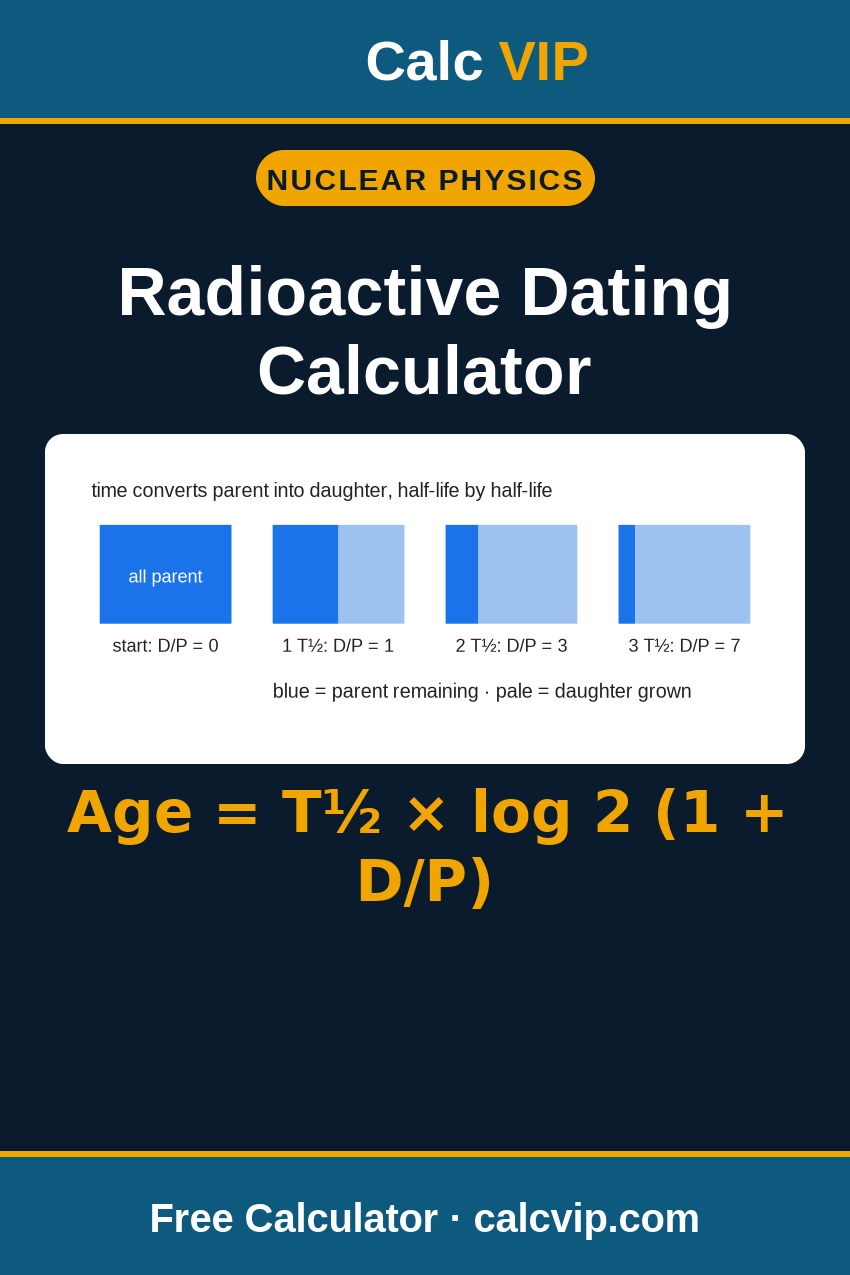
Every radioactive parent atom that decays leaves a receipt: a daughter atom, sitting where the parent used to be. Count the receipts and the survivors, take the ratio, and you hold a clock. If the daughter atoms equal the remaining parents (D/P = 1), exactly one half-life has passed. If daughters outnumber parents three to one, two half-lives. Seven to one, three. The relationship is a pure logarithm — age = T½ × log₂(1 + D/P) — and it works without knowing how much parent the sample started with, because the daughter population is the record of the starting amount. This calculator evaluates that clock for any parent half-life and any measured ratio.
The method's quiet genius is its indifference to sample size and starting quantity. Geologists rarely know how much uranium a mineral crystallised with — but they do not need to. Every decayed atom announces itself as a lead atom; every surviving atom is still uranium; the ratio between them encodes the elapsed half-lives and nothing else. It is the same trick as dating a party by the ratio of empty bottles to full ones, immune to not knowing how many guests arrived. What the method does need is honesty from the sample: a closed system, in which no parent or daughter has leaked in or out since the clock started, and a known starting condition — usually, that no daughter was present at crystallisation, or a correction for the amount that was.
With half-lives as the gear ratios, a family of clocks covers all of deep time. Carbon-14 (5,730 years) dates wood, bone and cloth back some fifty thousand years. Potassium-40 (1.25 billion years) and uranium-238 (4.47 billion years) date the rocks of the Earth itself; rubidium-87 and samarium-147 reach further still. The meteorite clocks, read with this page's formula, give the solar system its birthday: 4.57 billion years. Few equations in science have returned so much history for so little input — two counts and a half-life.
Formula
Age = T½ × log2(1 + D/P) • age and T½ in the same time unit; D/P is the daughter-to-parent ratio, dimensionless.
The derivation is three lines. After n half-lives the parent remaining is P = P₀/2n. In a closed system every decayed parent became a daughter, so D = P₀ − P. Dividing, D/P = (P₀ − P)/P = 2n − 1, and solving gives n = log2(1 + D/P) — the number of half-lives — which the final multiplication by T½ turns into years. The calculator also reports the parent remaining as a percentage, 100/(1 + D/P), which is the form carbon dating uses (its daughter, nitrogen-14, escapes as gas and cannot be counted; radiocarbon instead measures the surviving C-14 fraction against a modern standard). The assumptions are printed on the tin: closed system, and zero initial daughter — or an isochron correction for it, the subject of the depth section. Common clocks: U-238 → Pb-206, T½ = 4.47 × 10⁹ yr; U-235 → Pb-207, 7.04 × 10⁸ yr; K-40 → Ar-40, 1.25 × 10⁹ yr; Rb-87 → Sr-87, 4.88 × 10¹⁰ yr; C-14 → N-14, 5,730 yr.
| Symbol | Meaning | Units |
|---|---|---|
| D/P | daughter atoms divided by parent atoms remaining | dimensionless ratio |
| T½ | half-life of the parent isotope | years (usually) |
| n | half-lives elapsed, log₂(1 + D/P) | count |
| P₀ | original parent amount — never needed explicitly | atoms or moles |
The two assumptions, and how geology defends them
Everything that can go wrong with this clock attacks one of its two assumptions. The closed-system assumption fails when heat, water or weathering lets atoms wander: a rock reheated in a later geological event can lose argon gas (K–Ar ages come out too young — the clock was partly reset) or gain uranium from groundwater (ages skew old). The initial-daughter assumption fails when the mineral crystallised with some daughter already inside — lead was in the magma before the zircon formed — inflating D and counterfeiting age. Neither failure is rare, and the history of geochronology is largely the history of defeating them: choosing minerals that exclude daughter at birth (zircon accepts uranium but rejects lead almost perfectly, which is why it is the field's favourite), and measuring in ways that cancel the unknowns.
The cancellation masterpiece is the isochron. Measure several minerals from the same rock, with different parent contents, and plot daughter isotope ratios against parent ratios. If the system stayed closed, the points fall on a straight line whose slope is 2n − 1 — the age — while the line's intercept quietly absorbs whatever daughter was present at the start. Initial daughter stops being an assumption and becomes a measured quantity. A scattered plot, meanwhile, is the sample confessing that it was disturbed. When you read that a meteorite is 4.57 billion years old, an isochron is the instrument that spoke.
How to use
- Measure or look up the daughter-to-parent ratio D/P in your sample — atom counts, masses or molar amounts all work, because the units cancel in the ratio. Correct it for any initial daughter if your source provides one.
- Enter the parent's half-life in the unit you want the age in — years for every geological clock, so ages come out in years.
- Click "Calculate Age" to get the number of half-lives elapsed, the age, and the percentage of parent remaining.
- Sanity-check the result against the clock's range: a ratio demanding more than ~10 half-lives means under 0.1% of the parent survives — near the measurement limit of any real instrument.
Worked examples
Example 1 — the potassium-argon reference. A rock holds 3 times as much daughter as parent (D/P = 3) and the parent's half-life is 1.25 × 10⁹ years (potassium-40).
n = log2(1 + 3) = log2(4) = 2 half-lives.
Age = 2 × 1.25 × 109 = 2.5 × 10⁹ years — the rock crystallised about 2.5 billion years ago, when only 1/4 of the original parent remained.
Example 2 — a younger uranium rock. D/P = 0.25 with U-238 (T½ = 4.47 × 10⁹ yr).
n = log2(1.25) = 0.322 half-lives; age = 0.322 × 4.47 × 109 = 1.44 × 10⁹ years, with 80% of the parent still in place. Small ratios are not small ages when the half-life is geological — a fifth of the uranium gone already means a billion and a half years.
Example 3 — a meteorite on the rubidium clock. D/P = 0.05, Rb-87 half-life 4.88 × 10¹⁰ yr.
n = log2(1.05) = 0.0704; age = 0.0704 × 4.88 × 1010 = 3.43 × 10⁹ years. Rb–Sr isochrons on such material are how the oldest solar-system solids earn their dates — the ratio is tiny because the half-life dwarfs the age.
Example 4 — the halfway rock. D/P = 1 exactly, K-40 clock.
n = log2(2) = 1; age = 1.25 × 10⁹ years, parent remaining 50%. The D/P = 1 point is the clock's most legible tick: daughters and parents in equal number can only mean one half-life, whatever the isotope.
Example 5 — a barely-started clock. D/P = 0.01, U-238.
n = log2(1.01) = 0.01436; age = 0.01436 × 4.47 × 109 = 6.42 × 10⁷ years — 64 million years, with 99.01% of the parent remaining. Young volcanic rocks are dated in this regime, where the measurement challenge is counting the scarce daughter atoms honestly.
Example 6 — deep time on the fast uranium clock. D/P = 7 with U-235 (T½ = 7.04 × 10⁸ yr).
n = log2(8) = 3; age = 3 × 7.04 × 108 = 2.112 × 10⁹ years, parent remaining 12.5%. Running U-235 and U-238 clocks side by side on one sample (the U–Pb concordia method) cross-checks both — agreement is the strongest evidence the system stayed closed.
Radioactive dating in real life
The age of the Earth. Clair Patterson's 1956 lead-isotope work on meteorites — this formula's family applied to the solar system's raw material — fixed the Earth's age at about 4.55 billion years, ending centuries of estimates that ranged from thousands to trillions of years. The oldest Earth rocks (Jack Hills zircons) reach about 4.4 billion years on the U–Pb clock.
Archaeology and radiocarbon. The Dead Sea Scrolls, Ötzi the iceman and the Turin Shroud were all dated by carbon-14 — the fraction-remaining variant of this clock. A 2,000-year-old sample retains 2−2000/5730 = 78.5% of its modern C-14 level; by 50,000 years only 0.24% remains, which sets the method's horizon.
Dating eruptions and human origins. K–Ar and its refinement Ar–Ar dating fixed the ages of the volcanic ash layers bracketing early human fossils in East Africa — the chronology of human evolution is written in potassium's half-life.
Art, wine and forgery. Radiocarbon exposes forged paintings (post-1950s "bomb carbon" from nuclear tests marks modern materials unmistakably) and verifies vintage wines and antique timbers — the same ratio, interrogated for authentication rather than antiquity.
Groundwater and climate archives. C-14 in dissolved carbon dates aquifers, telling water managers whether they are mining ancient water or skimming a renewable flow; U–Th dating of corals and cave deposits (the ingrowth clock of the Daughter Activity Calculator, run in reverse) reconstructs past sea levels and climates.
Planetary exploration. Moon rocks returned by Apollo read 3.1–4.4 billion years on these clocks, dating the lunar maria and the late heavy bombardment; meteorites from Mars, dated the same way, anchor the chronology of a planet no clock has visited in person.
Choosing a clock: the half-life must fit the question
Every dating method has a sweet range, roughly a tenth of a half-life to five half-lives, and the boundaries are set by measurability. Too young for the clock, and the daughter has barely accumulated — D/P is a whisper against contamination and initial-daughter corrections. Too old, and the parent is nearly extinct: after 10 half-lives, 0.098% remains, and the ratio D/P ≈ 1,023 must be measured against a vanishing denominator. Carbon-14's 50,000-year wall is exactly this extinction (0.24% left), and it is why no one radiocarbon-dates dinosaur bone — at 66 million years the surviving fraction is 2−11,500, a number indistinguishable from zero by any instrument that will ever exist. Dinosaurs are dated by the volcanic rocks around them, on potassium and uranium clocks whose half-lives are sized to the question. Match the gear ratio to the journey: that is the whole art this calculator serves.
What a "date" actually means
One last discipline of interpretation: a radiometric date is the time since the clock's starting event — crystallisation for a mineral, death for an organism, closure of the system in every case — not necessarily the time since the thing itself formed. A sandstone's grains may be billions of years old while the rock is young; the grains date their source mountains, the cement between them dates the burial. Skilled geochronology is largely the art of matching the dated event to the question being asked, and of reporting the uncertainty honestly alongside the number. Treat every date you meet — including this calculator's — as the answer to "how long since this system closed?", and you will read the literature the way its authors intended.
Quick reference: ratio, half-lives, parent remaining
| D/P | Half-lives elapsed | Parent remaining |
|---|---|---|
| 0 | 0 | 100% |
| 0.25 | 0.322 | 80% |
| 1 | 1 | 50% |
| 3 | 2 | 25% |
| 7 | 3 | 12.5% |
| 15 | 4 | 6.25% |
| 1,023 | 10 | 0.098% |
The integers in the middle column are the pattern to memorise: every time the parent halves, D/P doubles and adds one — 0, 1, 3, 7, 15 — the signature of exponential decay written as a counting rhyme.
Common mistakes
- Assuming zero initial daughter without checking. Magmas contain lead, strontium and argon before any decay occurs. Uncorrected, that inheritance inflates D/P and counterfeits antiquity — the reason isochrons and daughter-rejecting minerals like zircon exist.
- Dating a disturbed sample. Heating, groundwater and weathering open the system: argon escapes (age too young), uranium leaches in or out (age skewed either way). A date is only as good as the sample's biography.
- Using carbon-14 logic on a D/P clock — or vice versa. C-14's daughter is a gas and is never counted; the method reads the parent fraction remaining. Plugging a C-14 fraction into this D/P formula (or a D/P into the fraction formula) garbles both.
- Picking a clock whose half-life mismatches the age. Fifty-thousand-year-old bone on a uranium clock gives D/P ≈ 0.0000078 — unmeasurable; a billion-year rock on C-14 gives exactly zero parent. Match the gear ratio to the era.
- Taking logarithms in the wrong base. The formula wants log₂. Using log₁₀ or ln without converting multiplies the age by 3.32 or 0.693 respectively — errors large enough to move continents in the literature, and they have.
FAQ
Why not just use the fraction of parent remaining?
You can — age = T½ × log2(P₀/P). The D/P method is used when the original amount P₀ is unknown, because the daughter atoms themselves record how much parent has decayed.
What if there was some daughter in the sample at the start?
Then the simple formula overestimates the age. Real geochronology uses an isochron diagram — plotting several minerals from the same rock separates the initial daughter from the radiogenic daughter by the slope of a straight line.
How old can this method date?
With long-lived clocks like U-238 it reaches the oldest rocks on Earth (≈ 4 billion years) and meteorites at 4.57 billion years — the age of the solar system itself. After about 10 half-lives too little parent remains to measure reliably.
How accurate is radioactive dating?
In expert hands, startlingly: modern U–Pb zircon dates carry uncertainties near 0.1% — a few million years on billions. The limiting factors are rarely the counting statistics; they are the sample's closed-system behaviour and the half-life's own measurement uncertainty.
Can this method date a living thing directly?
Only carbon-14 applies, and only after death: while an organism lives it exchanges carbon with the environment and its C-14 fraction stays at the modern level. Death closes the system and starts the clock — the event dated is always the death, or the rock's crystallisation, never the birth.
What is the concordia method?
Running the U-238 → Pb-206 and U-235 → Pb-207 clocks simultaneously and plotting their two ages against each other. Undisturbed samples land on a single curve, the concordia; lead loss moves them off it along a line that itself dates the disturbance — two clocks auditing each other.
Why is there no daughter at the start in a zircon?
Crystal chemistry: zircon's lattice welcomes uranium ions (similar size and charge to zirconium) but lead ions fit so badly they are excluded as the crystal grows. Nature performs the initial-daughter correction at crystallisation, which is why zircons are geochronology's gold standard.
What does the method date in a rock that has been melted twice?
Usually the last melting — crystallisation is what closes the system and zeroes (or resets) the clock. Detrital grains can preserve older cores inside younger rims, and modern instruments date the zones separately, reading two chapters of one stone.
Could the half-lives themselves have changed over time?
Decay constants are set by nuclear structure and are insensitive to temperature, pressure and chemistry at any level that matters (a handful of electron-capture nuclides shift by fractions of a percent under extreme ionisation). Tests using ancient natural reactors and distant supernova light curves confirm the constants held billions of years ago.
What is the youngest thing this can date?
With uranium clocks, volcanic rocks a few hundred thousand years old are routine and younger is possible with U–Th disequilibrium methods; radiocarbon reaches back from the present to 50,000 years. Between them, and with luminescence methods beside, essentially every era of Earth and human history has a working clock.