 Calc
Recoil Calculator – Gun Recoil Velocity From Momentum
 Created by James Carter · Physics Writer · Forces & Motion · Last updated: November 2026
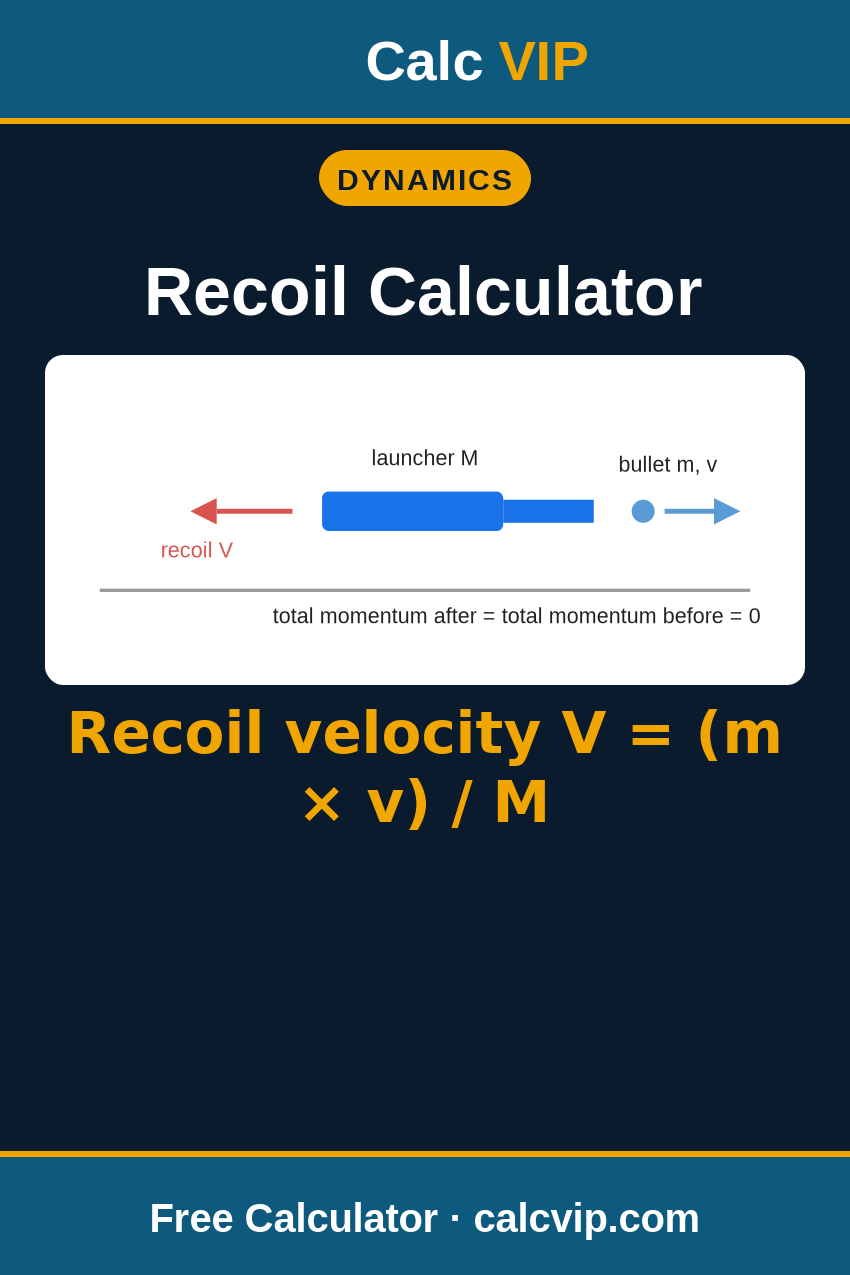
Use this free Recoil Calculator to find how fast a gun (or cannon, or firework launcher) recoils when it fires a projectile. Because the total momentum starts at zero, the launcher's backward momentum exactly balances the projectile's forward momentum.
Recoil Velocity
Recoil is Newton's third law made personal. The explosion inside a firearm pushes the bullet forwards and the gun backwards with the same total momentum, because before the trigger was pulled the momentum of the whole system was zero — and no internal force can change that total. The bullet, being light, takes its share as a huge velocity; the gun, being heavy, takes its identical share as a small one. This calculator turns that balance into numbers: enter the projectile's mass and muzzle speed and the launcher's mass, and it returns the recoil velocity and the momentum both sides carry.
The velocity is only half the story, and the less dangerous half. Momentum is shared equally between bullet and gun, but kinetic energy is shared in inverse proportion to mass: the bullet in the worked example below carries 1,600 J while the rifle that fired it carries 8 J — a 200-to-1 split that exactly mirrors their 1-to-200 mass ratio. That asymmetry is why the projectile is lethal and the recoil is merely a shove, and it is the single most instructive result in the whole subject of explosions. The same mathematics governs a cannon's roll-back, an astronaut's drift after throwing a tool, and — fired continuously, a trillion times a second — the thrust of every rocket ever launched.
Real firearms add garnishes the clean model omits: propellant gases jetting from the muzzle carry their own forward momentum and add to the kick, and the shooter's body becomes part of the recoiling mass the instant the stock meets the shoulder. Treat this calculator's result as the honest core of the phenomenon — the part due to the projectile alone — and the sections below will show where the refinements attach.
Formula
Recoil velocity V = (m × v) / M — from conservation of momentum: the projectile's momentum p = mv forward must equal the launcher's momentum MV backward, since the total started at zero.
The formula rearranges for design questions: the launcher mass needed to hold recoil to a chosen speed is M = mv / V, and the projectile momentum — the number that actually predicts the shove — is simply p = mv, with the recoil energy following as KE = p² / (2M). That last form explains the whole feel of recoil: for a fixed projectile momentum, doubling the launcher's mass halves the recoil energy, and the energy the launcher carries is always the projectile's energy multiplied by the mass ratio m / M. One caution about definitions: v here is the projectile's speed relative to the launcher at the muzzle, which for a shooter standing on the Earth is, to excellent accuracy, its speed over the ground as well.
| Symbol | Meaning | Units |
|---|---|---|
| m | mass of the projectile | kg |
| v | muzzle speed of the projectile | m/s |
| M | mass of the launcher (gun, cannon, thrower) | kg |
| V | recoil velocity of the launcher | m/s |
| p | momentum carried by each side, p = mv = MV | kg·m/s |
Equal momentum, wildly unequal energy
Here is the derivation that makes recoil safe to stand behind. Both sides carry the same momentum p. Kinetic energy can be rewritten in terms of momentum as KE = p² / (2m) — check it against ½mv² with p = mv and they agree. Now the moral is unavoidable: with the same p in the numerator, the energy is inversely proportional to the mass underneath. The bullet, with 1/200th of the rifle's mass, carries 200 times the rifle's kinetic energy. Momentum is the quantity the universe insists on sharing fairly; energy is under no such obligation, and it flows overwhelmingly to the lightest participant. Every explosion-type event on this site — the bursting shell, the rocket, the recoiling cannon — obeys the same split, which is why fragments of a burst are dangerous in proportion to their lightness, and why the heavy launcher merely rocks back.
The recoil energy that does reach the launcher then has to be absorbed — by a shoulder, a carriage, a recoil mechanism — over whatever distance is available. That absorption is an impulse-and-work problem layered on top of this page's momentum answer: the velocity V computed here is the free recoil speed, the speed the launcher would reach if nothing held it. What a shooter feels is that velocity being arrested by body and ground over a few centimetres, and the pad, the stance and the gun's own recoil system all exist to stretch that arrest.
How to use
- Enter the projectile mass in kg (a rifle bullet is about 0.01–0.02 kg — note the leading zeros).
- Enter the projectile's muzzle speed in m/s and the launcher's mass in kg.
- Click "Calculate Recoil" to see the recoil speed and the shared momentum.
- To feel the result, convert: a recoil of 2 m/s is a brisk walking pace delivered as a shove; the recoil energy, p² / (2M), is the better guide to how hard the kick feels.
Worked examples
Example 1 — the rifle. A rifle of mass 4 kg fires a bullet of mass 0.02 kg at 400 m/s.
Bullet momentum p = 0.02 × 400 = 8 kg·m/s.
Recoil velocity V = 8 / 4 = 2 m/s — the rifle pushes back into the shooter's shoulder at 2 m/s. The energies show the famous split: the bullet carries ½ × 0.02 × 400² = 1,600 J, the rifle only ½ × 4 × 2² = 8 J. Equal momentum; a 200-fold difference in energy, matching the 200-fold mass ratio.
Example 2 — the cannon. A 2,000 kg cannon fires a 10 kg shell at 300 m/s. p = 10 × 300 = 3,000 kg·m/s; V = 3,000 / 2,000 = 1.5 m/s. Historical gun crews watched their piece roll back a metre or more at about this speed, and the recoil energy, ½ × 2,000 × 1.5² = 2,250 J, is what the carriage, ropes or hydraulic buffers had to absorb — against the shell's departing 450,000 J.
Example 3 — the astronaut's wrench. An astronaut (120 kg with suit) throws a 0.8 kg wrench away at 5 m/s to discard it. p = 0.8 × 5 = 4 kg·m/s; recoil V = 4 / 120 ≈ 0.033 m/s — a drift of 3.3 cm/s back towards the spacecraft, in this case conveniently. The wrench carries 10 J; the astronaut, 0.067 J. In orbit there is no shoulder and no ground: every throw is a recoil event, and mission planners budget for it.
Example 4 — the shotgun. A 3.5 kg shotgun fires a 0.03 kg charge of shot at 350 m/s. p = 0.03 × 350 = 10.5 kg·m/s; V = 10.5 / 3.5 = 3.0 m/s — half again faster than the rifle's recoil, with a recoil energy of ½ × 3.5 × 3² ≈ 15.75 J, roughly double the rifle's 8 J. Shotgunners' respect for the kick is this arithmetic, felt.
Example 5 — throwing a ball on ice. A 60 kg skater standing on frictionless ice throws a 0.5 kg ball forward at 12 m/s. p = 6 kg·m/s; V = 6 / 60 = 0.1 m/s backwards. A gentle drift — but a real one, and the standard classroom proof that recoil needs no explosion: muscles did the pushing, and momentum kept the books exactly as it does for gunpowder.
Example 6 — heavy artillery. An 8,000 kg gun fires a 43 kg shell at 800 m/s. p = 43 × 800 = 34,400 kg·m/s; V = 34,400 / 8,000 = 4.3 m/s, with recoil energy ½ × 8,000 × 4.3² = 73,960 J to be absorbed by the recoil system — while the shell leaves with ½ × 43 × 800² = 13,760,000 J. The energy ratio, 186 to 1, is once again just the mass ratio, 8,000 / 43, wearing different clothes.
Recoil in real life
Firearm design. Everything about a gun's manners is this page managed: heavier guns recoil slower and softer; recoil pads stretch the arrest over more distance and time; muzzle brakes redirect propellant gas to cancel part of the momentum. Designers quote "free recoil energy" — p² / (2M) — as the single number that predicts how a gun will feel.
Artillery recoil systems. Modern guns let the barrel slide against hydraulic buffers and springs: the recoil velocity from this calculator is arrested over a metre or so of travel, the energy stored and then spent returning the barrel to firing position. The gun fires again in seconds because the recoil was managed, not merely endured.
Recoilless rifles. These vent propellant gas backwards through a nozzle, giving the gas rearward momentum that cancels the shell's forward momentum. The launcher's books balance to near zero — recoil cancelled not by mass but by throwing something the other way, the rocket principle bolted onto a gun.
Fire hoses. A hose nozzle is a recoil device: water jets forward at tens of metres per second, and the hose crew feels the reaction as a continuous push — momentum per second, which is force. It is why large nozzles need several firefighters or a fixed mount.
Rockets, the continuous case. A rocket engine is a gun firing trillions of gas molecules per second, each a tiny projectile, the rocket recoiling from every one. Sum the micro-recoils and you get thrust; integrate over the burn and you get the rocket equation — recoil is not an analogy for propulsion, it is propulsion.
Balloon cars and skateboards. The schoolyard balloon car (air jets back, car rolls forward) and the skateboarder who jumps off the board (board shoots back) are recoil with the launcher and projectile swapping costumes. If a student can predict the board's speed from the jumper's, they have understood this page.
Managing the kick: from velocity to felt force
The calculator's V is the speed the launcher reaches if nothing resists it — free recoil. What a body actually feels depends on the arrest: the momentum MV must be cancelled by an impulse from shoulder, hands and ground, and by the impulse equation F = Δp / t, a short arrest means a sharp force. This is why technique matters as much as hardware. Pulling the stock firmly into the shoulder couples the gun to the body's mass early, effectively enlarging M during the critical milliseconds; a loose hold lets the gun accelerate freely and then arrive at the shoulder as a separate impact — the same momentum delivered as a punch instead of a push. Recoil pads, padded jackets and a proper stance all work the same trade the airbag works: they do not change the momentum, they change the schedule of its delivery.
Recoil also rotates. Because the barrel's line of thrust sits above the shooter's grip and shoulder contact, the rearward push acts with a lever arm, torquing the muzzle upwards — the muzzle flip or climb that pulls a pistol's sights off target and that automatic weapons fight with compensators and low bore axes. The calculator's V describes the straight-line part of the motion; the flip is the same momentum expressed as angular impulse about the support point. Designers lower the bore toward the hand, and shooters grip high, for one reason: shrink the lever arm, and the same recoil produces less rotation. It is a useful reminder that momentum conservation governs the rotation too — nothing about the kick escapes the bookkeeping.
Quick reference: recoil of familiar launchers
| Launcher | Projectile | Recoil V |
|---|---|---|
| air rifle (3 kg) | 0.0005 kg pellet at 200 m/s | ≈ 0.03 m/s — a nudge |
| pistol (0.9 kg) | 0.008 kg bullet at 350 m/s | ≈ 3.1 m/s — a sharp flip |
| rifle (4 kg) | 0.02 kg bullet at 400 m/s | 2 m/s |
| shotgun (3.5 kg) | 0.03 kg shot at 350 m/s | 3.0 m/s |
| cannon (2,000 kg) | 10 kg shell at 300 m/s | 1.5 m/s — tonnes rolling |
Read the pistol row carefully: it recoils faster than the rifle despite its smaller bullet, because the launcher's mass fell further than the projectile's momentum did. Recoil is a ratio, not a calibre — the table is the mass ratio m / M expressing itself through everyday hardware.
Common mistakes
- Entering the bullet mass in grams. 20 g is 0.02 kg. Skip the conversion and the recoil comes out a thousand times too large — the classic recoil-calculator blunder, instantly recognisable because it predicts the rifle leaving faster than a car.
- Expecting the recoil energy to match the bullet's. Momentum matches; energy does not. The energies split by the inverse mass ratio, so the launcher's share is small — anyone who "checks" the calculation by comparing energies will wrongly conclude it failed.
- Forgetting the gases. This model counts the projectile only. Real muzzle blast adds the momentum of the escaping propellant gas, which is why measured recoil exceeds the clean figure — and why muzzle brakes, which redirect that gas, work at all.
- Treating recoil velocity as the felt force. V is the free-recoil speed. The force a shoulder feels depends on how quickly that motion is arrested — the same V can arrive as a push or a punch depending on hold, padding and stance.
- Assuming a bigger calibre always kicks harder. Recoil follows the projectile's momentum and the launcher's mass, not the bore diameter. A heavy gun firing a large, slow projectile can be gentler than a light gun firing a small, fast one — compare p and M, not reputations.
FAQ
Why does a heavier gun kick less?
The bullet's momentum is fixed, so a larger launcher mass M means a smaller recoil velocity V = mv/M. The recoil energy is smaller too, which is why heavy rifles feel gentler.
Does recoil velocity equal the bullet speed divided by anything simple?
V = v × (m/M) — the recoil is the muzzle speed scaled by the mass ratio. A bullet 200 times lighter than the gun gives a recoil 200 times slower than the bullet.
Is the momentum exactly balanced in real life?
Almost — escaping gases from the muzzle also carry momentum forward, which adds a little extra recoil. This calculator uses the clean textbook model with the projectile alone.
Why is the recoil energy so much smaller than the bullet's energy?
Because energy in terms of momentum is KE = p² / (2m): with the same p on both sides, the heavier side takes the smaller share. The 200-fold mass advantage of rifle over bullet becomes a 200-fold energy disadvantage — the deepest reason the shooter is safe and the target is not.
What does a muzzle brake actually do?
It redirects the propellant gases sideways and partly backwards as they exit. Gas thrown backwards carries rearward momentum, which cancels part of the forward momentum the gun must balance — reducing recoil without touching the bullet at all.
Is recoil a collision or an explosion?
An explosion, in the physicist's sense: stored energy (the propellant) is released and the system's kinetic energy increases from zero, while momentum stays at zero throughout. Collisions redistribute existing kinetic energy; recoil creates it, split between projectile and launcher.
Can recoil be eliminated completely?
Only by giving the momentum somewhere else to go: venting gas backwards (recoilless designs), or bolting the launcher to something enormous — a ship, a fortress, the Earth itself — whose recoil velocity is then too small to notice. The momentum is always paid; the question is who pays it.
What would happen if an astronaut fired a rifle in space?
Exactly what the calculator says, with no ground to rescue the books: astronaut and rifle would drift backwards at V = mv / (M + m), rifle and astronaut separating slowly. The total momentum of astronaut, rifle and bullet would remain zero — a famous thought experiment because nothing about it is approximate.
Why do cannons roll back and then return to place?
The roll-back is free recoil being arrested by the recoil mechanism over a metre or so — stretching the arrest keeps the forces manageable. Springs or hydropneumatics store that energy and spend it pushing the barrel forward again, ready for the next shot.
How is a rocket's thrust the same physics?
A rocket throws mass backwards continuously — exhaust instead of a single bullet — and recoils forward continuously in response. Each molecule's tiny recoil sums into thrust, and integrating over the whole burn turns this page's V = mv / M into the Tsiolkovsky rocket equation.