 Calc
Satellite Energy Calculator – KE, PE & Total Orbital Energy
 Created by Rachel Novak · Senior Editor · All Topics · Last updated: November 2026
Use this free Satellite Energy Calculator to break down the total energy of a satellite in a circular orbit: kinetic energy, potential energy, and the (negative) total that keeps it bound, E = −GMm/(2r).
An orbiting satellite owns two kinds of energy that pull in opposite directions. Its motion gives it kinetic energy, always positive. Its position inside the planet's gravity well gives it potential energy, always negative when measured against the universal zero at infinity. Add them and you get the total — the single number that decides the satellite's fate. Negative total: bound forever, unless something intervenes. Zero or positive: leaving, never to return. This calculator evaluates all three quantities for a circular orbit around Earth, the Moon, Mars or Jupiter, or a custom body of your own.
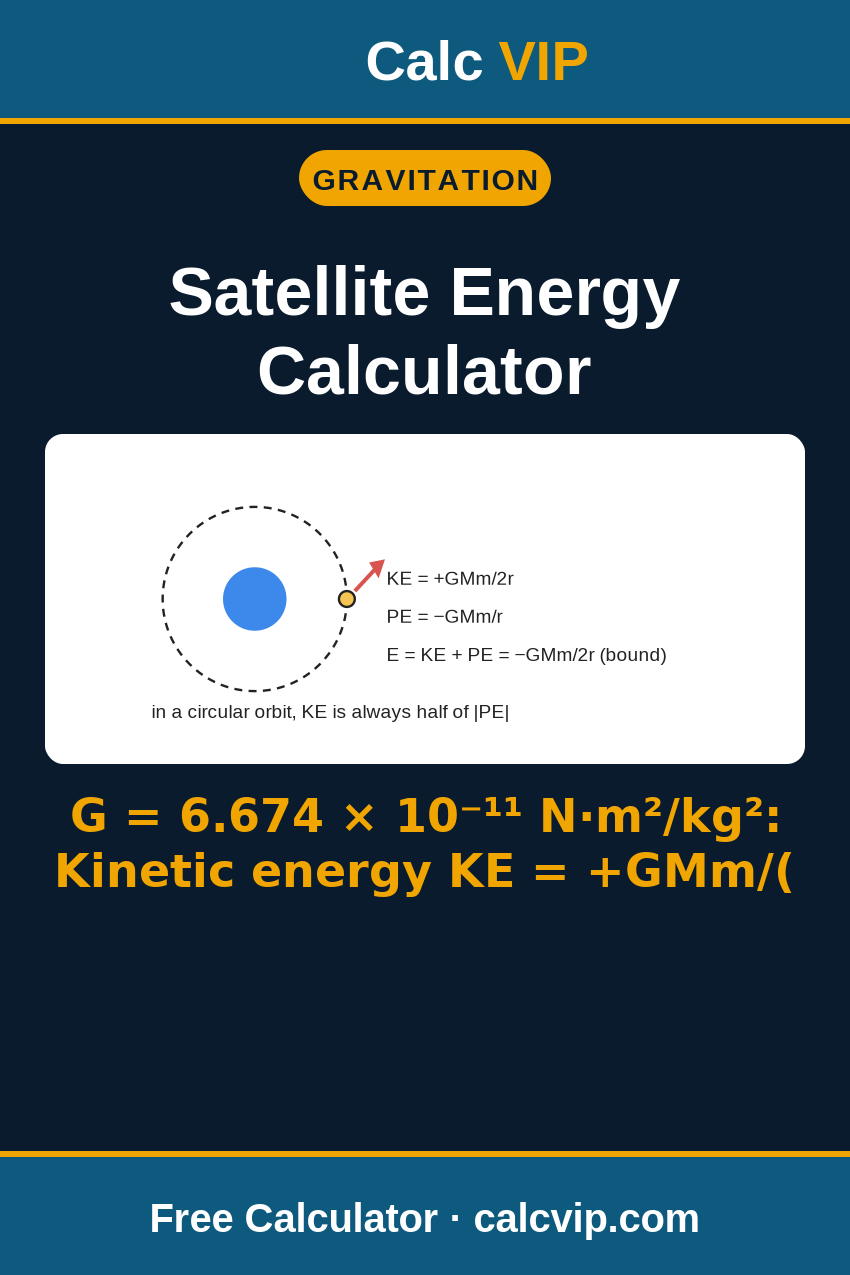
For circular orbits the three numbers obey a strikingly tidy pattern: the kinetic energy is always exactly half the magnitude of the potential energy, so the total is always exactly minus the kinetic energy, E = −KE = PE/2. This is the virial theorem at work, and it produces the famous paradox of orbital mechanics — to make a satellite go higher, you add energy, its total rises toward zero, yet it ends up moving slower, with less kinetic energy than before. Half of every joule you add goes into the deeper account of potential energy, and the other half is, in effect, refunded by the orbit's slower motion. Rocket engineers live inside this bookkeeping: it is why "speeding up" a spacecraft can leave it travelling more slowly than it started.
The pattern also prices escape precisely. A satellite in circular orbit needs its total energy raised to zero to break free — an addition exactly equal to its current kinetic energy. Double the kinetic energy (raise the speed by a factor of √2, about 41%) and the satellite escapes. Everything on this page is that accounting, evaluated honestly: enter a satellite's mass and altitude and read off what it owns, what it owes, and what freedom would cost.
Formula
For a circular orbit of radius r (from the centre), with G = 6.674 × 10⁻¹¹ N·m²/kg²:
Kinetic energy KE = +GMm/(2r) — equivalently ½mv² with the orbital speed v = √(GM/r).
Potential energy PE = −GMm/r.
Total energy E = KE + PE = −GMm/(2r) — always negative for a bound orbit, and exactly half the potential energy.
The energy needed to escape from the orbit is ΔE = +GMm/(2r) — precisely the kinetic energy already present, which is why escape speed is √2 times circular-orbit speed at the same radius.
| Symbol | Meaning | Units |
|---|---|---|
| KE | kinetic energy of the satellite, ½mv² | joules (J) |
| PE (U) | gravitational potential energy, zero at infinity | joules (J) |
| E | total mechanical energy, KE + PE | joules (J) |
| M, m | mass of the planet; mass of the satellite | kilograms (kg) |
| r | orbit radius from the planet's centre (radius + altitude) | metres (m) |
| G | universal gravitational constant, 6.674 × 10⁻¹¹ | N·m²/kg² |
The virial bargain: why higher orbits are slower but richer
Compare two identical satellites, one in low orbit and one at GPS height. The high satellite's total energy is greater — less negative — because real energy was spent lifting it there. Yet it drifts along at 3.87 km/s while the low satellite tears around at 7.67 km/s. Where did the added energy go? Entirely into potential energy, and then some: raising an orbit adds two units of PE for every unit by which KE falls, netting one unit of total gain. This is the virial theorem's bargain, and it explains everyday orbital operations: a satellite that fires its thruster forward rises, slows, and arrives at its higher orbit moving more gently than before the burn — while a satellite decaying through drag loses total energy and, perversely, speeds up as it spirals in.
The sign of E is also the cleanest classification in astronautics. Ellipses and circles (bound orbits) have E < 0. A parabola — the exact escape trajectory — has E = 0. A hyperbola, the path of a visitor swinging past and leaving with speed to spare, has E > 0. Interstellar guests like 'Oumuamua were recognised as visitors from other stars precisely because their computed total energy relative to the Sun was positive: the Sun's well had never owned them.
How to use
- Pick a central body preset (Earth, Moon, Mars or Jupiter) or choose Custom and type its mass — scientific notation like 5.972e24 works. For a custom body, the altitude box is read as the distance from the centre in kilometres.
- Enter the satellite's mass m in kilograms.
- Enter its altitude above the surface in kilometres.
- Click "Calculate Satellite Energy" to see the orbit radius and the full breakdown: KE, PE and total E, in joules.
- Read the total's sign: negative means bound. The energy needed to escape from that orbit equals the KE figure exactly — a useful cross-check of the whole calculation.
Worked examples
Example 1 — a satellite in low Earth orbit. A 1,000 kg satellite in a circular orbit 400 km above Earth (r = 6,771 km):
KE = +GMm/(2r) ≈ +2.943 × 10¹⁰ J; PE = −GMm/r ≈ −5.886 × 10¹⁰ J; E ≈ −2.943 × 10¹⁰ J. The negative total confirms the satellite is bound: it would need +2.943 × 10¹⁰ J more to escape Earth's gravity for good.
Example 2 — the Space Station itself. m = 420,000 kg at the same 400 km altitude. Everything scales with mass:
KE ≈ +1.236 × 10¹³ J; PE ≈ −2.472 × 10¹³ J; E ≈ −1.236 × 10¹³ J. Humanity's largest spacecraft is held by an energy debt of about twelve trillion joules — roughly the output of a large power station for three and a half hours.
Example 3 — a GPS satellite. 1,000 kg at r = 26,571 km:
KE ≈ +7.50 × 10⁹ J; PE ≈ −1.500 × 10¹⁰ J; E ≈ −7.50 × 10⁹ J. Its total energy is four times greater (less negative) than the low-orbit satellite's, yet its kinetic energy is four times smaller — the virial bargain in plain figures.
Example 4 — the Moon as a satellite. m = 7.348 × 10²² kg at r = 384,400 km from Earth:
KE ≈ +3.81 × 10²⁸ J; PE ≈ −7.62 × 10²⁸ J; E ≈ −3.81 × 10²⁸ J. The same three-line pattern, scaled up nineteen orders of magnitude, describes the largest "satellite" Earth has.
Example 5 — what escape from the ISS orbit costs. For the 1,000 kg satellite of Example 1, escape needs ΔE = +2.943 × 10¹⁰ J.
That is about 7.0 tonnes of TNT, or 8,176 kWh of electricity — the energy a typical home uses in most of a year, delivered to one tonne of satellite, is the price of unbinding it from Earth.
Example 6 — a geostationary weather satellite. 2,000 kg at r = 42,241 km:
KE ≈ +9.44 × 10⁹ J; PE ≈ −1.887 × 10¹⁰ J; E ≈ −9.44 × 10⁹ J. Per kilogram this is the richest (least negative) orbit in the set, bought with the enormous launch energy needed to climb 35,869 km and circularise there.
Satellite energy in real life
Launch vehicle design. A rocket's job, stated in this page's language, is to raise a payload's total energy from its launch-pad value (PE only, deeply negative) to the target orbit's E, while also arranging the KE/PE split a circle demands. The tyranny of the rocket equation is the cost of that energy delivered by chemical fuel.
Re-entry heating. A returning capsule must dispose of its kinetic energy — about 2.94 × 10¹⁰ J per tonne from low orbit — as heat in the atmosphere. Heat shields are sized by exactly this figure: roughly 30 gigajoules per tonne that must go somewhere survivable.
Orbital decay and the drag paradox. Atmospheric drag removes total energy, so a decaying satellite's E falls — and by the virial relation its KE rises: it speeds up as it sinks. Operators watch this counter-intuitive quickening as the signature of a dying orbit.
Gravity assists. A probe swinging by Jupiter exchanges energy with the planet's orbital motion: its heliocentric total energy can jump from negative-bound-for-Earth values to escape values, which is how Ulysses and the Voyagers bought interplanetary energy no rocket could carry.
Debris removal economics. Deorbiting a dead satellite means removing just enough energy to drop its perigee into the atmosphere — a small negative ΔE. The calculus of this page is why a modest 100 m/s nudge, properly aimed, can dispose of a tonne of junk.
Classifying interstellar visitors. 'Oumuamua and comet Borisov were flagged as interstellar because their solar total energy was positive — hyperbolic excess. E's sign is the passport check every newly discovered fast-moving object must pass.
Elliptical orbits: the same total, a moving split
Everything above assumed a circle, where the KE/PE split is frozen. On an ellipse the split breathes: the satellite dives toward perigee, trading PE for KE, then climbs back to apogee, trading them back — while the total E stays exactly constant, set by the semi-major axis alone through E = −GMm/(2a). A satellite on a 300 × 800 km ellipse has the same total energy as one on the circular 550 km orbit of our Orbital Period examples, and the same period too. This is why mission designers quote energy and period from the semi-major axis: shape changes the experience of the orbit, never its energy bill.
Plane changes: the most expensive manoeuvre in orbit
Energy bookkeeping has a blind spot, and it is direction. A satellite's total energy fixes its orbit's size, but tilting the orbit's plane costs velocity change without changing energy at all — and the price is savage. The Δv for a plane change of angle Δθ at speed v is 2v·sin(Δθ/2). At the ISS's 7,672 m/s, a single degree costs about 134 m/s — comparable to months of station-keeping — and swinging a satellite from a typical 28.5° launch inclination into the equatorial plane would cost about 3,780 m/s, more than the entire Δv budget of most satellites. This is why equatorial launch sites command premium prices, why geostationary deliveries are planned around the transfer orbit's geometry, and why mission designers speak of plane changes with genuine dread. The energies on this page tell you what an orbit is worth; the plane-change formula tells you what it costs to change your mind.
Deorbiting sits at the opposite extreme of expense. To bring a low-orbit satellite down, operators need only shave its total energy slightly — a retro burn of order 100 m/s lowers the perigee into the upper atmosphere, after which drag finishes the job for free, converting the satellite's remaining 29 MJ/kg of orbital energy into heat over a few fiery minutes. The asymmetry is the economics of space debris policy in one line: putting energy in is ruinously expensive, taking a little out is cheap, and taking it all out is something the atmosphere does at no charge.
Quick reference: energy per kilogram in Earth orbits
| Orbit | KE per kg | PE per kg | Total per kg |
|---|---|---|---|
| Surface-grazing (theoretical) | +31.28 MJ | −62.56 MJ | −31.28 MJ |
| ISS, 400 km | +29.43 MJ | −58.86 MJ | −29.43 MJ |
| GPS, 20,200 km | +7.50 MJ | −15.00 MJ | −7.50 MJ |
| GEO, 35,869 km | +4.72 MJ | −9.44 MJ | −4.72 MJ |
| Moon's orbit | +0.52 MJ | −1.04 MJ | −0.52 MJ |
Every row obeys the same two rules: PE is −2 × KE, and E is −KE. Learn those and you can reconstruct any circular orbit's energy budget from a single one of its three numbers — try it against the calculator.
The Moon's slow raise: tidal energy transfer
The most familiar satellite energy story is still unfolding. Tides raised by the Moon drag against Earth's rotation, and the angular momentum Earth loses is paid into the Moon's orbit: the Moon's total energy rises, its orbit expands by about 3.8 cm per year, and Earth's day lengthens by roughly 2.3 milliseconds per century in compensation. In this page's language, the Moon is being promoted, joule by joule, to a richer orbit — its E becoming less negative — at the expense of our planet's spin. Run the process forward a few billion years and the bookkeeping ends with Earth and Moon locked face to face, day and month equal at about 47 present days, the virial bargain's final settlement.
Common mistakes
- Reporting the total as positive for an orbit. A bound orbit's total is always negative with the zero at infinity. A positive total means the object is not in orbit at all — it is on an escape or flyby trajectory.
- Computing KE from the wrong speed. KE must use the circular-orbit speed at that radius, v = √(GM/r) — not the escape speed, and not a speed carried over from a different altitude. The virial check KE = |PE|/2 catches this instantly.
- Using altitude for r. All three formulas want the distance from the planet's centre. At 400 km altitude, r = 6.771 × 10⁶ m; using 4 × 10⁵ m multiplies every energy by about 17.
- Thinking a higher orbit means more kinetic energy. Higher means more total energy but less KE — the satellite moves slower. Confusing total with kinetic is the root of most orbital-mechanics surprises.
- Forgetting that escape costs exactly KE, not |PE|. From a circular orbit you need ΔE = +GMm/(2r) — half of |PE| — because the kinetic energy already aboard pays the other half of the well's depth.
FAQ
Why is the total energy negative?
Energy is measured against zero at infinite distance. A bound satellite sits in Earth's gravity well, so its total is below zero — like owing energy to escape.
Why is KE exactly half the size of PE?
That is a general result for circular orbits (the virial theorem): the kinetic energy is always half the magnitude of the potential energy, so the total is −KE.
Does a higher orbit have more or less total energy?
More — E becomes less negative as r grows (closer to zero), even though the satellite moves more slowly. Raising an orbit always costs energy.
How do I get the satellite's speed from these numbers?
KE = ½mv², so v = √(2·KE/m) — or directly, v = √(GM/r). For the ISS orbit that returns 7,672 m/s. The three formulas are one consistent triangle: energy, speed and radius each determine the other two.
What total energy does an escaping satellite have?
Zero at the moment of escape, positive thereafter. A probe that leaves Earth with speed to spare keeps that surplus forever (relative to Earth) — its positive E is the bookkeeping of its hyperbolic excess velocity.
Why does a decaying satellite speed up?
Drag removes total energy, the orbit shrinks, and the virial relation KE = −E forces the kinetic energy to grow as E becomes more negative. Losing energy makes it faster — the celebrated drag paradox, and a real headache for debris forecasting.
Does the satellite's mass affect the orbit itself?
No — the period, speed and the per-kilogram energies are mass-independent; only the totals scale with m. A bolt and a station share an orbit and a specific energy; the station simply has 100,000 times more joules in each column.
What changes for an elliptical orbit?
The total E is unchanged in form, with the semi-major axis a replacing r: E = −GMm/(2a). KE and PE individually vary around the loop — KE peaking at perigee, PE least negative at apogee — trading against each other at constant total.
How much energy did Apollo need to reach the Moon?
To raise 1 kg from low orbit to the Moon's distance, E must rise from −29.43 MJ to about −0.52 MJ — roughly 28.9 MJ per kilogram, plus the lunar-orbit arrangements at arrival. The translunar injection burn was, in this page's terms, buying the spacecraft's total energy up to nearly zero.
Can total energy be exactly zero in practice?
Only as a limiting case — a parabolic trajectory is a knife-edge between bound and free. Real missions aim slightly negative (a captured orbit) or slightly positive (a clean escape); exactly zero is a mathematical boundary, not a flight plan.