 Calc
Schwarzschild Radius Calculator – Black Hole Event Horizon Size
 Created by Rachel Novak · Senior Editor · All Topics · Last updated: November 2026
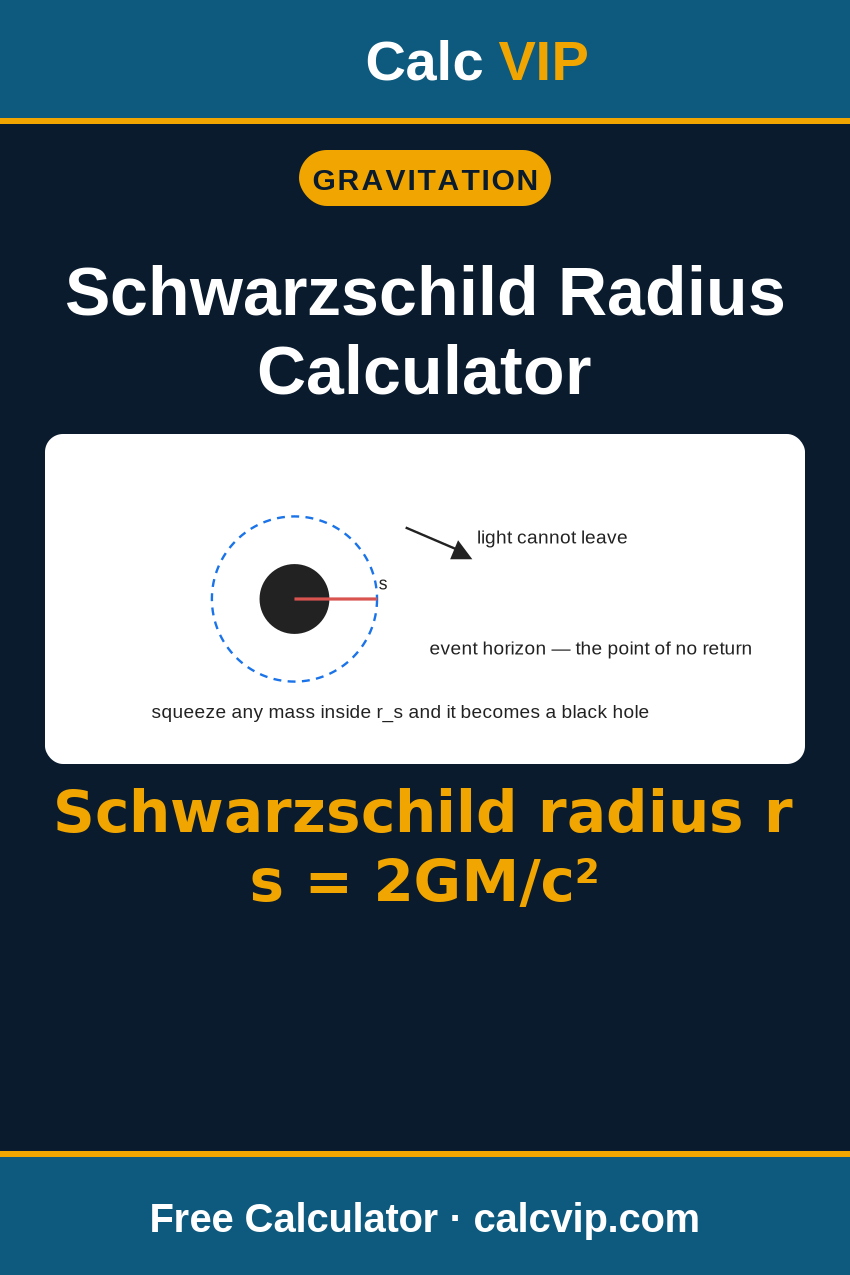
Use this free Schwarzschild Radius Calculator to find how small an object would have to be squeezed to become a black hole, rs = 2GM/c². Try the Sun, the Earth, or any mass you like.
Every mass in the universe comes with a critical size — the radius to which it would have to be compressed before gravity wins completely and not even light can escape. Karl Schwarzschild found the formula in 1916, solving Einstein's brand-new equations of general relativity while serving on the Russian front; the result, rs = 2GM/c², is disarmingly simple for something so extreme. Compress a mass inside its Schwarzschild radius and the surface you have created — the event horizon — is a one-way membrane: everything that crosses it, light included, is committed to the centre.
The formula's linearity is its charm. The Schwarzschild radius is strictly proportional to mass: about 2.95 kilometres per solar mass, scaling down through 2.82 metres for Jupiter, 8.87 millimetres for Earth, to 10⁻²⁵ metres for a person. Nothing about the object's composition, temperature or density enters — only M. That is why this single line of algebra serves both as a party trick (your Schwarzschild radius is smaller than an atom's nucleus by ten orders of magnitude) and as the working definition astronomers use when they announce the size of a black hole: a black hole is its event horizon, and the horizon's radius is this formula.
There is a famous coincidence hiding in the derivation. If you take Newton's escape-velocity formula, v = √(2GM/r), and simply set v equal to the speed of light, solving for r returns exactly 2GM/c² — the full general-relativistic answer, obtained with 18th-century physics. John Michell essentially did this in 1783 and predicted "dark stars". The agreement is luck (the Newtonian picture of light as a particle that can slow down is quite wrong), but it makes the formula easy to remember and to re-derive on a napkin: the Schwarzschild radius is where Newtonian escape velocity would have to be light speed.
Formula
Schwarzschild radius rs = 2GM/c², with G = 6.674 × 10⁻¹¹ N·m²/kg² and c = 2.998 × 10⁸ m/s. It rearranges to give the mass from a horizon size: M = rsc² / 2G — the direction astronomers use when an image or an orbit measures a black hole's extent. A convenient scaling: rs ≈ 2.95 km × (M / solar mass). If a mass is compressed inside this radius, its escape velocity exceeds the speed of light and it becomes a black hole; the surface at rs is called the event horizon. The formula assumes a non-rotating, uncharged, spherical mass — the pure Schwarzschild case; spinning black holes have somewhat smaller, squashed horizons.
| Symbol | Meaning | Units |
|---|---|---|
| rs | Schwarzschild radius — radius of the event horizon | metres (m); km or mm for display |
| M | mass of the object | kilograms (kg) |
| G | universal gravitational constant, 6.674 × 10⁻¹¹ | N·m²/kg² |
| c | speed of light in vacuum, 2.998 × 10⁸ | m/s |
Why density is a red herring — and when it isn't
Because rs grows in direct proportion to M while volume grows with the cube of radius, the density a mass needs to reach in order to become a black hole falls as the mass grows — as 1/M². For the Sun the required density is astronomical, around 10¹⁹ kg/m³. For a billion-solar-mass black hole like M87's, the average density inside the horizon is comparable to water. A sufficiently large region of quite ordinary matter, gathered together, crosses its own Schwarzschild condition without ever being "compressed" in the everyday sense. This is why supermassive black holes could form in the early universe from collapsing gas clouds, while Earth-mass black holes would require squeezing a planet into a marble at densities no natural process achieves.
It also means the event horizon is not a material surface. Nothing is there — no shell, no crust. For a large black hole, an astronaut crossing the horizon would notice nothing locally unusual at that instant; the horizon is a global property of the geometry, the boundary past which all futures point inward. The formula's quiet little radius is thus the most consequential surface in physics that is made of nothing at all.
How to use
- Pick an object preset (Sun, Earth, Jupiter or Moon) or choose Custom and type any mass in kilograms — scientific notation like 1.989e30 works.
- Click "Calculate Schwarzschild Radius".
- The result is shown in metres and kilometres, and in millimetres when the radius is below a metre.
- Compare the answer with the object's real size: the Sun's actual radius is 695,700 km against a Schwarzschild radius of 2.95 km — a factor of about 236,000 of headroom.
Worked examples
Example 1 — the Sun. M = 1.989 × 10³⁰ kg.
rs = 2GM/c² = 2 × 6.674 × 10⁻¹¹ × 1.989 × 10³⁰ / (2.998 × 10⁸)² ≈ 2,954 m ≈ 2.95 km. The whole Sun would have to be crushed into a ball less than 6 km across to become a black hole.
Example 2 — the Earth. M = 5.972 × 10²⁴ kg.
rs ≈ 8.87 mm — about the size of a marble, or a large blueberry. Squeezing Earth that small would require a density near 2 × 10³⁰ kg/m³, which is why no Earth-mass black holes are expected to exist.
Example 3 — Jupiter. M = 1.898 × 10²⁷ kg.
rs ≈ 2.82 m. The largest planet, 318 Earths of mass, would make a black hole smaller than a family car — a vivid measure of how far ordinary matter is from gravitational collapse.
Example 4 — the Moon. M = 7.348 × 10²² kg.
rs ≈ 0.109 mm — a tenth of a millimetre, the width of a human hair. Every familiar body is separated from black-hole status by an almost comical gulf of compression.
Example 5 — you. M = 70 kg.
rs ≈ 1.04 × 10⁻²⁵ m. That is ten billion times smaller than a proton. Everyday masses are so far from the condition that the number serves mainly as a reminder of how weak gravity is at human scales.
Example 6 — the Milky Way's central black hole. Sagittarius A* has M ≈ 4.3 million solar masses = 8.55 × 10³⁶ kg.
rs ≈ 1.27 × 10¹⁰ m ≈ 12.7 million km, about 0.085 AU — a horizon that would fit comfortably inside Mercury's orbit, holding the mass of 4.3 million Suns. The Event Horizon Telescope's famous orange ring image is this formula made visible.
Schwarzschild radius in real life
Reading black hole announcements. When astronomers report a black hole "the size of the solar system", they mean its Schwarzschild diameter. M87's black hole, at 6.5 billion solar masses, has rs ≈ 1.92 × 10¹³ m — about 128 AU in radius, several times Neptune's orbit.
Weighing black holes from their shadows. The Event Horizon Telescope measures the apparent size of a black hole's shadow, which is set by rs (magnified about 2.6-fold by light bending). Inverting the formula turns an image into a mass — the cleanest black-hole scale there is.
Why stars die as they do. A collapsing stellar core becomes a black hole only if its mass, squeezed inside the radius this formula assigns, cannot be held up by any pressure. The roughly 3-solar-mass ceiling on neutron stars is nature comparing a core's size with its rs and finding no escape.
Gravitational-wave astronomy. When LIGO hears two black holes merge, the final ringdown and the total energy radiated are interpreted through the horizon areas the formula gives each participant — the merger's bookkeeping is done in Schwarzschild radii.
Primordial black hole hunts. Theorists ask whether the early universe made small black holes directly. The formula prices every candidate: a black hole of asteroid mass (10¹² kg) would have rs ≈ 1.5 × 10⁻¹⁵ m — proton-sized — and would be evaporating via Hawking radiation today if it existed.
A unit of cosmic scale. Astronomers casually measure distances to black holes in units of rs: accretion discs begin a few rs out, the innermost stable orbit sits at 3 rs. The formula has become a ruler as well as a threshold.
Real black holes spin: the Kerr correction
Schwarzschild's solution assumes a perfectly still, spherical mass. Real black holes rotate — some near the maximum rate relativity allows — and rotation changes the geometry: the horizon shrinks (to as little as half the Schwarzschild radius for an extremal spinner), becomes oblate, and drags spacetime around with it, creating an ergosphere where nothing can remain stationary. The Schwarzschild value remains the indispensable baseline: it is exact for slow rotators, an upper bound for all, and the number every more complicated Kerr calculation is compared against. When a headline quotes one radius for a black hole, it is almost always this one.
Time at the edge: dilation, redshift and the 1919 test
The Schwarzschild radius also sets the strength of gravity's effect on time itself. A clock at distance r from a mass ticks slower than a distant clock by the factor √(1 − rs/r). At the photon sphere, r = 1.5 rs, that factor is √(1/3) ≈ 0.577 — time there runs at 58% of the distant rate, and light escaping from that depth is redshifted by the same factor. At Earth's surface the effect is homeopathic but real: rs/r ≈ 1.4 × 10⁻⁹, so surface clocks lose about 0.022 seconds per year relative to clocks in deep space — and satellite navigation systems must correct for exactly this family of effects, since GPS clocks, sitting higher in Earth's well, gain about 38 microseconds a day net. The formula on this page, derived for the extreme case of black holes, is quietly load-bearing in the phone in your pocket.
Schwarzschild's solution also made the prediction that first made Einstein famous. Light passing the Sun's limb is deflected by 2rs/R — with the Sun's numbers, 8.5 × 10⁻⁶ radians, or 1.75 arcseconds — exactly twice the Newtonian value. Arthur Eddington's 1919 eclipse expedition measured starlight bending by roughly that amount, confirming general relativity in headlines worldwide. The same solution accounts for the anomalous 43 arcseconds per century in Mercury's perihelion precession that Newtonian gravity never could. In other words, the little formula rs = 2GM/c² sits at the centre of the three classic tests that established Einstein's theory — Mercury, the eclipse, and the gravitational redshift later measured in laboratories and in the spectra of white dwarfs such as Sirius B, whose light climbs out of a well deep enough (rs ≈ 3 km against a radius of only about 5,800 km) to redden measurably.
Quick reference: Schwarzschild radii
| Object | Mass | rs |
|---|---|---|
| A person | 70 kg | 1.04 × 10⁻²⁵ m |
| Moon | 7.348 × 10²² kg | 0.109 mm |
| Earth | 5.972 × 10²⁴ kg | 8.87 mm |
| Jupiter | 1.898 × 10²⁷ kg | 2.82 m |
| Sun | 1.989 × 10³⁰ kg | 2.95 km |
| Stellar black hole | 10 solar masses | 29.5 km |
| Sagittarius A* | 4.3 × 10⁶ solar masses | 12.7 million km |
| M87* | 6.5 × 10⁹ solar masses | 1.92 × 10¹⁰ km |
One constant organises the whole table: 2.95 km per solar mass. Multiply any mass, expressed in Suns, by that figure and you have its horizon — from blueberries to the monsters anchoring galaxies.
The last stable orbit: the ISCO
One more landmark belongs on the map. Circular orbits around a non-spinning black hole are stable only outside three Schwarzschild radii — the innermost stable circular orbit, or ISCO, at r = 6GM/c². For a 10-solar-mass black hole (rs ≈ 29.5 km), the ISCO sits about 88.6 km from the centre, and matter there circles roughly 220 times per second before its final plunge. The ISCO is where accretion discs end and their light cuts off, so its location is written into the X-ray spectra astronomers use to weigh and spin-measure real black holes. Between the photon sphere at 1.5 rs and the ISCO at 3 rs, this page's single number organises the entire geography of the abyss.
A Newtonian coincidence: Michell's dark stars
Strangely, the formula was written down 132 years before Einstein — by accident. In 1783 the Reverend John Michell asked what happens if a star's escape velocity exceeds the speed of light, using Newton's laws and the corpuscular theory of light, and derived exactly r = 2GM/c² for his invisible "dark stars". The agreement is a famous coincidence: Michell's reasoning was wrong in detail (light does not slow down like a thrown ball, and a Newtonian dark star could still be detected by its light's behaviour), yet the factors of two conspire to the same answer. Karl Schwarzschild's 1916 derivation, from the full machinery of general relativity, is the one that means it.
Common mistakes
- Thinking the object must reach some special density. The condition is purely size versus mass: cross inside rs and a horizon forms, whatever the density — which for giant black holes can be less than water's.
- Imagining the horizon as a physical surface. There is no material at rs; it is a boundary in the geometry. An infalling observer crossing a large black hole's horizon notices nothing special at the crossing itself.
- Doubling wrongly. The formula is 2GM/c² — the factor 2 matters. Dropping it halves every answer; it comes from the escape-velocity energy balance, ½mv² = GMm/r.
- Assuming the Sun could collapse tomorrow. rs is a "what if compressed" size, not a prophecy. The Sun's mass is far too small for its own gravity to force that compression against the pressures its death will generate; it will retire as a white dwarf.
- Confusing rs with the size of the singularity. The formula gives the horizon, the only size a black hole meaningfully has from outside. The singularity at the centre is, in the classical theory, a point — a very different (and theory-breaking) statement.
FAQ
Is the Sun in danger of becoming a black hole?
No. The Schwarzschild radius is only a "what if" size — the Sun lacks the mass to collapse that far and will end its life as a white dwarf.
What happens if I cross the event horizon?
Inside rs all paths lead toward the centre; nothing, not even light, can escape back out.
Does the Schwarzschild radius depend on density?
No — it depends only on mass, growing in direct proportion: double the mass, double the radius.
Who was Schwarzschild?
Karl Schwarzschild, a German astrophysicist who found the first exact solution of Einstein's field equations in 1916 — within months of their publication, while serving in the First World War. He died the same year, aged 42; the radius named for him became central to physics a half-century later.
What is the Schwarzschild radius of a 10-solar-mass black hole?
Scale from the Sun: 10 × 2.95 km ≈ 29.5 km. Stellar black holes formed from collapsed massive stars are city-sized objects with the mass of many Suns — density beyond anything terrestrial.
Could a black hole the mass of a mountain exist?
In principle: 10¹² kg gives rs ≈ 1.5 × 10⁻¹⁵ m, proton-sized. None are known; such small holes, if formed in the early universe, would glow with Hawking radiation and may have evaporated by now — which is one way astronomers constrain their numbers.
Does light really orbit at some radius?
Yes — at the photon sphere, 1.5 × rs, light itself can circle the hole (unstably). This is what sculpts the black hole's shadow in telescope images: the bright ring we photograph is light that looped near that radius before escaping toward us.
Why does the Newtonian calculation give the exact answer?
Largely coincidence: two errors in the Newtonian picture — treating light as a massive particle and space as flat — cancel in this one formula. The honest derivation needs general relativity; the agreement is a famous piece of luck, first noticed in spirit by John Michell in 1783.
If the Sun became a black hole, would Earth be sucked in?
No. The Sun's gravity at Earth's distance depends only on its mass and our distance, neither of which changes in the hypothetical. Earth would orbit the 2.95-km black hole exactly as it orbits the Sun today — in darkness and cold, but in the same 365-day year.
Is the Schwarzschild radius the same as the event horizon for all black holes?
For non-rotating, uncharged holes, yes. Rotating (Kerr) black holes have a smaller, flattened horizon — down to half of rs at maximum spin — plus an ergosphere outside it. Real astrophysical holes spin, so rs is best read as the standard scale and upper bound.