 Calc
Submerged Plate Force Calculator – Hydrostatic Force on a Vertical Plate
 Created by Elena Petrova · Physics Editor · Fluids & Rotation · Last updated: November 2026
Use this free Submerged Plate Force Calculator to find the total hydrostatic force pushing on a vertical plate held under water — a dam wall, a tank side or an aquarium panel. Because pressure grows with depth, the force equals the pressure at the plate's centroid multiplied by its area.
Stand behind a dam, a lock gate or the glass wall of a large aquarium and a quiet question arises: how hard is the water actually pushing? The answer is almost always larger than intuition suggests — tonnes of force on a modest panel — and it is computed by one of the neatest shortcuts in fluid mechanics. Because pressure grows in a straight line with depth, the average pressure over a vertical plate is exactly the pressure at the plate's own midpoint, its centroid. Multiply that one pressure by the plate's area and you have the total force. This calculator runs that argument for any plate, any fluid, any depth.
The linearity is the whole trick, and it is worth seeing why it works. Pressure at depth h is ρgh: zero (gauge) at the surface, maximum at the bottom edge. Across a vertical plate the pressure distribution is a perfect ramp, and the average of a ramp is its midpoint value. The plate's top half is pushed more gently than the average, its bottom half harder, and the two departures cancel exactly. What does not cancel — and what the depth sections below take up — is the position of the resultant force: it acts below the centroid, because the harder-pushing bottom half wins the argument about where the total push is centred. Force magnitude from the centroid; force position from the centre of pressure.
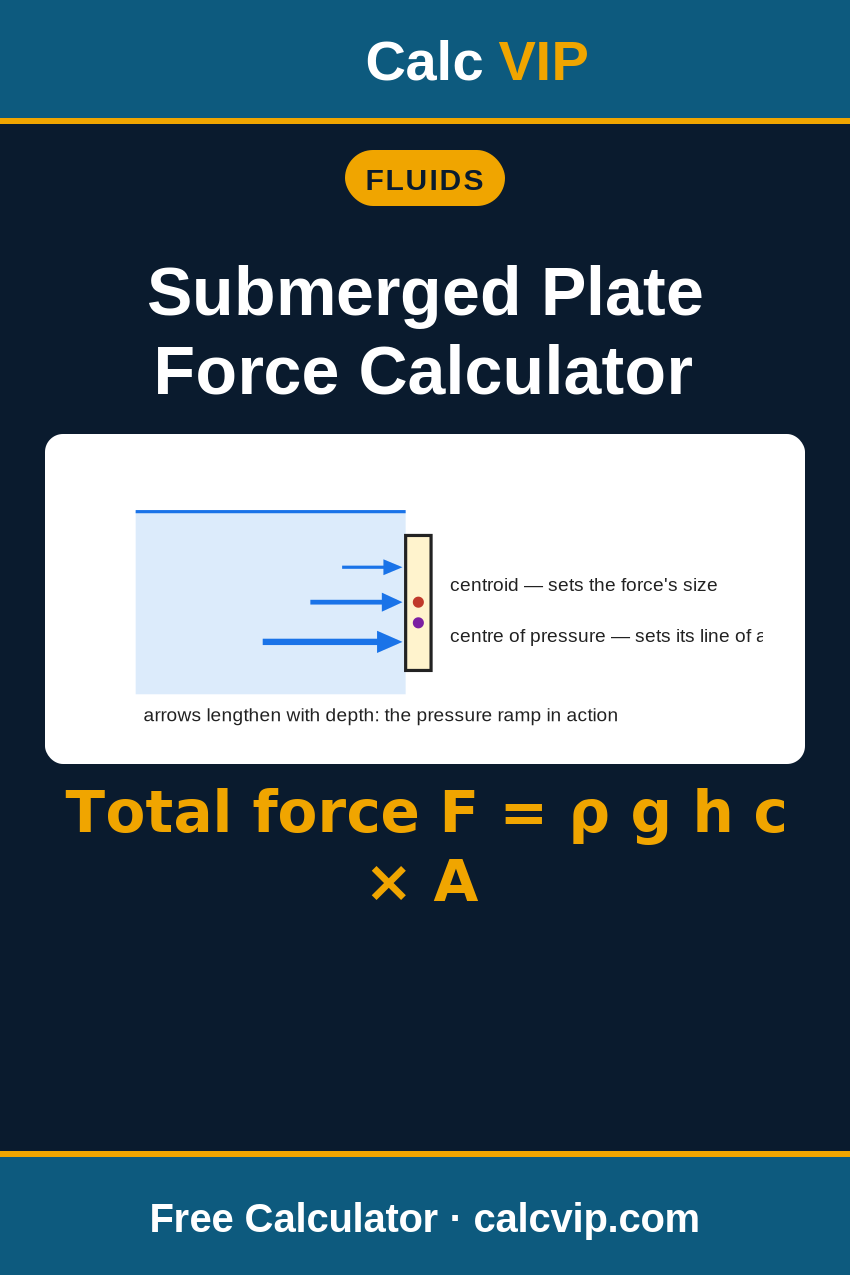
The numbers deserve respect. A plate the size of a household door, submerged with its top edge just a metre down, already carries a load measured in tonnes; a dam face carries the weight of a town. Nothing in the calculation is exotic — density, gravity, depth, area — yet it sizes the hinges of lock gates, the thickness of aquarium glass, the anchors of flood barriers and the safety factors of every tank farm. It is also the natural companion of the pressure solver on this site: that page finds a pressure from a force; this one finds the force a fluid's own pressure distribution delivers.
Formula
Total force F = ρ g hc × A • hc = d + H/2 (top-edge depth d plus half the plate height H); A = W × H; densities in kg/m³, lengths in m, force in newtons
Read the formula as two steps: the pressure at the centroid, Pc = ρ g hc, then that pressure applied uniformly over the area A. It is exact for a flat plate in a static liquid of constant density, whatever the plate's shape — only A and hc enter. For the centre of pressure (where the resultant acts), the depth is hp = hc + Ic/(hc × A), where Ic is the plate's second moment of area about its own horizontal centroid axis — for a rectangle, Ic = W × H³ / 12. Because hp always exceeds hc, hinges and supports belong at the centre of pressure, not at the centroid.
| Symbol | Meaning | Units |
|---|---|---|
| F | total hydrostatic force on one face of the plate | N (reported also in kN) |
| ρ | fluid density (fresh water 1,000; sea water 1,025) | kg/m³ |
| hc | depth of the plate's centroid below the surface | m |
| A | plate area, width × height | m² |
| hp | depth of the centre of pressure | m |
The pressure ramp: why the centroid rule is exact
Slice the plate into thin horizontal strips. Each strip sits at one depth, feels one pressure ρgh, and contributes a force of pressure × strip area. Summing the strips is adding up a ramp: the shallow strips contribute little, the deep strips much, and because the ramp is straight, the total equals the contribution of a single fictitious strip at the middle depth spread over the whole plate. Mathematically this is the mean-value property of a linear function; physically it says the water does not care about the plate's edges, only about where its middle lies and how much of it there is. Tilt the plate and the same argument survives with the vertical depth of the centroid — pressure knows nothing of slopes, only of depth.
Two consequences follow that designers rely on. First, the force is blind to the plate's shape: a circular hatch and a square one of equal area, centroids level, are pushed equally hard — shape matters only for bending stresses and for the centre of pressure. Second, the force is blind to what lies behind the plate: a gate holding back a reservoir feels the same push whether the reservoir is a kilometre wide or a metre, because pressure at a depth is set by depth alone. This is the hydrostatic paradox wearing work clothes, and it is why a modest standpipe can burst a stout barrel.
How to use
- Enter the fluid density — 1,000 kg/m³ for fresh water is pre-filled; use 1,025 for sea water.
- Enter the plate's width and height in metres.
- Enter the depth of the plate's top edge below the surface — 0 if the top edge is exactly at the surface.
- Click "Calculate Force on Plate" to see the centroid depth, the pressure there, and the total force in N and kN.
Worked examples
Example 1 — the reference plate. A plate 2 m wide × 3 m tall, top edge 1 m below the surface of fresh water.
hc = 1 + 3/2 = 2.5 m; A = 6 m²; Pc = 1,000 × 9.81 × 2.5 = 24,525 Pa; F = 24,525 × 6 = 147,150 N ≈ 147.15 kN — about fifteen cars' worth of push on a garden-fence-sized panel.
Example 2 — an aquarium wall. A viewing panel 1 m wide × 0.5 m tall with its top edge at the surface: hc = 0.25 m, A = 0.5 m², F = 1,000 × 9.81 × 0.25 × 0.5 = 1,226.25 N. A quarter-tonne of push on a home aquarium's glass — the reason its silicone seams and glass thickness are not decorative choices.
Example 3 — a dam face, per metre of width. Water 10 m deep against a vertical dam: per metre width, A = 10 m² and hc = 5 m, so F = 1,000 × 9.81 × 5 × 10 = 490,500 N per metre. A 100 m dam therefore holds back about 49 million newtons — and its curved, massively thick profile exists to turn that push into compression in concrete and thrust into the valley walls.
Example 4 — a tank inspection hatch. A rectangular hatch 1.5 m wide × 2 m tall whose top edge is 2 m below the surface of stored water: hc = 2 + 1 = 3 m, A = 3 m², F = 1,000 × 9.81 × 3 × 3 = 88,290 N. Nearly nine tonnes on the hatch's bolts — the calculation that decides how many bolts, and why they are never undone before the tank is drained.
Example 5 — a sea gate. A harbour gate 4 m wide × 2 m tall, top edge 0.5 m below sea water (1,025 kg/m³): hc = 1.5 m, Pc = 1,025 × 9.81 × 1.5 = 15,082.88 Pa, A = 8 m², F = 120,663 N ≈ 120.66 kN. Salt water's extra 2.5% density flows straight through to the force — one reason coastal structures are not designed with freshwater numbers.
Example 6 — where the push acts. For the plate of Example 1, Ic = W × H³/12 = 2 × 27/12 = 4.5 m⁴, so hp = 2.5 + 4.5/(2.5 × 6) = 2.5 + 0.3 = 2.8 m — the resultant acts 0.3 m below the centroid, 1.8 m below the top edge. A hinge placed at the centroid would still feel a turning moment from 147 kN acting 0.3 m off-line; gate designers place hinges and struts with this offset in hand.
Plate forces in real life
Dams and flood barriers. The defining load case of every dam, weir and demountable flood barrier is this formula integrated along the wall; per-metre forces like Example 3's set the wall's thickness, its keying into the foundation and its drainage design.
Lock gates and dry docks. Mitre gates hold back a pound of water with forces in the hundreds of kN; their hinges, sills and the meeting angle of the gate pair are all arranged around the centre of pressure computed here.
Aquariums and pool windows. Public aquariums push this physics to spectacle — acrylic panels holding back megalitres — but the home tank of Example 2 obeys the same law, and its safety factor begins with 1,226 N.
Tank hatches and manways. Example 4's bolt count is a legal matter: pressure-vessel and tank codes require closures to be rated for the full hydrostatic (and process) load at the centroid of the opening.
Ship bulkheads and cofferdams. A flooded compartment presses on its bulkheads exactly as a plate; damage-stability rules assume these forces when deciding whether the remaining structure holds the sea out of the dry side.
Retaining walls and basements. Groundwater behind a basement wall is a fluid looking for a plate; the same ρghcA estimate, with soil's saturated behaviour, explains many a cracked wall after a wet winter.
Inclined and curved surfaces: what changes, what does not
Tilt the plate — a dam's sloped upstream face, a canal gate leaning at 60° — and the recipe survives with one substitution: hc is the vertical depth of the centroid, while A remains the plate's true area. Pressure responds to vertical depth alone, so a long, shallow-sloped face can carry a smaller force than its area suggests, because its centroid is not as deep as its length implies. The centre of pressure likewise is measured along the slope with the same correction term. Curve the surface — a cylindrical tank end, a submarine hull — and the trick changes character: the horizontal component of force equals this calculator's result for the surface's vertical projection, while the vertical component equals the weight of fluid above the curve plus the fluid the curve "displaces". Engineers decompose curved walls into those two plate-like problems; the flat plate you are calculating now is the atom from which both are built.
Quick reference: pressure of still water, by depth
| Depth | Gauge pressure | Force on 1 m² centred there |
|---|---|---|
| 1 m | 9,810 Pa | 9,810 N |
| 5 m | 49,050 Pa | 49,050 N |
| 10 m | 98,100 Pa | 98,100 N |
| 20 m | 196,200 Pa | 196,200 N |
| 100 m | 981,000 Pa | 981,000 N |
The middle column is the pressure at the centroid of a one-metre plate; the right column is then just that pressure wearing the area of 1 m² — a reminder that on a per-square-metre basis, force and pressure are numerically the same story.
When still water is not the whole load
This calculator prices a motionless fluid, and honest design treats that figure as the floor, not the ceiling. Real water moves. Waves against a harbour gate add a rhythmic surcharge that can rival the static force at the crest; a rapidly closed valve sends a pressure surge — water hammer — down a pipeline that momentarily multiplies the pressure at a blank flange; an earthquake shakes a reservoir into sloshing modes that raise and lower the effective surface along a dam. Even the slow cases drift: silt accumulating against a wall adds a denser, heavier "fluid" layer, and ice forming on the surface can jack against gates with thermal expansion forces that have torn real structures. None of this invalidates ρghcA — every one of those loads is quoted as an addition to it. The static force is the reference from which surcharges are measured, the first number in the load case and the one against which safety factors are defined.
Common mistakes
- Using the bottom-edge pressure for the whole plate. That overstates the force, sometimes twofold. The average pressure lives at the centroid — half the height — not at the deepest point.
- Using the top-edge depth as hc. hc is top-edge depth plus half the plate height. Forgetting the half-height understates every force; on a surface-touching plate it would wrongly give zero.
- Measuring depth along a slope. Pressure follows vertical depth. On an inclined face, convert the centroid's slope distance to vertical depth with the sine of the face's angle.
- Forgetting the water on the other side. A gate with fluid on both faces feels the difference of the two plate forces. Dry-side calculations overstate the net load whenever the downstream side is also wet.
- Ignoring the centre of pressure in supports. The force's size is only half the design data; its line of action sits below the centroid, and hinges placed without that offset inherit a permanent turning moment.
FAQ
Why use the pressure at the centroid and not the average of top and bottom?
They are the same thing: pressure varies linearly with depth, so the average of the top-edge and bottom-edge pressures equals the pressure at the midpoint depth.
Does the force depend on the plate's shape?
Only through its area and the depth of its centroid. A circular gate and a rectangular plate of equal area with centroids at the same depth feel the same total force.
Where does the force effectively act?
At the centre of pressure, which is always slightly below the centroid because pressure grows with depth. Dam and gate hinges are designed around that point.
What if the plate's top edge is above the waterline?
Then only the submerged part is a "plate" for this formula: use the submerged height as H, with its top edge at the surface (d = 0). The dry part contributes nothing.
Does the force change if the tank is wider?
No. Pressure at a depth depends only on depth and density — the hydrostatic paradox. A plate in a narrow standpipe and the same plate in a reservoir at equal depths feel identical forces. It feels wrong the first time — surely the reservoir's millions of tonnes must push harder — but pressure is a local quantity, set by the column of fluid directly above each point, and the rest of the reservoir is carried by its own walls and floor.
How is this different from the buoyant force?
Buoyancy is the net of pressure forces over a closed, submerged volume (vertical faces cancel; top and bottom faces do not). This calculator gives the force on a single flat face — one ingredient of a buoyancy calculation, and the whole story for walls and gates.
What g does the calculator use?
9.81 m/s², standard Earth gravity, matching the worked examples. On a high plateau the difference is a fraction of a percent — far below construction tolerances.
Can I use it for a circular gate?
Yes: enter the circle's area (πD²/4) implicitly by using an equivalent width — or note the formula needs only A and hc. Set width × height to the circle's area with the centroid at the circle's centre depth and the force is correct; only the centre-of-pressure term changes shape factor.
Why do dams curve?
An arch dam carries the plate force largely as compression around the curve into the valley sides, letting a far thinner wall hold the same water. The force this page computes is unchanged; the structure's way of answering it is smarter.
What safety factor is typical on such forces?
Structural codes commonly design water-retaining elements for 1.5× or more of the calculated hydrostatic load, with the centre of pressure — not the centroid — as the load's assumed position. The factor is not distrust of the formula, which is exact; it covers the dynamic surcharges described above, deterioration over decades of service, and the simple fact that water finds every weakness a structure offers it.