 Calc
Specific Gravity Calculator – SG from Density & Density from SG
 Created by Elena Petrova · Physics Editor · Fluids & Rotation · Last updated: November 2026
Use this free Specific Gravity Calculator to compare the density of any substance with the density of water. Enter a density to find its specific gravity, or enter a specific gravity to find the density.
Specific gravity — SG for short — answers a deceptively simple question: how many times heavier is this stuff than the same volume of water? Water is the natural yardstick because the metric system was built around it: the kilogram was originally defined so that one litre of water has a mass of one kilogram, which makes the density of water exactly 1000 kg/m³ in round numbers. Divide any density by that 1000 and you get a pure number with no units — a number that a brewer in Belgium, a battery technician in Brazil and a doctor anywhere else all read on exactly the same scale.
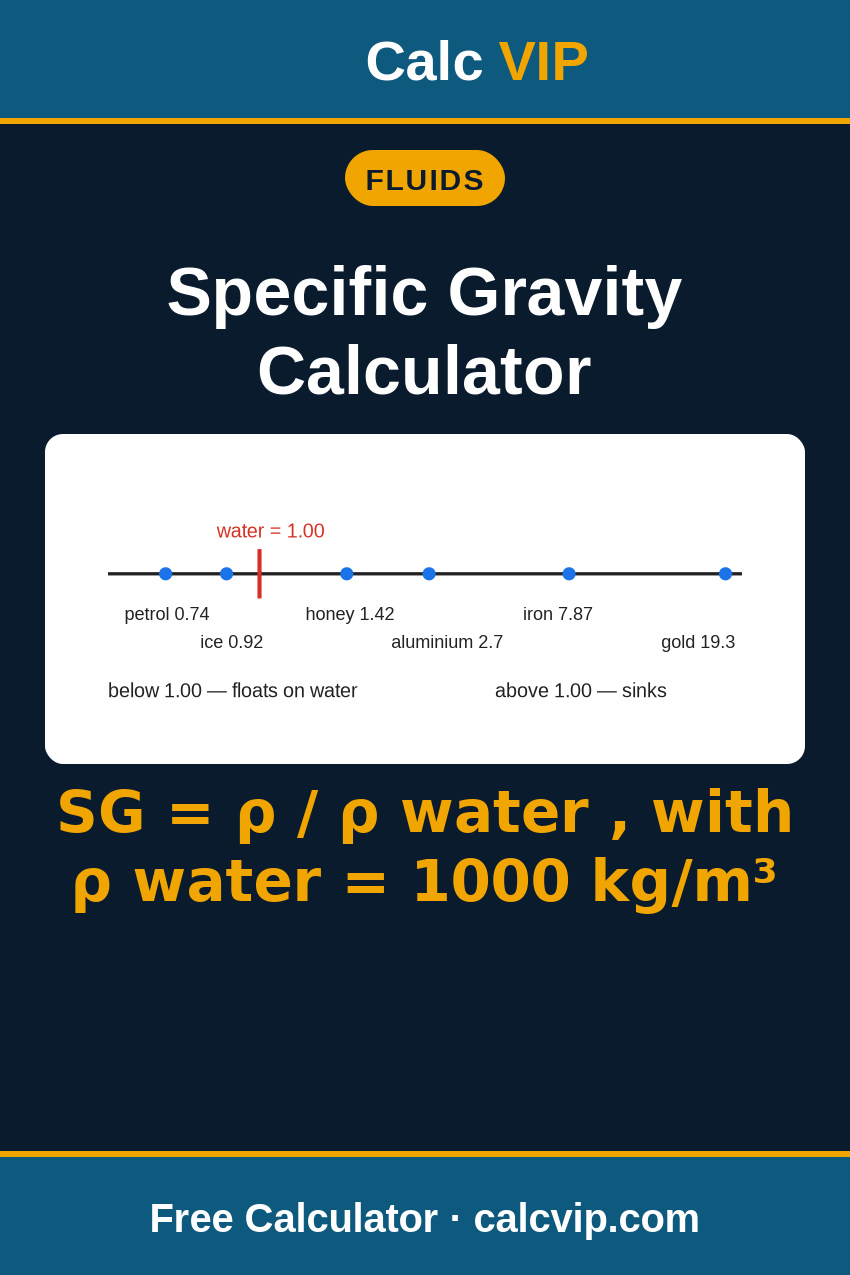
The scale runs a long way in both directions. Everyday liquids cluster close to 1: petrol at about 0.74, olive oil 0.91, milk 1.03, honey 1.42. Rocks and building materials sit between 2 and 3 — aluminium 2.7, ordinary stone around 2.65. The common metals climb steeply: iron 7.87, copper 8.96, silver 10.49, lead 11.34, mercury 13.6, and gold 19.3, with osmium, the densest natural element, at about 22.6. Because the comparison liquid is water, the number doubles as a float-or-sink verdict: below 1 the substance floats on water, above 1 it sinks — and as the Floating Fraction Calculator shows, it even fixes how high a floating object rides.
What makes specific gravity so durable in workshops and laboratories is that it can be measured with a floating glass tube. A hydrometer sinks into a liquid until it has displaced its own weight of liquid, and the depth it settles at reads the specific gravity straight off its stem — no balance, no measuring cylinder, no arithmetic. One glance tells a mechanic whether a battery is charged, a winemaker whether fermentation has finished, and a nurse whether a urine sample is concentrated or dilute. This calculator performs the same conversion in the other direction: density to SG, or SG back to density, whenever a data sheet gives one and you need the other.
Formula
Specific gravity = Density of substance ÷ Density of water → SG = ρ / ρwater, with ρwater = 1000 kg/m³.
The rearrangement is just as important: Density = SG × 1000 kg/m³. Because the reference density is 1000 kg/m³ = 1 g/cm³, the specific gravity is numerically equal to the density expressed in g/cm³ — a shortcut worth remembering, since data sheets freely mix the two. A substance quoted at 2.7 g/cm³ and one quoted at SG 2.7 are the same material described twice. Specific gravity itself has no units and no dimensions; it does not change when the same substance is measured in pounds and gallons, which is precisely why engineers trust it across unit systems.
| Symbol | Meaning | Units |
|---|---|---|
| SG | specific gravity — density relative to water | none (pure ratio) |
| ρ | density of the substance | kg/m³ (or g/cm³) |
| ρwater | density of pure water at 4 °C (the reference) | 1000 kg/m³ = 1 g/cm³ |
Why a ratio? Archimedes, hydrometers and the floating scale
The idea is older than the metric system by two thousand years. Archimedes realised that a floating body displaces a weight of liquid equal to its own weight, and that single insight makes specific gravity measurable by floating alone. A hydrometer is a sealed glass tube, weighted at the bottom so it floats upright. Dropped into a liquid, it sinks until the displaced liquid weighs as much as the instrument. In a light liquid it must displace a large volume, so it sinks deep; in a dense liquid a small displaced volume suffices, so it floats high. The stem is printed with the SG scale, and the reading is taken where the liquid surface crosses it. Every hydrometer in every brewery and battery shop is Archimedes' principle with a ruler glued on.
The same physics governs any floating object, which is why specific gravity predicts floating behaviour exactly: an object whose SG (relative to the liquid it floats in) is 0.92, like ice in fresh water, floats with 92% of its volume submerged. Change the liquid and the verdict changes with the ratio — iron, SG 7.87, sinks without argument in water, yet floats on mercury (SG 13.6) with only about 58% of its volume below the surface, a parlour demonstration that still startles students. Specific gravity is therefore never a property of a substance alone; it is a comparison, and the comparison liquid matters.
One refinement professionals respect is temperature. Water reaches its maximum density, 1000 kg/m³ for practical purposes, at 4 °C; at 20 °C it has already thinned to about 998 kg/m³, and the sample being measured expands too. The shifts are small — a few tenths of a percent — but hydrometers are calibrated at a stated temperature (often 15.6 °C, the 60 °F of the older standards), and readings taken on hot wort, warm battery acid or cold milk are corrected back to that temperature before anyone trusts the third decimal place. Modern laboratory instruments go further still: an oscillating U-tube meter times the vibration of a hair-thin glass tube filled with the sample and reports density — and with it, specific gravity — to five decimal places in under a minute, a precision Archimedes could not have imagined from a principle he discovered in his bath.
How to use
- Choose the mode: "Specific gravity (from density)" if you know the density, or "Density (from specific gravity)" if you know the SG.
- Enter the density in kg/m³, or the specific gravity as a plain number, as the label asks.
- Click "Calculate" to see the converted value, with a plain-language comparison against water.
- Read the result against the float test: SG below 1 means the substance floats on water; above 1 it sinks. For the submerged percentage, take the two densities to the Floating Fraction Calculator.
Worked examples
Example 1 — aluminium, and back again. Aluminium has a density of 2700 kg/m³. SG = 2700 ÷ 1000 = 2.7 — aluminium is 2.7 times as dense as water. Going the other way, a liquid with SG 0.92 has a density of 0.92 × 1000 = 920 kg/m³.
Example 2 — gold. Gold's density is 19,300 kg/m³, so its SG is 19,300 ÷ 1000 = 19.3. Read the other way, the number says one cubic metre of gold has a mass of 19.3 tonnes — which is why a gold bar the size of a house brick (about a litre) already weighs 19.3 kg, and why specific gravity is a classic first test for fake gold: tungsten, at SG 19.25, is the only cheap metal that comes close.
Example 3 — battery acid. The sulphuric acid in a fully charged car battery has an SG of about 1.28, so its density is 1.28 × 1000 = 1280 kg/m³. As the battery discharges, the acid is consumed and the SG falls towards 1.10 (1100 kg/m³). A hydrometer reading between those two values is a fuel gauge for the battery — no electronics required.
Example 4 — olive oil. Olive oil has a density of about 910 kg/m³: SG = 910 ÷ 1000 = 0.91. Below 1, so oil floats on water and spreads as a separate layer — the visible proof, in every salad dressing that has stood too long, that the two liquids differ in density by about 9%.
Example 5 — a urine test. A urine sample with SG 1.020 has a density of 1.020 × 1000 = 1020 kg/m³. Healthy urine ranges roughly from 1.005 to 1.030 depending on hydration; the SG is a quick measure of how much dissolved material the kidneys are clearing, read from a dipstick or refractometer in seconds.
Example 6 — iron on mercury. Mercury's density is 13,600 kg/m³, SG = 13.6. An iron bolt (SG 7.87) placed on mercury does not sink: it floats, because 7.87 is less than 13.6, with 7.87 ÷ 13.6 ≈ 58% of its volume submerged. "Denser than water" and "sinks in everything" are not the same statement — the comparison liquid decides.
Specific gravity in real life
Brewing and winemaking. Brewers measure the SG of wort before fermentation (the "original gravity", typically 1.040–1.060) and after (the "final gravity", near 1.010). The drop tells them how much sugar became alcohol: ABV ≈ (OG − FG) × 131.25, so a fall from 1.050 to 1.010 means roughly 5.25% alcohol by volume.
Car batteries. As Example 3 showed, electrolyte SG tracks charge: about 1.28 fully charged, about 1.10 flat. Fleet mechanics still check every cell with a hydrometer because a single low cell exposes a dying battery before it strands anyone.
Gem identification. Gemmologists weigh a stone in air and in water; the ratio is its SG. Quartz reads 2.65, diamond 3.51, and the common diamond imitation cubic zirconia about 5.6 — heavy for its size, which is one reason experienced jewellers can suspect it the moment it is in the hand.
Milk testing. Genuine milk has an SG of about 1.03. A lactometer — a hydrometer scaled for milk — exposes watered milk instantly, because added water drags the SG down towards 1.00. The test has policed milk supplies for over a century.
Antifreeze and coolant. Ethylene glycol has an SG of about 1.11, water 1.00, so the SG of the mixture in a radiator reports the mixing ratio — and therefore the temperature down to which the coolant protects the engine.
Petroleum trading. Crude oil is graded by its density-derived API gravity (see the depth section below): light, valuable crudes score high API numbers, heavy tar-like crudes low ones, and the price follows the scale.
When the reference is not water: API gravity and gas SG
Water is the usual reference, but not the only one. The oil industry inverts the scale on purpose: API gravity = 141.5 ÷ SG − 131.5, arranged so that water reads 10 and lighter oils read higher. A crude with SG 0.85 scores 141.5 ÷ 0.85 − 131.5 ≈ 35° API — a "light" crude that flows easily and commands a premium; a heavy crude at SG 0.95 scores only about 17.5° API. For gases, the reference is air at the same temperature and pressure: natural gas has an SG around 0.6 relative to air, which is why leaked gas rises and collects at ceilings, while propane (SG about 1.5 relative to air) sinks and pools at floor level — a difference that decides where gas detectors are mounted.
Blending liquids: the weighted-average rule
When two liquids that do not react are mixed, the density of the blend is close to the volume-weighted average of the two densities — and so is the specific gravity. Petrol stations sell this arithmetic: E10 fuel is 90% petrol (SG ≈ 0.737) and 10% ethanol (SG ≈ 0.789), giving a blend density of about 0.9 × 737 + 0.1 × 789 = 663.3 + 78.9 ≈ 742 kg/m³, an SG of about 0.74. The same rule, run backwards, is how antifreeze testers and battery-acid blenders work out a mixing ratio from a single hydrometer reading: measure the blend's SG, and the proportions follow. Two cautions keep the rule honest. First, a few famous pairs — ethanol and water above all — contract slightly on mixing, so the blend's volume is a percent or so less than the sum and its density a touch higher than the simple average. Second, the rule averages by volume; blending by mass needs the weights swapped, and confusing the two is a classic source of a blend that comes out stronger or weaker than intended.
Quick reference: specific gravities of familiar materials
| Material | Density (kg/m³) | SG |
|---|---|---|
| petrol | ≈ 737 | ≈ 0.74 |
| ethanol | 789 | 0.79 |
| olive oil | ≈ 910 | 0.91 |
| ice | 917 | 0.92 |
| fresh water | 1000 | 1.00 |
| sea water | 1025 | 1.025 |
| milk | ≈ 1030 | 1.03 |
| honey | ≈ 1420 | 1.42 |
| aluminium | 2700 | 2.70 |
| iron / steel | 7870 | 7.87 |
| copper | 8960 | 8.96 |
| silver | 10,490 | 10.49 |
| lead | 11,340 | 11.34 |
| mercury | 13,600 | 13.60 |
| gold | 19,300 | 19.30 |
Read as a design table, it is a float-and-sink chart for water: everything above the 1.00 row can float, everything below it cannot — and for anything that floats, the SG itself (× 100) is the percentage that will sit underwater.
Common mistakes
- Giving specific gravity units. SG is a ratio of two densities, so the units cancel. Writing "SG = 2.7 kg/m³" mixes two different quantities — 2.7 is the SG; 2700 kg/m³ is the density.
- Assuming SG above 1 always sinks. It sinks in water. Iron (7.87) floats on mercury (13.6); the verdict belongs to the pair of substances, not to one number.
- Using the g/cm³ shortcut in other unit systems. SG equals the density in g/cm³ only because water is 1 g/cm³. In lb/ft³, water is 62.4 — the shortcut dies, the ratio survives.
- Ignoring temperature. A hydrometer calibrated at 15–20 °C reads low in a hot sample, because the liquid has expanded. Precision work corrects the reading back to the calibration temperature.
- Treating sea water as the reference. Standard SG uses pure fresh water. Sea water is already 1.025, so measuring against it shifts every result by 2.5%.
FAQ
Is specific gravity the same as density?
No. Density has units (such as kg/m³), while specific gravity is a unitless ratio comparing a substance with water. They are linked: density = SG × 1000 kg/m³.
Which water density is used as the reference?
1000 kg/m³, the density of pure water at 4 °C (equal to 1 g/cm³). Most textbook specific gravities use this reference.
What does an SG below 1 mean?
The substance is less dense than water, so it floats in water. Wood (SG ≈ 0.5) and ice (SG ≈ 0.92) float; gold (SG ≈ 19.3) sinks quickly.
How is specific gravity measured in practice?
Most often with a hydrometer — a weighted glass float whose stem reads SG where it crosses the liquid surface. Laboratories also use a pycnometer (a flask of exactly known volume, weighed full and empty) or a digital density meter, and gemmologists get it from weighing a stone in air and in water.
What is the specific gravity of gold?
About 19.3 — gold is 19.3 times as dense as water, so a litre of gold weighs 19.3 kg. The extreme value is why SG is a standard authenticity test, and why tungsten (19.25), the one metal that nearly matches it, is the forger's favourite.
Does specific gravity change with temperature?
Yes, slightly, because both the sample and the reference water expand as they warm. Water is densest at 4 °C; a sample measured hot reads a little lower than the same sample measured at the hydrometer's calibration temperature. For most purposes the shift is in the third decimal place.
Why do brewers watch specific gravity so closely?
Because the fall in SG during fermentation measures the sugar converted to alcohol. Original gravity minus final gravity, times about 131.25, estimates the alcohol percentage — a wort falling from 1.050 to 1.010 gives roughly 5.25% ABV — and a gravity that stops falling tells the brewer fermentation is done.
What is the highest specific gravity of any material?
Osmium, a rare platinum-group metal, at about 22.6 — narrowly ahead of iridium at about 22.4. Both are laboratory curiosities rather than engineering materials, but they mark the top of the scale: nothing on Earth is more than about 23 times as dense as water.
Can specific gravity be greater than 1 for a gas?
Gas SG is measured against air, not water, and yes: carbon dioxide is about 1.5 times as dense as air, so it sinks and can pool in cellars and fermentation rooms — a genuine safety hazard. Hydrogen, at about 0.07, is at the opposite extreme and escapes upwards through almost any gap.
How does specific gravity relate to floating?
Directly: a solid floating in a liquid sits with a fraction of its volume submerged equal to its density divided by the liquid's density — its SG relative to that liquid. Ice at SG 0.92 in fresh water floats 92% submerged; in sea water (SG 1.025) the same ice floats with 917 ÷ 1025 ≈ 89.5% submerged, riding slightly higher.