 Calc
Stokes' Law Calculator – Terminal Velocity of a Sphere
 Created by Elena Petrova · Physics Editor · Fluids & Rotation · Last updated: November 2026
Use this free Stokes' Law Calculator to find the terminal velocity of a tiny sphere falling slowly through a viscous fluid — for example a ball bearing settling in glycerin, or a dust grain in oil. Enter the sphere's radius and the densities and viscosity of the fluid.
Drop a small sphere into a jar of thick liquid and something quietly remarkable happens: after a brief moment of acceleration it stops speeding up and settles into a perfectly constant, stately descent — fast for a big dense ball, absurdly slow for a tiny light one. That final speed is its terminal velocity, and Stokes' law predicts it exactly from four ingredients: the sphere's radius, the density difference between sphere and fluid, gravity, and the fluid's viscosity. This calculator performs that prediction, which is the working heart of falling-ball viscometers, sedimentation analysis and a surprising amount of atmospheric science.
The law is named for George Gabriel Stokes, who derived the drag on a slow sphere in 1851: F = 6πμrv, a force proportional to the sphere's radius, the viscosity, and its speed — proportional, note, to the first power of speed, unlike the squared drag of fast projectiles. Terminal velocity is simply the speed at which this growing drag, plus buoyancy, exactly cancels the sphere's weight; from then on, no net force, no acceleration — just the steady sinking. (The sphere reaches that balance astonishingly fast in a viscous fluid: in glycerin, within a small fraction of a second.)
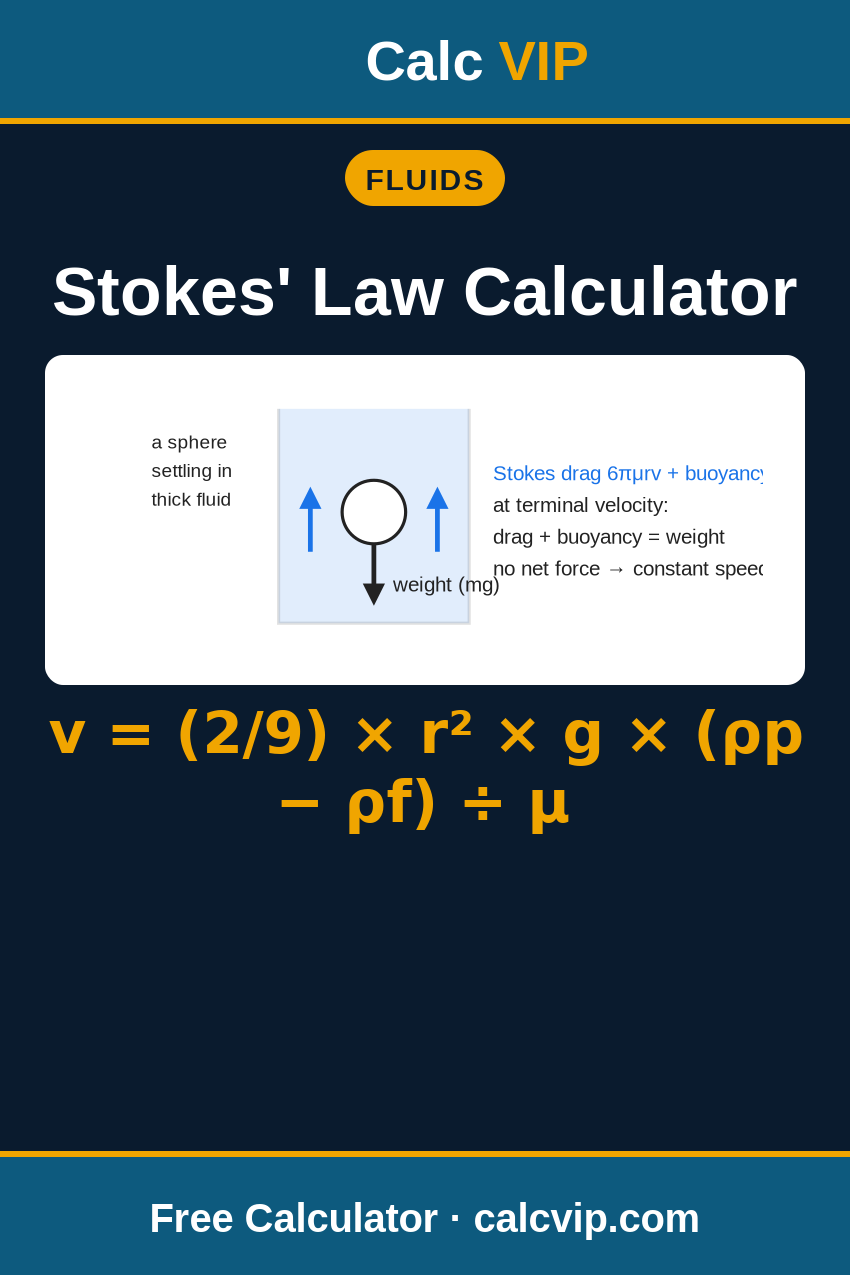
Enter the sphere's radius in millimetres, its density, the fluid's density and the fluid's viscosity, and the calculator returns the terminal velocity in metres, millimetres and centimetres per second. A negative density difference flips the answer into a rising velocity — bubbles and oil droplets obey the same law on their way up. The one condition to respect is the law's home territory: the flow around the sphere must be smooth and slow, roughly a Reynolds number below 1, which the FAQ and the last worked example show you how to check.
Formula
Terminal velocity: v = (2/9) × r² × g × (ρp − ρf) ÷ μ
This comes from balancing the sphere's effective weight against Stokes' drag force, F = 6πμrv. As the sphere speeds up, drag grows until it exactly balances the weight minus buoyancy — from then on the sphere falls at the constant terminal velocity. g = 9.81 m/s².
Written out, the balance is: weight (4/3)πr³ρp g = buoyancy (4/3)πr³ρf g + drag 6πμrv, and solving for v gives the formula above. It rearranges into the viscometer's working form, μ = (2/9) × r²g(ρp − ρf) ÷ v — measure the settling speed of a known ball and the unknown viscosity falls out, which is how the instrument on laboratory shelves actually earns its keep. Note the levers: v grows with the square of the radius, linearly with the density difference, and in inverse proportion to viscosity.
| Symbol | Meaning | Units |
|---|---|---|
| v | terminal velocity (downward if positive) | m/s |
| r | radius of the sphere | m (calculator accepts mm) |
| ρp | density of the sphere (particle) | kg/m³ |
| ρf | density of the fluid | kg/m³ |
| μ | dynamic viscosity of the fluid | Pa·s |
Why r² wins: the geometry of sinking slowly
The radius appears squared in the formula because two different scalings fight inside it. The driving force — effective weight — grows with volume, hence with r³. The resisting drag grows only with r (Stokes' 6πμrv is a surface-ish effect: the fluid is sheared around the sphere's girth). Divide an r³ drive by an r resistance and the terminal velocity inherits r². The consequences are extreme: halve a grain's radius and it sinks four times slower; shrink it tenfold — from sand to silt — and it sinks a hundred times slower, which is why fine silt clouds a river for days after coarse sand has long settled, why centrifuges (which multiply g) are needed to separate the finest particles at all, and why the boundary between "sediment" and "suspension" in geology is really a Stokes boundary.
The other lever, viscosity, works in simple inverse proportion, and temperature pulls it hard: glycerin at 20 °C has μ ≈ 1.41 Pa·s, but warm it and the same ball falls visibly faster as the fluid thins. Falling-ball viscometers are therefore thermostatted like laboratory instruments, not kitchen gadgets — a few degrees of drift masquerades as a viscosity change. The density difference, finally, is the law's signpost: positive, the sphere sinks; zero, it hangs suspended (the neutral point prized in density-gradient experiments); negative, it rises — Stokes' law governing bubbles with the same indifference it shows to ball bearings.
How to use
- Enter the sphere's radius in millimetres (a 2 mm-wide ball has r = 1 mm).
- Enter the density of the sphere and of the fluid in kg/m³ (steel = 7800, glass ≈ 2500, glycerin = 1260, water = 1000).
- Enter the fluid's viscosity in Pa·s (glycerin = 1.41, water = 0.001) and click "Calculate Terminal Velocity".
- Sanity-check the regime: compute the sphere's Reynolds number, Re = ρf × v × (2r) ÷ μ — Stokes' law is trustworthy while it stays below about 1.
Worked examples
Example 1 — the ball bearing in glycerin. A steel ball bearing of radius 1 mm (ρp = 7800 kg/m³) settles through glycerin (ρf = 1260 kg/m³, μ = 1.41 Pa·s). v = (2/9) × (0.001)² × 9.81 × (7800 − 1260) ÷ 1.41 ≈ 0.0101 m/s — about 10.11 mm/s, a slow, steady sink of roughly 1 cm per second. This is exactly how falling-ball viscometers measure a liquid's viscosity. It would take about 9.9 seconds to fall 10 cm — an easy, accurate timing for a stopwatch, which is the whole point of the instrument. Validity check: Re = 1260 × 0.0101 × 0.002 ÷ 1.41 ≈ 0.018 — safely inside Stokes territory.
Example 2 — a glass bead in glycerin. A glass bead of radius 0.5 mm (ρp = 2500 kg/m³) in the same glycerin: v = (2/9) × (0.0005)² × 9.81 × (2500 − 1260) ÷ 1.41 ≈ 0.000479 m/s — under half a millimetre per second (0.48 mm/s). Halving the radius quartered the speed, and the lower density difference slowed it further; a 10 cm fall would take over three minutes.
Example 3 — a silt grain in water. A quartz silt grain of radius 0.05 mm (ρp = 2650 kg/m³) in water (ρf = 1000, μ = 0.001): v = (2/9) × (0.00005)² × 9.81 × 1650 ÷ 0.001 ≈ 0.00899 m/s ≈ 9.0 mm/s. Its Reynolds number is 1000 × 0.009 × 0.0001 ÷ 0.001 ≈ 0.9 — just inside the Stokes limit, a borderline the careful analyst notes. Grains ten times finer sink a hundred times slower, about 0.09 mm/s, needing hours to cross a beaker: the physical reason muddy water clears from the top down over days.
Example 4 — a bubble rising through olive oil. An air bubble of radius 0.5 mm (ρp ≈ 1.2 kg/m³) in olive oil (ρf = 910, μ = 0.056): the density difference is negative, (1.2 − 910), so v ≈ −0.00884 m/s — the minus sign means it rises at about 8.84 mm/s. Watch bubbles climb through a bottle of oil and you are watching Stokes' law run in reverse, clearing the oil from the top as surely as sediment clears water from the bottom.
Example 5 — Millikan's oil drop. A charged oil droplet of radius 1 micrometre (ρp = 900 kg/m³) drifting in air (ρf ≈ 1.2, μ = 0.0000181): v ≈ 0.000108 m/s ≈ 0.108 mm/s. Robert Millikan timed exactly such falls (and electrically driven rises) between 1909 and 1913 to measure the charge of a single electron — Stokes' law converting a stopwatch and a microscope into one of the fundamental constants of nature, and a Nobel Prize.
Example 6 — the raindrop that breaks the law. Apply the formula blindly to a raindrop of radius 1 mm falling through air: v = (2/9) × (0.001)² × 9.81 × (1000 − 1.2) ÷ 0.0000181 ≈ 120 m/s — faster than a racing car, and false. Real raindrops of that size land at about 6–7 m/s. The check exposes the fraud: the drop's Reynolds number would be ≈ 15,950, hopelessly beyond the law's Re < 1 homeland. Up there, drag grows with v² instead of v, and a different terminal-velocity physics (the skydiver's kind) takes over. The example is the law's own warning label: verify the regime before trusting the number.
Stokes' law in real life
Falling-ball viscometers. Example 1 inverted is an industry standard instrument: time a calibrated ball through a thermostatted tube of the test liquid and the rearranged formula returns μ. Paints, oils, syrups and polymer melts are all graded this way somewhere in their quality chain.
Sedimentation and water treatment. Settling tanks, clarifiers and lamella separators are Stokes' law built at municipal scale: give particles time and stillness, and each size class sinks at its predicted rate. Designers size the tank so the water's residence time exceeds the settling time of the smallest particle they intend to remove.
Blood tests (ESR). The erythrocyte sedimentation rate — a century-old inflammation marker — is literally how fast red blood cells settle in a vertical tube of blood in one hour. Cells are not spheres and blood is not simple, so the test is empirical; but its soul is Stokes: inflammation makes cells clump into effectively larger "particles", and r² does the rest.
Geology and soil analysis. Soil scientists classify sand, silt and clay by settling: disperse a soil sample in water, and the fractions rain out in Stokes order — sand in seconds, silt in hours, clay over days (or with a centrifuge's help). River deltas sort themselves by the same timetable, coarse grains dropping where the current first slows.
Clouds and aerosols. A cloud droplet of radius 10 micrometres settles through air at about 1 cm/s — so slowly that the gentlest updraft cancels it, which is why clouds stay up. Aerosol scientists use the same arithmetic to predict how long dust, pollen and pollution particles remain airborne and how deep into the lung each size can travel.
Creameries and centrifuges. Cream rises through milk by Stokes' law run upwards (fat globules are less dense than the surrounding skim), taking hours in a pan; a centrifuge multiplies g thousands-fold and finishes the separation in minutes — the formula explains both the patience and the machine.
The edges of the law: walls, crowds and almost-spheres
Three corrections guard the law's borders in careful work. Wall effects: a sphere settling near a container wall drags against it and falls slower — viscometer tubes are sized so the ball is small compared with the bore, and correction factors (the Faxén corrections) adjust for the rest. Crowding: in a dense suspension, each particle's displaced fluid must squeeze past its neighbours, and the whole cloud settles slower than any lone sphere — hindered settling, vital in sewage and mineral processing. Shape: real grains are not spheres; flakes and fibres present more drag per volume and settle slower than their "equivalent sphere", which is why the formula's answers for natural sediment are excellent estimates rather than exact prophecies. Within its borders — small, slow, spherical, solitary — though, Stokes' law is one of the most exact results in all of fluid mechanics.
Quick reference: viscosities of familiar fluids (at about 20 °C)
| Fluid | μ (Pa·s) | Times thicker than water |
|---|---|---|
| air | 0.0000181 | 0.018 |
| water | 0.001 | 1 |
| olive oil | 0.056 | 56 |
| glycerin | 1.41 | 1,410 |
| honey | ≈ 10 | ≈ 10,000 |
Since terminal velocity divides by μ, this table is also a speed table: the same sphere settles about 25 times faster in olive oil than in glycerin, and about 1,410 times faster in water than in glycerin — before the density differences have their say.
Common mistakes
- Entering the diameter instead of the radius. Because v depends on r², this slip multiplies the answer by four. The calculator asks for radius in millimetres — a 2 mm ball means r = 1.
- Trusting the result outside its regime. Always run the Reynolds check (step 4 of How to use). Above Re ≈ 1 the true drag exceeds Stokes' drag and the true terminal velocity is lower than the formula claims — Example 6's 120 m/s raindrop is the standing warning.
- Forgetting buoyancy. The driving density is the difference ρp − ρf. Using ρp alone overstates the fall of anything in a dense fluid — in glycerin it would overstate a glass bead's drive by a factor of two.
- Ignoring temperature. Viscosity is the most temperature-sensitive number on this page. A viscometer reading taken on a cold morning and a warm afternoon can disagree by tens of percent with no error anywhere but the thermometer.
- Timing the fall too close to the surface or the bottom. The sphere needs a short run to reach terminal velocity and slows near the bottom (wall effects). Time the middle stretch of the fall, where the speed is the constant the formula describes.
FAQ
When is Stokes' law valid?
Only for very slow, smooth (laminar) flow around the sphere — roughly when the Reynolds number based on the sphere is below about 1 — and for spheres much bigger than the fluid's molecules but small compared with the container. In the worked example Re ≈ 0.018, well inside the valid range.
What if the particle is less dense than the fluid?
Then (ρp − ρf) is negative and the particle rises instead of sinking — the same formula gives its upward terminal velocity, like a tiny air bubble rising through oil.
Why does a bigger sphere fall faster?
Terminal velocity grows with r²: doubling the radius makes the sphere fall four times faster, because weight grows with volume (r³) while drag only grows with r.
How long does the sphere take to reach terminal velocity?
In a viscous fluid, almost no time at all — the drag responds instantly to speed, and the balance is struck within a fraction of a second and a fraction of a millimetre of travel for the glycerin examples. In thin fluids the run-up is longer, one more reason the law belongs to thick ones.
Can I use this for a falling stone in water?
Only if the stone is tiny and slow. A pebble of radius 1 cm in water would be assigned an enormous Stokes velocity with a Reynolds number in the tens of thousands — far outside the law. Real pebbles obey quadratic drag; their terminal velocity in water is of order a metre per second, set by shape as much as size.
Why does the formula use radius rather than diameter?
Stokes derived his drag, F = 6πμrv, in terms of the radius. In terms of diameter the same physics reads F = 3πμdv — identical answers, different bookkeeping. This calculator follows Stokes' original convention; just be sure which one your source uses before comparing numbers.
What is a falling-ball viscometer?
A precision tube filled with the test liquid, a set of calibrated balls, and a stopwatch. Time the ball between two marks, enter its radius and the densities, and the rearranged formula (μ = (2/9)r²g(ρp − ρf)/v) returns the viscosity. It remains a reference method because its physics is exact in its regime.
Do dust grains in air really obey this?
Yes — air is a fluid, and for micrometre grains the Reynolds numbers are minuscule, deep in Stokes country. The settling speeds the formula gives (fractions of a millimetre per second for fine dust) are exactly why fine dust hangs in a sunbeam for hours and why cleanrooms fight particles so small for so long.
How does a centrifuge change the answer?
It replaces g with the centrifugal acceleration, which can be thousands of times larger. Every other term is untouched, so settling speeds scale up in direct proportion — a day-long sedimentation becomes a minute-long spin. The same substitution, with g = 1.62 m/s², would describe settling in a tank on the Moon.
Why do clouds not fall?
Their droplets do fall — at roughly a centimetre per second for typical sizes, as Stokes' law predicts for 10-micrometre spheres in air. But the air inside a cloud is itself rising at least that fast, so the droplets' fall is cancelled by the elevator they ride. When droplets grow by coalescence, r² outruns the updraft and the cloud rains.