 Calc
Surface Tension Calculator – Force from γ and Length
 Created by Elena Petrova · Physics Editor · Fluids & Rotation · Last updated: November 2026
Use this free Surface Tension Calculator to find the force a liquid surface or soap film exerts along a line or edge. Enter the surface tension of the liquid and the length of the edge — and choose whether it is a free film (two surfaces) or a single surface.
A liquid's surface behaves like a stretched elastic skin, forever trying to shrink itself to the smallest possible area. That shrinking pull, measured along any line drawn in the surface, is surface tension — a force per unit length, γ, quoted in newtons per metre. It is the force that rounds raindrops into near-spheres, lets a steel needle rest on water it should sink through, holds a soap film trembling in its frame, and sets hard limits on how small a droplet can be and how high water can climb in a thin tube. This calculator turns γ into the actual force a surface exerts along an edge of any length you give it.
The microscopic story is a tale of missing neighbours. A molecule deep inside a liquid is pulled equally in all directions by the crowd around it, and the pulls cancel. A molecule at the surface has no neighbours above it: the inward and sideways pulls win, the surface layer is in permanent tension, and creating new surface costs energy because molecules must be dragged up into that neighbour-poor state. Surface tension and surface energy are the same fact in two currencies — γ in N/m is numerically equal to the energy in joules needed to create a square metre of fresh surface — which is why surfaces minimise area with the ruthlessness of accountants.
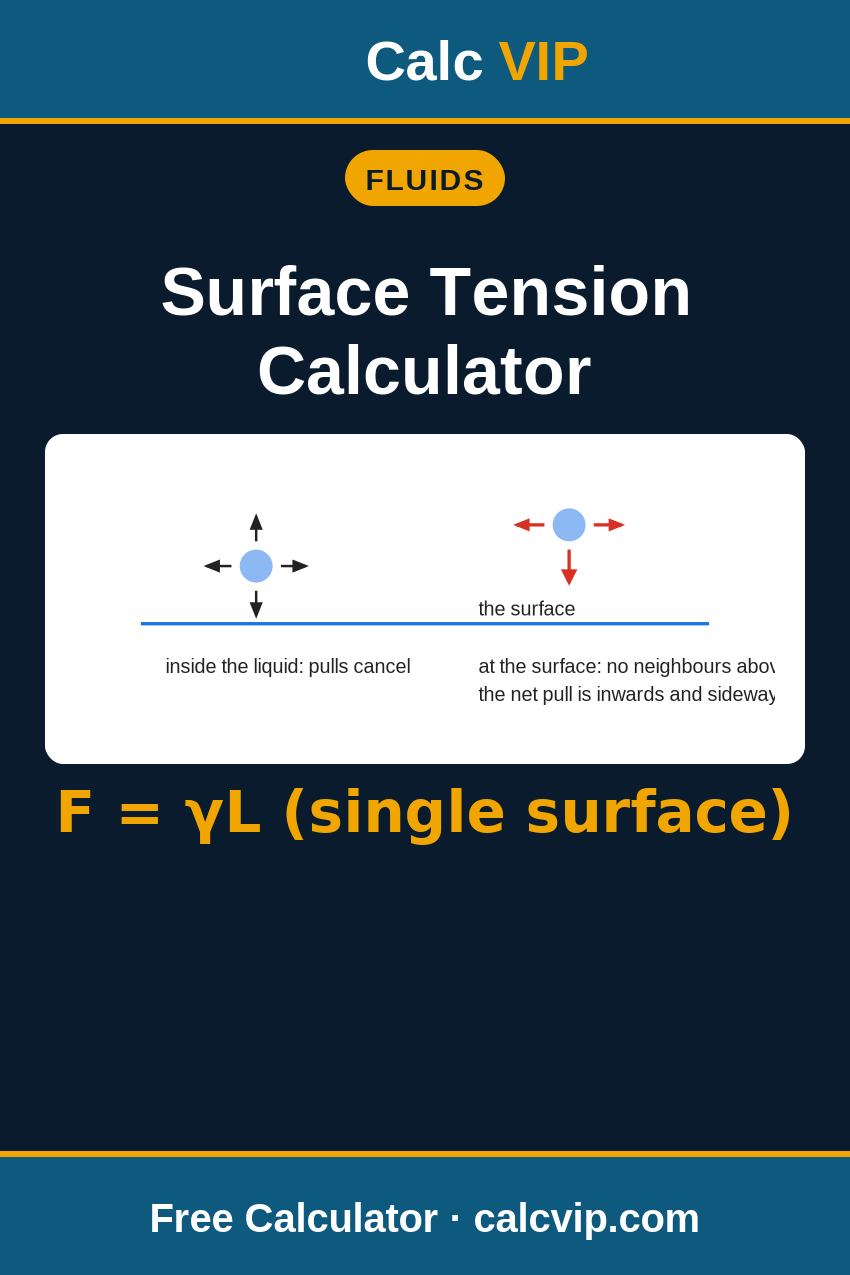
Give the calculator a liquid (water, soapy water, mercury and ethanol are preset) or your own γ, the length of edge the surface pulls along, and whether you are dealing with a single surface — a needle resting on water, a drop's skin — or a free film with two surfaces, like the soap film in a frame, which pulls twice as hard. The answer arrives in newtons and millinewtons: tiny forces by engineering standards, but at the scale of insects, droplets and thin tubes they are the largest forces in the room.
Formula
Surface tension force = γ × L → F = γL (single surface)
For a film: F = 2γL — a soap film has two surfaces (front and back), so it pulls twice as hard.
Surface tension γ is a force per unit length (N/m). It acts because molecules at a liquid's surface are pulled inwards by their neighbours, making the surface behave like a stretched elastic skin.
The same γ appears throughout small-scale fluid physics, always as force-per-length or, equivalently, energy-per-area: the excess pressure inside a droplet is ΔP = 2γ/r (and 4γ/r inside a soap bubble, which has two surfaces), and the height of capillary rise in a tube of radius r is h = 2γ cosθ/(ρgr) — the subject of the Capillary Rise Calculator on this site. Rearranged, this page's formula also measures γ: support a known length of frame against a film, weigh the pull, and γ = F/(2L).
| Symbol | Meaning | Units |
|---|---|---|
| F | force exerted by the surface along the edge | newton (N) |
| γ | surface tension of the liquid | N/m (= J/m²) |
| L | length of the edge or contact line | m |
| n | number of surfaces — 1, or 2 for a free film | — |
Why the small world runs on surface tension
Compare the two great body forces of everyday physics. Gravity's pull on an object scales with its volume — with the cube of its size. Surface tension scales with a length — the first power. Shrink the world and the cube collapses far faster than the line: at the scale of a millimetre, surface forces outweigh gravity outright, and at the scale of a micrometre gravity is a rounding error. This is why small creatures live in a different physical world from us: an ant can walk up a wall and across a ceiling, a pond skater dents water like a trampoline, and a raindrop smaller than about a millimetre stays almost perfectly spherical — while a falling elephant-sized blob of water would tear itself apart, its own weight overwhelming the skin. Engineers meet the same crossover in inkjet nozzles, spray dryers and microfluidic chips, where γ, not g, writes the rules.
Surface tension also explains the shapes liquids choose. A free droplet minimises its surface area for its volume, and the sphere is the minimal shape — hence dewdrops, hence the perfect spheres astronauts play with on space stations, where gravity cannot squash them. Bring two droplets together and they merge instantly into one: the combined surface is smaller than the two separate ones, and the energy saved is paid out as a tiny jiggle. Stretch a film and it pulls back with a force this calculator computes; blow it into a bubble and the same tension pressurises the inside (ΔP = 4γ/r — which is why small bubbles are stiffer and empty themselves into big ones when connected, a party trick with real physics inside).
How to use
- Pick a liquid or type your own surface tension γ in N/m.
- Enter the length of the edge or bar the surface pulls on, in metres (5 cm = 0.05 m).
- Choose "Film" for a soap film (two surfaces) or "Single surface", then click "Calculate Force".
- To test whether an object can rest on a surface, compare the force with the object's weight, mg — support needs F (summed over all contact edges) ≥ mg.
Worked examples
Example 1 — the film frame. A soap-film style frame of width L = 0.05 m is dipped in water (γ = 0.0728 N/m). Treating it as a film with two surfaces: F = 2 × 0.0728 × 0.05 = 0.00728 N = 7.28 mN. Small — but enough to let a steel needle or a pond-skater insect rest on the surface without sinking.
Example 2 — the floating needle, audited. A steel needle 4 cm long rests on water. Along each of its two long edges the surface pulls with F = γL = 0.0728 × 0.04 = 0.00291 N; the two edges together offer up to 0.00582 N of support, enough for a mass of 0.00582 ÷ 9.81 ≈ 0.59 g. A typical sewing needle of 0.3 g weighs 0.00294 N — comfortably within budget, provided it is laid on gently and horizontally so the dimple forms without breaking. Steel is seven times denser than water; the surface simply out-votes buoyancy here.
Example 3 — a mercury film. Mercury's surface tension is the giant of common liquids (γ = 0.4655 N/m). Across a 10 cm frame as a film: F = 2 × 0.4655 × 0.1 = 0.0931 N = 93.1 mN — nearly thirteen times the water film of Example 1 at twice the width. Mercury's extreme γ is why it beads into tight, rolling balls on a bench and refuses to wet or spread on almost anything.
Example 4 — soapy water, the weakened skin. A soap solution (γ = 0.025 N/m) on an 8 cm frame: F = 2 × 0.025 × 0.08 = 0.004 N = 4.0 mN. Compare pure water on the same frame (2 × 0.0728 × 0.08 = 11.6 mN): soap has cut the pull to about a third. That weakening is the point of soap — a feebler skin lets water spread into fabrics, lift grease into droplets and sustain the thin films of bubbles.
Example 5 — ethanol's faint grip. Ethanol (γ = 0.0223 N/m), single surface, along a 2 cm edge: F = 0.0223 × 0.02 = 0.000446 N = 0.446 mN. Alcohol-based liquids wet and creep over surfaces that water beads on — low γ is why sanitiser spreads itself across your hands while water must be rubbed in.
Example 6 — the pond skater's budget. Suppose a water strider's legs dimple the surface along a total contact length of 3 cm (single surface): F = 0.0728 × 0.03 = 0.00218 N, enough to support 0.00218 ÷ 9.81 ≈ 0.22 g — several times a typical strider's body mass of a few tens of milligrams. The insect is not "light enough to float" by buoyancy at all; it is standing on tension, with a safety factor most engineers would envy.
Surface tension in real life
Detergents and cleaning. Example 4 is the cleaning industry: surfactants slash γ so water can invade pores, surround grease and rinse it away. The same chemistry, reversed, waterproofs fabrics — coatings raise the effective tension barrier so droplets bead and roll instead of soaking in.
Inkjet printing and coating. A printer droplet's flight, impact and spreading are a γ-versus-inertia contest judged in microseconds; inks are formulated to a target surface tension so drops form cleanly at the nozzle (too high, they will not detach; too low, they spray). Paint, photographic film and pharmaceutical tablet coatings are all γ-managed for the same reason.
Bubbles and foams. A soap bubble's excess pressure, ΔP = 4γ/r, is 10 Pa for a 1 cm bubble in soapy water — tiny, but enough that connected bubbles exchange air from small to large, and foams slowly coarsen as their small bubbles feed their big ones. Firefighting foams and the head on a beer are γ engineering with deadlines.
The lung's alveoli. Your lungs end in millions of microscopic air sacs lined with fluid; surface tension there would collapse the smallest sacs into the larger ones (ΔP = 2γ/r again) if the body did not secrete pulmonary surfactant to lower γ — and lower it more in small sacs than large ones. Premature babies who cannot yet make surfactant struggle to breathe for exactly this physics.
Capillary action everywhere. γ pulling along the contact line inside a thin tube is the engine of capillary rise — in soil, in blotting paper, in plant xylem, in the wick of an oil lamp. The Capillary Rise Calculator prices that climb; this page prices the force doing the pulling.
Measuring γ itself. The classic school experiment is this calculator read backwards: a sliding-bar frame in a soap film, the pull measured with a sensitive balance, γ = F/(2L). Ring pull-off (du Noüy) and drop-shape analysis refine the same idea into laboratory instruments accurate to fractions of a percent.
Surface tension and temperature: the fading skin
Warm a liquid and its surface tension fades — thermal agitation loosens the molecular crowd, and the surface layer's one-sided pull weakens. Water falls from 0.0728 N/m at 20 °C towards zero as it approaches its critical temperature (374 °C), where liquid and vapour become indistinguishable and the surface itself ceases to exist. The fade is practical, not just theoretical: hot wash water wets and penetrates better partly because its γ is lower; soldering fluxes and industrial cleaning baths are heated partly for the same reason; and precision γ measurements are quoted with their temperature attached, because a degree or two moves the third decimal. It also powers a party-worthy effect — the Marangoni flow: a surface with uneven temperature has uneven γ, and the surface streams from low-γ regions towards high-γ ones, dragging liquid with it. The "tears" that climb and fall on a wine glass are Marangoni's signature in a restaurant.
Quick reference: surface tensions of familiar liquids
| Liquid (at ≈ 20 °C) | γ (N/m) | Character |
|---|---|---|
| mercury | 0.4655 | extreme — beads, will not wet |
| water | 0.0728 | strong for a common liquid |
| glycerin | ≈ 0.063 | near water |
| olive oil | ≈ 0.032 | moderate — spreads on water |
| soapy water | 0.025 | weakened on purpose |
| ethanol | 0.0223 | weak — wets and creeps |
Water's high value for so ordinary a liquid is hydrogen bonding at work — its molecules grip each other unusually hard, which is also why water has such a high boiling point for its size, and why so much of surface science is really water science.
Common mistakes
- Forgetting the second surface of a film. A soap film, a bubble and any free-standing sheet of liquid has two faces. Use the film setting (n = 2); the single-surface answer is exactly half the truth.
- Using a dirty-water γ for clean water (or the reverse). A fingerprint's worth of grease or a drop of detergent can cut water's γ by a third or more. Surface tension is the most contamination-sensitive quantity on this page — laboratory measurements begin with obsessive cleaning.
- Confusing γ with a pressure. γ is force per length, not per area. The pressure a curved surface generates needs the curvature too: ΔP = 2γ/r. A flat surface, however tense, pressurises nothing.
- Ignoring temperature. Quoting γ without a temperature is quoting half a fact. Hot water's skin is measurably weaker than cold water's; precision work states the degrees alongside the decimals.
- Expecting the surface to support a sharp or heavy object. Support requires the contact line to stay intact and the dimple unbroken. A needle dropped point-first pierces the skin instantly — the budget in Example 2 only spends if the object is laid on flat and gently.
FAQ
Why does soap lower the surface tension of water?
Soap molecules gather at the surface and push the water molecules apart, weakening the inward pull. That is why soapy water spreads and wets surfaces better — and why its γ (about 0.025 N/m) is roughly a third of pure water's.
Does surface tension change with temperature?
Yes — it decreases as the liquid gets hotter, because the molecules move more energetically and pull on each other less effectively. It reaches zero at the critical temperature.
How can insects walk on water?
Their legs press the surface down into dimples without breaking it, and the surface tension force along the legs' edges adds up to enough upward force to support their tiny weight.
Is surface tension a force or an energy?
Both descriptions are the same fact: γ as a force per unit length (N/m) is numerically equal to γ as the energy needed to create a unit area of new surface (J/m²). Pulling a film wider spends work against the force; the accounts match exactly.
Why are small droplets round but big puddles flat?
Surface tension minimises area and favours the sphere; gravity flattens. For droplets under about a millimetre, tension wins and the drop is nearly a perfect sphere; for puddles, gravity wins everywhere except the rim, where tension rounds the edge. The crossover size is set by γ, density and g together.
What is the difference between surface tension and capillary action?
Surface tension is the property; capillary action is one of its performances — the climb (or depression) of a liquid in a narrow tube, driven by the tension acting around the tube's contact line. The Capillary Rise Calculator computes that performance directly.
Can surface tension be negative?
No — a negative γ would mean a surface profits from growing, and the liquid would foam itself apart spontaneously. Zero is the floor, reached at the critical temperature where the surface disappears altogether.
Why does a bubble have two surfaces but a droplet one?
A droplet is liquid inside, gas outside: one boundary. A soap bubble is a film — gas inside, gas outside, liquid between — so it has an inner and an outer boundary, each contributing γ. That is why the bubble's excess pressure is 4γ/r against the droplet's 2γ/r.
How is surface tension measured precisely?
By the force on a platinum ring pulled from the surface (du Noüy), by a plate's wetting force (Wilhelmy), by the shape of a hanging drop analysed by camera, and by capillary rise itself. All are this page's formula or its close cousins, instrumented.
Does surface tension exist in space?
Emphatically yes — it needs no gravity, and without gravity to fight it becomes the dominant sculptor of liquids. Astronauts' free-floating water spheres are perfect γ demonstrations; spacecraft fuel tanks use surface-tension vanes to shepherd propellant to the outlet in weightlessness, a job gravity does for free on Earth.