 Calc
Torricelli Calculator – Jet Speed, Flow Rate & Emptying Time
 Created by Elena Petrova · Physics Editor · Fluids & Rotation · Last updated: November 2026
Use this free Torricelli Calculator to find how fast liquid jets out of a hole in a tank. Torricelli's law says the jet speed depends only on the depth of the hole below the liquid surface — not on the size of the hole or the liquid's density.
In 1643 Evangelista Torricelli — Galileo's last student, and the inventor of the barometer in the same fertile period — wrote down a jewel of a result: liquid escaping through a hole in a tank moves at exactly the speed a falling object would reach if it dropped from the liquid's surface to the hole. Depth h in, speed √(2gh) out. The law has a beautiful indifference to the details engineers usually fret about. Double the hole and the speed is unchanged (only the flow grows). Swap water for oil or mercury and the speed is unchanged again, because although a denser liquid presses harder, it is also proportionally harder to accelerate — the two effects cancel exactly, as they do for falling stones of different weights.
What the speed does depend on, ruthlessly, is the square root of the depth. Four times deeper means twice as fast, not four times: a hole 20 m down jets at about 19.8 m/s, only double the 9.9 m/s of a hole at 5 m. The square root is the signature of energy being converted — the liquid's gravitational potential energy per kilogram, gh, turning into kinetic energy per kilogram, ½v² — and it is why draining tanks slow so cruelly as they empty: the last quarter of the depth delivers barely half the original jet speed, and the flow rate fades with it.
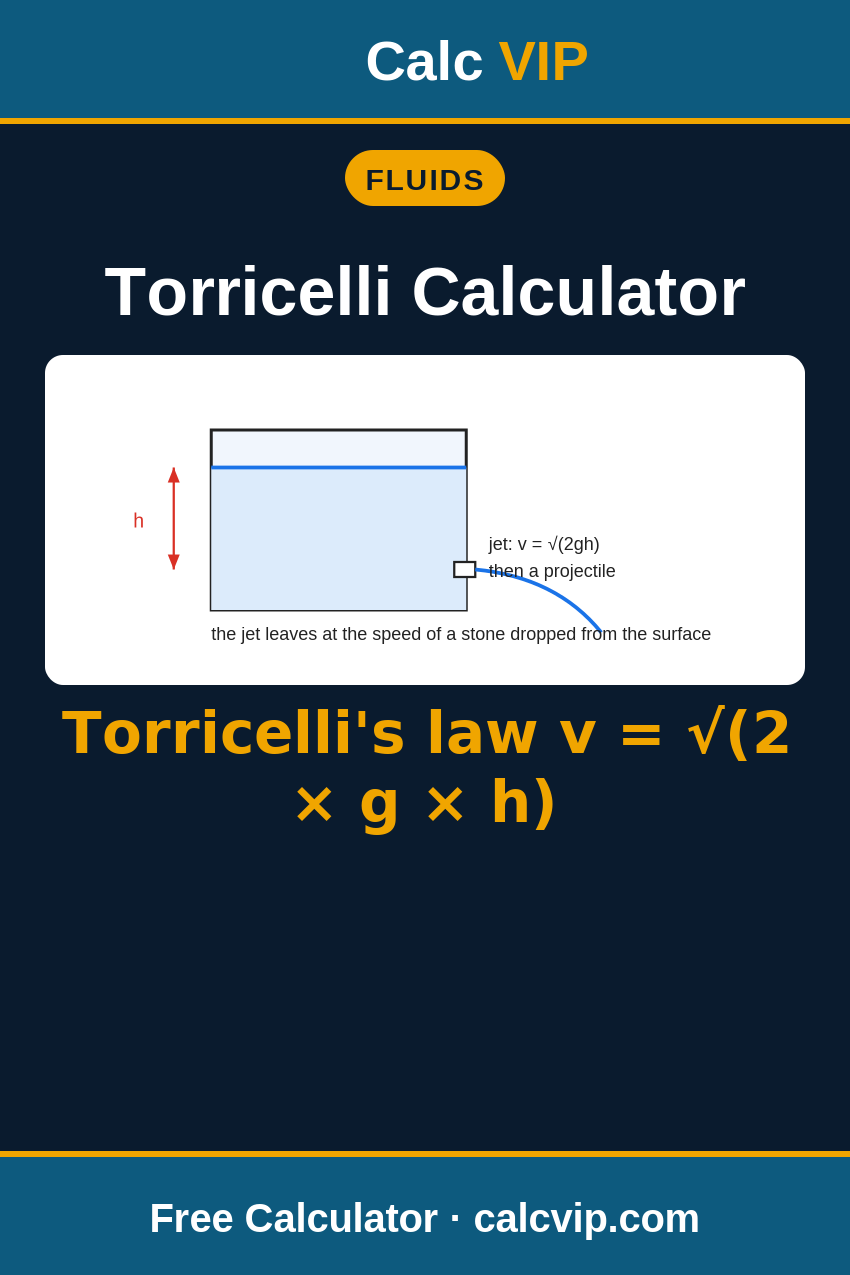
This calculator evaluates the full chain the law sets in motion: the jet speed from the head h; the flow rate Q = A × v if you give it the hole's area; and a first estimate of the emptying time if you give it the tank volume. That last number is honestly labelled an estimate — the calculator itself warns that the jet slows as the level falls — and the depth section below shows how much longer a real tank actually takes, and why the true answer is a pleasingly exact factor of two.
Formula
Torricelli's law v = √(2 × g × h) • v in metres per second (m/s), g = 9.81 m/s², h in metres (m) — the depth of the hole below the free surface
Two companions complete the toolkit. The flow rate is the jet's speed times the hole's area: Q = A × v, with A in m² giving Q in m³/s (multiply by 1000 for litres per second). The rough emptying time is the tank volume divided by that flow rate, t ≈ V ÷ Q — an underestimate, for the reason given below. Note what the law omits: the liquid's density, the tank's width, the hole's size and shape. Only h and g survive, which is why the same formula serves for a water butt, a fuel tank and a punctured tanker. This calculator takes h in metres, the hole area in cm² and the volume in litres, and does the unit conversions for you.
| Symbol | Meaning | Units |
|---|---|---|
| v | speed of the jet leaving the hole | m/s |
| h | head — depth of the hole below the surface | m |
| A | area of the hole | m² (calculator takes cm²) |
| Q | flow rate (volume per second) | m³/s or L/s |
| g | gravitational field strength | 9.81 m/s² |
Why the jet matches a falling stone: the energy argument
Torricelli's law is energy conservation wearing a disguise. Imagine a small parcel of liquid at the surface, essentially at rest, and the same parcel a moment later, squirting out of the hole at speed v. It has descended a height h, surrendering gravitational potential energy mgh, and gained kinetic energy ½mv². Set them equal and the mass cancels: v = √(2gh) — identically the speed of a stone dropped through h, because the stone obeys the same ledger, the ledger that also governs pendulums, roller coasters and every other machine that trades height for speed. The pressure at depth, ρgh, is the mechanism that does the pushing, but the energy bookkeeping is the deeper truth, and it explains the law's famous independences: density cancels because both the energy stored and the inertia scale with it; hole size cancels because energy is counted per kilogram, not per hole.
Reality trims the ideal number twice. First, the jet contracts just outside the hole — the streamlines curve inward, and the jet's narrowest section (the vena contracta) is only about 64% of the hole's area for a sharp-edged opening — so the real flow rate is roughly 0.6–0.65 of A × v even though the speed is nearly right. Second, viscosity steals a few percent of the speed, more for thick liquids and small holes. Engineers fold both effects into a discharge coefficient, typically 0.6–0.97 depending on how smoothly the hole is rounded: a polished, bell-mouthed outlet approaches the ideal; a ragged puncture falls well short. The law gives the ceiling; the coefficient reports how close your hole gets.
How to use
- Enter h — the vertical depth of the hole below the liquid surface, in metres (not the height of the hole above the floor).
- Click "Calculate Jet Speed" to see v = √(2gh) in m/s.
- Optionally enter the hole's area in cm² to also get the flow rate Q in litres per second.
- Optionally enter the tank volume in litres to also get the rough emptying time — remembering it is a lower bound, since the real jet slows as the level drops (see the depth section).
- For a round hole, get its area from its diameter: A = π × (d/2)². A 1 cm diameter hole has an area of about 0.785 cm².
Worked examples
Example 1 — the classic tank. A hole sits 5 m below the water surface. v = √(2 × 9.81 × 5) = √98.1 ≈ 9.90 m/s. If the hole has an area of 2 cm², the flow rate is Q = 0.0002 × 9.90 ≈ 1.98 L/s, so a 100 litre tank takes roughly 100 ÷ 1.98 ≈ 50.48 s to empty — at the starting rate; the true time is longer, as explained below.
Example 2 — a water butt. A garden water butt has its tap 1.25 m below the surface when full: v = √(2 × 9.81 × 1.25) ≈ 4.95 m/s. That brisk jet is why a full butt fills a watering can in seconds — and why, near the bottom with only 0.2 m of head, the same tap dwindles to √(2 × 9.81 × 0.2) ≈ 1.98 m/s and a frustrating trickle.
Example 3 — a shallow header tank. A hole 0.45 m below the surface: v = √(2 × 9.81 × 0.45) ≈ 2.97 m/s. Through a hole of 3 cm², Q = 0.0003 × 2.97 × 1000 ≈ 0.89 L/s — a respectable feed for a cistern, from less than half a metre of head.
Example 4 — a small round hole, deep tank. At h = 10 m, v = √(2 × 9.81 × 10) ≈ 14.01 m/s. A round hole 1 cm across has area π × (0.005)² ≈ 7.85 × 10⁻⁵ m², so Q ≈ 7.85 × 10⁻⁵ × 14.01 × 1000 ≈ 1.10 L/s. Depth beats diameter: this pinhole at 10 m outflows the hole of Example 3 despite having a quarter of its area.
Example 5 — how fast is that in road terms? At h = 2.5 m, v = √(2 × 9.81 × 2.5) ≈ 7.00 m/s ≈ 25.2 km/h. A jet from a tank on a roof hits like a bicycle at full pace — a useful calibration for anyone who has wondered whether a leaking standpipe is a nuisance or a hazard.
Example 6 — the jet as a projectile. Let the Example 1 jet (9.90 m/s) leave horizontally from a hole 1 m above the ground. It falls for t = √(2 × 1 ÷ 9.81) ≈ 0.45 s, travelling 9.90 × 0.45 ≈ 4.47 m sideways before it lands. (The neat general result: the range is 2√(h × H), with h the head and H the height above ground — here 2√(5 × 1) = 4.47 m.) Tank-test questions and fountain design both live on this little piece of geometry.
Torricelli in real life
Dams and spillways. Water leaving a dam's low-level outlet under a 40 m head jets at √(2 × 9.81 × 40) ≈ 28 m/s — over 100 km/h — which is why outlet works are built with stilling basins and armoured channels: the law tells the engineers exactly how much energy must be destroyed safely.
Fountains. A fountain jet rises to (very nearly) the height of the reservoir feeding it — Torricelli run backwards, v² ÷ 2g = h. The great fountains of Versailles were plumbed to a reservoir on a hill for precisely this reason, and their modest height was a head problem, not a pump problem, in the age before pumps.
Leaks and punctures. A holed water main, a punctured fuel tank, a leaking aquarium seam: the initial loss rate is Q = A√(2gh), and the h is measured from the surface to the hole — which is why a leak low on a tank is urgent and the same leak near the top is a chore for next week.
Draining and process engineering. Batch tanks, cisterns and emergency dump systems are sized with the draining version of the law; the exact emptying time (next section) decides whether a vessel can be emptied inside a safety window.
Siphons and toilet cisterns. The flush of a cistern is Torricelli with plumbing: the head between the cistern's surface and the bowl drives the flow, and the siphon's speed follows √(2gh) with h the difference in levels — the reason a high-level cistern flushes with more authority than a low one.
Medicine — IV drips and drainage. Gravity-fed infusions run on a head of about a metre between bag and vein, giving jet-scale speeds that the drip regulator then throttles; chest drains and catheter bags empty by the same square-root rule, slowing as the levels equalise.
The true emptying time: exactly twice the naive estimate
The calculator's emptying time pretends the head stays at its starting value. It does not: as liquid leaves, h falls, the jet slows, and the draining stretches out. The calculus of the fading jet gives one of the prettiest results in elementary fluid mechanics — for a tank of constant cross-section, the true emptying time is exactly twice the naive estimate: t = 2V ÷ (A√(2gh₀)), where h₀ is the starting head. Example 1's 100-litre tank, estimated at 50.48 s, really takes about 101 s. The factor of two is no coincidence: the flow rate falls as √h, and the average of the square-root curve over the drain works out to exactly half the starting rate. (For tanks that narrow as they empty, like a conical hopper, the factor differs — the shape enters through the cross-section's variation with height.) Practical moral: double the calculator's estimate for a cylindrical tank, and treat any draining schedule built on the naive figure as fiction.
Quick reference: jet speed by head
| Head h | Jet speed v = √(2gh) | In km/h |
|---|---|---|
| 0.5 m | 3.13 m/s | 11.3 |
| 1 m | 4.43 m/s | 15.9 |
| 2 m | 6.26 m/s | 22.6 |
| 3 m | 7.67 m/s | 27.6 |
| 5 m | 9.90 m/s | 35.7 |
| 10 m | 14.01 m/s | 50.4 |
| 20 m | 19.81 m/s | 71.3 |
The pattern to internalise: to double the jet, quadruple the head. Speed is bought with the square of the depth — the square root tax that every fountain builder and dam engineer pays.
Common mistakes
- Measuring h from the floor. h is the depth of the hole below the surface, not its height above the ground. A hole 1 m above the floor of a tank with 5 m of water above it has h = 5 m, not 1 m. (The 1 m matters for the projectile range, not the speed.)
- Expecting density to matter. Mercury and water jet at the same speed from the same head. Density cancels — harder push, proportionally more inertia. It matters for the pressure and the mass flow, not the speed.
- Treating the emptying estimate as exact. The level falls and the jet fades; a cylindrical tank takes twice the naive time. Schedules and safety cases built on the raw estimate are wrong by a factor of two.
- Confusing diameter with area. Flow rate needs the hole's area, π(d/2)² — entering the diameter as if it were the area (or in cm² that are really mm²) wrecks Q while leaving v deceptively correct.
- Applying the law to a long pipe. Torricelli assumes a clean hole in a thin wall. A long outlet pipe adds friction (the Poiseuille effect), and a viscous liquid in a small hole falls well short of √(2gh). The law is the ceiling, not a promise.
FAQ
Does a bigger hole make the jet faster?
No — in the ideal law the speed depends only on h. A bigger hole gives a bigger flow rate (more litres per second) at the same speed.
Why is the emptying time only an estimate?
As the tank drains, the surface level — and therefore h — falls, so the jet slows down. The estimate assumes h stays at its starting value, so a real tank takes somewhat longer.
Is the speed the same as free fall?
Yes. √(2gh) is exactly the speed an object reaches after falling freely through height h. Torricelli's law is energy conservation applied to the liquid.
How much longer does a real tank take to empty?
For a tank of constant cross-section, exactly twice the constant-head estimate — about 101 s for this page's 100-litre example instead of 50.48 s. The jet's speed falls as the square root of the falling head, and the average works out to precisely half the starting flow.
Does the shape of the tank matter?
Not for the jet speed, which depends only on h. It matters for the emptying time: a tank that narrows towards the bottom holds less volume at low heads and drains its last portion differently from a cylinder. The factor-of-two rule is exact only for constant cross-section.
Why is the real flow less than A × v?
Because the jet contracts after leaving the hole (the vena contracta) to about 64% of the hole's area for a sharp edge, and viscosity trims a little more. Engineers apply a discharge coefficient — roughly 0.6 for a sharp hole, up to 0.97 for a smoothly rounded outlet — to the ideal flow.
What if the tank is pressurised?
Then the pressure adds an equivalent head: a gas pressure P above the liquid acts like an extra depth of P ÷ (ρg). A tank pressurised to 100 kPa gauge drives water as if the hole were about 10.2 m deeper. Torricelli's law still applies, with the effective head.
Does Torricelli's law work on the Moon?
Yes, with the Moon's g of 1.62 m/s²: the same 5 m head gives √(2 × 1.62 × 5) ≈ 4.02 m/s instead of 9.90. The law is really about energy per unit mass, gh — change the gravity and the speed follows the square root of it.
How far will the jet travel sideways?
It becomes a projectile: the range is 2√(h × H), where h is the head above the hole and H is the hole's height above the landing surface. A hole halfway down a tank wall actually throws the jet farthest — the product h × H is greatest when the hole bisects the total height.
Who was Torricelli?
Evangelista Torricelli (1608–1647), Galileo's successor as mathematician to the Grand Duke of Tuscany. In a few years he invented the mercury barometer, founded the science of atmospheric pressure, and published this law of efflux — one of the first places the conservation of energy quietly appears, a century before the idea had a name.