Calc
Venturi Meter Calculator – Flow Rate from Pressure Difference
 Created by Elena Petrova · Physics Editor · Fluids & Rotation · Last updated: November 2026
Use this free Venturi Meter Calculator to find the flow rate in a pipe from a pressure reading. Enter the wide and narrow cross-section areas, the pressure difference between them and the fluid density — the calculator combines the continuity equation with Bernoulli's principle to give the flow rate.
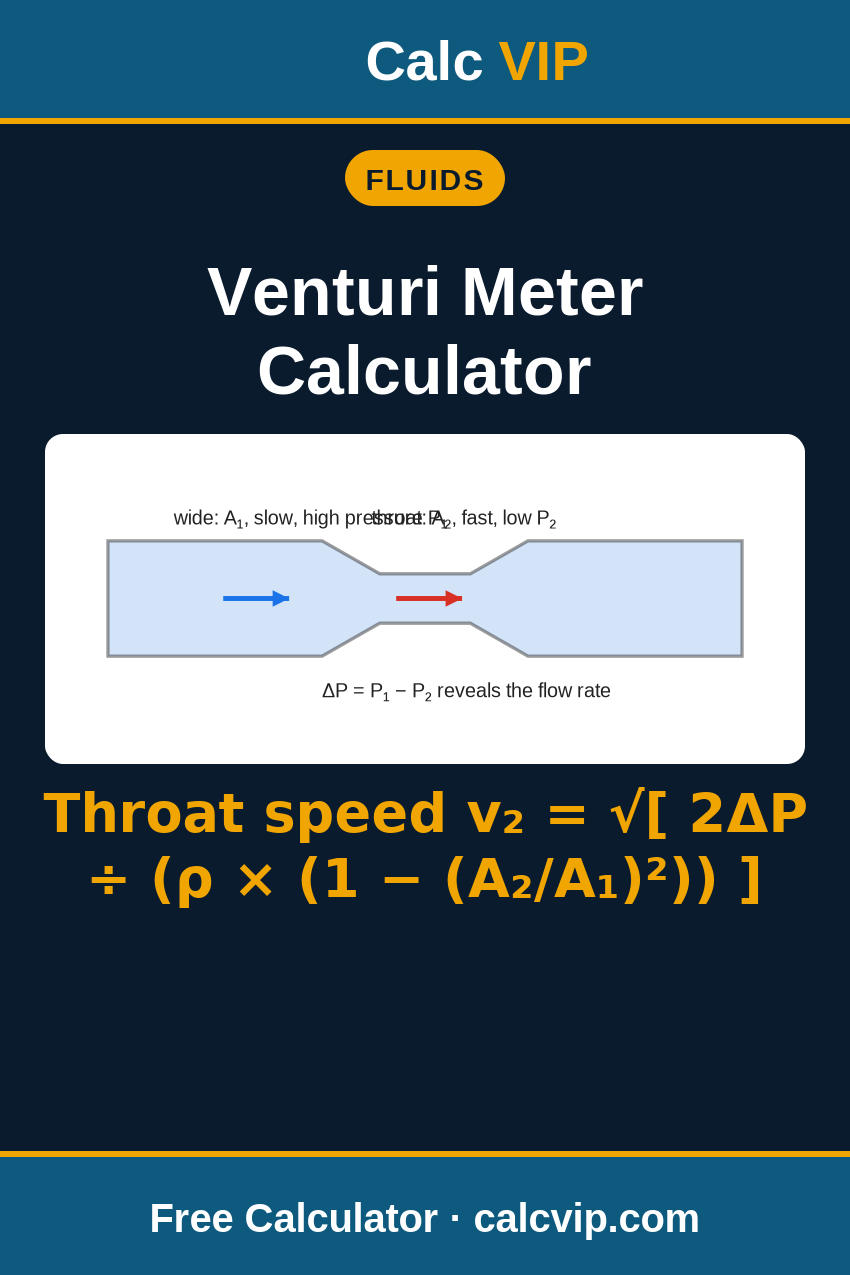
A venturi meter measures flow by deliberately squeezing it. The pipe narrows to a throat, the fluid speeds up to get through, and — by Bernoulli's principle — its pressure falls as it accelerates. Measure that pressure fall and you can work backwards to the speed, and from the speed to the flow rate. The device has no moving parts, nothing pokes into the stream, and the gentle cone shapes waste very little energy, which is why a design published by Giovanni Battista Venturi in 1797 still measures the water supply of cities and the fuel feed of engines today.
Two ideas share the work. Continuity says the same volume must pass every section each second, so the speed rises in inverse proportion to the area: halve the area, double the speed. Bernoulli says the speeding-up is paid for in pressure: the faster section sits at lower pressure by exactly ½ρ(v₂² − v₁²). Put the two together and the pressure difference becomes a speedometer. This calculator does that algebra for you — enter the two areas, the pressure difference and the density, and it returns both speeds and the flow rate in m³/s and L/s.
The areas deserve a word, because they are the input people most often fumble. The calculator wants cross-sectional areas, not diameters: A = πd²/4. The worked example below uses A₁ = 0.01 m² and A₂ = 0.005 m², which correspond to pipe diameters of about 112.8 mm and 79.8 mm. Notice that halving the area does not halve the diameter — it divides it by √2 — and that the pressure difference responds to the fourth power of the diameter ratio, which is what makes venturi meters so sensitive and so useful.
Formula
Throat speed v₂ = √[ 2ΔP ÷ (ρ × (1 − (A₂/A₁)²)) ] • then v₁ = v₂ × A₂/A₁ and Q = A₂ × v₂
The derivation is short enough to keep in your head. Continuity: A₁v₁ = A₂v₂, so v₁ = v₂(A₂/A₁). Bernoulli: ΔP = ½ρ(v₂² − v₁²). Substituting gives ΔP = ½ρv₂²(1 − (A₂/A₁)²), and solving for v₂ yields the formula above. Rearrangements worth knowing: ΔP = ½ρv₂²(1 − (A₂/A₁)²) predicts the pressure drop a given flow will cause (the design direction), and since A ∝ d², the bracket can be written with diameters as (1 − (d₂/d₁)⁴) — the famous fourth-power sensitivity. The calculator's result is the ideal (frictionless) flow; real meters multiply by a discharge coefficient Cd of 0.95–0.98, as the FAQ explains.
| Symbol | Meaning | Units |
|---|---|---|
| A₁, A₂ | cross-section areas, wide section and throat | m² |
| v₁, v₂ | flow speeds in the wide section and throat | m/s |
| ΔP | pressure difference P₁ − P₂ | Pa |
| ρ | fluid density | kg/m³ |
| Q | volume flow rate | m³/s (also L/s) |
Why the throat pressure falls — and comes back
It is tempting to say the throat "sucks" the pressure down, but the energy bookkeeping is cleaner: the fluid's total head is (nearly) conserved, so the kinetic energy gained in the throat is paid out of the pressure energy. Downstream, the pipe widens in a long, gentle diffuser cone, the flow slows, and most of the pressure returns — a well-made venturi permanently loses only 10–20% of its measured ΔP, the lowest loss of any pressure-based meter. The gentleness matters: make the exit cone too steep and the flow detaches from the walls, the recovery collapses and the meter becomes a heater of turbulence. That trade — a long, expensive casting in exchange for a tiny permanent loss — is the venturi's whole commercial proposition, and it is why the cheaper orifice plate (its rough cousin, elsewhere on this site) is chosen only where the energy loss can be afforded.
The same physics, run in reverse, is a pump with no parts: a fast jet through a throat entrains surrounding fluid into its low-pressure zone. Steam ejectors, paint sprayers, carburettor fuel jets and the vacuum systems of chemistry labs all live off the venturi effect — the meter and the pump are one equation read in two directions.
How to use
- Enter the wide-section area A₁ in m² — from a diameter, A = πd²/4 (a 100 mm pipe has A = 0.00785 m²).
- Enter the throat area A₂ in m²; it must be smaller than A₁ or there is no pressure drop to measure.
- Enter the measured pressure difference ΔP in pascals and the fluid density ρ in kg/m³ (water 1000, air 1.225).
- Click "Calculate" to see the throat speed v₂, the wide-section speed v₁ and the flow rate Q in m³/s and L/s. For a real meter, multiply Q by its discharge coefficient (typically 0.95–0.98).
Worked examples
Example 1 — the standard water meter. A₁ = 0.01 m², A₂ = 0.005 m², ΔP = 5,000 Pa, water (ρ = 1000).
(A₂/A₁)² = 0.25, so v₂ = √(2 × 5000 ÷ (1000 × 0.75)) = √13.33 = 3.65 m/s; v₁ = 3.65 × 0.5 = 1.83 m/s; Q = 0.005 × 3.65 = 0.0183 m³/s = 18.26 L/s.
Example 2 — an air duct. A₁ = 0.2 m², A₂ = 0.1 m², ΔP = 100 Pa, air (ρ = 1.225): v₂ = √(200 ÷ (1.225 × 0.75)) = √217.7 = 14.75 m/s; v₁ = 7.38 m/s; Q = 0.1 × 14.75 = 1.475 m³/s. Ventilation engineers live here — modest pressures, big areas, air's low density doing the arithmetic.
Example 3 — a stronger squeeze. A₁ = 0.02 m², A₂ = 0.008 m² (ratio 0.4), ΔP = 2,000 Pa, water: (A₂/A₁)² = 0.16, so v₂ = √(4000 ÷ 840) = √4.762 = 2.18 m/s; v₁ = 0.87 m/s; Q = 0.0175 m³/s = 17.46 L/s. A smaller area ratio concentrates the same flow into a bigger, easier-to-measure ΔP.
Example 4 — petrol in a carburettor venturi. A₁ = 0.001 m², A₂ = 0.0004 m², ΔP = 3,000 Pa, petrol (ρ = 740): v₂ = √(6000 ÷ (740 × 0.84)) = √9.652 = 3.11 m/s; v₁ = 1.24 m/s; Q = 0.00124 m³/s = 1.24 L/s of air-side equivalent flow — the pressure dip at this throat is what draws fuel up the jet in a classic carburettor.
Example 5 — a waterworks main. A₁ = 0.05 m², A₂ = 0.02 m², ΔP = 20,000 Pa, water: v₂ = √(40,000 ÷ 840) = √47.62 = 6.90 m/s; v₁ = 2.76 m/s; Q = 0.138 m³/s = 138 L/s — a respectable municipal flow, measured by nothing more than two pressure taps and a shaped casting.
Example 6 — applying the discharge coefficient. Take Example 1's ideal Q = 18.26 L/s and a real meter with Cd = 0.97: Qreal = 0.97 × 18.26 = 17.71 L/s. The 3% is the toll taken by friction and the slight contraction of the jet — small enough that venturis are trusted for custody transfer, where money changes hands on the reading.
Venturi meters in real life
Water supply and billing. Utilities meter district flows with venturis because they pass silt and scale without jamming, lose little pressure, and hold calibration for decades — the meter that bills a neighbourhood cannot be one that drifts.
Chemical and process plants. Corrosive or hot fluids that would destroy a turbine meter merely flow through a venturi's smooth throat; only the pressure transmitters touch the process, through isolating diaphragms.
Carburettors. The classic car and small-engine carburettor is a venturi with a fuel jet opening into its throat: the faster the air, the deeper the pressure dip, the more fuel is drawn — an automatic mixture computer made of shaped metal.
Aircraft and wind tunnels. Venturi tubes once drove airspeed indicators and gyroscopic instruments, and wind tunnels are themselves giant venturis, contracting to speed the air over the model while the wide section houses the fan.
Steam ejectors and vacuum systems. Run backwards as a pump, a high-speed steam jet through a venturi entrains air from a vessel and holds a vacuum with no moving parts — standard equipment in power stations and chemical plants.
Medical and laboratory flow. Oxygen therapy and anaesthesia equipment use small venturi valves to mix air into oxygen at a fixed ratio, the entrainment set purely by the throat geometry — a ratio that cannot drift because there is nothing to drift.
The square-root character — and what it costs
Because ΔP ∝ Q², the venturi's sensitivity is uneven: at a tenth of full flow the pressure difference is a hundredth of its full-scale value, down where transmitters struggle to read it. Practical venturi installations therefore cover a turndown of about 10:1 in flow, not the 100:1 the pressures span. Doubling the flow always quadruples ΔP (Example 3 versus a halved case makes the point), and the same square law means a 1% error in ΔP becomes only a 0.5% error in Q — a rare kindness. It also means pulsating flows read high, because the meter averages the pressure but the square root of an average is not the average of square roots; pulsation dampers are fitted where pumps make the flow throb.
Quick reference: what the area ratio does
| A₂/A₁ | v₂/v₁ | 1 − (A₂/A₁)² | Character |
|---|---|---|---|
| 0.8 | 1.25 | 0.36 | gentle — small ΔP, tiny loss |
| 0.5 | 2.0 | 0.75 | the standard compromise (Examples 1–2) |
| 0.4 | 2.5 | 0.84 | strong signal, more loss |
| 0.25 | 4.0 | 0.9375 | near the practical limit — cavitation risk in liquids |
Squeeze too hard and a second limit appears: if the throat pressure falls to the liquid's vapour pressure, the fluid boils in the throat (cavitation), the reading collapses and the collapsing bubbles erode the metal. Venturi sizing is the art of taking enough ΔP to measure, never so much that the throat misbehaves.
Sizing a venturi from scratch: a design walk-through
Run the formula backwards and it becomes a design tool. Suppose a 200 mm water line must meter up to Q = 0.05 m³/s. The pipe's area is A₁ = π × 0.2² ÷ 4 = 0.0314 m², so the approach speed is v₁ = 0.05 ÷ 0.0314 = 1.59 m/s. Choose a diameter ratio β = d₂/d₁ = 0.6 — the middle of the usual 0.4–0.75 design band — which makes the area ratio (A₂/A₁) = β² = 0.36 and A₂ = 0.0113 m². Continuity then sets the throat speed: v₂ = Q ÷ A₂ = 4.42 m/s, and Bernoulli prices the signal: ΔP = ½ × 1000 × (4.42² − 1.59²) = 500 × (19.54 − 2.53) ≈ 8,506 Pa at full flow — a comfortable reading for a modern differential transmitter, big enough to measure precisely, small enough that the permanent loss (about 15% of it, ~1,300 Pa) costs little pumping energy. Every term of that paragraph is this calculator or its inverse; venturi design is not a separate subject, just the same algebra with the unknown moved.
Standards complete the picture: manufactured venturis follow ISO 5167 geometries, with pressure tappings at prescribed positions and the discharge coefficient given as a function of β and Reynolds number rather than measured on every unit. That is the quiet endpoint of the instrument's two-century development — a meter accurate enough to bill from, built entirely from published dimensions and this page's equation.
What the venturi's thrift is worth, in watts
The diffuser's pressure recovery sounds abstract until it is billed. Give Example 1's meter a permanent loss of 15% of its ΔP — 750 Pa — at its flow of 0.01826 m³/s, and the wasted power is ΔP × Q = 750 × 0.01826 ≈ 13.7 W, continuously, or about 120 kWh a year. Run the same duty through an orifice plate losing 60% of a comparable ΔP and the bill quadruples; scale the flow to a waterworks main and the difference between the two instruments becomes a power station's rounding error — or a small town's supply. This is the venturi's whole commercial argument expressed in one multiplication, and the reason the expensive casting keeps winning tenders against the cheap plate wherever the flow never stops.
A translator's note for the examples: engineers usually specify venturis by the diameter ratio β = d₂/d₁ rather than by areas. Example 5's areas (A₁ = 0.05 m², A₂ = 0.02 m²) correspond to diameters of about 252 mm and 160 mm, so β ≈ 0.63 — inside the standard 0.4–0.75 design band. Since areas go as the diameter squared, β = √(A₂/A₁); keep the square root in mind when a datasheet's β meets this calculator's areas.
Common mistakes
- Entering diameters instead of areas. The calculator's A₁ and A₂ are areas in m². A 100 mm pipe is 0.00785 m², not 0.1. Convert with A = πd²/4 before typing.
- Swapping A₁ and A₂. A₁ is the wide inlet, A₂ the throat. Reversed, the formula's bracket goes negative — the calculator warns you, because nature does not allow a "venturi" that widens.
- Expecting the reading to be exact. The formula is the ideal-flow result. Real meters need their discharge coefficient (0.95–0.98) applied, or you will overstate every flow by 2–5%.
- Using the wrong density. ΔP-to-flow conversion scales with 1/√ρ. Measuring a hot liquid with its cold density (or a gas at the wrong pressure) shifts every reading by the square root of the density error.
- Assuming ΔP is proportional to flow. It is proportional to flow squared. Halving the flow quarters the pressure difference — small flows hide at the bottom of the transmitter's range.
FAQ
Where are venturi meters used?
In water supply, chemical plants, carburettors and aircraft airspeed systems — anywhere you need to measure flow without blocking the pipe or adding moving parts.
Must A2 be smaller than A1?
Yes. The throat must be narrower than the inlet, otherwise there is no speed increase and no pressure drop to measure. The calculator warns you if A2 ≥ A1.
How accurate is this formula?
It is the ideal (frictionless) result. Real venturi meters are very efficient, so a discharge coefficient of about 0.95–0.98 is applied in practice — multiply Q by that factor for a real-world reading.
How is a venturi different from an orifice plate?
Shape and manners. The venturi guides the fluid through a smooth contraction and expansion, recovering most of the pressure (Cd ≈ 0.95–0.98, permanent loss 10–20% of ΔP). The orifice plate is a abrupt hole: cheaper, but Cd ≈ 0.62 and most of its ΔP is lost forever.
Can a venturi meter measure gas flow?
Yes, with the density taken at the actual pressure and temperature, and — for large pressure drops — a compressibility (expansibility) correction, because the gas expands as the pressure falls in the throat. For small ΔP relative to the line pressure, this calculator's formula is fine.
Why does the pressure recover downstream?
Because the diffuser cone slows the fluid gradually, trading kinetic energy back into pressure. Bernoulli runs both ways; only friction's cut (10–20% of ΔP) fails to return.
What happens if the throat pressure gets too low?
In a liquid, it can reach vapour pressure and cavitate: bubbles form and collapse violently, noise and erosion follow, and the flow chokes — more upstream pressure no longer raises the flow. Designers keep throat pressure safely above vapour pressure.
Does the meter need straight pipe before it?
Yes — swirling or asymmetric flow from a nearby bend falsifies the pressure field the formula assumes. Standards call for several pipe diameters of straight run upstream, or a flow straightener where space is tight.
Who was Venturi?
Giovanni Battista Venturi (1746–1822), an Italian physicist who characterised the pressure fall in a constriction in 1797, building on Bernoulli's and Euler's work. Clemens Herschel turned the effect into the practical meter in 1887 — and named it after Venturi.
Can the venturi effect pump anything?
Yes — that is the ejector: put a fast jet through the throat and the low-pressure zone drags surrounding fluid along. Paint guns, steam ejectors, laboratory water aspirators and carburettor fuel feeds are all venturi pumps.