 Calc
Water Depth Pressure Calculator – Pressure at Depth (Fresh & Sea)
 Created by Elena Petrova · Physics Editor · Fluids & Rotation · Last updated: November 2026
Use this free Water Depth Pressure Calculator to find the pressure at any depth below the surface, in fresh water or sea water. As a rule of thumb, the pressure grows by about one extra atmosphere for every 10 metres you descend.
Descend into water and the pressure climbs with a steadiness few physical quantities can match: every metre of depth adds ρg ≈ 9.81 kPa in fresh water, 10.05 kPa in the sea. Ten metres down, the water alone has added a whole second atmosphere; at 30 m a diver's body carries four times the absolute pressure of the surface world; at the bottom of the Mariana Trench the pressure exceeds a thousand atmospheres — about a tonne of force on every square centimetre, a small car's weight balanced on a postage stamp. The rule never wavers, because it is nothing but the weight of the water overhead, counted honestly.
Two features of the rule surprise everyone who meets it first. The pressure at a depth does not depend on the size or shape of the water body — a 30 m standpipe presses its base exactly as hard as the sea presses at 30 m, because only the vertical column above the point counts. And the pressure pushes equally in all directions: sideways on a diver's mask, upward on a hull, downward on the seabed. Pressure in a fluid at rest is not a force with a direction but a state of squeezing, and depth is its measure.
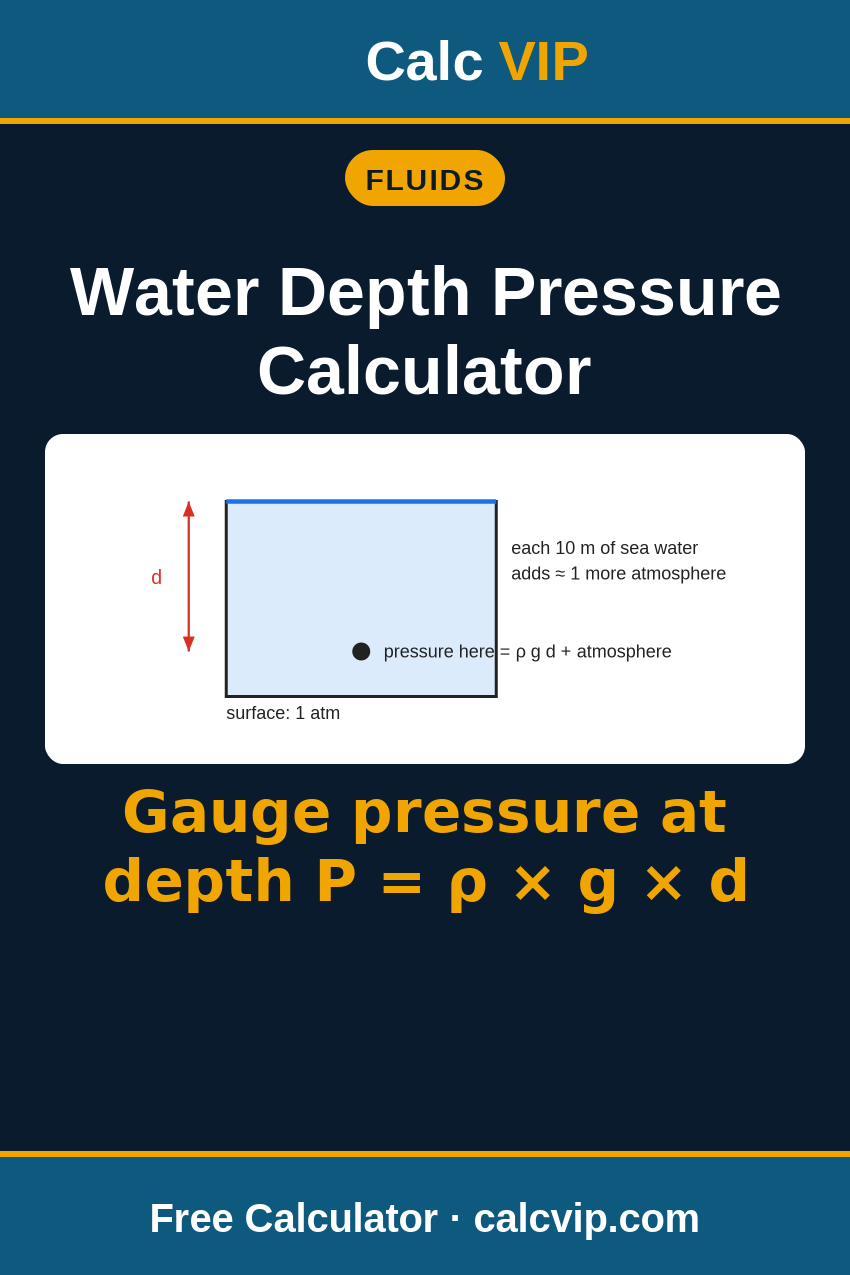
This calculator evaluates both pressures that matter: the gauge pressure, the water's own contribution ρgd, and the absolute pressure, gauge plus the atmosphere that was already pressing on the surface. It handles fresh and sea water at the touch of a selector and reports kilopascals, atmospheres and psi — the numbers divers, dam engineers, submariners and aquarium keepers actually plan with.
Formula
Gauge pressure at depth P = ρ × g × d • P in pascals (Pa), ρ in kilograms per cubic metre (kg/m³), g = 9.81 m/s², d in metres (m). Absolute pressure = ρgd + Patm, with Patm = 101,325 Pa.
The rearrangement d = P ÷ (ρg) answers the diver's question — how deep am I, from a pressure reading — and it is how depth gauges and dive computers actually work: they measure pressure and divide. Two densities cover most of life: fresh water at 1000 kg/m³ (lakes, rivers, pools, tanks) and sea water at 1025 kg/m³, whose dissolved salt makes every depth press about 2.5% harder. The calculator adds the standard atmosphere automatically for the absolute figure, because nearly everything that responds to pressure at depth — ears, lungs, gas solubility, hull stress — responds to the total. If you need pressure at depth inside a pressurised system instead, the same ρgd is the increment to add to whatever the surface pressure is.
| Symbol | Meaning | Units |
|---|---|---|
| P | pressure at depth (gauge or absolute, as labelled) | Pa, kPa, atm, psi |
| ρ | density of the water (fresh 1000, sea 1025) | kg/m³ |
| d | depth below the surface | m |
| g | gravitational field strength | 9.81 m/s² |
The column above you: why only depth counts
The formula P = ρgd is the weight of a column of water of unit cross-section and height d, divided by its area — the pressure is literally the overhead water's weight per square metre. That picture explains both surprises from the introduction. The shape of the container cannot matter, because the column above the point is the same column whether the water spreads into an ocean or rises in a pipe: this is the hydrostatic paradox, demonstrated most theatrically by Pascal, who is said to have burst a stout barrel by pouring water into a tall thin pipe fitted to its lid — a few litres of water, a column some 10 m tall, and a pressure at the barrel of about an extra atmosphere (1000 × 9.81 × 10 ≈ 98 kPa) that no barrel could argue with. And the pressure is equal in all directions because a fluid at rest cannot sustain sideways forces: any imbalance would flow until it vanished, leaving the squeeze uniform at every point of a given depth.
Life at depth is governed by the absolute figure, through two mechanisms. The first is mechanical: gas spaces — lungs, ears, sinuses, buoyancy compensators — shrink as pressure grows, halving in volume by 10 m (2 atm), shrinking to a third by 20 m, exactly as Boyle's law dictates; this is why pressure changes bite hardest near the surface, where the relative change per metre is greatest. The second is chemical: the amount of gas that dissolves in blood and tissue is proportional to its absolute pressure (Henry's law), so a diver at 30 m absorbs roughly four times the nitrogen of the surface — the dissolved load whose too-quick release on ascent causes decompression sickness. Depth pressure is gentle arithmetic with unforgiving consequences, which is why divers plan with tables built on exactly this page's formula.
How to use
- Select the water type: fresh water (1000 kg/m³) or sea water (1025 kg/m³, pre-selected).
- Enter the depth below the surface in metres.
- Click "Calculate Pressure".
- Read both results: the gauge pressure (the water's own addition) and the absolute pressure in kPa, atm and psi — the total that lungs, gauges referenced to vacuum, and gas laws respond to.
- For a quick mental check, remember the diver's rule: in the sea, absolute pressure in atm ≈ 1 + (depth ÷ 10). At 30 m that gives 4 atm against the calculator's 3.98 — close enough to plan a dive's first sketch.
Worked examples
Example 1 — the diver at 30 m. A diver is 30 m down in sea water. Gauge pressure = 1025 × 9.81 × 30 = 301.66 kPa. Adding the atmosphere: absolute pressure = 301.66 + 101.33 = 402.98 kPa ≈ 3.98 atm ≈ 58.45 psi — about four times the pressure at the surface.
Example 2 — the deep end of the pool. At 10 m in fresh water (a diving pit, or a tall water tower's base): gauge = 1000 × 9.81 × 10 = 98.1 kPa, absolute = 98.1 + 101.33 ≈ 199.42 kPa ≈ 1.97 atm. Ten metres of any water costs almost exactly one extra atmosphere — the rule of thumb is exact enough to trust.
Example 3 — a working diver at 40 m. In sea water at 40 m: gauge = 1025 × 9.81 × 40 ≈ 402.21 kPa; absolute ≈ 503.54 kPa ≈ 4.97 atm ≈ 73.03 psi. This is near the limit for recreational air diving — not because of the pressure itself, but because breathing gas at 5 atm loads the body with nitrogen five times as fast.
Example 4 — a reservoir dam. At the base of a dam holding back 100 m of fresh water: gauge = 1000 × 9.81 × 100 = 981 kPa, absolute ≈ 1082.32 kPa ≈ 10.68 atm. Every square metre of the dam's base is pushed with a force of about 981,000 N — the weight of roughly 100 tonnes — which is why dams are built as massive wedges, thickest exactly where this pressure peaks.
Example 5 — the deep ocean. At 1000 m in the sea: gauge = 1025 × 9.81 × 1000 ≈ 10,055 kPa ≈ 10.06 MPa; absolute ≈ 10,157 kPa ≈ 100.24 atm. No sunlight, near-freezing water, and a hundred atmospheres: the bathyal zone, where every research submersible's hull is a pressure vessel first and a vehicle second.
Example 6 — the bottom of the world. The Challenger Deep in the Mariana Trench lies about 10,935 m down. Gauge pressure = 1025 × 9.81 × 10,935 ≈ 109.95 MPa; absolute ≈ 1086 atm. On each square centimetre rests about 1.1 tonnes of force — yet shrimp-like amphipods live there, unbothered, because their bodies have no gas spaces to crush: pressure only destroys what contains a pressure difference.
Depth pressure in real life
Scuba diving. The whole sport is scheduled by this formula: air consumption scales with absolute pressure (a tank lasts a quarter as long at 30 m as at the surface), buoyancy compresses with it, and ascent limits exist because dissolved nitrogen — loaded in proportion to absolute pressure — must be given time to leave.
Submarines and submersibles. A military submarine at 300 m faces about 30 atm of sea pressure trying to implode its hull; the research submersible that visited the Challenger Deep was built around a spherical cabin with walls 9 cm of titanium thick, sized by the Example 6 arithmetic.
Dams and water supply. Dam thickness, penstock design and the pressure zones of a city's water network are all ρgd bookkeeping: a tower 50 m above a neighbourhood delivers about 490 kPa of static pressure to its taps before a single pump is considered.
Ear and sinus pain. The pain of descending in a pool or an aircraft is this formula felt from inside: a mere 1–2 m of water adds 10–20 kPa that the middle ear must equalise through the Eustachian tube, and the first 10 m — where pressure doubles — is where nearly all the discomfort of diving lives.
Aquariums and tanks. The glass of a deep aquarium is specified by the pressure at its base: a 2 m deep public tank presses its lowest panels with about 19.6 kPa gauge — modest per square centimetre, but tonnes summed over a panoramic window, which is why such windows are acrylic many centimetres thick.
Ocean science. Pressure is one of the three master variables of oceanography (with temperature and salinity): it sets the density of deep water, the depth rating of every instrument, and the behaviour of gases in hydrothermal vents, where water at 400 °C stays liquid because 30 MPa of pressure forbids it to boil.
The oceanographer's shortcut: one decibar, one metre
Ocean scientists measure pressure in decibars (1 dbar = 10,000 Pa) for a reason that delights every student who meets it: in sea water, the pressure grows by almost exactly one decibar per metre of depth — ρgd = 1025 × 9.81 × 1 ≈ 10,055 Pa ≈ 1.0055 dbar. So a CTD instrument lowered on a cable reporting 500 dbar is, to within half a percent, 500 m down; the pressure reading is the depth, with no conversion table in sight. The small residual difference — real seawater compresses slightly and its density varies with temperature and salinity — is absorbed by standard correction tables when precision matters. It is a rare gift in physics when a unit and a quantity coincide, and the decibar is kept in service long after the bar itself fell from favour purely because of this one: the ocean measures itself.
Quick reference: pressure by depth (sea water)
| Depth | Gauge pressure | Absolute pressure |
|---|---|---|
| 10 m | 100.55 kPa | 201.88 kPa (1.99 atm) |
| 20 m | 201.10 kPa | 302.43 kPa (2.98 atm) |
| 30 m | 301.66 kPa | 402.98 kPa (3.98 atm) |
| 40 m | 402.21 kPa | 503.54 kPa (4.97 atm) |
| 100 m | 1005.52 kPa | 1106.85 kPa (10.92 atm) |
| 1000 m | 10,055.25 kPa | 10,156.58 kPa (100.24 atm) |
The table is a straight line wearing a grid: add about 100.55 kPa of gauge pressure for every 10 m of sea water, forever, from a paddling pool's deep end to the trench floor. Fresh water runs about 2.5% gentler — 98.1 kPa per 10 m.
Common mistakes
- Forgetting the atmosphere in the total. At 10 m the water adds one atmosphere, but the absolute pressure is two. Gas consumption, buoyancy compression and nitrogen loading all follow the absolute figure — halving your estimate of it is the classic beginner's error.
- Using sea-water density for a lake (or the reverse). The 2.5% difference is small per metre and large per hundred metres: at 1000 m it amounts to 250 kPa of error. Pick the water you are actually in.
- Believing a bigger body of water presses harder. It does not. Depth, density and gravity are the whole formula; the narrow standpipe matches the ocean at equal depth, as Pascal's barrel learned the hard way.
- Measuring depth from the wrong surface. d runs from the free surface to the point — in a boat's hull gauge, from the waterline outside, not from the deck. In a pressurised tank, add the surface pressure separately; ρgd is only the water's part.
- Assuming pressure only pushes down. At a point underwater the pressure is the same in every direction. Hulls, dams and eardrums are designed for a squeeze, not a weight — the force on a surface is pressure × area, in whatever direction the surface faces.
FAQ
Why do divers' ears hurt after just a few metres?
The pressure changes fastest near the surface: the first 10 m adds a whole extra atmosphere. Your ears feel that change long before the total pressure becomes dangerous.
What is the pressure at 10 m depth?
About 1 extra atmosphere of gauge pressure, so roughly 2 atm absolute (about 200 kPa) — double the surface pressure.
Does the size of the body of water matter?
No. Pressure at a depth depends only on ρ, g and the depth itself. A narrow vertical pipe 30 m tall produces the same pressure at its base as the sea at 30 m.
Why does my air run out faster at depth?
Because every breath at 30 m contains air at 4 atm absolute — four times as many molecules per lungful as at the surface. Your regulator delivers gas at the ambient pressure, so a cylinder's contents are spent in proportion to the absolute pressure: a tank that lasts 60 minutes at the surface lasts about 15 minutes at 30 m, all else equal.
What is the pressure at the deepest point of the ocean?
At the Challenger Deep, about 10,935 m down in the Mariana Trench, the gauge pressure is roughly 110 MPa — an absolute pressure of about 1086 atm, or around 1.1 tonnes of force on every square centimetre. Crewed submersibles have visited it; their cabins are among the strongest pressure vessels ever built.
How do depth gauges work?
They are pressure gauges read backwards: measure the absolute (or gauge) pressure, subtract the surface atmosphere, and divide by ρg to get depth. Dive computers do exactly this many times a second, which is why they must be told — or must sense — whether the water is fresh or salt: the divisor differs by 2.5%.
Does pressure crush a sealed empty bottle taken down?
Yes — the air inside stays near 1 atm while the outside climbs, and the difference (the gauge pressure) acts on every square centimetre of the bottle's surface. At 30 m that is about 300 kPa of net inward pressure; a thin plastic bottle collapses long before that, while a rigid one with air inside at surface pressure is crushed flat as the air compresses to a quarter of its volume.
Why don't fish get crushed?
Because their tissues are mostly water, at the same pressure as the water outside — there is no pressure difference to do the crushing. Only gas spaces are squeezed, which is why deep-sea fish brought up quickly are damaged mainly by their swim bladders expanding, and why the trench's amphipods, with no gas spaces at all, are indifferent to a thousand atmospheres.
How deep can a human free-dive on one breath?
Remarkably deep — beyond 100 m, where the absolute pressure exceeds 11 atm and the lungs compress to a fraction of their surface volume. The records (past 120 m in the no-limits discipline) are set by athletes whose bodies adapt to the squeeze; the pressure itself, applied evenly, is survivable — it is the gas management and the ascent that demand the training.
What pressure does a submarine hull feel?
The gauge pressure at its depth — the difference between the sea outside and the roughly 1 atm of air maintained inside. At 300 m that difference is about 3 MPa across the hull, which is why submarine pressure hulls are thick, circular in cross-section (the shape that carries squeeze best), and tested well beyond their rated depth.