 Calc
Vehicle Kinetic Energy Calculator – KE of a Moving Vehicle & Equivalent Fall Height
 Created by Priya Sharma · Physics Editor · Energy & Gravity · Last updated: November 2026
Use this free Vehicle Kinetic Energy Calculator to find how much kinetic energy a moving car, truck or train carries. Enter the mass and speed to get the energy, plus the equivalent fall height — the height the vehicle would have to fall from to gain the same energy.
Every moving vehicle is a store of energy in transit, and the store's size is set by the most consequential formula in road safety: KE = ½mv². The mass matters, but the speed matters squared — double it and the energy quadruples. This calculator evaluates a vehicle's kinetic energy from its mass and speed, and translates the answer into the page's signature comparison: the equivalent fall height, the height from which the vehicle would have to fall to arrive carrying exactly that much energy. Crashing at 90 km/h, it turns out, is energetically indistinguishable from driving off a ten-storey building — a translation that has startled generations of students into respecting the square.
The fall height deserves a moment's appreciation, because it isolates speed's role perfectly. Setting ½mv² equal to mgh, the mass cancels: h = v² ÷ (2g) depends on speed alone. A motorcycle and a lorry at the same speed share the same equivalent fall height; the lorry simply brings far more energy to the same fall. That cancellation is why the comparison communicates so well across vehicle types — and why speed limits, which govern v, govern the height of the building every driver is perpetually falling from.
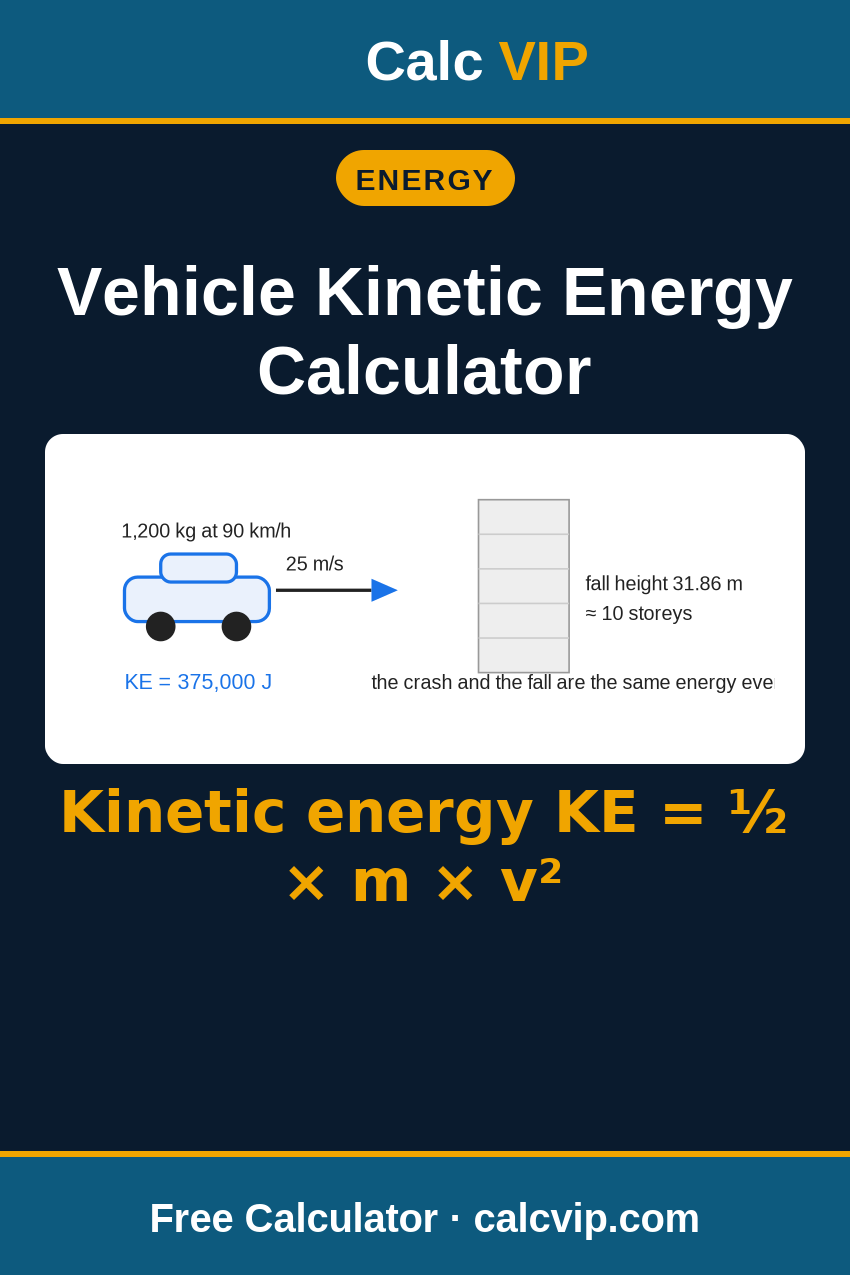
Where does the energy go when it must be shed? Brakes convert it to heat, crumple zones convert it to bent metal, and regenerative braking in electric vehicles converts a useful share back into battery charge. Every one of those technologies is sized by this formula: the brakes of Example 1's car must dispose of 375 kJ in seconds, and everything in the depth sections — stopping distances, crash physics, EV recovery — is bookkeeping on that single obligation.
Formula
Kinetic energy KE = ½ × m × v² • Equivalent fall height h = v² ÷ (2g) (g = 9.81 m/s²; speed converted from km/h by dividing by 3.6)
The fall height comes from equating the two energy stores: ½mv² = mgh. The mass cancels — which is why this calculator can report the height from the speed alone — leaving h = v² ÷ (2g). Unit discipline decides most errors here: the formula wants v in metres per second, so the calculator accepts the speed in km/h (as speedometers report it) and divides by 3.6 internally; anyone working by hand must perform that conversion before squaring, because squaring an unconverted 90 produces an answer 12.96 times too large (3.6², the square law amplifying a units slip into a fantasy). The energy emerges in joules, with kilojoules alongside; in kilowatt-hours the numbers shrink to domestic scale, as the worked examples show — 375 kJ is only about 0.104 kWh, a reminder that the danger of vehicle energy lies not in its total but in the fraction of a second available to shed it.
| Symbol | Meaning | Units |
|---|---|---|
| KE | kinetic energy of the vehicle | J (kJ) |
| m | total mass — vehicle, passengers, load | kg |
| v | speed (entered in km/h, used in m/s) | km/h → m/s |
| h | equivalent fall height | m |
The square law: why speed is the whole story
Compare the examples side by side and the square law stops being algebra and becomes biography. At 50 km/h the family car carries about 115,741 J; at 90 km/h, 375,000 J; at 180 km/h, 1,500,000 J. Speed went up by factors of 1.8 and 2; energy went up by factors of 3.24 and 4. Braking distance obeys the same tyranny, because brakes shed energy at a roughly fixed rate per metre: the stopping distance from 90 km/h is 3.24 times that from 50 km/h, not the 1.8 times intuition requests. This is the quantitative spine of every speed-limit debate: small increases in cruising speed purchase disproportionate increases in the energy that brakes, tyres, crumple zones and bodies must dispose of when something goes wrong — and the fall-height column makes the disproportion visible as architecture, from a one-storey 30 km/h (3.54 m) to a forty-storey 180 km/h (127.42 m).
The timescale completes the danger. 375 kJ is, as noted, a trivial amount of electricity — about an hour of a 100 W bulb. But a crash must shed it in roughly a tenth of a second, which is an average power of about 3.75 megawatts flowing through the structure of the car. Crumple zones exist to stretch that tenth of a second and to spend the power on bending sacrificial metal at a governed rate; brakes exist to shed the same energy over seconds instead, as heat, at a rate their discs can radiate. Same joules, wildly different power — the distinction between an arrival and an accident.
How to use
- Enter the vehicle's total mass in kilograms — including passengers, fuel and cargo, not just the brochure kerb weight.
- Enter the speed in kilometres per hour, exactly as read from the speedometer; the calculator converts to m/s before squaring.
- Click "Calculate KE" to see the speed in m/s, the kinetic energy in joules and kilojoules, and the equivalent fall height in metres.
- For perspective, divide the fall height by about 3 m per storey — and compare speeds in pairs to feel the square law: the ratio of energies is the square of the ratio of speeds.
Worked examples
Example 1 — the motorway car. A 1,200 kg car at 90 km/h (25 m/s): KE = ½ × 1,200 × 25² = 375,000 J (375 kJ), and the equivalent fall height is h = 25² ÷ (2 × 9.81) = 31.86 m — the ten-storey fall of the introduction. Every number in road safety is downstream of this one.
Example 2 — the same car in town. At 50 km/h (13.89 m/s): KE = ½ × 1,200 × 13.89² ≈ 115,740.74 J and h ≈ 9.83 m. Dropping from 90 to 50 km/h — barely half the speed — sheds more than two-thirds of the energy. Urban speed limits are written in this ratio.
Example 3 — the lorry. A 10,000 kg lorry at the same 90 km/h: KE = ½ × 10,000 × 625 = 3,125,000 J (3.125 MJ) — over eight times the car's energy, at the identical fall height of 31.86 m. The height prices the speed; the energy prices the mass as well, and it is energy that barriers and brakes must absorb.
Example 4 — the train. A 400,000 kg train at 100 km/h (27.78 m/s): KE = ½ × 400,000 × 27.78² ≈ 154,320,987.65 J ≈ 154.32 MJ, fall height 39.33 m. Trains brake over kilometres for a reason: a store of that size cannot be shed quickly by any friction surface, so signalling systems enforce the distance the energy demands.
Example 5 — the cyclist. Rider and bicycle, 80 kg at 30 km/h (8.33 m/s): KE = ½ × 80 × 8.33² ≈ 2,777.78 J, fall height 3.54 m — a first-floor window. Small, but not nothing: those 2.8 kJ are what a helmet and a sliding fall must manage, and why even bicycle speeds reward protective gear.
Example 6 — the doubling. Example 1's car at 180 km/h (50 m/s): KE = ½ × 1,200 × 2,500 = 1,500,000 J — exactly four times the 90 km/h figure, and the fall height quadruples to 127.42 m. There is no speed so familiar that the square law stops applying to it; autobahn energies are skyscraper energies.
Vehicle kinetic energy in real life
Brake engineering. A brake disc must convert the full KE to heat in one stop without fading: Example 1's 375 kJ in a few seconds is kilowatts of heating per disc, repeated downhill until the discs glow. Brake size, venting and fluid boiling points are this formula expressed in cast iron.
Crash testing and crumple zones. Test speeds are chosen from the energy table: a 64 km/h barrier test is not "a bit more" than a 50 km/h one but roughly 64% more energy to absorb. Ratings, airbag timings and crumple lengths all trace back to ½mv² at the test speed.
Regenerative braking. An EV stopping from 90 km/h has 375 kJ — about 0.104 kWh — on offer; recovering even half of it, stop after stop in city traffic, is a measurable share of an electric car's range. Regen is this calculator running in reverse, with an efficiency tax.
Speed-limit policy. The 3.24 energy ratio between 50 and 90 km/h, and the matching stopping-distance ratio, is the entire quantitative case for urban limits — and for why motorway limits, where the surroundings are engineered for the energy, can safely differ.
Runway and rail safety. Overrun areas, arrestor beds and rail buffer stops are energy absorbers sized in megajoules — Example 4's 154 MJ train is why rail signalling, not braking, is the primary safety system.
Motorsport barriers. Catch fencing and tyre walls at circuits are rated by the energy of the cars they must stop; a barrier that works at 150 km/h faces barely half the energy of the same car at 200, the square law again setting the engineering.
Where the energy goes: brakes, crumple zones and batteries
Stopping is an energy disposal problem with three approved landfills. Friction brakes turn KE into hot discs — effective, but the heat must be radiated away, which is why repeated downhill stops fade brakes: the landfill fills faster than it empties. Crumple zones turn KE into the work of deforming metal along a designed collapse path, stretching the disposal over distance and time so the passenger cell — and its occupants' own kinetic energy — is spent gently; the car's front is a sacrificial energy budget, spent once. Regenerative braking runs the motor as a generator and banks the energy chemically, the only landfill that pays rent. A modern EV blends all three: regen first, friction to finish, crumple zones in reserve for the day the other two are overwhelmed. In every case the amount to be disposed of is fixed by this page's formula before any engineer chooses the method — ½mv² is the invoice; the technologies are merely payment plans.
The disposal arithmetic can be made concrete with one braking calculation. A 1,200 kg car on dry asphalt with a friction coefficient of about 0.7 can brake with a force of roughly 0.7 × 1,200 × 9.81 ≈ 8,240 N. Shedding Example 1's 375,000 J against that force takes 375,000 ÷ 8,240 ≈ 45.5 m of braking from 90 km/h; from 50 km/h, the same force disposes of 115,740.74 J in about 14.05 m. The distances stand in the energy ratio 3.24, not the speed ratio 1.8 — the square law measured in metres of skid mark, and the reason the gap a driver must leave grows so much faster than the speedometer suggests. (Reaction distance, travelled before the brakes even bite, adds its own strictly linear toll on top.)
Loading quietly rewrites every figure, too. Example 1's car with four passengers and luggage aboard masses nearer 1,700 kg, and at the same 90 km/h it carries ½ × 1,700 × 625 = 531,250 J — 42% more energy than the empty car, against brakes and tyres sized by the manufacturer with that margin in mind but not always with the driver's awareness. The fall height, characteristically, does not move: still 31.86 m. Mass decides how much energy the stop must absorb; speed alone decides how violent the stop is equivalent to being — and a driver controls the second of those completely, and the first only at the packing stage.
Quick reference: one car, five speeds
| Speed | Kinetic energy (1,200 kg) | Equivalent fall height |
|---|---|---|
| 30 km/h | 41,666.67 J | 3.54 m |
| 50 km/h | 115,740.74 J | 9.83 m |
| 90 km/h | 375,000 J | 31.86 m |
| 120 km/h | 666,666.67 J | 56.63 m |
| 180 km/h | 1,500,000 J | 127.42 m |
The fall-height column is mass-independent — it is every vehicle's column, from moped to lorry. Post it next to the speedometer of the mind: each speed is a building, and the building grows quadratically.
Common mistakes
- Squaring the km/h figure. The formula needs m/s. Entering 90 where 25 belongs inflates the energy by 3.6² ≈ 12.96 times. The calculator converts for you; hand calculations must divide by 3.6 before the square, not after.
- Thinking energy grows in proportion to speed. It grows with the square — the error behind most underestimates of high-speed danger. 20% faster is 44% more energy, not 20%.
- Using the brochure kerb mass. Passengers, fuel and cargo are part of m. Four adults and luggage can add 400 kg to a "1,200 kg" car — a third more energy at every speed, and a third more work for the brakes.
- Expecting the fall height to depend on mass. It cancels in the derivation: h = v² ÷ (2g). A heavier vehicle has more energy but the same equivalent fall height — the two outputs answer different questions and must not be blended.
- Judging crash severity by energy alone. 375 kJ shed over 5 seconds of braking is routine; shed in 0.1 s it is a catastrophe. Energy sets the total bill, but the rate — power — decides survival, which is why crumple zones trade distance for time.
FAQ
Why does doubling the speed matter so much?
Kinetic energy grows with the square of the speed. Doubling speed means four times the energy — and roughly four times the braking distance.
What does the equivalent fall height mean?
It compares a crash at that speed to falling from that height. It is a vivid way to understand why high-speed crashes are so destructive.
How much energy is 375 kJ?
About 0.104 kWh — the electricity to run a 100 W bulb for roughly an hour, all of which must be absorbed in a second or two during a crash.
How much kinetic energy does a plane have at take-off?
A 70,000 kg airliner rotating at 280 km/h (77.78 m/s) carries ½ × 70,000 × 77.78² ≈ 211.7 MJ — over five hundred times Example 1's car. Rejected take-offs are among the most demanding braking events in transport, which is why runway length calculations are, at heart, this formula.
Does a heavier vehicle take longer to stop?
Not automatically: its brakes and tyre grip scale with its weight too, so in principle stopping distance is set by speed and grip, not mass. In practice, heavily loaded vehicles run hotter brakes and longer stops — but the naive claim "twice the mass, twice the distance" is wrong; the energy doubles, and so does the friction available to shed it.
Why do brakes fade on long descents?
Descending converts potential energy continuously, and the brakes must radiate it as fast as it arrives. When input power exceeds cooling, disc temperatures climb until friction falls away — fade. Engine braking and regen exist to divert the energy stream before it reaches the discs.
How much of its energy can an EV recover?
In city driving, regenerative braking commonly recovers a substantial share — often quoted in the range of a fifth to a third of the traction energy over a trip, with single stops recovering more before friction braking blends in. The ceiling is always the KE itself: 0.104 kWh for Example 1's stop from 90 km/h.
Is rotational energy of the wheels included?
Strictly, no: ½mv² counts translation only. Wheels, tyres and spinning drivetrain parts add a few percent of rotational KE — engineers fold them in as a small "effective mass" correction. For estimates at this page's level, the omission is honest and small.
What speed corresponds to a fall from 10 m?
Invert the height formula: v = √(2gh) = √(2 × 9.81 × 10) ≈ 14 m/s ≈ 50 km/h — matching the table's 9.83 m row. Any crash above urban speeds is, energetically, a fall from a building; the table is that statement itemised.
Why is the factor ½ there at all?
It falls out of the work–energy theorem: accelerating a mass with a steady force over a distance builds KE = F × d = ma × (v² ÷ 2a) = ½mv². The same ½ appears in the spring's ½kx² — both are receipts for a quantity that grew steadily from zero while the work was being done.