 Calc
Work Against Friction Calculator – Friction Force × Distance
 Created by Priya Sharma · Physics Editor · Energy & Gravity · Last updated: November 2026
Use this free Work Against Friction Calculator to find how much energy is lost to friction when an object slides over a surface. Enter the friction coefficient, mass, surface angle and sliding distance — flat ground is just an angle of 0°.
Friction is the tax collector of the physical world. Every sliding object pays it: kinetic energy is skimmed off, metre by metre, and converted into heat until the object stops or something keeps pushing. This calculator adds up the tax. Give it the coefficient of friction between the surfaces, the object's mass, the angle of the surface and the distance slid, and it returns the friction force and the total work done against friction — the exact amount of energy the slide will cost.
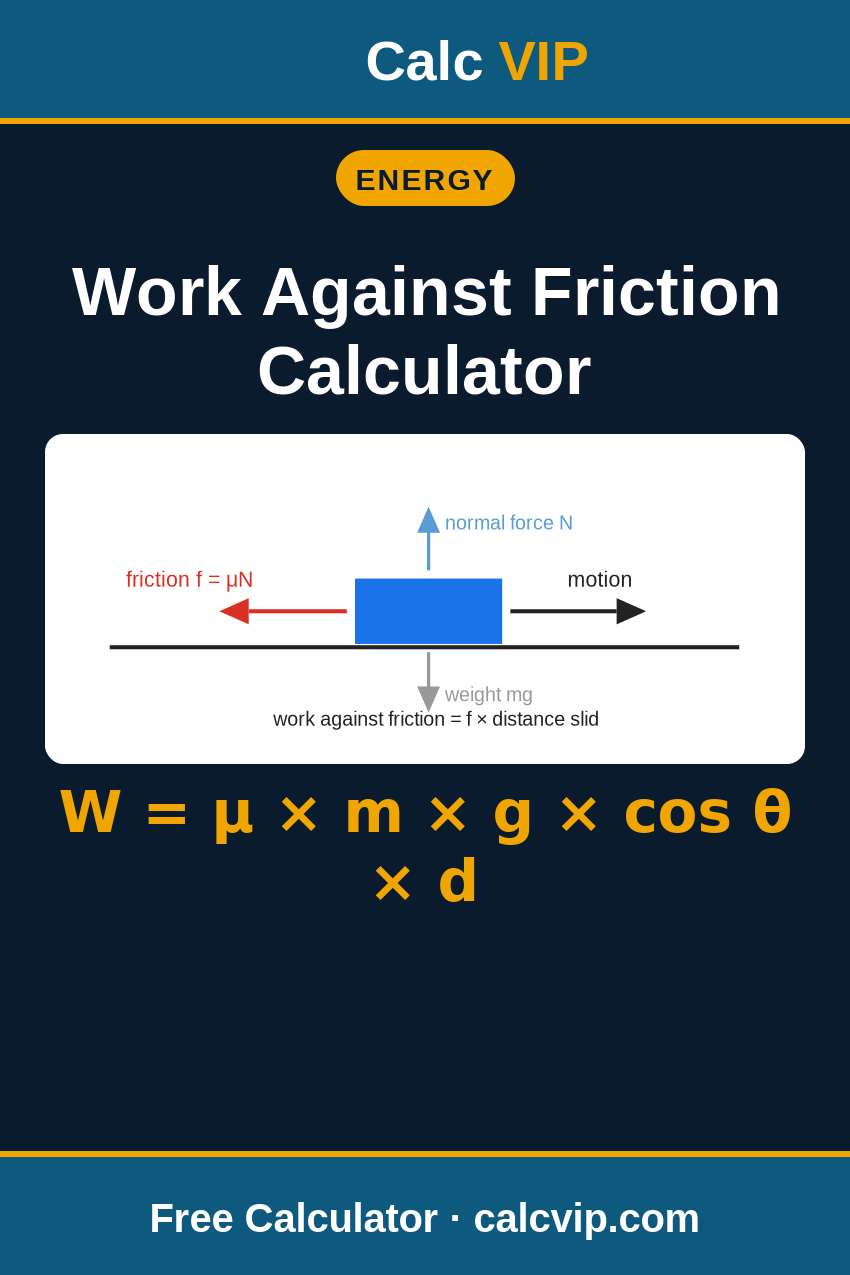
The physics is a single line: the friction force is the coefficient of friction multiplied by how hard the surfaces are pressed together, and the work is that force multiplied by the distance. On flat ground the pressing force is simply the object's weight, mg. On a slope it is only the component of the weight that presses into the surface, mg cos θ — which is why this calculator asks for the angle, and why things slide more easily, and stop more slowly, on a ramp than the same object on the flat.
The answers matter far beyond the textbook. The work against friction is the heat your brakes must survive on a mountain descent, the energy a factory spends dragging parts along a line, the reason a curling stone travels forty metres while a hockey puck on rough ice dies in five. It is also the stopping-distance equation in disguise: set the friction work equal to a moving object's kinetic energy and out falls the distance it needs to stop. Enter your surfaces below and see what the tax collector charges.
Formula
Work against friction = friction force × distance → W = μ × m × g × cos θ × d
On a slope the normal force is mg cos θ, so the friction force is f = μmg cos θ. On flat ground θ = 0° and cos θ = 1, giving the familiar f = μmg. g = 9.81 m/s². The formula rearranges for the two questions people ask most. Given a measured energy loss, the coefficient was μ = W ÷ (mgd cos θ) — how surfaces are tested in laboratories. And given a sliding object's kinetic energy, the distance it will travel before friction stops it is d = KE ÷ f — the stopping-distance form used in the depth section below. Signs deserve one word: friction's work is done against the motion, so in energy accounts it appears as a loss — this calculator reports its size as a positive number of joules, the amount of kinetic energy converted to heat. Mass in kilograms, distance in metres, and μ is a pure number with no units at all.
| Symbol | Meaning | Units |
|---|---|---|
| W | work done against friction — energy converted to heat | joules (J) |
| μ (mu) | coefficient of (kinetic) friction for the surface pair | no unit |
| m | mass of the sliding object | kilograms (kg) |
| θ | angle of the surface — 0° is flat | degrees (°) |
| d | distance slid | metres (m) |
| N | normal force pressing the surfaces together, mg cos θ | newtons (N) |
| f | friction force, μN | newtons (N) |
Where the energy goes: the interface is a furnace in miniature
Zoom in on a sliding contact and the smoothness is a lie. Both surfaces are mountain ranges at the microscopic scale, and sliding means the ranges collide, weld briefly at the peaks, tear apart and collide again, thousands of times per second. Each microscopic collision converts a little ordered kinetic energy into random vibration of the material — which is to say, heat. That is the destination of every joule this calculator counts: the interface warms, the surfaces wear, and occasionally (a struck match, a fire bow) the heating is the entire point. Friction is not a force that destroys energy; it is a mechanism that degrades it, from the useful, directed motion of the whole object into the useless, random motion of its atoms.
The coefficient μ packages all that microscopic violence into one empirical number, and it belongs to a pair of surfaces, never to one material alone: rubber is grippy on asphalt and treacherous on ice; steel is slippery on ice and stubborn on steel. In the simple model used here, μ does not depend on the contact area or the sliding speed — a brick slides with the same friction force on its face, its side or its end, because a smaller area simply presses proportionally harder per square centimetre and the two effects cancel. Real surfaces bend these rules at the extremes (racing tyres and climbing-shoe rubber genuinely do grip harder with area and temperature), but for the enormous middle ground of everyday sliding, μ × N is one of the most reliable formulas in applied physics.
There are two coefficients for every pair, and the difference runs the world. Static friction, which resists the start of sliding, is almost always larger than kinetic friction, which resists sliding already under way. That is why a heavy crate lurches when it finally breaks free, why brakes squeal at the moment of stopping, and why anti-lock braking systems work so hard to keep wheels rolling — a rolling wheel's contact patch is statically gripped, and static grip is the stronger kind. This calculator deals in kinetic friction, the tax on motion already happening.
How to use
- Enter the coefficient of friction μ (about 0.05 for ice, 0.3–0.5 for wood or tyres on dry surfaces — the quick-reference table below has more).
- Enter the mass in kilograms (kg).
- Enter the slope angle in degrees — use 0 for flat ground.
- Enter the sliding distance in metres (m), then click "Calculate" to see the normal force, the friction force and the work done against friction.
- To find a stopping distance instead, divide the object's kinetic energy (½mv²) by the friction force this calculator reports — the depth section works an example.
Worked examples
Example 1 — the headline case. A 10 kg box with μ = 0.3 slides 5 m over flat ground (θ = 0°). Friction force = 0.3 × 10 × 9.81 × cos 0° = 29.43 N. Work against friction = 29.43 × 5 = 147.15 J — that much kinetic energy is turned into heat. A box pushed at a few metres per second carries about this much energy, which is why it stops within a few metres of your letting go.
Example 2 — the sled on ice. A 20 kg sled on ice, μ = 0.05, slides 30 m. Friction force = 0.05 × 20 × 9.81 = 9.81 N — barely a newton per kilogram. Work = 9.81 × 30 = 294.3 J. The sled travels six times further than Example 1's box while paying only twice the energy: low μ is worth more than low mass, every time.
Example 3 — down the ramp. An 8 kg crate slides 6 m down a 20° ramp with μ = 0.4. The normal force is 8 × 9.81 × cos 20° = 73.75 N (less than its 78.48 N weight — the slope carries the rest), so friction = 0.4 × 73.75 = 29.50 N and the work against friction = 29.50 × 6 = 176.99 J. Notice the slope's double effect: it weakens friction, but it is also what makes the crate slide at all, since gravity's downhill pull now exceeds that weakened friction.
Example 4 — braking the family car. A 1,200 kg car braking with locked wheels on dry asphalt, μ = 0.7, over 40 m: friction force = 0.7 × 1,200 × 9.81 = 8,240.4 N; work = 8,240.4 × 40 = 329,616 J — about a third of a megajoule of heat poured into four tyres and the road in a few seconds. Cross-check by energy: 329,616 J is the kinetic energy this car has at 23.44 m/s (84 km/h), which is exactly the speed a 40-metre locked-wheel stop implies. (Real stops use the brakes' friction inside the wheel, and ABS keeps the tyres near static grip — stronger than the sliding figure used here.)
Example 5 — dragging the crate. A warehouse worker drags a 25 kg crate 3 m across concrete, μ = 0.5. Friction = 0.5 × 25 × 9.81 = 122.63 N; work = 122.63 × 3 = 367.88 J of the worker's energy becomes heat in the floor. This is why warehouses run on wheels and rollers: rolling replaces this tax with one a hundred times smaller.
Example 6 — how far will the puck glide? A hockey puck (m = 0.17 kg) is sliding at 10 m/s on ice, μ = 0.1. Its kinetic energy is ½ × 0.17 × 100 = 8.5 J, and the friction force is 0.1 × 0.17 × 9.81 = 0.167 N. Stopping distance = 8.5 ÷ 0.167 = 50.97 m — longer than a hockey rink is wide, which matches every spectator's experience of a puck rattling around the boards long after the shot.
Work against friction in real life
Brakes and mountain descents. A car descending a long pass must convert its potential energy into heat continuously. Riding the brakes pours that energy into the discs faster than they can shed it — they fade, and in the worst case fail. Truck escape ramps and the instruction to use a low gear exist because engine braking pays the friction bill somewhere other than the brake pads.
Curling's sweeping. Curlers sweep frantically ahead of the stone because the brooms briefly warm the ice and lower μ — from about 0.05 toward 0.04 over the swept stretch — letting the stone travel metres further and curl less. It is this calculator being played as a sport: adjust μ mid-slide, adjust the stopping point.
Tyres and wet roads. A tyre on dry asphalt grips at μ ≈ 0.7; on a wet road that can halve, and on ice it collapses to about 0.1. Since stopping distance is kinetic energy divided by friction force, halving μ doubles the stopping distance — the physics inside every "slow down in the rain" warning ever issued.
The energy bill of industry. A large share of the world's machinery energy — by some estimates a fifth of all energy use — is spent overcoming friction in engines, gearboxes, pumps and bearings. Lubrication science is an economic giant for exactly this reason: every point shaved off an effective μ is a percentage point off the energy bill of everything that moves.
Friction as a tool. The same effect that wastes energy is deliberately harvested where grip is the product: sandpaper and files (friction as a cutter), matches (friction as an igniter), climbing shoes and gym chalk (friction as safety), and the knot in every shoelace (friction as the fastener). Engineering is rarely about eliminating friction — it is about posting it to the right address.
Walking itself. Every step you take is powered by static friction between shoe and ground; without it your foot would slip backwards and walking would be a mime on ice. The kinetic friction of this page is the enemy of motion, but its static sibling is the enabler of nearly all of it — the same surfaces, the same μ family, opposite reputations.
Stopping distances: the formula turned around
Set friction's work equal to the kinetic energy it must remove and the mass cancels beautifully: ½mv² = μmgd gives d = v² ÷ (2μg). The stopping distance of a sliding (or locked-wheel) object depends on its speed squared and on μ — and on nothing else, not even its mass. For dry asphalt (μ = 0.7): at 10 m/s the stop takes 7.28 m; at 20 m/s, 29.13 m; at 30 m/s, 65.54 m. Double the speed, quadruple the distance — the same square law that haunts every energy page, here with consequences measured in metres of road. It also explains why the puck in Example 6 glides so far: at μ = 0.1 the denominator shrinks sevenfold, and distances stretch by the same factor. Highway stopping-distance charts are this formula with a reaction-time distance added on top.
Quick reference: coefficients of friction for common pairs
| Surface pair | Typical μ (kinetic) | Character |
|---|---|---|
| steel on ice | ≈ 0.03 | skates and sleds — the slipperiest common pair |
| Teflon on steel | ≈ 0.04 | the non-stick champion |
| wood on wood | 0.3–0.5 | furniture and crates |
| rubber on wet asphalt | ≈ 0.4 | braking distances roughly double |
| rubber on dry asphalt | 0.7–1.0 | tyres doing their job |
| rubber on concrete (climbing shoes) | ≈ 1.0+ | grip engineered past the "limit" |
Use the table to choose μ honestly: the difference between dry and wet asphalt is the difference between two rows, and it doubles or halves every answer this calculator gives. When in doubt, calculate with the lower μ — the longer stopping distance is the safer assumption.
Common mistakes
- Using the weight where the normal force belongs. On flat ground they coincide, but on a slope the pressing force is mg cos θ. Forgetting the cos θ overstates friction on every ramp — at 20° by about 6%, at 45° by nearly a third.
- Using the static coefficient for a sliding object. Static μ is the larger, break-free value; once sliding, the kinetic coefficient rules. This calculator is about work during sliding, so the kinetic figure is the honest input — using the static one overstates the energy loss.
- Believing μ can never exceed 1. It can and does: clean rubber on dry concrete, climbing-shoe soles and drag-racing tyres all exceed μ = 1, meaning the friction force can exceed the object's weight. μ is a measured ratio, not a probability — nothing caps it at 1.
- Expecting a bigger contact patch to mean more friction. In the standard model, friction depends on μ and the normal force only. A wider patch presses less per unit area and the effects cancel — one of the model's most counterintuitive and best-tested claims. (Real tyres add subtleties, but the model is the right starting point.)
- Losing the sign in energy accounts. Friction's work removes kinetic energy: in any energy balance it enters as a subtraction, KEfinal = KEinitial − W. Adding it instead produces objects that speed up by sliding — a sure sign the tax collector has been entered as a benefactor.
FAQ
Where does the energy lost to friction go?
It becomes heat (and a little sound and surface wear). That is why brakes get hot and why sliding objects slow down and stop.
Why does a slope reduce the friction force?
On a slope only part of the weight presses the surfaces together — the normal force is mg cos θ instead of mg — so the friction force is smaller.
Does the friction force depend on the contact area?
In the simple school model, no. Friction depends on μ and the normal force only, not on how wide the contact patch is.
Can the coefficient of friction be greater than 1?
Yes. μ is simply the ratio of friction force to normal force, and nothing in physics caps that ratio at 1. Soft rubber on clean, dry concrete exceeds it, climbing shoes are engineered to exceed it, and drag-racing tyres can reach well past it under load. Values above 1 mean the friction force is larger than the object's weight — remarkable, but not forbidden.
Which coefficient does this calculator use — static or kinetic?
Kinetic. The calculator prices the work done while sliding, and sliding friction is the kinetic kind. If you are instead asking what force is needed to get an object moving in the first place, use the (larger) static coefficient with the same f = μN formula — just do not mix the two in one calculation.
Why do truck brakes fail on long descents?
Because the work against friction has nowhere else to go. A descending truck converts potential energy at a rate of megajoules per minute, and if the brakes absorb it all, the discs and drums overheat, the friction material fades, and μ itself collapses. Low gears let the engine absorb the energy instead; escape ramps exist for when neither works.
How does sweeping help a curling stone?
The broom's friction warms the very top of the ice and lays down a microscopic film of moisture, dropping μ slightly along the swept path. A slightly smaller μ means slightly less work done against friction per metre — so the stone keeps more of its energy, travels further (often by several metres over a full-length shot) and curls less. It is this page's formula, adjusted in real time.
Does the friction force depend on sliding speed?
In the simple model used here, no — kinetic friction is treated as constant at any speed. Real surfaces deviate modestly: some pairs grip a little less as speed rises, others (notably rubber) vary with temperature as the sliding itself heats the interface. For school, engineering-estimate and everyday purposes, the constant-μ model is accurate enough to design with.
Why is ice so slippery?
Its μ against most materials is exceptionally low — around 0.03 for steel — because the surface carries a microscopically thin, lubricating layer and because pressure and friction melt a film of water under a blade or runner. The same physics makes ice treacherous under shoes (μ for a shoe sole can be near 0.1) and glorious under a skate, where low friction work means a push buys a long glide.
Can friction ever do useful work?
Friction is how cars accelerate and how you walk: the static friction between tyre and road is the external force that pushes the car forward. The subtlety is that static friction at a rolling contact does not itself consume energy — the engine pays the energy bill. Kinetic (sliding) friction, this page's subject, is the one that always converts ordered energy into heat.