 Calc
Wind Power Calculator – P = ½ρAv³ from Rotor Diameter & Wind Speed
 Created by Priya Sharma · Physics Editor · Energy & Gravity · Last updated: November 2026
Use this free Wind Power Calculator to find how much power is available in the wind for a turbine of a given rotor size. Enter the rotor diameter and wind speed, and optionally the power coefficient Cp to estimate the power a real turbine can actually capture.
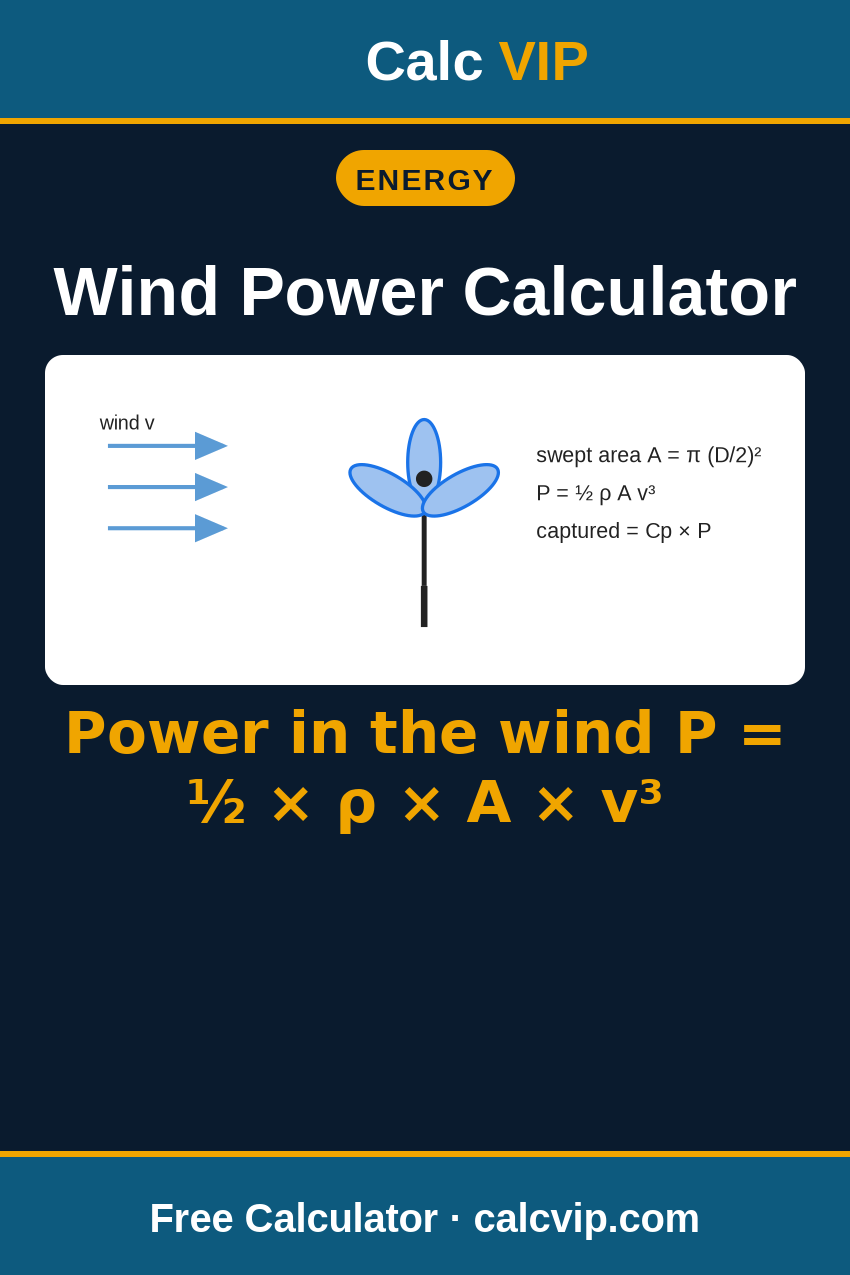
Wind is moving air, and moving air carries kinetic energy. A wind turbine is a device for intercepting a river of that energy: the rotor sweeps out a disc of area A, the air streams through it at speed v, and the power in that stream is P = ½ρAv³. This calculator evaluates the stream's power from the rotor diameter and wind speed, and — when you supply the power coefficient Cp — estimates the share a real machine can actually harvest, which physics caps well below the whole stream.
Two features of the formula dominate everything about wind energy. The first is the area: A = π(D/2)² grows with the square of the rotor diameter, so modest increases in blade length buy large increases in catch. The second is the cube: power grows with v³, so a site with double the wind speed offers eight times the power. Between the square and the cube, wind engineering becomes a hunt for tall towers, long blades and genuinely windy places — the formula leaves no other levers, except the air density ρ, which altitude and cold quietly adjust.
The Cp correction is the honesty clause. A turbine cannot take all the wind's power: stop the air completely and it would pile up and block the flow behind it. The air must keep moving to get out of the way, and that necessity caps the harvest at 59.3% of the stream's power — the Betz limit — with real machines achieving Cp values around 0.35–0.45. Enter a Cp and the calculator shows the capturable power; leave it blank and you see the full stream power, the ceiling every real rotor lives beneath.
Formula
Power in the wind P = ½ × ρ × A × v³ • Swept area A = π × (D ÷ 2)² • Captured power = Cp × P
Each factor earns its place. The swept area A is the disc the rotor paints in the sky — the size of the net. The term ½ρv² is the kinetic energy per cubic metre of moving air (the ½mv² of a unit volume), and multiplying by A × v — the volume of air arriving per second — gives the energy per second: watts. The cube on v is really a square (energy per kilogram) times a first power (kilograms per second rising with v), which is why it bites so hard: faster air is both richer per kilogram and more plentiful per second. Air density ρ is 1.225 kg/m³ at sea level in standard conditions, lower on mountains and in hot climates. Cp, the power coefficient, is the fraction a real rotor captures — bounded by the Betz limit of 0.593 and typically 0.35–0.45 for good machines. The calculator reports area in m² and power in watts and kilowatts, rounded to two decimal places.
| Symbol | Meaning | Units |
|---|---|---|
| P | power available in the wind stream | watts (W) |
| ρ | air density | kg/m³ (sea level: 1.225) |
| A | rotor swept area, π(D/2)² | m² |
| v | wind speed at hub height | m/s |
| Cp | power coefficient — fraction captured | 0 to 0.593 |
The cube law: why siting is destiny
Run the numbers twice and the cube law stops being algebra and becomes geography. At 5 m/s, a square metre of wind stream carries about 76.56 W. At 10 m/s it carries 612.5 W. At 15 m/s, 2,067.19 W; at 20 m/s, 4,900 W. A 50% improvement in wind speed nearly triples the harvest (1.5³ = 3.375), and a doubling multiplies it eightfold. This is why wind atlases are worth fortunes, why turbines crowd onto ridges and coasts and march offshore, and why two neighbouring hills can differ utterly as sites. It also explains the cruelty of averages: a site whose wind averages 8 m/s but arrives in gusts and calms produces more than a steady 8 m/s site, because the cube rewards the gusts more than it punishes the calms. Honest yield estimates therefore cube each measured speed first and average afterwards — averaging first and cubing second systematically undercounts, a subtlety built into every serious wind assessment.
The cube has a destructive mirror. The same v³ that fills the stream with power loads the rotor and tower with force, and storm winds are not eight but hundreds of times more violent than working winds. Turbines therefore feather their blades and shut down above a cut-out speed (typically around 25 m/s): the machine flees the very abundance it was built to harvest, because structure, unlike revenue, cannot bank a surplus. Every wind turbine lives between a cut-in speed too weak to bother with and a cut-out speed too dangerous to use, harvesting the cube's bounty in the band between.
How to use
- Enter the rotor diameter D in metres — the full tip-to-tip span of the blades, not the radius and not the tower height.
- Enter the wind speed v in metres per second at hub height. Convert from km/h by dividing by 3.6 (36 km/h = 10 m/s).
- Check the air density: 1.225 kg/m³ is pre-filled for sea level. Reduce it for altitude (about 1.0 at 1,500–2,000 m) or hot climates.
- Optionally enter Cp (0.35 is a fair default for a decent turbine; never above 0.593) to see the capturable power. Click "Calculate Wind Power" for the swept area, the stream power and the captured power.
Worked examples
Example 1 — the manifest check, with Cp. A small turbine with rotor diameter 2 m in a 10 m/s wind.
A = π × (2 ÷ 2)² = 3.14 m². P = ½ × 1.225 × 3.14 × 10³ = 1,924.23 W in the stream. At Cp = 0.35, the turbine captures 1,924.23 × 0.35 = 673.48 W — a useful small machine, honestly rated.
Example 2 — a utility-scale giant. A modern turbine with D = 100 m in a 12 m/s wind.
A = π × 50² = 7,853.98 m². P = ½ × 1.225 × 7,853.98 × 12³ = 8,312,654.16 W (about 8.31 MW) in the stream; at Cp = 0.42 it captures about 3,491,314.75 W — roughly 3.49 MW, matching the nameplate class of real machines this size.
Example 3 — a micro turbine in a light breeze. D = 1 m, v = 5 m/s.
A = π × 0.5² = 0.79 m²; P = ½ × 1.225 × 0.79 × 125 = 60.13 W in the stream, of which perhaps 21 W is capturable at Cp 0.35. Light winds and small rotors multiply to very little — the cube and the square conspiring together.
Example 4 — a farm turbine. D = 5 m, v = 8 m/s.
A = π × 2.5² = 19.63 m²; P = ½ × 1.225 × 19.63 × 512 = 6,157.52 W in the stream. At Cp 0.4 the harvest is about 2,463 W — enough to matter on a farm's electricity bill.
Example 5 — the cube, demonstrated. The Example 1 turbine again, but the wind rises to 20 m/s.
P = ½ × 1.225 × 3.14 × 20³ = 15,393.8 W — exactly 8 × 1,924.23, as 2³ demands. Doubling the wind octupled the stream power; whether the little turbine may use it is a structural question, not an energetic one.
Example 6 — thin mountain air. D = 3 m, v = 10 m/s, but ρ = 1.0 kg/m³ at altitude.
A = π × 1.5² = 7.07 m²; P = ½ × 1.0 × 7.07 × 1,000 = 3,534.29 W. The same machine at sea level would see about 4,329 W — altitude taxes the harvest through density alone, even when the wind itself blows just as fast.
Wind power in real life
Wind farms and grid planning. Every turbine in a wind farm is this formula with a Cp curve attached. Developers measure a site's wind for a year, cube every reading, and let P = ½ρAv³ — summed over the year — decide whether the farm gets built.
Home and boat turbines. Small machines live or die by Example 3's arithmetic. A honest run through this calculator, with a realistic Cp and the site's true average wind, prevents the classic disappointment of a rooftop turbine that powers a light bulb.
Sailing and wind loading. The same stream power, resisted rather than harvested, is the force that heels boats and loads buildings. Engineers use the underlying ½ρv² pressure everywhere from bridge design to the rating of fences and signs.
Ventilation and windcatchers. Traditional windcatcher towers and modern passive-ventilation designs harvest a whisper of stream power to move air through buildings — the formula at its gentlest, with comfort rather than kilowatts as the yield.
Drone and kite energy research. Airborne wind systems fly kites or drones in fast high-altitude winds, chasing the cube law where it pays best. Their prospectuses are, at bottom, this page's equation evaluated at 300 m.
Weather and damage assessment. The v³ scaling explains why storm damage escalates so violently with wind speed, and why forecasters' categories jump in consequence faster than the wind numbers seem to. Energy in the stream is the hidden variable behind the wreckage.
The Betz limit: why 59.3% is a law, not an engineering failure
The limit has a design consequence that is easy to miss: since no rotor can pass 59.3%, and good ones already reach the mid-40s, the remaining progress in wind energy comes mostly from elsewhere — taller towers reaching faster air, longer blades sweeping more area, smarter controls holding the rotor at its best Cp as conditions change, and siting that exploits the cube law's geography. The physics ceiling was found a century ago; engineering now works the other three factors of the formula, ρ, A and v, because Cp has nearly given all it can.
In 1919 Albert Betz showed that the perfect turbine — frictionless, flawless — still cannot take more than 16/27 (59.3%) of the wind's power. The reasoning is beautiful: the rotor extracts energy by slowing the air, but the slowed air must still leave, or the stream chokes. The optimum compromise slows the air to one third of its upstream speed at the rotor's wake, and the arithmetic of that compromise yields 16/27. Every real loss — blade drag, tip vortices, gearbox and generator inefficiency — only subtracts further, landing practical machines at Cp 0.35–0.45. When a manufacturer's brochure implies a Cp above 0.5 for a conventional rotor, this calculator plus Betz's century-old proof give you the tools to be politely sceptical.
Capacity factor: the number annual yield actually uses
A turbine's nameplate is its output at rated wind speed — a condition the weather supplies only sometimes. The honest annual figure is the capacity factor: actual energy produced over a year divided by the energy the nameplate power would have produced running flat-out all year. Good onshore sites achieve 25–40%; offshore, 40–55%. Work it through Example 2's giant: at 3.49 MW captured in a 12 m/s wind but a 35% capacity factor, its average output across the year is about 1.22 MW, and its annual energy about 10,700 MWh. This is why yield estimates cube the wind distribution hour by hour rather than trusting any single speed: the cube law and the weather together write the revenue, and the capacity factor is their summary.
Quick reference: power density of wind
| Wind speed | Description | Power per m² (ρ = 1.225) | Captured at Cp 0.4 |
|---|---|---|---|
| 5 m/s | light breeze | 76.56 W | 30.63 W |
| 10 m/s | fresh breeze | 612.5 W | 245 W |
| 15 m/s | strong wind | 2,067.19 W | 826.88 W |
| 20 m/s | gale | 4,900 W | 1,960 W |
Multiply any row by a rotor's swept area to get its stream power at that speed. The table's brutal message: the difference between a mediocre site and a superb one is not a few percent — it is a factor of ten or more, delivered entirely by the cube, and no cleverness in blade design can substitute for choosing the windy hill over the sheltered one.
Common mistakes
- Entering the radius as the diameter. The calculator wants D, tip to tip. Feeding it the radius halves D, quarters the area (the square law), and understates the power fourfold — the most common wind-calculation error of all.
- Cubing the average wind wrongly. Yield is the average of v³, not the cube of the average v. Gusty sites outperform their averages; steady-wind estimates built from a mean speed alone systematically undervalue real, variable wind.
- Using a Cp above the Betz limit. No rotor captures more than 0.593 of the stream's power. A spreadsheet promising Cp = 0.7 is not optimistic engineering; it is a violation of a proven physical law.
- Quoting stream power as output. P = ½ρAv³ is what the wind carries, not what the generator delivers. Without a Cp, the figure is a ceiling. Brochures that blur the two flatter small turbines by a factor of two or three.
- Forgetting density at altitude or in heat. Sea-level ρ = 1.225 flatters mountain and desert sites. At 2,000 m the air is roughly 18% thinner and the harvest falls in proportion — Example 6's quiet tax.
FAQ
What happens if the wind speed doubles?
The power goes up 8 times, because v is cubed (2³ = 8). This is why turbines are placed in the windiest spots available.
What is the Betz limit?
No turbine can capture more than 59.3% of the wind's power (Cp = 0.593), because the air must keep moving to leave the rotor. Real turbines achieve Cp values of roughly 0.35 to 0.45.
Does a bigger rotor help much?
Yes — the area grows with the square of the diameter, so doubling the diameter gives 4 times the area and 4 times the power at the same wind speed.
What wind speed should I enter — the average?
For a single snapshot, the speed you are curious about. For yield estimates, beware: because of the cube law, you should average the cubes of measured speeds, not cube the average. A site gusting between 4 and 12 m/s outproduces a steady 8 m/s site with the same mean.
Why do turbines shut down in storms if more wind means more power?
Structure. Loads grow ferociously with speed, and beyond the cut-out (around 25 m/s) the risk of damage outweighs the energy on offer. The turbine feathers its blades and waits — the cube law giveth, and the cube law threateneth.
What Cp should I use for an unknown turbine?
0.35 is a fair, slightly conservative default for a decent modern small turbine; 0.4–0.45 for the best large machines at their design point. If a seller quotes output without a Cp, run this calculator at 0.35 and compare.
Does air density really change?
Yes. It falls with altitude (about 1.0 kg/m³ near 1,800 m) and with heat, and rises in cold sea-level air (up to about 1.3). Winter wind at the coast is literally heavier — and more powerful — than summer wind on a plateau at the same speed.
How big is the rotor of a 3 MW turbine?
Working backwards from Example 2: at Cp 0.42 in a 12 m/s rated wind, 3 MW needs an area near 6,750 m², a diameter around 93 m. That is why modern rotors span wider than a football pitch — the square law demands it.
Can a turbine capture all the wind's power with better blades?
No. The Betz limit is not about blade quality; it follows from the air needing to exit the rotor. Perfect blades approach 59.3% and stop there, as Betz proved in 1919.
What is the power in a hurricane's wind, per square metre?
At 33 m/s, ½ × 1.225 × 33³ ≈ 22,011 W per square metre — over twenty kilowatts through every square metre, which no structure harvests and every structure must survive. The cube law is a weather forecaster's warning as much as an engineer's tool.