 Calc
Work Calculator – Work Done by a Force (W = F × d)
 Created by Priya Sharma · Physics Editor · Energy & Gravity · Last updated: November 2026
Use this free Work Calculator to find how much work is done when a force moves an object. Enter the force in newtons and the distance in metres, and the calculator gives you the work done in joules (J).
The word "work" means something very precise in physics, and it is not quite what it means in everyday speech. Studying hard for an exam feels like work, and holding a heavy shopping bag feels like work, but in physics neither counts unless a force actually moves something. Work is done when a force pushes or pulls an object and the object moves in the direction of that force. The bigger the force and the further the object moves, the more work is done.
Work is really a way of transferring energy. When you push a box across the floor, you transfer energy from your muscles to the box: some becomes the box's kinetic energy while it speeds up, and the rest is spent fighting friction and ends up as heat in the floor and the box's underside. That is why work and energy share the same unit, the joule — they are two views of the same thing. Doing work on an object changes its energy, and the amount of work done is exactly the amount of energy transferred.
One joule is a small, human-sized amount of energy. It is roughly the work needed to lift a small apple (mass about 0.1 kg, weight about 1 N) one metre up against gravity. Every time you climb a flight of stairs you do thousands of joules of work against your own weight, and the food you eat is measured in hundreds of thousands of joules — a single banana contains around 420,000 J of chemical energy, which your body can turn into work over several hours.
Formula
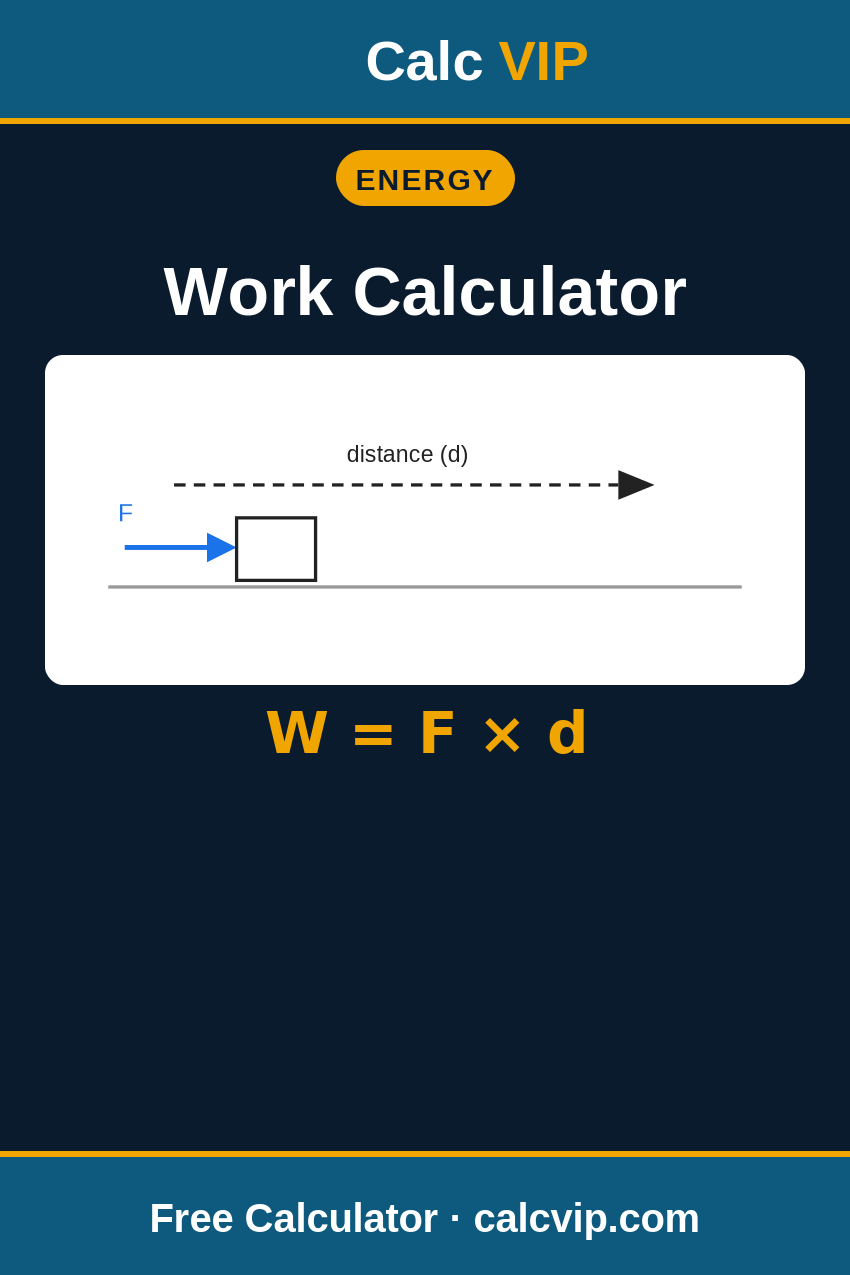
Work = Force × Distance → W = F × d
The force must act in the direction of movement. Work is measured in joules (J): 1 joule is the work done by a force of 1 newton moving an object 1 metre. Because the formula is a simple multiplication, it rearranges easily. If you know the work and the distance, the force was F = W ÷ d — spreading 400 J over 8 m means an average force of 400 ÷ 8 = 50 N. If you know the work and the force, the distance was d = W ÷ F — 400 J done by a 50 N force means the object moved 400 ÷ 50 = 8 m.
There is one refinement. If the force acts at an angle to the movement, only the part of the force pointing along the movement does work, and the full formula becomes W = F × d × cosθ, where θ is the angle between the force and the direction of travel. This calculator covers the common straight case, where the force and movement line up (θ = 0° and cosθ = 1), so the formula reduces to W = F × d.
| Symbol | Meaning | Units |
|---|---|---|
| W | work done | joules (J) |
| F | force (the part acting along the movement) | newtons (N) |
| d | distance moved in the force's direction | metres (m) |
| θ | angle between force and movement (full formula) | degrees (°) |
Work when the force is at an angle
Imagine pulling a sled with a rope. The rope angles upward, so part of your pull lifts the sled slightly (wasted effort, as far as forward motion goes) and only the horizontal part drags it forward. If you pull with 100 N at 30° above the horizontal, the useful part is 100 × cos30° = 100 × 0.866 = 86.6 N. Over a distance of 10 m, the work done is 86.6 × 10 = 866 J — noticeably less than the 1000 J you would have done pulling horizontally with the same force. This is why porters and removal workers try to push at the same height as the load's centre, and why pushing a car from behind, level and straight, feels easier than pulling it with a rope.
How to use
- Enter the force in newtons (N).
- Enter the distance the object moves in metres (m).
- Click "Calculate Work" to see the work done in joules.
- If your force is a weight — for example, lifting a mass — first find the force by multiplying the mass in kilograms by 9.81 to get newtons.
Worked examples
Example 1 — pushing a box. A force of 50 N pushes a box 8 m across the floor. Work = 50 × 8 = 400 J.
Example 2 — a crane lifting a load. A crane lifts a 200 kg steel beam by 12 m. The force needed equals the beam's weight: 200 × 9.81 = 1962 N. Work = 1962 × 12 = 23,544 J, about 23.5 kJ. All of that work is stored in the beam as gravitational potential energy, ready to be released if the beam ever falls.
Example 3 — pushing a broken-down car. Two people push a car with a combined force of 300 N for 25 m to reach a garage. Work = 300 × 25 = 7500 J. Notice the car's mass does not appear in this calculation at all: work depends on the force applied and the distance moved, however heavy the object is.
Example 5 — lifting the shopping. A bag of mass 15 kg weighs 15 × 9.81 = 147.15 N. Lifting it 1.2 m onto a counter takes W = 147.15 × 1.2 = 176.58 J. Carrying it across the kitchen at counter height adds nothing against gravity — the lift was the whole bill, and it was paid in the first second.
Example 6 — the angled pull. A sledge is pulled with 100 N at 60° above the horizontal for 10 m. Only the horizontal component works: W = F × d × cosθ = 100 × 10 × cos 60° = 100 × 10 × 0.5 = 500 J. The other half of the pull merely lightens the sledge against the ground — real force, real effort, no work in the direction of travel.
Work in real life
Climbing stairs. Every step up is work done against gravity. A 60 kg person climbing a 3 m flight of stairs does 60 × 9.81 × 3 = 1765.8 J of work against their own weight — which is why several flights leave you breathing hard even though you end up only a few metres higher.
Weightlifting. A weightlifter who raises a 100 kg barbell 2 m overhead does 100 × 9.81 × 2 = 1962 J of work on the bar. But while they stand still holding it overhead, shaking with effort, they do no further work on the bar at all — the bar is not moving. The burning feeling comes from their muscles constantly tensing and micro-adjusting internally, which uses energy without doing external work.
Your car. A car's engine does work against air resistance and rolling friction on every journey. A family car cruising against a total resistive force of about 400 N does 400 J of work for every metre travelled — 400,000 J (400 kJ) per kilometre — all of it supplied by burning fuel.
Escalators: work by the tonne. An escalator lifting a 70 kg passenger through 5 m of height does W = 70 × 9.81 × 5 = 3433.5 J per passenger against gravity. Multiply by a station's ten thousand passengers a day and the escalator's motors have done over 34 million joules of lifting before the evening rush — all of it this page's formula, one passenger at a time.
Cycling into the wind. A cyclist at a steady speed does no net work on the bicycle — the kinetic energy never changes — yet the rider's legs do continuous work against air resistance and rolling friction, every joule of it ending as heat and stirred air. Steady motion on Earth is never free; it is work spent exactly as fast as resistance can waste it.
Zero work and negative work
Work can also be zero or negative, and both cases matter. Work is zero when the object does not move (pushing a wall), when there is no force, or when the force is exactly perpendicular to the movement. The Moon's gravity pulls Earth inward while Earth moves along its orbit at right angles to that pull, so over each short stretch gravity does no work on Earth at all — which is why Earth's speed stays constant around its nearly circular orbit. Work is negative when the force opposes the movement: friction always does negative work on a sliding object, and your car's brakes do negative work on the wheels' motion, removing kinetic energy as heat. Negative work is simply energy being taken away instead of added.
The work–energy connection
Physicists prize the work formula because of a powerful result called the work–energy theorem: the total work done on an object equals the change in its kinetic energy. Push a 4 kg box with a net 50 N over 8 m on a frictionless floor and the 400 J of work becomes exactly 400 J of kinetic energy, so the box ends up moving at v = √(2 × 400 ÷ 4) = √200 ≈ 14.1 m/s. In the real world friction takes its share first, which is why the box in Example 1 ends up slower — but the accounting always balances. Whenever energy appears or disappears, work is the receipt that explains where it went.
Example 4 \u2014 rowing a boat. A rower pulls each stroke with an average force of 250 N over a stroke length of 1.2 m, so the work per stroke is 250 \u00d7 1.2 = 300 J. At 30 strokes a minute for half an hour \u2014 900 strokes in total \u2014 the rower does 900 \u00d7 300 = 270,000 J of work. That is why rowing is such demanding exercise even though each individual stroke feels modest: small amounts of work, repeated, add up fast.
Work against friction: where the joules go
Push the box of Example 1 across the floor at a steady speed and the account looks paradoxical: you do 400 J of work, the box gains no kinetic energy and no height, so where did the joules go? Into the floor and the box's underside as heat, via friction — a transfer measurable with a thermometer on an industrial scale, where conveyor friction warms warehouses. Work done against friction is never stored; it is spent, immediately and irreversibly, which is why friction is called a non-conservative force while gravity (whose work is banked as potential energy, recoverable in full) is conservative.
The distinction runs engineering. A crane's work against gravity can be recovered by lowering the load through a generator; a brake's work against friction cannot be recovered at all — it can only be survived, by discs and pads built to glow without failing. Same formula, same joules, opposite destinies: the difference is entirely in what the force was working against.
Quick reference: work done in familiar efforts
The joule is a small unit at human scale — a heartbeat's worth of lifting is a few hundred — so everyday efforts cluster between about 100 J and 25,000 J. The crane's entry shows how quickly force × distance grows teeth when both numbers are industrial.
| Effort | Work done |
|---|---|
| lifting the shopping (Ex. 5) | 176.58 J |
| pushing a box 8 m (Ex. 1) | 400 J |
| escalator, one passenger up 5 m | 3433.5 J |
| pushing a car 25 m (Ex. 3) | 7500 J |
| crane lifting a beam 12 m (Ex. 2) | 23,544 J |
Negative work and the regenerative brake
Work changes sign when the force opposes the motion, and the most valuable negative work in modern transport is done by an electric car's motor running backwards as a generator. A 1000 kg car at 20 m/s carries ½ × 1000 × 20² = 200,000 J of kinetic energy; friction brakes do −200,000 J of work on it and throw the whole amount away as heat. A regenerative system does the same negative work but routes a large share of the energy into the battery instead — the work is identical, the destination is not.
The distinction generalises. Lowering a crane load, descending a hill on a bicycle, landing an aircraft: each is a stream of negative work looking for somewhere useful to go. Engineering progress, viewed through this page, is largely the art of giving negative work a better address than a hot brake disc.
Common mistakes
- Using mass instead of force. The formula needs newtons, not kilograms. If you are lifting something, multiply its mass by 9.81 first to get its weight in newtons.
- Counting effort instead of movement. Pushing hard against something that does not move does zero work in physics, however tired you get.
- Forgetting the angle. If the force is angled, only the component along the movement counts — use W = F × d × cosθ, or straighten the push.
- Confusing work with power. Work is the total energy transferred; power is how quickly. The same 400 J can be done in a second or spread over an hour — the work is identical, the power is not.
- Counting a there-and-back lift twice against gravity. Lifting a box 1 m costs mgh of work; lowering it back, gravity returns exactly that much, so the net work against gravity over the round trip is zero. Your muscles bill you for both halves anyway — bodies are not reversible machines — but the physics ledger nets to nothing.
FAQ
Is work done if the object does not move?
No. If the distance is zero, the work done is zero — even if you push very hard. Pushing against a wall that does not move does no work on the wall.
What if the force is at an angle?
Only the part of the force along the movement does work, so the full formula is W = F × d × cosθ. This calculator covers the common case where the force and movement are in the same direction (θ = 0°).
What is the unit of work?
Work is measured in joules (J). One joule equals one newton-metre (1 J = 1 N·m).
What is the difference between work and energy?
Energy is the capacity to do work; work is energy actually being transferred by a force. A raised weight has potential energy; lowering it lets gravity do work and hand that energy to something else.
Can work be negative?
Yes. When a force acts opposite to the movement — friction, brakes, or catching a fast ball — it removes energy from the object, and the work it does is negative.
Does carrying a bag across a room do work?
Against gravity, no: your upward force is perpendicular to your horizontal movement, and the bag ends at the same height. Your body still burns energy holding it, because muscles consume energy just to maintain tension, but no work is done on the bag itself.
How many joules are in a food Calorie?
One food Calorie (the kilocalorie printed on food labels) is 4184 J. A 100-Calorie snack holds about 418,400 J — enough, in pure physics terms, to lift a 60 kg person about 710 m into the air, though real muscles are only about 25% efficient.
How much work is done carrying a 20 kg suitcase up 3 m of stairs?
Against gravity: the suitcase weighs 20 × 9.81 = 196.2 N, and the vertical rise is 3 m, so W = 196.2 × 3 = 588.6 J. The horizontal metres of the staircase contribute nothing — only the height appears in gravity's invoice, however long the stairs.
How much work does gravity do on a falling book?
A 2 kg book falling 1.5 m: gravity's force is 2 × 9.81 = 19.62 N acting over 1.5 m in its own direction, so W = 19.62 × 1.5 = 29.43 J — exactly the potential energy the book loses, and exactly the kinetic energy it gains. The work–energy theorem is this equality, generalised.
Why can no machine give out more work than is put in?
Because work is energy in transit, and energy is conserved. Machines can multiply force (trading distance) or multiply speed (trading force), but the product — the work — can only ever shrink, taxed by friction. A machine claiming otherwise is not an invention; it is an arithmetic error with a patent pending.