 Calc
Work–Energy Theorem Calculator – Final Speed from Net Work
 Created by Priya Sharma · Physics Editor · Energy & Gravity · Last updated: November 2026
Use this free Work–Energy Theorem Calculator to find an object's final speed after work is done on it. Enter the mass, the starting speed and the net work done, and the calculator works out the final speed from the change in kinetic energy.
The work–energy theorem is one of the shortest true sentences in physics: the net work done on an object equals its change in kinetic energy. Push on something, pull it, let gravity haul it downhill or let friction drag against it — add up all the work from every force, and that total tells you exactly how much the object's kinetic energy, and therefore its speed, has changed. This calculator turns that bookkeeping into a number: give it a mass, a starting speed and a net work, and it returns the final speed.
Notice what the theorem does not ask about. It does not care which forces acted, how long they acted, or whether the path was straight, curved or zig-zag. A force that swells and fades, a push delivered in bursts, a long grind of friction — all of it collapses into a single figure, the net work W. That is what makes the theorem so useful in real problems, where forces are messy and changing: you never have to follow the motion moment by moment. You only need the energy at the start and the total work done along the way.
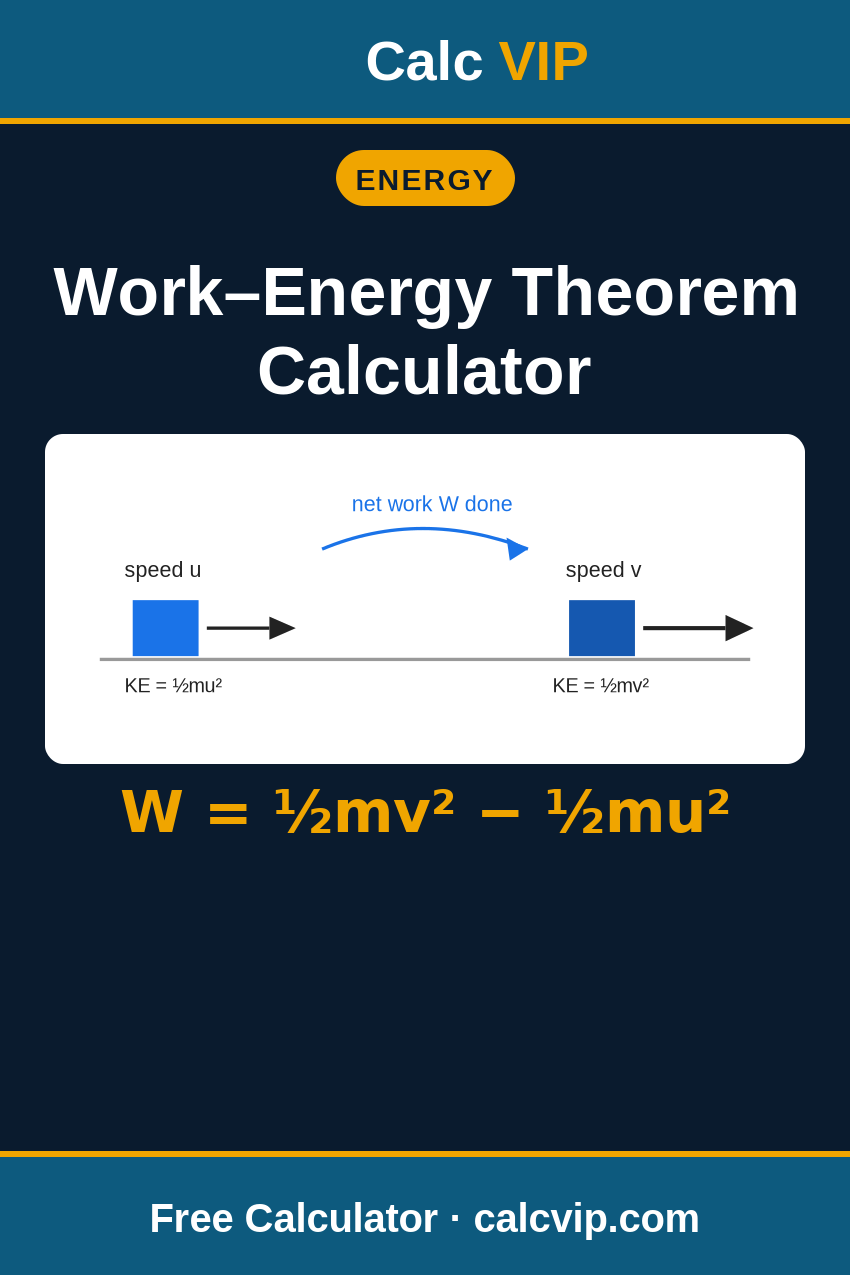
The one catch is the square. Kinetic energy grows with the square of speed, so speed and work do not trade evenly. Doubling a speed takes four times the kinetic energy, not two — which is why the last few metres per second of a car's top speed are so expensive, and why braking distances explode as speed rises. Every example on this page is shaped by that square, and the calculator handles it automatically: positive work speeds the object up, negative work slows it down, and if the negative work would remove more energy than the object has, the object simply stops.
Formula
Net Work = Change in Kinetic Energy → W = ½mv² − ½mu²
The theorem rearranges to answer each of its questions in turn. The final kinetic energy is KEfinal = ½mu² + W, and the final speed — the answer this calculator gives — is v = √(2 × KEfinal ÷ m). Run it backwards and the work needed to reach a target speed is W = ½m(v² − u²); if the object starts from rest that shortens to W = ½mv². The sign of W carries the story: positive work adds energy and speeds the object up, negative work removes energy and slows it down, and W = 0 means the speed never changes, however many forces were busy cancelling each other out. Work must be in joules, mass in kilograms and speeds in metres per second — convert kilometres per hour by dividing by 3.6 before you start.
| Symbol | Meaning | Units |
|---|---|---|
| W | net work — the total work of ALL forces acting | joules (J) |
| m | mass of the object | kilograms (kg) |
| u | initial speed | m/s |
| v | final speed | m/s |
| KE | kinetic energy, ½mv² | joules (J) |
Work is energy changing hands
It helps to think of work as energy in transit. When a force pushes an object along, it hands energy over; kinetic energy is simply the account where that energy lands. A cricketer's bat does positive work on the ball and the ball leaves faster; the fielder's hands do negative work on it and it leaves slower, or not at all. Nothing about the theorem is abstract bookkeeping — every joule of net work shows up, visibly, as a change in how fast the thing is moving.
The word net does heavy lifting. Several forces usually act at once, and each does its own work, positive or negative. Gravity may add energy on a downhill stretch while friction removes it on the same stretch; a car's engine and its brakes can fight over the same journey. The theorem only ever sees the sum. That is also why a force pointing sideways to the motion — like the centripetal force holding a car on a roundabout — does no work at all: it changes the direction of travel but never the speed, and the energy account is untouched.
Because only the total matters, the theorem connects two snapshots — before and after — and ignores everything in between. Two objects with the same mass and starting speed that receive the same net work finish at the same speed, even if one was pushed hard for a second and the other gently for a minute. Physicists call results like this state results: the route is forgotten, only the endpoints survive. It is the same spirit as the conservation of energy, and indeed the two are close cousins — this theorem is what conservation looks like when you follow one object's motion energy and let every outside force pay in or out through work.
One honest limitation is worth naming: the theorem says nothing about time. It connects the start and finish of a motion but cannot tell you how long the change took, or what the speed was halfway through — for that you need the force's size and the equations of motion. What the theorem trades away in detail it repays in simplicity: whenever a question asks only "how fast at the end?" and gives you energies or work, this is almost always the shortest path to the answer.
How to use
- Enter the mass of the object in kilograms (kg).
- Enter its starting speed in metres per second (m/s) — divide km/h by 3.6 if you need to convert.
- Enter the total (net) work done on it in joules (J) — use a negative value for work that slows it down, such as friction or braking.
- Click "Calculate Final Speed" to see the initial KE, the final KE and the final speed.
- If your negative work is bigger than the starting kinetic energy, the calculator reports that the object simply comes to a stop — kinetic energy can never go below zero.
Worked examples
Example 1 — the headline case. A 2 kg object moving at 3 m/s has 32 J of net work done on it. Initial KE = ½ × 2 × 3² = 9 J. Final KE = 9 + 32 = 41 J. Final speed = √(2 × 41 ÷ 2) = √41 = 6.40 m/s. The work more than quadrupled the energy, yet the speed only a little more than doubled — the square at work.
Example 2 — starting from rest. A 0.5 kg ball at rest receives 10 J of work from a kick. Final KE = 0 + 10 = 10 J, so v = √(2 × 10 ÷ 0.5) = √40 = 6.32 m/s. From rest, every joule of work becomes kinetic energy, which is why the "from rest" case is the simplest the theorem ever offers.
Example 3 — braking a car. A 1,000 kg car travelling at 20 m/s (72 km/h) carries KE = ½ × 1,000 × 20² = 200,000 J. Its brakes do −150,000 J of work, leaving KE = 50,000 J and v = √(2 × 50,000 ÷ 1,000) = √100 = 10 m/s. The brakes removed three quarters of the energy but only half the speed — the reason the last part of any stop feels deceptively quick, and why brake discs glow on long descents.
Example 4 — friction draining a crate. A 5 kg crate slides at 8 m/s, so its KE = ½ × 5 × 64 = 160 J. Friction does −100 J of work over the next stretch of floor, leaving 60 J: v = √(2 × 60 ÷ 5) = √24 = 4.90 m/s. Let friction keep working and it will take the remaining 60 J too — a sliding object always stops in the end, because friction never runs out of opportunity, only the object runs out of energy.
Example 5 — what doubling a speed really costs. A 1 kg ball rolls at 5 m/s (KE = 12.5 J). To double its speed to 10 m/s the KE must reach ½ × 1 × 100 = 50 J, so the work needed is 50 − 12.5 = 37.5 J — three times the energy the ball already has. This is the hidden tax behind every "just a bit faster": each doubling of speed demands four times the total energy.
Example 6 — gravity doing negative work. A 0.2 kg ball is thrown upward at 12 m/s, starting with KE = ½ × 0.2 × 144 = 14.4 J. By the time it has risen 5 m, gravity has done W = −mgh = −0.2 × 9.81 × 5 = −9.81 J of work on it. Remaining KE = 14.4 − 9.81 = 4.59 J, so its speed is √(2 × 4.59 ÷ 0.2) = 6.77 m/s — no kinematics equations, no time, just energy in and energy out.
The work–energy theorem in real life
Car braking distances. Brakes can only remove energy at the rate friction allows, so stopping distance grows with the kinetic energy — with the square of speed. Doubling from 30 to 60 km/h quadruples the energy to shed and roughly quadruples the braking distance, a fact written into every highway code's stopping-distance table.
Hammers and pile drivers. A hammer head arrives with kinetic energy and does that much work driving the nail in. A heavier head or a faster swing both raise the energy — but the swing speed counts squared, which is why a long, fast swing outperforms a heavy, slow one.
Catching and crumple zones. Catching a fast ball hurts because your hands must do all the negative work in a short distance. Moving your hands back with the ball, like a car's crumple zone collapsing, stretches the same work over more distance — the energy removed is identical, the force is gentler. Airbags, gymnastics mats and packaging foam are all this trick.
Kicking and throwing. A footballer's boot is in contact with the ball for only about a hundredth of a second, yet the work done in that instant is the ball's entire kinetic energy at launch. Analysts who measure a shot's speed are, without saying so, measuring the work the leg did.
Cycling into the wind. A cyclist's legs do positive work while air resistance does negative work. At a steady cruising speed the two cancel exactly — net work zero, kinetic energy constant — and the rider's effort is entirely spent replacing what the air takes away.
Re-entering spacecraft. A returning capsule must shed the kinetic energy of orbital flight — tens of megajoules per kilogram. The atmosphere does that work as drag, turning the energy into the heat that makes the heat shield glow. The theorem is the mission plan: that much energy, removed that fast, and not one joule of it can go missing.
Where the theorem comes from
The theorem is not a new law bolted onto physics — it falls straight out of Newton's second law. For a constant net force, work is W = F × s, and Newton's law says F = ma. The kinematic identity v² = u² + 2as rearranges to as = (v² − u²) ÷ 2, so W = m × (v² − u²) ÷ 2 = ½mv² − ½mu². The kinetic-energy change was hiding inside F = ma all along. For forces that vary along the path the same result survives — calculus replaces the single product F × s with the accumulated sum of little pushes, and the answer is still exactly the change in ½mv². That is why the theorem holds for springs, gravity, friction and engines alike, steady or not.
Quick reference: work to reach a speed from rest (1 kg object)
| Target speed | Kinetic energy at that speed | Work needed from rest |
|---|---|---|
| 5 m/s | 12.5 J | 12.5 J |
| 10 m/s | 50 J | 50 J |
| 15 m/s | 112.5 J | 112.5 J |
| 20 m/s | 200 J | 200 J |
| 30 m/s | 450 J | 450 J |
Read the table as the price list of speed. Going from 10 to 20 m/s costs four times the work of reaching 10 m/s in the first place — and the pattern scales with mass: a 10 kg object pays ten times every figure shown. When a problem asks "how much work to get it moving at…?", this square-law price list is the whole answer.
Common mistakes
- Using one force's work instead of the net work. The theorem's W is the sum over every force — engine and friction, gravity and push. Leaving one out silently changes the answer.
- Expecting double work to mean double speed. Kinetic energy follows v², so doubling the work multiplies the speed by √2 ≈ 1.41, not 2. Quadrupling the work is what doubles the speed.
- Getting the sign wrong. Work that speeds an object up is positive; work against the motion — friction, brakes, gravity on the way up — is negative and must be entered with its minus sign.
- Feeding in km/h or grams. The formula is built for m/s and kg. A speed of 36 km/h is 10 m/s; a mass of 500 g is 0.5 kg. Skipping either conversion corrupts the energy by a large factor.
- Trying to make kinetic energy negative. If the negative work exceeds the starting KE, the object stops — KE bottoms out at zero. Any calculation that reports a negative KE or an imaginary speed has made exactly this error.
FAQ
What is the work–energy theorem?
It says the net work done on an object equals its change in kinetic energy. Work is just an energy transfer: add energy and the object speeds up, remove energy and it slows down.
What happens if the work is bigger than the starting kinetic energy, but negative?
The object stops before using up all that work. For example, friction can only remove as much kinetic energy as the object actually has — after that the object is at rest.
Does the direction of motion matter?
Only through the sign of the work. Work done in the direction of motion is positive (speeds the object up); work done against the motion is negative (slows it down).
Can the theorem handle a force that changes along the way?
Yes. W is the total work accumulated over the whole path, however the force varied. A spring that pushes hard then gently, or an engine that fades at high speed, still delivers one total number of joules — and that total is all the theorem needs.
Does the theorem work on slopes and hills?
Yes, as long as gravity's work is included in the net work. Going downhill gravity does positive work (mgh gained); going uphill it does negative work. Many slope problems are quicker this way than by resolving forces along the incline.
Why does a satellite in a steady circular orbit keep the same speed?
Gravity pulls it toward the centre, exactly sideways to its motion at every instant. A force at 90° to the motion does no work, so W = 0 and the kinetic energy — and speed — never changes, even though the direction changes constantly.
How is this different from conservation of energy?
They are two views of the same bookkeeping. The work–energy theorem follows one object's kinetic energy and counts every outside force's work. Conservation of energy instead keeps potential energy inside the account, so gravity's contribution appears as a change in potential energy rather than as work. Both give identical answers when used consistently.
What work is needed to stop a moving object?
Exactly its kinetic energy, delivered negatively: W = −½mv². That is the number behind braking distances, catching forces and crash design — a 1,000 kg car at 20 m/s needs 200,000 J of negative work, whoever or whatever provides it.
Does the theorem apply to rotating objects?
The basic version tracks the motion of the centre of mass. A rolling wheel or a spinning flywheel also stores rotational kinetic energy, and the full treatment adds a matching term, ½Iω². The idea is the same — net work equals the total change in kinetic energy — with rotation counted as well as travel.
Can I use the theorem backwards to find the work from two speeds?
That is one of its best uses. Measure the mass and the speeds before and after, and W = ½m(v² − u²) tells you the net work that must have been done — by an engine, a brake, a spring or a collision — without ever measuring a force.