 Calc
Work Solver Calculator – Find Force or Distance (W = Fd cosθ)
 Created by Priya Sharma · Physics Editor · Energy & Gravity · Last updated: November 2026
Use this free Work Solver Calculator when you know the work done and need the missing force or distance — including pulls at an angle. Rearranging W = F × d × cosθ gives F = W ÷ (d cosθ) and d = W ÷ (F cosθ). Just pick a mode and enter the values you know.
Work is the most misnamed quantity in everyday physics. In the lab it has one precise meaning: a force doing work when it pushes or pulls something along its line of action, transferring energy in the process. The amount is W = F × d × cosθ, where θ is the angle between the force and the direction of motion. This solver runs that equation backwards. Given the work that was done, it recovers the force that must have been applied, or the distance over which it acted — the two questions that arise whenever an energy transfer is measured first and its cause is investigated second.
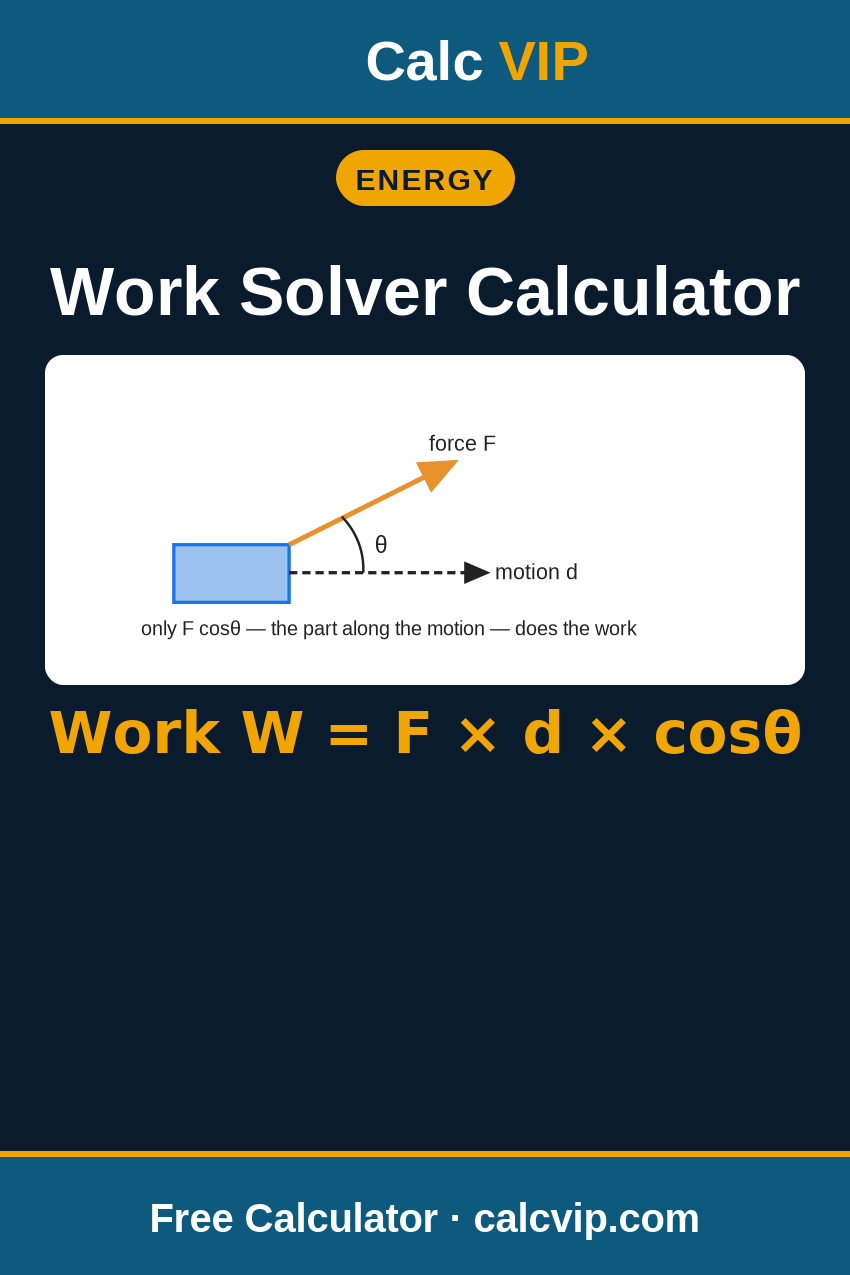
The cosθ factor is what makes this solver more interesting than a plain division. Pull a sled with a rope angled up at 60° and only half your force — cos60° = 0.5 — works along the snow; the other half merely lifts, wasting effort against gravity without moving the sled forward. Push at 90° to the motion and the work is zero however hard you push. The angle therefore belongs inside the rearrangements: F = W ÷ (d cosθ) and d = W ÷ (F cosθ). Forget it, and at steep angles your answers can be wrong by factors of two or more.
Real problems that arrive in this shape are everywhere. A winch's energy consumption is logged but the cable tension is not. A tow truck's job is quoted in joules and the distance is in dispute. A physiotherapist measures the work a patient does against a resistance band and wants the force. In each case work is the measured quantity and force or distance is the missing witness — which is precisely the testimony this calculator extracts.
Formula
Work W = F × d × cosθ • W in joules (J), F in newtons (N), d in metres (m), θ in degrees
The solver uses the two rearrangements: F = W ÷ (d × cosθ) to recover the force from the work, distance and angle, and d = W ÷ (F × cosθ) to recover the distance from the work, force and angle. The cosine is the gatekeeper of the whole formula. At θ = 0° it equals 1 and the equation collapses to the familiar W = F × d; at 30° it is 0.866; at 45°, 0.707; at 60°, exactly 0.5; and at 90° it is 0 — no work is done at all, which is why this solver cannot (and should not) solve anything at 90° or beyond: dividing by zero or by a negative cosine describes a force that cannot have produced positive work along the motion. Angles must therefore lie between 0° and just under 90°. The calculator reports force in newtons and distance in metres, rounded to two decimal places.
| Symbol | Meaning | Units |
|---|---|---|
| W | work done — energy transferred by the force | joules (J) |
| F | size of the applied force | newtons (N) |
| d | distance moved in the direction of travel | metres (m) |
| θ | angle between force and direction of motion | degrees (°) |
Only the component along the motion counts
Every angled force splits into two components: one along the direction of motion, F cosθ, and one perpendicular to it, F sinθ. Only the first does work. The perpendicular component is not useless in life — it is what lifts the front of the sled and lightens its friction, what keeps a carried bag from dragging — but it transfers no energy along the path, and the work formula ignores it completely. This is why the cosθ sits inside both rearrangements: when you solve for F, you are recovering the whole force, including the wasted perpendicular part, which is why steep angles demand such large forces for modest work.
The extreme cases calibrate the intuition. At 0°, nothing is wasted: every newton works, and the force needed for a given job is at its minimum. At 60°, half is wasted and the required force doubles. Approaching 90°, the required force explodes towards infinity — the solver's refusal at 90° is the mathematics announcing that no finite force, applied purely sideways, moves anything forwards. Between those poles lies every real rope, handle, tow bar and harness, all angled, all paying the cosine tax.
How to use
- Choose what you want to find from the dropdown: force or distance. The input row you need appears automatically.
- Enter the work done in joules, then the value you know — distance in metres for force mode, or force in newtons for distance mode.
- Enter the angle θ in degrees between the force and the direction of motion. Use 0 if the force points straight along the motion; the angle must be below 90°.
- Click "Solve" and sanity-check: the force at an angle should always be larger than the straight-ahead force for the same work (W ÷ d). If yours is smaller, the angle has probably been measured from the wrong direction.
Worked examples
Example 1 — the manifest check, both directions. A pull at 60° does 200 J of work over 8 m.
F = W ÷ (d cosθ) = 200 ÷ (8 × 0.5) = 200 ÷ 4 = 50 N. Reverse it: d = W ÷ (F cosθ) = 200 ÷ (50 × 0.5) = 200 ÷ 25 = 8 m. Note the straight-ahead comparison: at 0° the same job needs only 200 ÷ 8 = 25 N. The 60° angle exactly doubled the force.
Example 2 — pushing straight ahead. A worker does 500 J of work pushing a cart 10 m with the force along the motion (θ = 0°).
F = 500 ÷ (10 × 1) = 50 N — a gentle, steady push, and the baseline against which every angled version of the same job looks expensive.
Example 3 — how far did the tow go? A tow rope pulls with 100 N at 30°, doing 1,000 J of work.
d = 1,000 ÷ (100 × 0.866) = 1,000 ÷ 86.6 = 11.55 m. Without the angle the answer would have been a tidy 10 m — the cosine quietly adds a metre and a half of travel.
Example 4 — a diagonal drag. Dragging a load at 45° does 300 J over 6 m.
F = 300 ÷ (6 × 0.707) = 300 ÷ 4.24 = 70.71 N. At 45° the penalty factor is 1 ÷ 0.707 ≈ 1.41 — the force is about 41% larger than the 50 N a straight pull over the same distance would need for the same work.
Example 5 — a long straight haul. A force of 80 N, applied along the motion, does 1,200 J of work.
d = 1,200 ÷ 80 = 15 m. With cosθ = 1 the rearrangement is pure division — a useful reminder that the angled formula contains the simple one as a special case.
Example 6 — a shallow rope angle. A rope at 20° does 750 J of work over 5 m.
F = 750 ÷ (5 × 0.940) = 750 ÷ 4.70 = 159.63 N. Even a modest 20° tilt raises the required force by about 6% over the straight-ahead figure — small angles are cheap, but never quite free.
Work in real life
Towing and winching. Tow straps and winch cables rarely pull dead straight. Recovery operators estimate loads with the angled formula — the cosine explains why a badly angled pull can snap a strap that would easily hold a straight one.
Dog leads, luggage and lawn mowers. Every handle you pull sits at an angle, and the force your arm must supply follows F = W ÷ (d cosθ). It is why pulling a suitcase feels harder than its wheels suggest: a third of your effort may be lifting, not rolling.
Physiotherapy and resistance bands. Rehab exercises prescribe work against elastic resistance, often with the band anchored at an angle. Therapists use the angled formula to convert a target energy dose into the band tension a patient must actually produce.
Sailing and rowing. A sail's drive and an oar's push both act at angles to the boat's motion; only the along-motion component does useful work. Rig tuning is, in part, cosine management.
Construction and materials handling. Crane slings rigged at angles multiply the tension in each leg for the same lifted load — the same mathematics, with the angle measured from the vertical. Riggers carry the cosine table in their heads because loads depend on it.
Exercise science. Sled pushes and drags are prescribed training loads. The work done against the sled, the distance of the push and the handle angle together determine the true force the athlete produced — this solver, run in force mode.
Negative work and the forces that take energy away
Work can be negative, and the sign carries meaning. When a force points partly against the motion — θ between 90° and 180° — its cosine is negative and it removes energy instead of adding it. Friction is the everyday example: it always opposes motion, does negative work, and converts the object's kinetic energy into heat. Brakes are engineered friction, doing large negative work over short distances. This solver deliberately stays on the positive side of 90°, where the recovered force or distance describes work delivered. But when you meet a problem where the numbers refuse to fit, check whether the force in question was actually a braking one — the formula is the same, the sign is the story.
Work, energy and the work–energy theorem
There is also a housekeeping rule the theorem enforces: when several forces act, it is the net work — the sum of each force's contribution, each with its own angle — that equals the change in kinetic energy. Gravity's contribution on a dragged load is zero (it acts at 90°), the pull's contribution is the subject of this page, and friction's is negative. Students who compute only the pull's work and wonder why the speed change does not match have usually forgotten friction's silent subtraction. This solver isolates one force at a time; real bookkeeping adds the columns together.
Work is not a substance; it is a transfer. The joules counted by W = Fd cosθ arrive somewhere — as kinetic energy if the object speeds up, as potential energy if it is lifted, as heat if friction is involved. The work–energy theorem states the cleanest version: the net work done on an object equals its change in kinetic energy. That is why this solver pairs naturally with the kinetic-energy tools on this site: measure the work delivered (here), and the speed change follows (there). Real situations split the transfer — a pulled sled gains a little speed, warms its runners a little, and lifts against its angled rope not at all — but the total is always accounted. Energy bookkeeping never loses a joule; it only changes its name.
Quick reference: the cosine tax
| Angle θ | cosθ | Share of force that works | Force multiplier vs straight pull |
|---|---|---|---|
| 0° | 1.000 | 100% | × 1.00 |
| 20° | 0.940 | 94% | × 1.06 |
| 30° | 0.866 | 87% | × 1.15 |
| 45° | 0.707 | 71% | × 1.41 |
| 60° | 0.500 | 50% | × 2.00 |
| 90° | 0 | 0% | impossible — no work done |
The multiplier column is the force mode of this solver in disguise: whatever force a straight pull needs, divide by cosθ — or multiply by the table's factor — to get the angled force for identical work over identical distance, every single time.
Common mistakes
- Ignoring the angle entirely. Using F = W ÷ d for an angled pull understates the force — by 15% at 30°, 41% at 45° and a full factor of two at 60°. If a rope, handle or strap is involved, assume an angle exists until proven straight.
- Measuring θ from the wrong line. θ is between the force and the direction of motion — usually the ground for a dragged load. Measuring from the vertical instead swaps cos for sin and quietly wrecks the answer.
- Using sinθ instead of cosθ. The along-motion component is F cosθ because θ is measured from the motion direction. (If an angle is given from the perpendicular, the components swap — check the diagram before choosing.)
- Expecting an answer at 90°. At exactly 90° the work is zero for any force, so a nonzero work figure cannot be solved — the solver's refusal is the physics talking, not a bug. Real "90°" problems usually have a small along-motion component hiding in them.
- Confusing work with force. A large force over a tiny distance can do less work than a small force over a long one. Work is the product — which is why this solver needs the distance (or the force) as well as the energy before it can say anything.
FAQ
What happens at an angle of 90°?
cos90° = 0, so the work done is zero no matter how big the force is. A force at right angles to the motion — like the normal force on a sliding box — does no work at all.
Why does pulling at 60° need more force?
At 60°, cosθ = 0.5, so only half of the force acts along the motion. To do the same work over the same distance you need twice the force compared with pulling straight ahead (0°).
Does this work for pushing as well as pulling?
Yes. The formula only cares about the size of the force, the distance moved, and the angle between them — not whether it is a push or a pull.
Why can't the solver handle angles of 90° or more?
Because at 90° cosθ = 0 and beyond it the cosine turns negative: the force does no positive work along the motion, so a positive work figure cannot be produced by it. The division the solver would need is by zero or a negative — physically meaningless for delivered work.
What if the force is directly opposite the motion?
Then θ = 180°, cosθ = −1, and the work is negative: the force removes energy, as friction and brakes do. The size of the force follows from |W| = F × d — use the magnitude and remember the sign tells the direction of the energy flow.
Does the perpendicular part of the force do anything at all?
It does no work, but it is not inert: an upward component reduces the load's effective weight and therefore its friction, and a sideways component must be balanced or the object veers. "Does no work" means "transfers no energy along the path" — nothing more.
How is work different from energy?
Energy is a state — how much an object or system holds at a given moment. Work is a transfer — how much energy a force moves from one place or form to another during a process. They share the joule because work is measured by the energy it delivers.
Can work be done without motion?
No, not on the object in question. Holding a heavy bag still feels exhausting, but with d = 0 the work done on the bag is zero — your muscles burn energy internally, shuffling it between chemical stores, without transferring any to the bag. Physics and tired arms are both right; they are counting different things.
What force does 1,000 J over 10 m at 0° imply?
F = 1,000 ÷ 10 = 100 N. At 60° the same job needs 200 N — the quickest way to feel the cosine tax is to run one job through the solver at several angles.
Is the angle always measured from the direction of motion?
In this formula, yes — θ is defined as the angle between the force vector and the displacement. Some diagrams quote angles from a surface or from the vertical; convert before calculating, or the cosine will silently become a sine.