Calc
Water Hammer Calculator – Joukowsky Pressure Surge ΔP = ρaΔv
 Created by Elena Petrova · Physics Editor · Fluids & Rotation · Last updated: November 2026
Use this free Water Hammer Calculator to estimate the pressure surge when a valve in a water pipe closes suddenly. Enter the fluid density, the pressure-wave speed and the change in flow velocity — the calculator applies the Joukowsky equation.
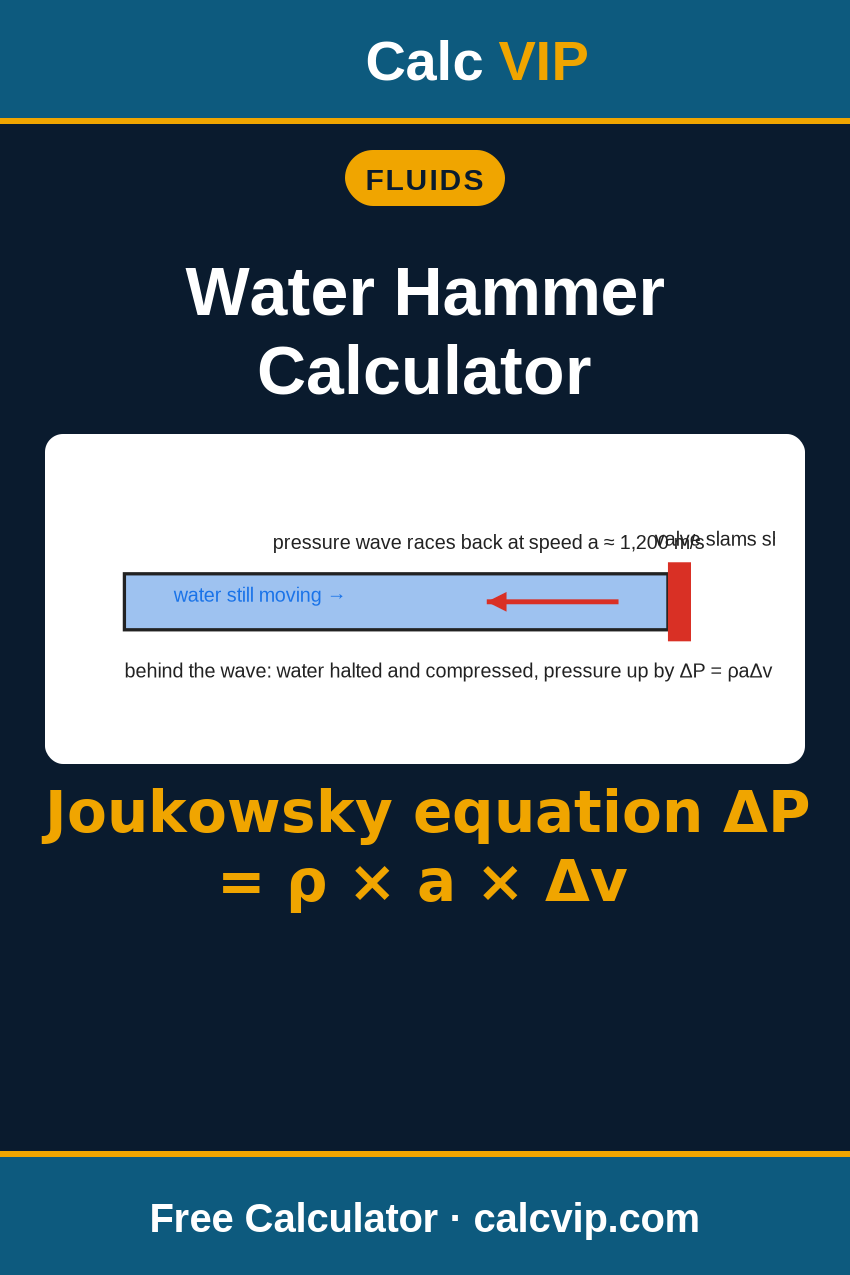
The bang that shudders through a house's plumbing when a washing machine's valve snaps shut is a pressure wave strong enough, scaled up, to burst steel mains. Water hammer is what happens when moving water is stopped faster than it can politely decelerate: the water at the valve compresses, the pipe swells slightly, and a pressure surge races away down the line at the speed of sound in the pipe, reflecting back and forth until friction spends it. The size of the surge is fixed by one of fluid mechanics' most unforgiving equations, ΔP = ρaΔv, the Joukowsky equation — and this calculator evaluates it, with the equivalent head rise alongside.
Read the equation slowly, because every symbol is a warning. The surge is proportional to the density (water is heavy), to the wave speed a (around 1,200 m/s in a typical water main — the surge is essentially a sound wave, and just as unstoppable), and to the change in velocity Δv. Stop a modest 2 m/s flow dead and the product is 2.4 million pascals: 24 bar, added on top of whatever pressure the pipe already carried, arriving in milliseconds. No term in the equation cares how gently you meant to close the valve — only how fast the flow actually changed, compared with the time the wave needs to travel to the far end and back.
Water hammer wrecked enough nineteenth-century waterworks to earn its physics early: Nikolai Joukowsky published the theory in 1898 after systematic experiments on Moscow's water supply, and the equation still bears his name. Its lessons shape modern practice everywhere — slow-closing valves, surge tanks on hydroelectric penstocks, air chambers by household appliances, and the soft-start pumps of tall buildings. The calculator takes the three inputs the equation needs and returns the surge in pascals, megapascals and bar, plus the equivalent rise in head — the form dam and pump engineers think in.
Formula
Joukowsky equation ΔP = ρ × a × Δv • ΔP in pascals (Pa), ρ in kg/m³, a in m/s, Δv in m/s • head rise Δh = a × Δv ÷ g
The equation rearranges for design: Δv = ΔP ÷ (ρa) gives the largest velocity change a pipe of known strength can survive — the form used to set closing times and flow limits — and a = ΔP ÷ (ρΔv) turns a measured surge into the wave speed, a diagnostic for the pipe's condition. The wave speed itself is set by the water's compressibility and the pipe's elasticity: a = √(K/ρ) ÷ √(1 + (K/E)(D/t)), where K is water's bulk modulus (2.2 GPa), E the pipe material's Young's modulus, D the diameter and t the wall thickness. In a perfectly rigid pipe a would be √(2.2 × 10⁹ ÷ 1000) ≈ 1,483 m/s; real pipes stretch, so steel mains run 1,000–1,400 m/s, and plastic pipes, being far more elastic, slow the wave to 300–500 m/s — one reason plastic plumbing hammers more softly.
| Symbol | Meaning | Units |
|---|---|---|
| ΔP | pressure surge above the running pressure | Pa (also MPa, bar) |
| ρ | fluid density | kg/m³ |
| a | pressure-wave speed in the pipe | m/s |
| Δv | change in flow velocity caused by the closure | m/s |
| Δh | surge expressed as head, ΔP/(ρg) | m |
Fast closure, slow closure: the 2L/a rule
Whether a closure counts as "sudden" is decided by a race. The surge wave needs 2L/a seconds to travel from the valve to the pipe's far end (a reservoir, a tank) and back — for a 1 km main at a = 1,200 m/s, that is 1.67 s. Close the valve faster than the round trip and the returning relief wave arrives too late: the valve feels the full Joukowsky surge, as if the pipe were endless. Close it more slowly and the reflected wave returns while the valve is still moving, bleeding the pressure off; the surge then shrinks roughly in proportion, ΔP ≈ ρLΔv/T for closing time T. This is why the fix for water hammer is so often just patience — a valve that takes ten seconds instead of one can cut the surge fivefold — and why the dangerous devices are the ones that close in milliseconds by design: solenoid valves, washing-machine inlets, and check valves slamming on a reversed flow.
The wave's journey does not end at one reflection. At a reservoir the wave reflects inverted — the pressure surge becomes a suction — and the pipe experiences a decaying oscillation between high and low pressure, period 4L/a. The low-pressure half-cycle can pull the pressure down to vapour pressure, cavitating the water column or even collapsing thin pipes inward, and the column's rejoining produces a second hammer. Surge analysis in serious systems simulates this whole dance; the Joukowsky number from this calculator is its opening beat and its worst-case ceiling.
How to use
- Enter the fluid density ρ in kg/m³ — 1000 for water, about 850 for oils.
- Enter the pressure-wave speed a in m/s: 1,000–1,400 for water in steel or iron mains, ~1,200 typical; 300–500 for water in plastic pipe; use 1,483 for the rigid-pipe upper limit.
- Enter Δv, the change in flow velocity the closure causes, in m/s — for a full sudden stop, the running velocity itself.
- Click "Calculate" to see the surge ΔP in Pa, MPa and bar, and the equivalent head rise Δh in metres. Add ΔP to the pipe's steady pressure before comparing with its rating.
Worked examples
Example 1 — the textbook slam. ρ = 1000 kg/m³, a = 1,200 m/s, Δv = 2 m/s.
ΔP = 1000 × 1200 × 2 = 2,400,000 Pa = 2.4 MPa = 24 bar, a head rise of 244.6 m. A perfectly ordinary flow, stopped instantly, generates the pressure of a 245 m-deep dive — on top of the pressure already in the main.
Example 2 — the household bang. Same pipe, a gentler Δv = 1 m/s: ΔP = 1000 × 1200 × 1 = 1.2 MPa = 12 bar, head rise 122.3 m. Domestic plumbing runs at 2–4 bar; a 12 bar spike hunting through it is the noise you hear — and the reason arrestors are fitted by fast appliance valves.
Example 3 — plastic pipe forgives. ρ = 1000, a = 400 m/s (elastic plastic pipe), Δv = 1.5 m/s: ΔP = 1000 × 400 × 1.5 = 600,000 Pa = 6 bar, head rise 61.2 m. The pipe's own stretch absorbs the blow — a slower wave is a smaller hammer.
Example 4 — a steel penstock. ρ = 1000, a = 1,400 m/s, Δv = 3 m/s: ΔP = 4.2 MPa = 42 bar, head rise 428 m. Hydroelectric penstocks live in this territory, which is why their governors close over many seconds and surge tanks stand beside them like chimneys.
Example 5 — an oil line. ρ = 850 kg/m³, a = 1,100 m/s, Δv = 2 m/s: ΔP = 850 × 1100 × 2 = 1,870,000 Pa = 1.87 MPa = 18.7 bar, head rise 224.3 m. Oil's lower density softens the blow only slightly; tanker and terminal lines are surge-analysed as carefully as water mains.
Example 6 — a partial, kinder closure. ρ = 1000, a = 1200, but the valve only throttles the flow by Δv = 0.5 m/s quickly (the rest slowly): ΔP = 600,000 Pa = 6 bar, head rise 61.2 m. What matters is the velocity change accomplished within the wave's round-trip time — stage the closure and the hammer shrinks in proportion.
Water hammer in real life
Household plumbing. The banging pipe is the domestic face of the Joukowsky equation: solenoid valves in washing machines and dishwashers close in milliseconds. Hammer arrestors — small sealed air chambers — give the surge somewhere compressible to go.
Hydroelectric plants. A turbine rejecting load must close its guide vanes fast for safety but slowly for the penstock; surge tanks and pressure-relief valves mediate, and the design surge comes straight from ρaΔv with the plant's real a and Δv.
Municipal water mains. Burst mains are frequently hammer failures, not age failures: a pump trip or a fast valve operation launches a surge that finds the weakest joint. Utilities model networks for transients before they model them for flow.
Fire protection and sprinklers. Rapidly opening or closing large valves in sprinkler and hydrant systems can spike pressures far beyond the working rating; codes require slow-operating valves for exactly this reason.
Rail and road tankers. Liquid cargo surging under braking — "sloshing" — is water hammer's cousin in a moving tank, and baffle plates inside tankers exist to break the travelling wave.
The pulse in your arteries. Each heartbeat launches a pressure wave down the aorta whose speed (5–15 m/s, set by the artery walls' elasticity) physicians measure as an index of arterial stiffness — Joukowsky physics as a diagnostic.
Why the wave is slower than sound — the pipe breathes
Sound in free water travels at about 1,483 m/s, and it is tempting to use that as a. In a pipe the wave runs slower, because the pressure does not only compress the water — it also stretches the pipe wall, and the wall's elasticity absorbs part of the squeeze. The correction factor 1/√(1 + (K/E)(D/t)) rewards stiff, thick pipes: a steel main (E ≈ 200 GPa) keeps a near 1,200–1,400 m/s, while a polyethylene pipe (E ≈ 1 GPa) drops it to 300–500 m/s. This is a rare case of a flaw acting as a feature — the plastic pipe's weakness is its protection — and it explains why swapping a steel section for plastic changes a system's whole transient behaviour, for better and occasionally, by shifting reflections, for worse.
Quick reference: surge per 1 m/s stopped (water, ρ = 1000)
| Pipe | Wave speed a | ΔP per 1 m/s | Head rise per 1 m/s |
|---|---|---|---|
| plastic (PE/PVC) | 400 m/s | 4 bar | 40.8 m |
| older iron main | 1,000 m/s | 10 bar | 101.9 m |
| steel main | 1,200 m/s | 12 bar | 122.3 m |
| rigid-pipe limit | 1,483 m/s | 14.8 bar | 151.2 m |
Memorise the steel row: in a water main, every metre per second of suddenly stopped flow costs about twelve bar. Few numbers in engineering concentrate the mind faster.
Column separation: when the suction wins
Follow Example 1's wave through one full round trip in a main whose steady pressure is a typical 5 bar. The valve slams, the pressure at the valve leaps by +24 bar to 29 bar, and the wave departs for the reservoir. When it reflects and returns, it brings the mirror image: an attempted fall of 24 bar from a line that only holds 5. Water cannot sustain tension — the pressure cannot fall below vapour pressure — so the column separates: a vapour cavity opens at the valve or at a high point of the line, the two water columns drift apart, and when the next reflection drives them back together they collide at a relative speed that can exceed the original Δv, generating a second hammer sometimes worse than the first. This is why surge analysis never stops at the positive peak, why air valves are placed at high points to admit air before a vacuum forms, and why the "equivalent head rise" this calculator reports has a dark twin: an equal head fall, quite capable of collapsing a thin-walled pipe inward or sucking joint gaskets out of place. The Joukowsky number is a magnitude; the system feels both of its signs.
Putting a number on "sudden" for your own pipe
Before leaving the page, make the 2L/a rule personal. A 250 m steel rising main (a = 1,200 m/s) has a round-trip time of 2 × 250 ÷ 1,200 ≈ 0.42 s: any valve, pump trip or check-valve event that changes the flow materially inside half a second earns the full Joukowsky surge from this calculator, unsoftened. The same event on a 5 km transmission main (round trip 8.3 s) is almost impossible to make "sudden" with ordinary valves — which is why long mains fear pump trips, the one event that can still change Δv in a second, and short lines fear everything with a solenoid. Length first, then closure time, then the equation: that is the order of every competent surge assessment.
Common mistakes
- Comparing the surge alone with the pipe rating. The pipe feels steady pressure plus ΔP. A 10-bar-rated main running at 7 bar has only 3 bar of headroom — less than a third of a metre-per-second of sudden stoppage in steel.
- Using the speed of sound in free water for a plastic pipe. a is a property of water and pipe. Using 1,483 m/s for PE pipe overstates the surge nearly fourfold; using a steel value for a rigid analysis understates the timing of reflections.
- Assuming a "slow" valve is safe without checking 2L/a. Sudden means faster than the wave's round trip, 2L/a — which for a short pipe is a fraction of a second. A one-second closure is gentle on a kilometre main and violent on a ten-metre line.
- Forgetting pump trips and check valves. The worst closures are often not valves being shut but pumps stopping: the flow reverses, and the check valve slams on moving water, manufacturing its own Δv at the worst possible speed.
- Ignoring the negative surge. The reflected wave pulls pressure down by a similar amount. Column separation and pipe collapse on the suction half-cycle damage as many systems as the pressure peak does.
FAQ
What causes water hammer?
Moving water has momentum. If a valve stops it suddenly, the water piles up at the valve and compresses, launching a pressure wave that rattles back and forth through the pipe — the banging noise in household plumbing is the same effect on a small scale.
How is water hammer prevented?
Close valves slowly, fit air chambers or surge tanks near quick-closing valves, add pressure-relief valves, and keep flow speeds modest. In homes, a hammer arrestor near washing machines and dishwashers absorbs the surge.
Does a longer pipe make the surge bigger?
The peak pressure from the Joukowsky equation does not depend on pipe length, but a longer pipe gives the wave more travel time — so a closure that counts as "instant" is easier to achieve, and the surge lasts longer before it dies away.
What closing time counts as "instant"?
Anything faster than the wave's round trip to the far end and back: T < 2L/a. For 500 m of steel main that is about 0.83 s — most motorised and all solenoid valves qualify, which is why they are the usual suspects.
Why does the surge not depend on the pipe's length or diameter directly?
Because the surge is set locally, at the valve, by the compression of the water arriving there — ρ, a and Δv are all local properties. Length enters only through the timing (2L/a) that decides whether reflections can relieve the peak.
Can water hammer damage a pipe that never bursts?
Yes — fatigue. Repeated surges work joints, loosen fittings, crack meter housings and shorten pump life, and the low-pressure half-cycle can draw contaminated water in through leaks. Many systems die of a thousand hammers, not one.
What is a surge tank, exactly?
An open or pressurised chamber connected to the line, into which the surge can spill. It gives the wave a free surface to lift instead of a wall to hit, converting the hammer into a slow sloshing — the tall towers beside hydroelectric penstocks are exactly this.
Does air in the pipes help or hurt?
Both, unpredictably — which is why engineers remove it. A pocket of air can cushion a surge like a spring, but it can also be expelled violently or collapse and let the water columns slam together. Designed air chambers are placed deliberately; random air is a hazard.
How fast is the wave in my home's copper pipes?
Copper is stiff and its pipes are small and thick-walled relative to their bore, so a is high — roughly 1,300–1,400 m/s. Stopping 1 m/s in copper therefore spikes about 13–14 bar, which is why short household runs bang so sharply.
Who was Joukowsky?
Nikolai Zhukovsky (Joukowsky), a Russian engineer who derived and experimentally confirmed the surge equation in 1898 while investigating bursts in Moscow's water network. The same man later founded Russian aerodynamics — the pressure wave and the aerofoil were, to him, one subject.